PUBLISHER: Mordor Intelligence | PRODUCT CODE: 2124830

PUBLISHER: Mordor Intelligence | PRODUCT CODE: 2124830
Europe Insurance Telematics - Market Share Analysis, Industry Trends & Statistics, Growth Forecasts (2026 - 2031)
According to Mordor Intelligence, the Europe insurance telematics market size is estimated at USD 1.20 billion in 2026, and is expected to reach USD 3.53 billion by 2031, at a CAGR of 24.08% during the forecast period (2026-2031).
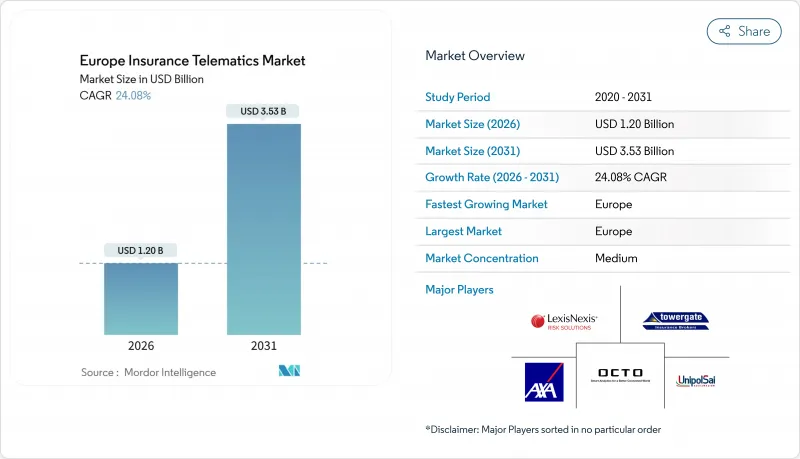
This report is Segmented by Usage-Based Insurance Type (Pay-As-You-Drive, and More), Telematics Technology (Black Box Device, and More), Vehicle Category (Passenger Cars, Light Commercial Vehicles, and More), Deployment Model (Cloud-Based and On-Premise), Distribution Channel (Insurer Direct Digital Channels, and More), and Geography. The Market Forecasts are Provided in Terms of Value (USD).
Europe Insurance Telematics Market Trends and Insights
Rising Penetration of Embedded OEM Telematics in New-Vehicle Sales
Factory-installed telematics control units shipped in 4.2 million new European cars during 2025, allowing insurers to activate usage-based policies at the point of sale. Stellantis and Wrisk estimate 40% lower customer-acquisition cost from this embedded model, while BMW's Qover partnership locks drivers into multi-year contracts that secure predictable premium income. Operational expenses drop by EUR 15-20 (USD 16.9-22.5) per policy once device-return logistics disappear, offsetting OEM data-access fees. Volkswagen disclosed that 68% of its 2025 deliveries carried embedded connectivity, signaling that telematics-ready vehicles will be standard before 2027.
Rapid Scale-up of Smartphone-Based UBI Solutions Among Price-Sensitive Drivers
Smartphone-only telematics removes hardware subsidies, letting insurers bind policies within minutes. By Miles reported 22% higher retention than black-box equivalents in 2025 because drivers can pause coverage when their cars sit idle. Sentiance's software kit detects harsh cornering and distraction with 92% accuracy, equaling dedicated devices at one-tenth cost. Spain and Poland doubled penetration to 14% in 2025 as younger demographics readily grant location permissions, easing working-capital burdens on insurers.
GDPR-Driven Data-Privacy Compliance Costs
Explicit consent, double-opt-in mechanisms, and 30-day deletion requests raised 2025 compliance spending to EUR 2-5 million (USD 2.25-5.63 million) per mid-tier insurer, eroding underwriting margins by up to 60 basis points. Fines totaling EUR 8.3 million (USD 9.34 million) in Germany highlighted the penalty risk. Data-residency clauses force EU-only hosting, adding 25-35% to cloud bills, while human review rules for premium changes above 15% reduce automation upside.
Other drivers and restraints analyzed in the detailed report include:
- EU eCall and Data-Access Regulations Catalyzing Data Availability for Insurers
- AI-Driven Claims Automation Reducing Loss Ratios and Fraud
- Fragmented National Pricing and Taxation Rules Limiting Cross-Border Scalability
For complete list of drivers and restraints, kindly check the Table Of Contents.
Segment Analysis
Manage-how-you-drive policies are projected to be the fastest-growing component of the Europe insurance telematics market, expanding at 24.88% through 2031. The segment already reduced harsh-braking events by up to 25% within three months, unlocking deeper premium reductions that resonate with fleet managers chasing ESG targets. Pay-as-you-drive retained 46.73% revenue share in 2025 and dominates urban motorists under 8,000 kilometers annually. Mile-based products remain niche but flourish in the United Kingdom, thanks to By Miles' pure-app offer. Allianz's 2025 collaboration with Ticker showed that coaching features appeal to over-50 drivers once messaging shifts from surveillance to safer motoring. Regulatory shifts in France and Germany now permit monthly premium recalibration, accelerating adoption.
The wider behavioral pivot reflects insurers' realization that exposure-hour metrics understate risk relative to micro-driving style. Fleet operators gravitate to driver-score dashboards that document duty-of-care compliance. Gamified rewards and cashback schemes pioneered by challenger brands like Ticker hint at future convergence between insurance and mobility-subscription services. In parallel, the Europe insurance telematics market size for mileage-only products will plateau as embedded OEM connectivity and AI scoring democratize behavior-based underwriting across mass-market segments.
Smartphone-only products are forecast to outpace overall Europe insurance telematics market growth at 24.65% CAGR, capturing consumers drawn to zero-hardware onboarding. Black-boxes held 38.74% share in 2025 amid Italy's legacy base, but subsidies of EUR 50-80 (USD 56.25-90) per policy mark a rising cost line as inflation hits components. OBD dongles show marginal gains, while embedded OEM units are scaling rapidly as connectivity becomes default. Hybrid tag-and-app architectures serve as a bridge, especially in dense urban corridors where Bluetooth beacons improve GPS fidelity.
Vodafone Automotive's 2025 pivot toward software-defined services underscores the hardware margin squeeze. The Floow's processing of 1.2 billion smartphone-kilometers monthly feeds 90-day premium refresh cycles that conventional annual renewals cannot match, reinforcing app-centric momentum. Europe insurance telematics market share advantages will increasingly hinge on algorithmic accuracy rather than device inventory, prompting incumbents to retool supply chains for software delivery.
Complete Report Scope:
- By Usage-Based Insurance Type
- Pay-As-You-Drive (PAYD)
- Pay-How-You-Drive (PHYD)
- Manage-How-You-Drive (MHYD)
- Mile-Based Insurance
- Reward-Based Models
- By Telematics Technology
- Black Box Device
- OBD Dongle
- Smartphone-Only
- Embedded OEM Unit
- Hybrid Tag and App
- Dashcam-Centric
- By Vehicle Category
- Passenger Cars
- Light Commercial Vehicles
- Heavy Commercial Vehicles
- Two-Wheelers
- Shared-Mobility Fleets
- By Deployment Model
- Cloud-Based
- On-Premise
- By Distribution Channel
- Insurer Direct Digital Channels
- Broker and Aggregator Portals
- OEM Insurance Partnerships
- Third-Party Telematics Providers
- Bancassurance and Retail Partners
- By Country
- Italy
- United Kingdom
- Germany
- France
- Spain
- Netherlands
- Sweden
- Denmark
- Belgium
- Switzerland
- Austria
- Poland
- Czech Republic
- Rest of Western Europe
- Rest of Central and Eastern Europe
List of Companies Covered in this Report:
- UnipolSai Assicurazioni
- Octo Group S.p.A.
- Allianz SE
- AXA S.A.
- Admiral Group plc
- Targa Telematics
- The Floow Limited
- Vodafone Automotive S.p.A.
- Viasat Group
- Towergate Insurance
- IMS (Insurance and Mobility Solutions)
- LexisNexis Risk Solutions
- Cambridge Mobile Telematics
- Generali Group
- Sentiance NV
- Redtail Telematics
- By Miles Ltd.
- Agero, Inc.
- Otonomo Technologies Ltd.
- Scope Technologies
- Telepass
Additional Benefits:
- The market estimate (ME) sheet in Excel format
- 3 months of analyst support
TABLE OF CONTENTS
1 INTRODUCTION
- 1.1 Study Assumptions and Market Definition
- 1.2 Scope of the Study
2 RESEARCH METHODOLOGY
3 EXECUTIVE SUMMARY
4 MARKET LANDSCAPE
- 4.1 Market Overview
- 4.2 Market Drivers
- 4.2.1 Rising Penetration of Embedded OEM Telematics in New-Vehicle Sales
- 4.2.2 Rapid Scale-up of Smartphone-based UBI Solutions among Price-Sensitive Drivers
- 4.2.3 EU eCall and Data-Access Regulations Catalysing Data Availability for Insurers
- 4.2.4 AI-Driven Claims Automation Reducing Loss Ratios and Fraud
- 4.2.5 Demand for Eco-Driving and ESG-Linked Premium Discounts
- 4.2.6 Emergence of Neutral Data Marketplaces Enabling Smaller Insurers
- 4.3 Market Restraints
- 4.3.1 GDPR-Driven Data-Privacy Compliance Costs
- 4.3.2 Fragmented National Pricing and Taxation Rules Limiting Cross-Border Scalability
- 4.3.3 Data-Quality Variability across Telematics Devices
- 4.3.4 OEM-Insurer Bargaining Power Imbalance over Data Fees
- 4.4 Industry Value Chain Analysis
- 4.5 Regulatory Landscape
- 4.6 Technological Outlook
- 4.7 Impact of Macroeconomic Factors on the Market
- 4.8 Porter's Five Forces Analysis
- 4.8.1 Threat of New Entrants
- 4.8.2 Bargaining Power of Buyers
- 4.8.3 Bargaining Power of Suppliers
- 4.8.4 Threat of Substitutes
- 4.8.5 Intensity of Competitive Rivalry
- 4.9 Impact of Macroeconomic Factors on the Market
5 MARKET SIZE AND GROWTH FORECASTS (VALUE)
- 5.1 By Usage-Based Insurance Type
- 5.1.1 Pay-As-You-Drive (PAYD)
- 5.1.2 Pay-How-You-Drive (PHYD)
- 5.1.3 Manage-How-You-Drive (MHYD)
- 5.1.4 Mile-Based Insurance
- 5.1.5 Reward-Based Models
- 5.2 By Telematics Technology
- 5.2.1 Black Box Device
- 5.2.2 OBD Dongle
- 5.2.3 Smartphone-Only
- 5.2.4 Embedded OEM Unit
- 5.2.5 Hybrid Tag and App
- 5.2.6 Dashcam-Centric
- 5.3 By Vehicle Category
- 5.3.1 Passenger Cars
- 5.3.2 Light Commercial Vehicles
- 5.3.3 Heavy Commercial Vehicles
- 5.3.4 Two-Wheelers
- 5.3.5 Shared-Mobility Fleets
- 5.4 By Deployment Model
- 5.4.1 Cloud-Based
- 5.4.2 On-Premise
- 5.5 By Distribution Channel
- 5.5.1 Insurer Direct Digital Channels
- 5.5.2 Broker and Aggregator Portals
- 5.5.3 OEM Insurance Partnerships
- 5.5.4 Third-Party Telematics Providers
- 5.5.5 Bancassurance and Retail Partners
- 5.6 By Country
- 5.6.1 Italy
- 5.6.2 United Kingdom
- 5.6.3 Germany
- 5.6.4 France
- 5.6.5 Spain
- 5.6.6 Netherlands
- 5.6.7 Sweden
- 5.6.8 Denmark
- 5.6.9 Belgium
- 5.6.10 Switzerland
- 5.6.11 Austria
- 5.6.12 Poland
- 5.6.13 Czech Republic
- 5.6.14 Rest of Western Europe
- 5.6.15 Rest of Central and Eastern Europe
6 COMPETITIVE LANDSCAPE
- 6.1 Market Concentration
- 6.2 Strategic Moves
- 6.3 Market Share Analysis
- 6.4 Company Profiles (includes Global Level Overview, Market Level Overview, Core Segments, Financials as available, Strategic Information, Market Rank/Share for key companies, Products and Services, and Recent Developments)
- 6.4.1 UnipolSai Assicurazioni
- 6.4.2 Octo Group S.p.A.
- 6.4.3 Allianz SE
- 6.4.4 AXA S.A.
- 6.4.5 Admiral Group plc
- 6.4.6 Targa Telematics
- 6.4.7 The Floow Limited
- 6.4.8 Vodafone Automotive S.p.A.
- 6.4.9 Viasat Group
- 6.4.10 Towergate Insurance
- 6.4.11 IMS (Insurance and Mobility Solutions)
- 6.4.12 LexisNexis Risk Solutions
- 6.4.13 Cambridge Mobile Telematics
- 6.4.14 Generali Group
- 6.4.15 Sentiance NV
- 6.4.16 Redtail Telematics
- 6.4.17 By Miles Ltd.
- 6.4.18 Agero, Inc.
- 6.4.19 Otonomo Technologies Ltd.
- 6.4.20 Scope Technologies
- 6.4.21 Telepass
7 MARKET OPPORTUNITIES AND FUTURE OUTLOOK
- 7.1 White-Space and Unmet-Need Assessment

