PUBLISHER: Mordor Intelligence | PRODUCT CODE: 2124943

PUBLISHER: Mordor Intelligence | PRODUCT CODE: 2124943
Asia-Pacific Warehouse Automation - Market Share Analysis, Industry Trends & Statistics, Growth Forecasts (2026 - 2031)
According to Mordor Intelligence, the Asia-Pacific warehouse automation market size is expected to increase from USD 14.18 billion in 2025 to USD 17.36 billion in 2026 and reach USD 38.57 billion by 2031, growing at a CAGR of 17.31% over 2026-2031.
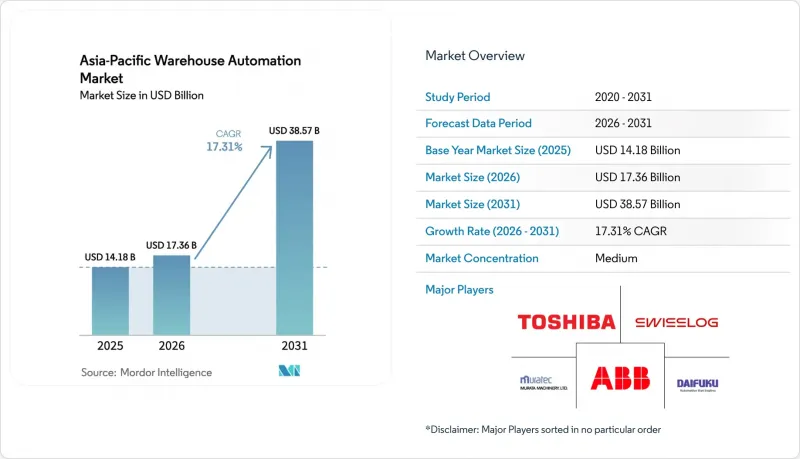
This report Segments the Industry Into Component (Hardware, Software (Warehouse Management Systems (WMS), Warehouse Execution Systems (WES)), Services (Value Added Services, Maintenance)), End-User (Food and Beverage, Post and Parcel, Groceries, General Merchandise, Apparel, Manufacturing, Other End-User Industries), and Country. The Market Forecasts are Provided in Terms of Value (USD).
Asia-Pacific Warehouse Automation Market Trends and Insights
Exponential Growth of the E-commerce Industry and Same-Day Delivery Expectations
Southeast Asia's e-commerce gross merchandise value reached USD 139 billion in 2024, a 15% year-on-year jump that tightened delivery windows across Jakarta and Manila. During China's Singles' Day 2024, platforms processed 2.9 billion parcels in 72 hours, forcing logistics providers to adopt sortation robots capable of handling 30,000 packages per hour. In India, 58% of online shoppers expected same-day service for electronics and apparel orders in 2024, up from 41% two years earlier, putting pressure on warehouses to automate pick-and-pack flows. Amazon India reported that goods-to-person robotics trimmed order-to-dispatch time by 40%, enabling two-hour delivery in 15 metropolitan areas. The surge in urban demand is pushing capital toward micro-fulfillment hubs within 5 kilometers of customers, where automation offsets urban real estate premiums.
Government Incentives for Smart Manufacturing Under Industry 4.0 Programs
Japan earmarked JPY 200 billion (USD 1.8 billion) in fiscal 2024 to subsidize collaborative robots and warehouse execution systems, aiming for 50% logistics automation by 2027. China's 14th Five-Year Plan mandates 70% mechanization in cold-chain warehouses by 2025, accelerating the deployment of shuttles and AS/RS systems that reduce food waste and energy per order. South Korea launched a USD 500 million Smart Logistics Innovation Fund in 2024, covering up to 40% of capital outlays for mobile robots for small and medium operators. India's Production-Linked Incentive scheme, announced in 2024, provides tax credits equal to 6% of incremental revenue for warehouses installing automation through 2028. These fiscal levers shorten typical payback periods from five years to under three, unlocking projects that mid-tier 3PLs once deemed unaffordable.
High Capital Expenditure and Long Payback Periods
Installing an automated storage and retrieval system for a 100,000 ft2 warehouse typically costs USD 8-15 million, with payback stretching three to five years depending on wage differentials. Autonomous mobile robots price between USD 20,000 and USD 100,000 each, and fleets of 50 units push upfront spend beyond USD 1 million, plus annual software fees near 20% of the hardware cost. Commercial loan rates in India averaged 9.5% in 2024, thereby inflating the weighted-average cost of capital and extending breakeven timelines for thin-margin operators. Robotics-as-a-service contracts at USD 2,000-4,000 per robot per month lower barriers but raise the total five-year cost 20-30%. These financing hurdles leave automation penetration below 12% in Vietnam and Indonesia, despite robust online retail growth.
Other drivers and restraints analyzed in the detailed report include:
- Rising Labor Costs Amid Aging Workforce in Developed Asia-Pacific Economies
- Surge in Dark Stores and Micro-Fulfillment Adoption in Urban Centers
- Availability of Low-Cost Labor in Emerging Economies
For complete list of drivers and restraints, kindly check the Table Of Contents.
Segment Analysis
Services revenue is growing at a 17.93% CAGR, slightly outpacing hardware's 17.31% trajectory, as operators discover that successful projects hinge on the smooth integration of legacy ERP, WMS, and OT layers. In 2025, hardware still delivered 67.13% of the Asia-Pacific warehouse automation market, largely because mobile robots, shuttle systems, and conveyors remain the backbone of throughput gains. Mobile fleets alone accounted for 28% of component turnover, buoyed by deployments such as 1,000 Geek+ units at Yamato Logistics, which trimmed processing time by 35%. Software captured 18% market share and is accelerating as real-time control and predictive maintenance mature, evidenced by a 40% jump in Blue Yonder and Manhattan Associates WMS licenses.
System integrators stand to benefit most, as 68% of operators surveyed in 2024 cited IT-OT convergence as their top hurdle. Consulting lines now bundle process redesign, safety certification, and workforce upskilling into multi-year contracts, swelling service margins. Hardware vendors respond by offering end-to-end packages, yet many mid-sized 3PLs prefer neutral advisers who can orchestrate mixed fleets. As warehouse complexity rises and the Asia-Pacific warehouse automation market expands, demand for cyber-secure integration eclipses the allure of marginal mechanical upgrades.
Grocery stores register the fastest 18.77% CAGR as strict temperature compliance and one-hour delivery windows intensify capital allocation toward mechanized cold storage. Food and beverage retained the largest 23.44% share of the Asia-Pacific warehouse automation market in 2025, underpinned by beverage distributors that streamline repetitive case handling with palletizing robots. State mandates in China require 70% mechanization of cold-chain sites by 2025, prompting carriers like SF Express to adopt multi-zone AS/RS systems with temperature ranges from -25 °C to +15 °C.
Post and parcel accounted for 19% of 2025 revenue, driven by high-speed sorters at hubs processing over 18,000 parcels per hour. Apparel and general merchandise accounted for 22%, but slower automation due to SKU variability complicates robotic grasping. Manufacturing accounted for 16%, with auto and electronics plants using AGVs to improve safety and increase space utilization. Pharmaceuticals, chemicals, and other niches expand on traceability standards that reward automated data capture. Overall, grocery momentum, especially for frozen and fresh produce, is driving the Asia-Pacific warehouse automation market beyond its historical reliance on parcel carriers.
Complete Report Scope:
- By Component
- Hardware
- Mobile Robots (AGV, AMR)
- Automated Storage and Retrieval Systems (AS/RS)
- Automated Conveyor and Sorting Systems
- De-palletizing/Palletizing Systems
- Automatic Identification and Data Collection (AIDC)
- Piece Picking Robots
- Software
- Warehouse Management Systems (WMS)
- Warehouse Execution Systems (WES)
- Services
- Hardware
- By End-User
- Food and Beverage
- Post and Parcel
- Groceries
- General Merchandise
- Apparel
- Manufacturing (Durable and Non-Durable)
- Other End-User
- By Warehouse Function
- Distribution Centers
- Fulfillment Centers
- Return Centers
- Cold Storage Facilities
- Micro-Fulfillment Centers
- Dark Stores
- By Warehouse Size
- Small (Below 50 000 sq ft)
- Medium (50 000 - 250 000 sq ft)
- Large (Above 250 000 sq ft)
- By Country
- China
- India
- Japan
- South Korea
- Australia
- Rest of Asia Pacific
List of Companies Covered in this Report:
- Daifuku Co., Ltd.
- Murata Machinery, Ltd.
- Geek+ Inc.
- GreyOrange Pte. Ltd.
- SSI Schaefer Group
- Swisslog Holding AG
- Toyota Material Handling
- HAI Robotics
- ABB Ltd.
- Yaskawa Electric Corporation
- Godrej Consoveyo Logistics Automation Ltd.
- Bastian Solutions
- ST Engineering
- Toshiba Global Commerce Solutions
- Vanderlande Industries
- Honeywell Intelligrated
- Knapp AG
- Locus Robotics Corp.
- Kion Group
Additional Benefits:
- The market estimate (ME) sheet in Excel format
- 3 months of analyst support
TABLE OF CONTENTS
1 INTRODUCTION
- 1.1 Study Assumptions and Market Definition
- 1.2 Scope of the Study
2 RESEARCH METHODOLOGY
3 EXECUTIVE SUMMARY
4 MARKET LANDSCAPE
- 4.1 Market Overview
- 4.2 Market Drivers
- 4.2.1 Exponential Growth of the E-commerce Industry and Same-Day Delivery Expectations
- 4.2.2 Government Incentives for Smart Manufacturing Under Industry 4.0 Programs
- 4.2.3 Rising Labor Costs Amid Aging Workforce in Developed Asia Pacific Economies
- 4.2.4 Surge in Dark Store and Micro-Fulfillment Adoption in Urban Centers
- 4.2.5 Deployment of 5G Private Networks Enabling Ultra-Low-Latency Warehouse Control
- 4.2.6 Decarbonization Mandates Driving Automation to Reduce Energy per Order
- 4.3 Market Restraints
- 4.3.1 High Capital Expenditure and Long Payback Periods
- 4.3.2 Availability of Low-Cost Labor in Emerging Economies
- 4.3.3 Complexity of Integrating Legacy IT and OT Systems
- 4.3.4 Cybersecurity Vulnerabilities in Connected Robotic Fleets
- 4.4 Industry Value Chain Analysis
- 4.5 Regulatory Landscape
- 4.6 Technological Outlook
- 4.7 Impact of Macroeconomic Factors on the Warehouse Automation Market
- 4.8 Impact of COVID-19 on the Market
- 4.9 Warehouse Investment Scenario
- 4.10 Porter's Five Forces Analysis
- 4.10.1 Threat of New Entrants
- 4.10.2 Bargaining Power of Buyers
- 4.10.3 Bargaining Power of Suppliers
- 4.10.4 Threat of Substitutes
- 4.10.5 Intensity of Competitive Rivalry
5 MARKET SIZE AND GROWTH FORECASTS (VALUE)
- 5.1 By Component
- 5.1.1 Hardware
- 5.1.1.1 Mobile Robots (AGV, AMR)
- 5.1.1.2 Automated Storage and Retrieval Systems (AS/RS)
- 5.1.1.3 Automated Conveyor and Sorting Systems
- 5.1.1.4 De-palletizing/Palletizing Systems
- 5.1.1.5 Automatic Identification and Data Collection (AIDC)
- 5.1.1.6 Piece Picking Robots
- 5.1.2 Software
- 5.1.2.1 Warehouse Management Systems (WMS)
- 5.1.2.2 Warehouse Execution Systems (WES)
- 5.1.3 Services
- 5.1.1 Hardware
- 5.2 By End-User
- 5.2.1 Food and Beverage
- 5.2.2 Post and Parcel
- 5.2.3 Groceries
- 5.2.4 General Merchandise
- 5.2.5 Apparel
- 5.2.6 Manufacturing (Durable and Non-Durable)
- 5.2.7 Other End-User
- 5.3 By Warehouse Function
- 5.3.1 Distribution Centers
- 5.3.2 Fulfillment Centers
- 5.3.3 Return Centers
- 5.3.4 Cold Storage Facilities
- 5.3.5 Micro-Fulfillment Centers
- 5.3.6 Dark Stores
- 5.4 By Warehouse Size
- 5.4.1 Small (Below 50 000 sq ft)
- 5.4.2 Medium (50 000 - 250 000 sq ft)
- 5.4.3 Large (Above 250 000 sq ft)
- 5.5 By Country
- 5.5.1 China
- 5.5.2 India
- 5.5.3 Japan
- 5.5.4 South Korea
- 5.5.5 Australia
- 5.5.6 Rest of Asia Pacific
6 COMPETITIVE LANDSCAPE
- 6.1 Market Concentration
- 6.2 Strategic Moves
- 6.3 Market Share Analysis
- 6.4 Company Profiles (includes Global Level Overview, Market Level Overview, Core Segments, Financials as Available, Strategic Information, Market Rank/Share for Key Companies, Products and Services, and Recent Developments)
- 6.4.1 Daifuku Co., Ltd.
- 6.4.2 Murata Machinery, Ltd.
- 6.4.3 Geek+ Inc.
- 6.4.4 GreyOrange Pte. Ltd.
- 6.4.5 SSI Schaefer Group
- 6.4.6 Swisslog Holding AG
- 6.4.7 Toyota Material Handling
- 6.4.8 HAI Robotics
- 6.4.9 ABB Ltd.
- 6.4.10 Yaskawa Electric Corporation
- 6.4.11 Godrej Consoveyo Logistics Automation Ltd.
- 6.4.12 Bastian Solutions
- 6.4.13 ST Engineering
- 6.4.14 Toshiba Global Commerce Solutions
- 6.4.15 Vanderlande Industries
- 6.4.16 Honeywell Intelligrated
- 6.4.17 Knapp AG
- 6.4.18 Locus Robotics Corp.
- 6.4.19 Kion Group
7 MARKET OPPORTUNITIES AND FUTURE OUTLOOK
- 7.1 White-Space and Unmet-Need Assessment

