PUBLISHER: Mordor Intelligence | PRODUCT CODE: 2124930

PUBLISHER: Mordor Intelligence | PRODUCT CODE: 2124930
North America Warehouse Automation - Market Share Analysis, Industry Trends & Statistics, Growth Forecasts (2026 - 2031)
According to Mordor Intelligence, the North America warehouse automation market size is expected to grow from USD 8.01 billion in 2025 to USD 9.33 billion in 2026 and is forecast to reach USD 19.97 billion by 2031 at 16.45% CAGR over 2026-2031.
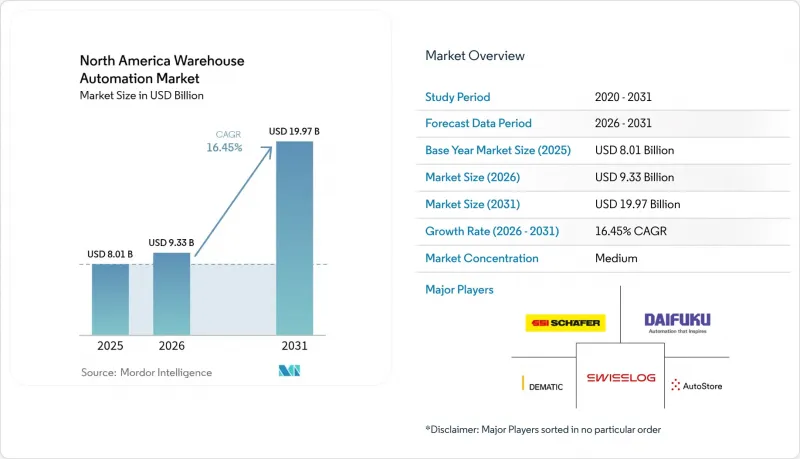
This report is Segmented by Component (Hardware, Software, Services), Technology (Automated Storage and Retrieval Systems, and More), End-User Industry (Food and Beverage, Automotive, and More), Function (Storage, Packing and Dispatch, Palletizing and Depalletizing, Sortation, and More), and Geography (United States, Canada, Mexico). The Market Forecasts are Provided in Terms of Value (USD).
North America Warehouse Automation Market Trends and Insights
Surge in E-Commerce Fulfillment Automation
Retailers are compressing order-to-ship cycles to hours, pushing capital toward high-speed sortation, goods-to-person picking, and robotic palletizing. Walmart allocated USD 200 million to autonomous forklifts in 2024, evidencing confidence that robotics offset margin pressure from online orders that carry 400-600 basis-point lower gross margins than stores. Amazon's Shreveport and Detroit fulfillment centers each deployed more than 1,000 AMRs to triple peak throughput during holiday surges. Third-party logistics operators serving multiple storefronts on Shopify are embracing modular automation so they can amortize costs across clients and redeploy robots as contract volumes shift. Real-estate premiums in urban cores are steering inventory toward larger regional hubs where dense, software-defined automation scales without expanding footprints. As same-day delivery becomes table stakes, the North America warehouse automation market embeds fulfillment speed as an existential competitive variable.
Rising Labor Shortages and Wage Inflation in Warehousing
Warehouse pay grew 4.1% year-over-year in Q3 2024, while vacancy rates in rural hubs remain acute, forcing operators to pay shift differentials for overnight coverage. Shortfalls in certified robotics technicians further elevate compensation costs or push operators into vendor-locked service contracts. Vendors now embed predictive maintenance into control software to cut unplanned downtime and remote diagnostics that let a single engineer cover multiple sites. When wage growth exceeds 3% annually, autonomous mobile robots show sub-24-month paybacks in high-volume facilities, strengthening the structural ties between labor economics and automation capital plans. Consequently, AMR vendors that package hardware with fleet-optimization software are well positioned inside the North America warehouse automation market.
High Upfront Capital Expenditure for SMEs
Automated storage and retrieval systems can demand USD 5-20 million per site, a misalignment for third-party logistics contracts that often renew every three years. Robotics-as-a-service models convert equipment purchases into operating costs by charging per pick or pallet move, but they also shift utilization risk to the vendor. Lacking standardized performance benchmarks, smaller operators struggle to compare proposals, elongating sales cycles. This disparity concentrates automation adoption among big-box retailers and multi-site 3PLs that can amortize engineering and integration across distributed networks. Consequently, the North America warehouse automation market still shows under-penetration among mid-market operators despite falling hardware prices.
Other drivers and restraints analyzed in the detailed report include:
- US Inflation Reduction Act Incentives for Domestic Automation Hardware
- Integration of AI-Driven Warehouse Orchestration Platforms
- Integration Complexity with Legacy WMS and ERP Systems
For complete list of drivers and restraints, kindly check the Table Of Contents.
Segment Analysis
Hardware retained 68.73% share in 2025, underscoring the capital intensity of conveyors and ASRS that anchor automated facilities across the North America warehouse automation market. Software is tracking a 16.85% CAGR because orchestration, labor planning, and inventory optimization are now the fastest levers to raise throughput without heavy construction. As subscription models replace perpetual licenses, operators can roll out feature enhancements over-the-air, decoupling capability from physical refresh cycles.
Expanding fleets of AMRs embed their own fleet-management layers that dynamically reassign robots to zones with rising order depth, cutting idle time and squeezing higher asset utilization. Digital-twin models simulate rack redeployments or aisle-width tweaks before crews step on the floor, slashing project risk. Service revenues installation, maintenance, managed operations are pivoting toward outcome-based contracts where integrators guarantee lines per hour rather than equipment uptime, aligning vendor incentives with the operator's service-level goals.
Automated storage and retrieval systems delivered 33.15% revenue in 2025, prized for vertical density in parts and beverage distribution. Meanwhile, AMRs and AGVs are advancing at 17.35% annually as operators prioritize flexibility that lets fleets scale in increments of tens rather than hundreds. Conveyor and sortation assets remain indispensable for parcel hubs handling predictable volumes, but retrofits frequently embed diverters that interact with AMRs for last-meter routing.
AutoStore's cube-based storage underscores a hybrid trend: dense static grids coupled with mobile robots on top to liberate bin content quickly. Locus Robotics surpassed 10,000 collaborative units across North America in 2024, validating the pay-per-pick model in high-mix e-commerce. Operators increasingly deploy hybrid estates where ASRS stores A-class inventory and AMRs ferry B- and C-class SKUs to ergonomic workstations, ensuring resilience when demand profiles shift.
Complete Report Scope:
- By Component
- Hardware
- Software
- Services
- By Technology
- Automated Storage and Retrieval Systems
- Autonomous Mobile Robots and AGVs
- Conveyor and Sortation Systems
- Picking and Packing Automation
- Warehouse Management and Execution Software
- By End-User Industry
- E-Commerce and Retailers
- Third-Party Logistics
- Food and Beverage
- Automotive
- Healthcare and Pharmaceuticals
- Electronics and Electrical
- By Function
- Storage
- Order Picking
- Packing and Dispatch
- Palletizing and Depalletizing
- Sortation
- By Country
- United States
- Canada
- Mexico
List of Companies Covered in this Report:
- Daifuku Co., Ltd.
- SSI Schaefer AG
- Dematic Corp.
- Swisslog Holding AG
- AutoStore Holdings Ltd.
- TGW Logistics Group GmbH
- Honeywell Intelligrated Inc.
- Bastian Solutions LLC
- MHS Holdings, LLC
- Murata Machinery, Ltd.
- KNAPP AG
- Kardex Holding AG
- Vanderlande Industries B.V.
- Geekplus Technology Co., Ltd.
- Locus Robotics Corp.
- Fetch Robotics, Inc. (Zebra Technologies Corp.)
- GreyOrange Pte. Ltd.
- Seegrid Corporation
- Ocado Group plc
- Exotec SAS
Additional Benefits:
- The market estimate (ME) sheet in Excel format
- 3 months of analyst support
TABLE OF CONTENTS
1 INTRODUCTION
- 1.1 Study Assumptions and Market Definition
- 1.2 Scope of the Study
2 RESEARCH METHODOLOGY
3 EXECUTIVE SUMMARY
4 MARKET LANDSCAPE
- 4.1 Market Overview
- 4.2 Market Drivers
- 4.2.1 Surge in E-Commerce Fulfillment Automation
- 4.2.2 Rising Labor Shortages and Wage Inflation in Warehousing
- 4.2.3 US Inflation Reduction Act Incentives for Domestic Automation Hardware
- 4.2.4 Integration of AI-Driven Warehouse Orchestration Platforms
- 4.2.5 Demand for Cold-Chain Compliance and Temperature-Controlled Automation
- 4.2.6 2025 US Tariffs Accelerating Nearshoring of Automation Supply Chains
- 4.3 Market Restraints
- 4.3.1 High Upfront Capital Expenditure for SMEs
- 4.3.2 Integration Complexity with Legacy WMS and ERP Systems
- 4.3.3 Shortage of Skilled Robotics Technicians in Rural Distribution Hubs
- 4.3.4 Cybersecurity Risks to Connected Warehouse Control Systems
- 4.4 Industry Value Chain Analysis
- 4.5 Regulatory Landscape
- 4.6 Technological Outlook
- 4.7 Impact of Macroeconomic Factors
- 4.8 Porter's Five Forces Analysis
- 4.8.1 Threat of New Entrants
- 4.8.2 Bargaining Power of Suppliers
- 4.8.3 Bargaining Power of Buyers
- 4.8.4 Threat of Substitutes
- 4.8.5 Industry Rivalry
5 MARKET SIZE AND GROWTH FORECASTS (VALUE)
- 5.1 By Component
- 5.1.1 Hardware
- 5.1.2 Software
- 5.1.3 Services
- 5.2 By Technology
- 5.2.1 Automated Storage and Retrieval Systems
- 5.2.2 Autonomous Mobile Robots and AGVs
- 5.2.3 Conveyor and Sortation Systems
- 5.2.4 Picking and Packing Automation
- 5.2.5 Warehouse Management and Execution Software
- 5.3 By End-User Industry
- 5.3.1 E-Commerce and Retailers
- 5.3.2 Third-Party Logistics
- 5.3.3 Food and Beverage
- 5.3.4 Automotive
- 5.3.5 Healthcare and Pharmaceuticals
- 5.3.6 Electronics and Electrical
- 5.4 By Function
- 5.4.1 Storage
- 5.4.2 Order Picking
- 5.4.3 Packing and Dispatch
- 5.4.4 Palletizing and Depalletizing
- 5.4.5 Sortation
- 5.5 By Country
- 5.5.1 United States
- 5.5.2 Canada
- 5.5.3 Mexico
6 COMPETITIVE LANDSCAPE
- 6.1 Market Concentration
- 6.2 Strategic Moves
- 6.3 Market Share Analysis
- 6.4 Company Profiles (includes Global Level Overview, Market Level Overview, Core Segments, Financials as available, Strategic Information, Market Rank/Share for key companies, Products and Services, and Recent Developments)
- 6.4.1 Daifuku Co., Ltd.
- 6.4.2 SSI Schaefer AG
- 6.4.3 Dematic Corp.
- 6.4.4 Swisslog Holding AG
- 6.4.5 AutoStore Holdings Ltd.
- 6.4.6 TGW Logistics Group GmbH
- 6.4.7 Honeywell Intelligrated Inc.
- 6.4.8 Bastian Solutions LLC
- 6.4.9 MHS Holdings, LLC
- 6.4.10 Murata Machinery, Ltd.
- 6.4.11 KNAPP AG
- 6.4.12 Kardex Holding AG
- 6.4.13 Vanderlande Industries B.V.
- 6.4.14 Geekplus Technology Co., Ltd.
- 6.4.15 Locus Robotics Corp.
- 6.4.16 Fetch Robotics, Inc. (Zebra Technologies Corp.)
- 6.4.17 GreyOrange Pte. Ltd.
- 6.4.18 Seegrid Corporation
- 6.4.19 Ocado Group plc
- 6.4.20 Exotec SAS
7 MARKET OPPORTUNITIES AND FUTURE OUTLOOK
- 7.1 White-Space and Unmet-Need Assessment

