PUBLISHER: Mordor Intelligence | PRODUCT CODE: 2124684

PUBLISHER: Mordor Intelligence | PRODUCT CODE: 2124684
Warehouse Automation - Market Share Analysis, Industry Trends & Statistics, Growth Forecasts (2026 - 2031)
According to Mordor Intelligence, the warehouse automation market size is expected to increase from USD 29.98 billion in 2025 to USD 34.17 billion in 2026 and reach USD 65.74 billion by 2031, growing at a CAGR of 13.98% over 2026-2031.
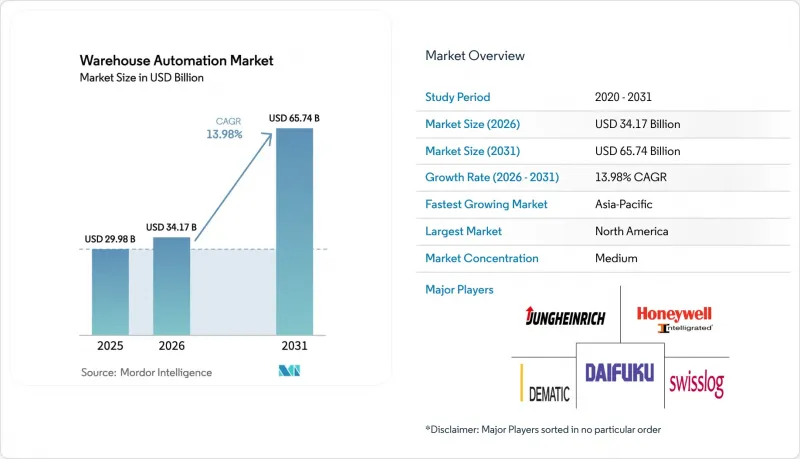
This report is Segmented by Component (Hardware, Software, and Services), Technology (Mobile Robots, AS/RS, and More), End-User Industry (Food and Beverage, Post and Parcel, and More), Warehouse Size (Small, Medium, and More), Application Function (Inbound Handling, and More), Ownership Model (E-Commerce Pure-Plays, and More), and Geography. The Market Forecasts are Provided in Terms of Value (USD).
Global Warehouse Automation Market Trends and Insights
E-commerce Boom And Last-Mile Expectations
Quarterly U.S. e-commerce sales reached USD 310.3 billion in Q3 2025, but the strategic hinge lies in compressing order-to-door intervals to two hours or less. Retailers now locate inventory within 10 miles of demand clusters, fragmenting networks into micro-fulfillment nodes that cannot house traditional conveyor grids. Vertical shuttle arrays and tote-retrieval robots reclaim floor area, processing 500-1,000 orders per hour from footprints under 20,000 square feet. Last-mile economics therefore reward capital intensity over labor flexibility, reversing the historic low-automation model. Grocery and quick-commerce operators lead adoption by repurposing retail basements and parking decks into automated hubs that bypass zoning constraints on new industrial builds.
Labour Shortages And Rising Wage Inflation
Logistics wages in North America advanced 3.8% over the twelve months ending September 2025, eclipsing the 3.6% average for all civilian workers, while voluntary turnover slid below 2%. Autonomous mobile robot fleets priced at USD 2,000-4,000 per unit per month reach payback in as little as 12 months, effectively replacing 2.5-3 full-time equivalents per robot. Operators in Scandinavia, Switzerland, and urban Japan now automate cross-docking and kitting because the opportunity cost of unfilled jobs outweighs capital risk. Wage-driven automation also neutralizes the labor cost edge once enjoyed by mid-tier U.S. cities, homogenizing fulfillment economics regionally.
High Upfront Capex And Long Pay-Back For Fixed Systems
A single aisle of crane-based automated storage can exceed USD 2 million, with payback stretching beyond five years if throughput misses design targets by 15%-20%. Such capital intensity bifurcates the market into incumbents able to finance greenfield mega-hubs and challengers confined to mobile robots. The risk rises in apparel and consumer electronics, where SKU volatility renders fixed systems inflexible because re-configuring crane heights may require multi-week shutdowns. Consequently, mid-tier operators favor modular solutions that preserve optionality, even when long-run efficiency is lower than purpose-built conveyor grids.
Other drivers and restraints analyzed in the detailed report include:
- Rapid ROI From Plug-And-Play AMR And AGV Fleets
- Robotics-As-A-Service Lowering Cap-Ex Hurdles
- Legacy IT And WMS Integration Complexity
For complete list of drivers and restraints, kindly check the Table Of Contents.
Segment Analysis
Software revenue is projected to post a 14.87% CAGR between 2026 and 2031, even though hardware controlled 55.12% of spending in 2025. Operators deploy cloud-native execution layers that lift throughput by 15% to 25% from existing conveyors, favoring code updates that arrive weekly over physical retrofits that can idle docks for days. Subscription pricing folds maintenance and analytics into the license, cutting unscheduled downtime 30% and trimming service truck rolls. Venture capital follows the margin profile, pushing software firms to acquire niche workflow applications and bundle them into unified orchestration suites.
Hardware remains vital for greenfield mega-hubs exceeding 500,000 square feet, where custom conveyors and high-bay cranes amortize efficiently across 20-year leases. Services revenue concentrates in brownfield projects that need installers to work overnight shifts and avoid order-cutoff disruption. Mobile robot suppliers now preload fleet software that self-calibrates on arrival, limiting integrator hours and shifting profit pools from wrench work to data services. The net result is a gradual migration of spending toward software while hardware remains the anchor in high-throughput facilities, preserving balance within the overall warehouse automation market.
Piece-picking robots are forecast to grow at 15.27% CAGR because new grippers and vision reduce mis-pick rates below 0.5%. This removes the historical need to restrict robots to the top 20% of fast movers, unlocking automation for apparel, cosmetics, and mixed grocery orders. Autonomous mobile robots, which captured 41.36% of 2025 spend, now integrate with pick arms to create end-to-end goods-to-robot loops that shrink travel by 70%.
Automated storage and retrieval systems retain a stronghold in cold chain sites where +-2°C accuracy is mandatory, while conveyor and sortation equipment dominates parcel hubs running 10,000 units per hour. Automatic identification and data capture equips every technology layer with real-time inventory truth, feeding orchestration engines that choose the optimal robot for each task. Together these advances expand the warehouse automation market share held by advanced robotics within multi-technology system sales.
Complete Report Scope:
- By Component
- Hardware
- Software
- Services
- By Technology
- Mobile Robots (AGV, AMR)
- Automated Storage and Retrieval Systems (AS/RS)
- Conveyor and Sortation Systems
- Palletizing / Depalletizing Robotics
- Piece-Picking Robots
- Automatic Identification and Data Collection (AIDC)
- By End-User Industry
- Food and Beverage
- Post and Parcel
- Retail and E-commerce
- Apparel and Footwear
- Manufacturing (Durable and Non-Durable)
- Pharmaceuticals and Healthcare
- 3PL / Contract Logistics
- Other End-User Industries
- By Warehouse Size
- Small (Less than 50 k sq ft)
- Medium (50-200 k sq ft)
- Large (200-500 k sq ft)
- Mega (More than 500 k sq ft)
- By Application Function
- Inbound Handling
- Storage and Buffering
- Picking and Packing
- Sorting and Consolidation
- Outbound Loading
- Returns Processing
- By Ownership Model
- Company-Owned Warehouses
- 3PL / Contract Warehouses
- E-commerce Pure-Plays
- Government / Defence
- By Geography
- North America
- United States
- Canada
- Mexico
- South America
- Brazil
- Argentina
- Chile
- Rest of South America
- Europe
- Germany
- United Kingdom
- France
- Italy
- Spain
- Netherlands
- Russia
- Rest of Europe
- Asia Pacific
- China
- Japan
- South Korea
- India
- ASEAN
- Australia
- New Zealand
- Rest of Asia Pacific
- Middle East
- GCC
- Turkey
- Israel
- Rest of Middle East
- Africa
- South Africa
- Nigeria
- Kenya
- Rest of Africa
- North America
Geography Analysis
North America held 35.51% of revenue in 2025, anchored by the United States and Mexico's nearshoring boom. The region added 500 million square feet of warehouses from 2020-2024, but growth cools as large-site penetration peaks. Mexico attracted USD 20 billion in nearshoring investment during 2024-2025, spawning automated hubs in Monterrey and the Bajio region to synchronize manufacturing with U.S. demand. Canada focuses on cold-chain automation around Toronto and Vancouver to support pharmaceutical and grocery fulfillment.
Asia-Pacific will expand at a 15.91% CAGR, the fastest globally. China targets 70% automation penetration in tier-one city logistics parks by 2030 under its smart-logistics guidelines. Japan counters a shrinking labor pool by subsidizing robotics, despite 15%-20% higher costs for seismic compliance. India's GST reforms foster mega-hubs, while Australia automates export-oriented cold chains.
Europe remains a mature stronghold yet faces regulatory capex diversion as the Energy Performance of Buildings Directive mandates retrofits before capacity additions. Middle East and Africa adoption centers on UAE and Saudi Arabia free zones, whereas South America battles currency volatility that inflates imported equipment costs by up to 50%.
- Dematic Group (Kion Group AG)
- Daifuku Co. Ltd
- Swisslog Holding AG (KUKA AG)
- Jungheinrich AG
- Honeywell Intelligrated
- Murata Machinery
- KNAPP AG
- TGW Logistics Group GmbH
- Kardex Group
- Mecalux SA
- BEUMER Group
- SSI Schaefer AG
- Vanderlande BV
- WITRON Logistik + Informatik GmbH & Co. KG
- Boston Dynamics
- Zebra Technologies
- Exotec
- Geek+
- Symbotic
- AutoStore
- Locus Robotics
- GreyOrange
- Berkshire Grey
- Element Logic
- Ocado Group
- Fetch Robotics (Zebra)
- Magazino
Additional Benefits:
- The market estimate (ME) sheet in Excel format
- 3 months of analyst support
TABLE OF CONTENTS
1 INTRODUCTION
- 1.1 Study Assumptions and Market Definition
- 1.2 Scope of the Study
2 RESEARCH METHODOLOGY
3 EXECUTIVE SUMMARY
4 MARKET LANDSCAPE
- 4.1 Market Overview
- 4.2 Market Drivers
- 4.2.1 E-commerce Boom and Last-Mile Expectations
- 4.2.2 Labour Shortages and Rising Wage Inflation
- 4.2.3 Rapid ROI from Plug-and-Play AMR and AGV Fleets
- 4.2.4 Robotics-as-a-Service Lowering Cap-Ex Hurdles
- 4.2.5 ESG-Linked Energy-Efficiency Mandates
- 4.2.6 Reshoring-Driven Mega-Hubs Needing High-Density Automation
- 4.3 Market Restraints
- 4.3.1 High Upfront Capex and Long Pay-Back for Fixed Systems
- 4.3.2 Legacy IT and WMS Integration Complexity
- 4.3.3 Cyber-Security Vulnerabilities of Connected Devices
- 4.3.4 Stricter Li-ion Battery Fire-Safety Regulations for AMRs
- 4.4 Industry Value Chain Analysis
- 4.5 Regulatory Landscape
- 4.6 Technological Outlook
- 4.7 Impact of Macroeconomic Factors on the Market
- 4.8 Porter's Five Forces Analysis
- 4.8.1 Bargaining Power of Buyers
- 4.8.2 Bargaining Power of Suppliers
- 4.8.3 Threat of New Entrants
- 4.8.4 Threat of Substitutes
- 4.8.5 Intensity of Competitive Rivalry
- 4.9 Warehouse Investment Scenario
5 MARKET SIZE AND GROWTH FORECASTS (VALUE)
- 5.1 By Component
- 5.1.1 Hardware
- 5.1.2 Software
- 5.1.3 Services
- 5.2 By Technology
- 5.2.1 Mobile Robots (AGV, AMR)
- 5.2.2 Automated Storage and Retrieval Systems (AS/RS)
- 5.2.3 Conveyor and Sortation Systems
- 5.2.4 Palletizing / Depalletizing Robotics
- 5.2.5 Piece-Picking Robots
- 5.2.6 Automatic Identification and Data Collection (AIDC)
- 5.3 By End-User Industry
- 5.3.1 Food and Beverage
- 5.3.2 Post and Parcel
- 5.3.3 Retail and E-commerce
- 5.3.4 Apparel and Footwear
- 5.3.5 Manufacturing (Durable and Non-Durable)
- 5.3.6 Pharmaceuticals and Healthcare
- 5.3.7 3PL / Contract Logistics
- 5.3.8 Other End-User Industries
- 5.4 By Warehouse Size
- 5.4.1 Small (Less than 50 k sq ft)
- 5.4.2 Medium (50-200 k sq ft)
- 5.4.3 Large (200-500 k sq ft)
- 5.4.4 Mega (More than 500 k sq ft)
- 5.5 By Application Function
- 5.5.1 Inbound Handling
- 5.5.2 Storage and Buffering
- 5.5.3 Picking and Packing
- 5.5.4 Sorting and Consolidation
- 5.5.5 Outbound Loading
- 5.5.6 Returns Processing
- 5.6 By Ownership Model
- 5.6.1 Company-Owned Warehouses
- 5.6.2 3PL / Contract Warehouses
- 5.6.3 E-commerce Pure-Plays
- 5.6.4 Government / Defence
- 5.7 By Geography
- 5.7.1 North America
- 5.7.1.1 United States
- 5.7.1.2 Canada
- 5.7.1.3 Mexico
- 5.7.2 South America
- 5.7.2.1 Brazil
- 5.7.2.2 Argentina
- 5.7.2.3 Chile
- 5.7.2.4 Rest of South America
- 5.7.3 Europe
- 5.7.3.1 Germany
- 5.7.3.2 United Kingdom
- 5.7.3.3 France
- 5.7.3.4 Italy
- 5.7.3.5 Spain
- 5.7.3.6 Netherlands
- 5.7.3.7 Russia
- 5.7.3.8 Rest of Europe
- 5.7.4 Asia Pacific
- 5.7.4.1 China
- 5.7.4.2 Japan
- 5.7.4.3 South Korea
- 5.7.4.4 India
- 5.7.4.5 ASEAN
- 5.7.4.6 Australia
- 5.7.4.7 New Zealand
- 5.7.4.8 Rest of Asia Pacific
- 5.7.5 Middle East
- 5.7.5.1 GCC
- 5.7.5.2 Turkey
- 5.7.5.3 Israel
- 5.7.5.4 Rest of Middle East
- 5.7.6 Africa
- 5.7.6.1 South Africa
- 5.7.6.2 Nigeria
- 5.7.6.3 Kenya
- 5.7.6.4 Rest of Africa
- 5.7.1 North America
6 COMPETITIVE LANDSCAPE
- 6.1 Market Concentration
- 6.2 Strategic Moves
- 6.3 Market Share Analysis
- 6.4 Company Profiles (includes Global Level Overview, Market Level Overview, Core Segments, Financials as Available, Strategic Information, Market Rank/Share for Key Companies, Products and Services, Recent Developments)
- 6.4.1 Dematic Group (Kion Group AG)
- 6.4.2 Daifuku Co. Ltd
- 6.4.3 Swisslog Holding AG (KUKA AG)
- 6.4.4 Jungheinrich AG
- 6.4.5 Honeywell Intelligrated
- 6.4.6 Murata Machinery
- 6.4.7 KNAPP AG
- 6.4.8 TGW Logistics Group GmbH
- 6.4.9 Kardex Group
- 6.4.10 Mecalux SA
- 6.4.11 BEUMER Group
- 6.4.12 SSI Schaefer AG
- 6.4.13 Vanderlande BV
- 6.4.14 WITRON Logistik + Informatik GmbH & Co. KG
- 6.4.15 Boston Dynamics
- 6.4.16 Zebra Technologies
- 6.4.17 Exotec
- 6.4.18 Geek+
- 6.4.19 Symbotic
- 6.4.20 AutoStore
- 6.4.21 Locus Robotics
- 6.4.22 GreyOrange
- 6.4.23 Berkshire Grey
- 6.4.24 Element Logic
- 6.4.25 Ocado Group
- 6.4.26 Fetch Robotics (Zebra)
- 6.4.27 Magazino
7 MARKET OPPORTUNITIES AND FUTURE OUTLOOK
- 7.1 White-Space and Unmet-Need Assessment

