PUBLISHER: Mordor Intelligence | PRODUCT CODE: 2124969

PUBLISHER: Mordor Intelligence | PRODUCT CODE: 2124969
Europe Water Meter - Market Share Analysis, Industry Trends & Statistics, Growth Forecasts (2026 - 2031)
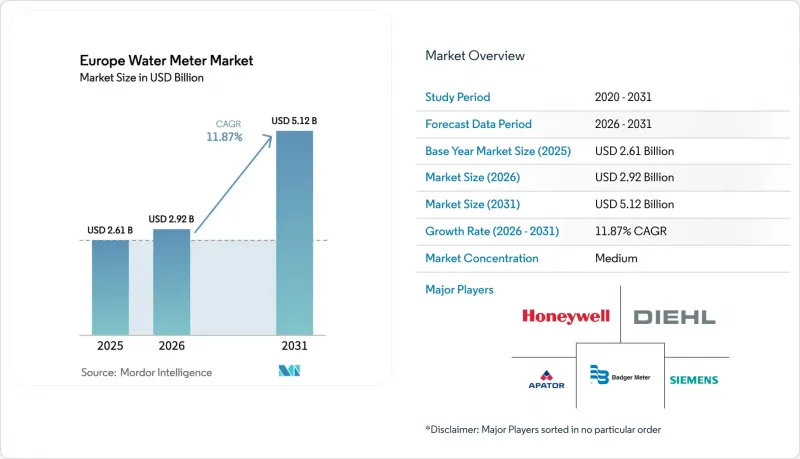
According to Mordor Intelligence, the Europe water meter market size was valued at USD 2.61 billion in 2025 and estimated to grow from USD 2.92 billion in 2026 to reach USD 5.12 billion by 2031, at a CAGR of 11.87% during the forecast period (2026-2031).
This report is Segmented by Meter Type (Basic/Mechanical Meters, and More), Technology (Automatic Meter Reading (AMR), and More), End-User (Residential, Commercial, and More), Communication Network (Radio Frequency (Wireless M-Bus/RF Mesh), and More), Meter Size Class (<= DN 25 (Domestic), DN 32-50 (Light Commercial), and More), and Geography. The Market Forecasts are Provided in Terms of Value (USD).
Europe Water Meter Market Trends and Insights
EU Leakage-Reduction Mandates and Water-Scarcity Policies
The European Environment Agency warns that demand could outstrip supply by 5 billion litres daily by 2050, leading member states to tighten leakage rules and mandate remote-read meters. Ofwat earmarked GBP 1.7 billion under AMP8 to install almost 10 million smart meters, aiming for a 17% leakage cut and 48% household penetration by 2030. Germany obliges remote-read devices in new builds since October 2020, with all retrofits due by end-2026, while France is scaling ultrasonic rollouts that already deliver >75% leak-detection success and lift network efficiency above 89%. The upcoming EU water-resilience strategy positions smart metering as critical infrastructure and ties compliance to ISO 4064 accuracy classes.
Accelerating Smart-Meter Rollouts Funded by AMP8 and EU Recovery Plans
The UK's GBP 104 billion AMP8 program is the largest sector investment since privatization, with a clear priority on smart metering and network data upgrades. Thames Water's GBP 50 million framework with Honeywell and Sensus commits to more than 1 million new meters using Vodafone NB-IoT for up to 24 daily readings. Affinity Water budgets GBP 150 million for 397,000 endpoints, and Yorkshire Water contracts Netmore to replace 1.3 million units via LoRaWAN. French municipalities tap the EU Recovery Facility, with FNCCR estimating EUR 1.233 billion to equip 53% of the nation's meters by 2035, yielding EUR 205 million annual gains and 811 million m3 in savings. MID and RED directives harmonize metrology and radio compliance, allowing multi-vendor tendering.
Fragmented Data-Access Regulations (GDPR, National Hubs)
Meter data are classified as personal under GDPR, so utilities must encrypt payloads, store them on certified servers, and obtain explicit consent for analytics or third-party sharing. Germany goes further, requiring BSI-approved smart-meter gateways with Common Criteria EAL 4+ security, delaying many projects. France's CNIL imposes similar vetting, and post-Brexit UK utilities juggle both EU and domestic rules. Compliance raises back-office costs, complicates API exposure, and forces periodic software audits.
Other drivers and restraints analyzed in the detailed report include:
- AI-Enabled Acoustic Leak Detection Lowering Non-Revenue Water
- Growth of Eco-Tariffs and Consumption-Based Billing Models
- High Retrofit Costs in Legacy Housing Stock
For complete list of drivers and restraints, kindly check the Table Of Contents.
Segment Analysis
Mechanical meters still represented 56.82% of the Europe water meter market share in 2025. Their large installed base and low unit price underpin volume, yet shipment growth is trending negative as utilities pivot to digital accuracy. Communicating smart meters are forecast to grow 13.78% CAGR, steadily eroding legacy share and lifting the Europe water meter market size through higher average selling price and value-added services.
Regulated leakage targets and the need for acoustic leak detection have tipped procurement toward solid-state ultrasonic devices that measure down to 4 L h with no moving parts. Yorkshire Water's 1.3 million replacement program shows how utilities bundle connectivity, analytics, and warranty in a single tender that sidelines purely mechanical products. As vendors retire mechanical tooling and scale solid-state lines, price gaps are narrowing and the total cost of ownership Favors digital endpoints, accelerating displacement.
AMR solutions accounted for 53.65% of the Europe water meter market size in 2025, reflecting a decade of semi-automated walk-by and drive-by deployments. Utilities now demand bidirectional communication, hourly data granularity, and firmware upgrade paths, pushing AMI shipments to a 12.96% CAGR. NB-IoT modules in AMI platforms allow 24-hour battery-friendly polling and seamless cloud integration, enabling predictive maintenance and dynamic tariffs.
Essex and Suffolk Water's LoRaWAN AMI pilot covers 1 million meters and transmits hourly reads that feed leakage reduction algorithms. Spain's early NB-IoT adoption validates commercial viability in high-density apartments, and vendor roadmaps show unified stacks combining edge analytics and over-the-air calibration. As analytics subscriptions gain traction, AMI hardware forms the gateway for recurring SaaS, locking in long-term vendor-utility partnerships.
Complete Report Scope:
- By Meter Type
- Basic (Mechanical) Meters
- Communicating Smart Meters
- By Technology
- Automatic Meter Reading (AMR)
- Advanced Metering Infrastructure (AMI)
- By End-User
- Residential
- Commercial
- Industrial
- Utilities and Municipal Networks
- By Communication Network
- Radio Frequency (Wireless M-Bus / RF Mesh)
- NB-IoT / LTE-M
- Power-Line Communication (PLC)
- 4G/5G Cellular
- By Meter Size Class
- <= DN 25 (Domestic)
- DN 32 - 50 (Light Commercial)
- >= DN 80 (Bulk / District)
- By Country
- United Kingdom
- Germany
- France
- Rest of Europe
List of Companies Covered in this Report:
- Honeywell International Inc. (Elster Group GmbH)
- Diehl Stiftung & Co. KG (Diehl Metering)
- Apator SA
- Siemens AG
- Badger Meter Inc.
- Landis+Gyr AG
- Kamstrup A/S
- Sontex SA
- B Meters s.r.l.
- Xylem Inc. (Sensus)
- Arad Ltd.
- Zenner International GmbH & Co. KG
- Ningbo Water Meter Co., Ltd.
- DH Metering Europe SA
- Landis+Gyr AG
- Xylem (Sensus)
- Itron Inc.
Additional Benefits:
- The market estimate (ME) sheet in Excel format
- 3 months of analyst support
TABLE OF CONTENTS
1 INTRODUCTION
- 1.1 Study Assumptions and Market Definition
- 1.2 Scope of the Study
2 RESEARCH METHODOLOGY
3 EXECUTIVE SUMMARY
4 MARKET LANDSCAPE
- 4.1 Market Overview
- 4.2 Market Drivers
- 4.2.1 EU leakage-reduction mandates and water-scarcity policies
- 4.2.2 Accelerating smart-meter roll-outs funded by AMP8 and EU Recovery plans
- 4.2.3 AI-enabled acoustic leak detection lowering non-revenue water
- 4.2.4 Growth of eco-tariffs and consumption-based billing models
- 4.2.5 PFAS-related quality standards driving real-time monitoring
- 4.2.6 Open data APIs enabling new value-added services
- 4.3 Market Restraints
- 4.3.1 Fragmented data-access regulations (GDPR, national hubs)
- 4.3.2 High retrofit costs in legacy housing stock
- 4.3.3 Cyber-security and privacy concerns over AMI networks
- 4.3.4 Supply-chain tightness for ultrasonic chips and batteries
- 4.4 Industry Value-Chain Analysis
- 4.5 Regulatory Landscape
- 4.6 Technological Outlook
- 4.7 Porter's Five Forces Analysis
- 4.7.1 Threat of New Entrants
- 4.7.2 Bargaining Power of Buyers
- 4.7.3 Bargaining Power of Suppliers
- 4.7.4 Threat of Substitutes
- 4.7.5 Intensity of Competitive Rivalry
5 MARKET SIZE AND GROWTH FORECASTS (VALUE)
- 5.1 By Meter Type
- 5.1.1 Basic (Mechanical) Meters
- 5.1.2 Communicating Smart Meters
- 5.2 By Technology
- 5.2.1 Automatic Meter Reading (AMR)
- 5.2.2 Advanced Metering Infrastructure (AMI)
- 5.3 By End-User
- 5.3.1 Residential
- 5.3.2 Commercial
- 5.3.3 Industrial
- 5.3.4 Utilities and Municipal Networks
- 5.4 By Communication Network
- 5.4.1 Radio Frequency (Wireless M-Bus / RF Mesh)
- 5.4.2 NB-IoT / LTE-M
- 5.4.3 Power-Line Communication (PLC)
- 5.4.4 4G/5G Cellular
- 5.5 By Meter Size Class
- 5.5.1 <= DN 25 (Domestic)
- 5.5.2 DN 32 - 50 (Light Commercial)
- 5.5.3 >= DN 80 (Bulk / District)
- 5.6 By Country
- 5.6.1 United Kingdom
- 5.6.2 Germany
- 5.6.3 France
- 5.6.4 Rest of Europe
6 COMPETITIVE LANDSCAPE
- 6.1 Market Concentration
- 6.2 Strategic Moves
- 6.3 Market Share Analysis
- 6.4 Company Profiles (includes Global level Overview, Market level overview, Core Segments, Financials as available, Strategic Information, Market Rank/Share for key companies, Products and Services, and Recent Developments)
- 6.4.1 Honeywell International Inc. (Elster Group GmbH)
- 6.4.2 Diehl Stiftung & Co. KG (Diehl Metering)
- 6.4.3 Apator SA
- 6.4.4 Siemens AG
- 6.4.5 Badger Meter Inc.
- 6.4.6 Landis+Gyr AG
- 6.4.7 Kamstrup A/S
- 6.4.8 Sontex SA
- 6.4.9 B Meters s.r.l.
- 6.4.10 Xylem Inc. (Sensus)
- 6.4.11 Arad Ltd.
- 6.4.12 Zenner International GmbH & Co. KG
- 6.4.13 Ningbo Water Meter Co., Ltd.
- 6.4.14 DH Metering Europe SA
- 6.4.15 Landis+Gyr AG
- 6.4.16 Xylem (Sensus)
- 6.4.17 Itron Inc.
7 MARKET OPPORTUNITIES AND FUTURE OUTLOOK
- 7.1 White-Space and Unmet-Need Assessment

