PUBLISHER: Mordor Intelligence | PRODUCT CODE: 2125284

PUBLISHER: Mordor Intelligence | PRODUCT CODE: 2125284
United States Water Meter - Market Share Analysis, Industry Trends & Statistics, Growth Forecasts (2026 - 2031)
According to Mordor Intelligence, the United States water meter market size was 25.09 million units in 2025, is rising to 26.16 million units in 2026, and is projected to reach 31.57 million units by 2031, growing at a CAGR of 3.83% from 2026 to 2031.
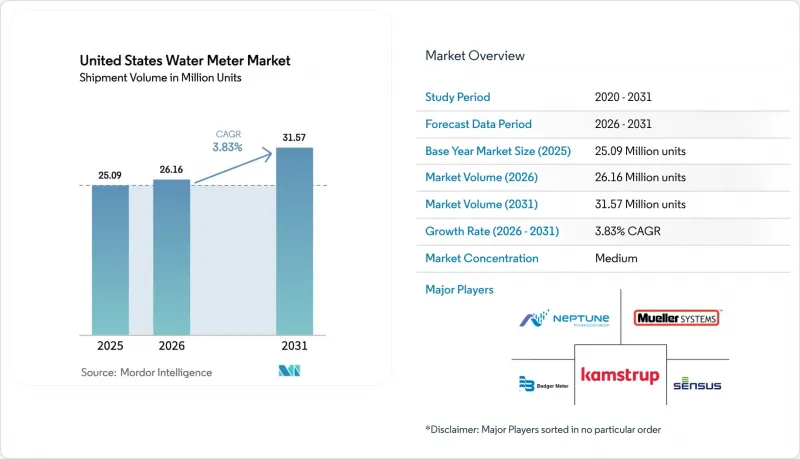
This report is Segmented by Meter Type (Smart Water Meter, Mechanical and Basic Meter, and More), Communication Technology (AMI, AMR, and More), Network Connectivity (Cellular, PLC and Wired, and More), End-User Sector (Residential, Commercial, Industrial, and More), Utility Size Tier (Tier-1, Tier-2, and Tier-3), and Geography. The Market Forecasts are Provided in Terms of Volume (Units).
United States Water Meter Market Trends and Insights
Federal IIJA Grants Accelerating AMI Roll-Outs
IIJA allocates roughly USD 50 billion to water infrastructure, now explicitly covering cybersecurity and AMI expenditures. The funding removes the staggered, decade-long rollout model that utilities once adopted and instead enables full-system deployments in a single bond cycle. Disadvantaged communities qualify for principal forgiveness, yet complex application paperwork rewards the larger utilities that maintain grant-writing teams, perpetuating a scale advantage. Bureau of Reclamation WaterSMART grants add performance incentives that tie disbursements to measured reductions in non-revenue water. Consequently, project scopes increasingly bundle meters, pipe replacement, and cybersecurity in one capital plan, accelerating adoption and lifting the United States water meter market.
Tightening State Conservation Mandates on Non-Revenue Water
California's "Making Conservation a California Way of Life" regulation introduces firm timelines for dedicated irrigation meters, listing AMI as an approved compliance technology. Arizona groundwater management areas, Texas annual water-loss audits, and emerging Florida rules build similar enforcement frameworks that reference minimum read frequencies and data-accuracy classes only AMI can meet. Utilities that fail to comply risk enforcement actions and curtailed access to state funding, compressing their decision window to under two years in many jurisdictions. Because Western drought conditions amplify public scrutiny, political backing for stringent mandates remains strong, cementing a long-run uplift for the United States water meter market.
Up-Front CAPEX Pressure on Tier-3 Utilities
Systems with fewer than 45,000 connections pay 30-50% more per endpoint because network infrastructure costs are spread over a smaller base. Revolving-fund loans charge low interest, but the paperwork demands asset-management plans, environmental studies, and board approvals that many eight-person utilities cannot deliver. Vendors respond with 15-20-year metering-as-a-service contracts that remove the initial check but result in higher lifetime payments and long-term lock-in. Where federal principal-forgiveness grants are available, small utilities often lack staff to capture them, making financing the primary hand-brake on United States water meter market adoption in rural pockets.
Other drivers and restraints analyzed in the detailed report include:
- 5G RedCap and NB-IoT Penetration Extending Rural Coverage
- Aging Meter Fleet Triggering 15-Year Replacement Cycle
- Semiconductor Supply Volatility for Ultrasonic Meter ICs
For complete list of drivers and restraints, kindly check the Table Of Contents.
Segment Analysis
Mechanical models account for 63.84% of 2025 deployments, underpinned by a vast legacy base still read manually or via drive-by systems. Yet utilities increasingly install static smart meters when the old mechanical units reach end-of-life because every percentage point of under-registration directly erodes revenue. Ultrasonic meters deliver high-resolution leak detection at low flow, a capability publicized by early adopters such as Publiacqua, which chose Intelis wSource to exceed MID R1000 accuracy standards. Over 2026-2031, smart water meter shipments are forecast to outpace total market growth, lifting their United States water meter market share by several points. Mechanical options will cling to cost-sensitive residential retrofits through 2027, but static technology's maintenance savings and data granularity eventually outweigh higher upfront prices.
The vendor landscape is moving in step. Badger Meter reported record utility revenue in Q3-2024 on the back of AMI demand, while Neptune's software-defined R900 Gateway v4 lets cities upgrade from AMR to AMI without stranding prior investments. Such backward compatibility accelerates decision making for councils wary of sunk costs, reinforcing the gradual but decisive tilt from mechanical to ultrasonic and electromagnetic platforms in the United States water meter market.
One-way Automated Meter Reading (AMR) still represented 56.91% of 2025 endpoints, a legacy of early-2000s drive-by deployments. However, almost every new procurement now specifies two-way capability for remote disconnect, firmware updates, and hourly interval data. Utilities from Minnesota's Anoka Municipal to Florida's Orange County have budgeted full AMI conversions starting in 2025, replacing or overlaying AMR modules with networked endpoints that stream data to customer portals. As procurement shifts, AMI's share of the United States water meter market size is set to rise steadily, aided by IIJA grants that favor projects delivering cybersecurity and conservation outcomes.
AMI also future-proofs utilities against forthcoming conservation rules that demand rapid leak alerts and customer engagement. Because AMR cannot meet these latency and data-volume thresholds, the installed base will continue to migrate to AMI through swap-outs and overlay networks. Consequently, AMI is expected to dominate new installations within two years, relegating AMR to a shrinking portion of the installed base that will be phased out with the next replacement cycle.
Complete Report Scope:
- By Meter Type
- Smart Water Meter
- Mechanical and Basic Meter
- Ultrasonic Meter
- Electromagnetic Meter
- By Communication Technology
- Advanced Metering Infrastructure (AMI)
- Automated Meter Reading (AMR)
- Manual and Walk-by
- By Network Connectivity
- Cellular (LTE-M / NB-IoT / 5G RedCap)
- RF-Mesh 900 MHz
- PLC and Wired
- LoRaWAN
- By End-User Sector
- Residential
- Commercial
- Industrial
- Municipal Utilities
- By Utility Size Tier
- Tier-1 (Above 400 k connections)
- Tier-2 (45 k - 400 k)
- Tier-3 (<Less than 45 k)
- Badger Meter Inc.
- Sensus USA Inc.
- Neptune Technology Group Inc.
- Mueller Systems LLC
- Kamstrup Water Metering LLC
- Diehl Metering LLC USA
- Itron Inc.
- Aclara Technologies LLC
- Landis+Gyr Technology Inc.
- Master Meter Inc.
- Zenner USA Inc.
- Metron-Farnier LLC
- Carlon Meter Inc.
- Elster AMCO Water LLC
- Datamatic Inc.
- Spire Metering Technology LLC
- Arad Technologies USA Inc.
- Honeywell International Inc.
- Xylem Inc.
- B Meters USA Inc.
- Trimble Water Inc.
- SmartCover Systems Inc.
Additional Benefits:
- The market estimate (ME) sheet in Excel format
- 3 months of analyst support
TABLE OF CONTENTS
1 INTRODUCTION
- 1.1 Study Assumptions and Market Definition
- 1.2 Scope of the Study
2 RESEARCH METHODOLOGY
3 EXECUTIVE SUMMARY
4 MARKET LANDSCAPE
- 4.1 Market Overview
- 4.2 Market Drivers
- 4.2.1 Federal IIJA Grants Accelerating AMI Roll-outs
- 4.2.2 Tightening State Conservation Mandates on Non-Revenue Water
- 4.2.3 5G RedCap and NB-IoT Penetration Extending Rural Coverage
- 4.2.4 Aging Meter Fleet Triggering 15-Year Replacement Cycle
- 4.2.5 Utility Shift Toward Subscription "Metering-as-a-Service" Models
- 4.2.6 ESG-Linked Municipal Bond Financing Boosting Smart Projects
- 4.3 Market Restraints
- 4.3.1 Up-Front CAPEX Pressure on Tier-3 Utilities
- 4.3.2 Semiconductor Supply Volatility for Ultrasonic Meter ICs
- 4.3.3 Rising Cyber-Insurance Premiums for Utilities
- 4.3.4 Analytics Workforce Skill Gap Inside Small Utilities
- 4.4 Industry Value Chain Analysis
- 4.5 Regulatory Landscape
- 4.6 Technological Outlook
- 4.7 Porter's Five Forces Analysis
- 4.7.1 Bargaining Power of Suppliers
- 4.7.2 Bargaining Power of Buyers
- 4.7.3 Threat of New Entrants
- 4.7.4 Threat of Substitutes
- 4.7.5 Degree of Competition
- 4.8 Impact of Macroeconomic Factors on the Market
5 MARKET SIZE AND GROWTH FORECASTS (VOLUME)
- 5.1 By Meter Type
- 5.1.1 Smart Water Meter
- 5.1.2 Mechanical and Basic Meter
- 5.1.3 Ultrasonic Meter
- 5.1.4 Electromagnetic Meter
- 5.2 By Communication Technology
- 5.2.1 Advanced Metering Infrastructure (AMI)
- 5.2.2 Automated Meter Reading (AMR)
- 5.2.3 Manual and Walk-by
- 5.3 By Network Connectivity
- 5.3.1 Cellular (LTE-M / NB-IoT / 5G RedCap)
- 5.3.2 RF-Mesh 900 MHz
- 5.3.3 PLC and Wired
- 5.3.4 LoRaWAN
- 5.4 By End-User Sector
- 5.4.1 Residential
- 5.4.2 Commercial
- 5.4.3 Industrial
- 5.4.4 Municipal Utilities
- 5.5 By Utility Size Tier
- 5.5.1 Tier-1 (Above 400 k connections)
- 5.5.2 Tier-2 (45 k - 400 k)
- 5.5.3 Tier-3 (<Less than 45 k)
6 COMPETITIVE LANDSCAPE
- 6.1 Market Concentration
- 6.2 Strategic Moves
- 6.3 Market Share Analysis
- 6.4 Company Profiles (includes Global Level Overview, Market Level Overview, Core Segments, Financials as available, Strategic Information, Market Rank/Share, Products and Services, Recent Developments)
- 6.4.1 Badger Meter Inc.
- 6.4.2 Sensus USA Inc.
- 6.4.3 Neptune Technology Group Inc.
- 6.4.4 Mueller Systems LLC
- 6.4.5 Kamstrup Water Metering LLC
- 6.4.6 Diehl Metering LLC USA
- 6.4.7 Itron Inc.
- 6.4.8 Aclara Technologies LLC
- 6.4.9 Landis+Gyr Technology Inc.
- 6.4.10 Master Meter Inc.
- 6.4.11 Zenner USA Inc.
- 6.4.12 Metron-Farnier LLC
- 6.4.13 Carlon Meter Inc.
- 6.4.14 Elster AMCO Water LLC
- 6.4.15 Datamatic Inc.
- 6.4.16 Spire Metering Technology LLC
- 6.4.17 Arad Technologies USA Inc.
- 6.4.18 Honeywell International Inc.
- 6.4.19 Xylem Inc.
- 6.4.20 B Meters USA Inc.
- 6.4.21 Trimble Water Inc.
- 6.4.22 SmartCover Systems Inc.
7 MARKET OPPORTUNITIES AND FUTURE OUTLOOK
- 7.1 White-Space and Unmet-Need Assessment

