PUBLISHER: Mordor Intelligence | PRODUCT CODE: 2125280

PUBLISHER: Mordor Intelligence | PRODUCT CODE: 2125280
Europe Customs Brokerage - Market Share Analysis, Industry Trends & Statistics, Growth Forecasts (2026 - 2031)
According to Mordor Intelligence, the Europe customs brokerage market size was valued at USD 28.80 billion in 2025 and estimated to grow from USD 30.37 billion in 2026 to reach USD 39.61 billion by 2031, at a CAGR of 5.45% during the forecast period (2026-2031).
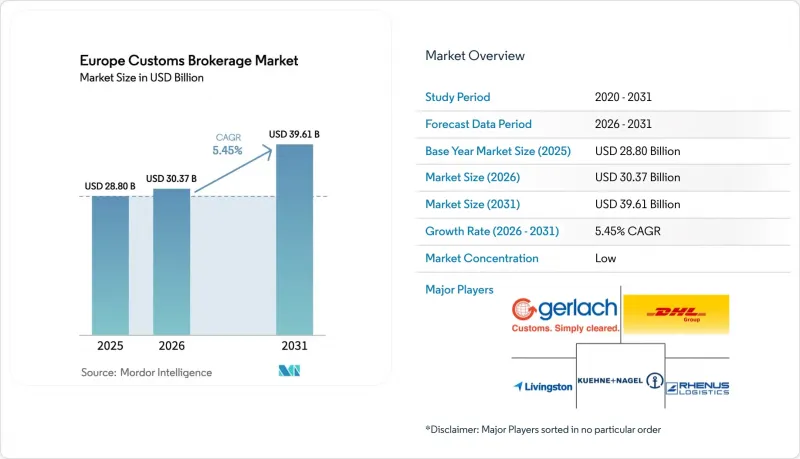
This report is Segmented by Mode of Transport (Ocean/Sea, Air Express and General Cargo, Cross-Border Land Truck and Rail), Broker Type (Pure Customs Broker, and More), Importer Size (Large Enterprises, and More), Digital Adoption (Traditional Brokerages, and More), End-Use Industry (Retail and E-Commerce, and More), and Geography. The Market Forecasts are Provided in Terms of Value (USD).
Europe Customs Brokerage Market Trends and Insights
Post-Brexit Surge in Customs Declarations
The United Kingdom's departure from the EU triggered a multi-fold rise in declaration volumes, driving sustained demand for brokerage expertise. New rules of origin checks, risk-based sanitary controls under the Border Target Operating Model, and Northern Ireland's Windsor Framework two-lane system have multiplied document touchpoints per shipment. Specialized brokers now package consulting, data validation, and automated audit trails to help traders avoid duty misclassification penalties. Integrated providers are embedding API links to HMRC's Customs Declaration Service, cutting processing time and reducing manual errors. As UK-EU traffic normalizes, complexity rather than sheer volume will sustain brokerage revenue, ensuring the Europe customs brokerage market continues to rely on human expertise for high-risk commodities.
E-Commerce-Driven Rise in Low-Value Import Clearances
Elimination of the EUR 22 de minimis threshold and the mandatory IOSS regime shifted VAT collection to the point-of-sale, compelling platforms and sellers to integrate customs workflows. Brokers with robust IT interfaces are onboarding marketplaces that ship thousands of daily parcels into Germany and the Netherlands. Parcel operators leverage network reach, yet niche brokers gain share by offering rule-based product classification, dynamic VAT calculation, and automated returns documentation. The Europe customs brokerage market is therefore witnessing intensified competition, with technology literacy overtaking scale as the main differentiator in B2C clearances.
Geopolitical Trade Disruptions in EU Border Corridors
Conflict-driven rerouting from the Northern route to the Middle Corridor has increased transit times and customs congestion at Turkish, Georgian, and Kazakh borders. Brokers face volatile regulatory environments, currency swings, and emerging sanctions checks, which collectively raise processing costs. Automotive and electronics importers in Germany confront uncertainty incompatible with just-in-time norms, thereby dampening shipment volumes. The resulting unpredictability restrains the Europe customs brokerage market's short-term growth.
Other drivers and restraints analyzed in the detailed report include:
- EU Customs Reform 2028 Data-Hub Roll-Out
- AI-Based HS-Code Classification Adoption
- EU Customs-Talent Shortages and Ageing Workforce
For complete list of drivers and restraints, kindly check the Table Of Contents.
Segment Analysis
Ocean/sea services owned 41.55% of the Europe customs brokerage market in 2025, mirroring Europe's heavy reliance on Asian imports through Rotterdam, Hamburg, and Antwerp. Port-centric brokers generate premium revenue by managing intricate documentation for automotive components, electronics, and industrial machinery. Cross-border land services are forecast to grow at a 4.62% CAGR, benefiting from factory relocations into Poland and Romania that shorten supply routes. Tightened truck security checks and the digitalization of road transit procedures encourage brokers to integrate e-TIR and NCTS-Phase 5 modules, reinforcing land-mode relevance. Over the forecast horizon, Europe customs brokerage market momentum will hinge on synchronized port-to-inland digital corridors that balance sea dominance with growing intra-European trucking flows.
Freight forwarder/3PL-integrated brokers captured 50.40% of 2025 revenue as shippers gravitated toward single-provider logistics solutions. Their technology budgets, global network reach, and ability to bundle warehousing create formidable entry barriers. Traditional pure brokers defend share through niche expertise in pharmaceutical imports, dual-use goods, and AEO consultancy. The Europe customs brokerage market size for integrated brokers is set to compound at 4.26% CAGR, but pure specialists still attract clients needing tailored compliance. As mega-deals such as DSV's USD 15.9 billion acquisition of DB Schenker close, competitive intensity will pivot on advisory depth rather than freight capacity.
Complete Report Scope:
- By Mode of Transport
- Ocean / Sea
- Air (Express and General Cargo)
- Cross-Border Land (Truck and Rail)
- By Broker Type
- Pure Customs Broker
- Freight Forwarder / 3PL-Integrated Brokers
- By Importer Size
- Large Enterprisess
- Mid-Market
- SMEs / Micro-shippers
- By Digital Adoption
- Traditional Brokerages
- Digital-first / API-based Brokerages
- By End-Use Industry
- Retail and E-commerce
- Automotive and EV
- Electronics and Semiconductors
- Pharmaceuticals and Life Sciences
- Aerospace and Defense
- Chemicals and Industrial Goods
- Others
- By Country
- Germany
- United Kingdom
- France
- Netherlands
- Italy
- Spain
- Poland
- Rest of Europe
List of Companies Covered in this Report:
- Livingston International
- DHL Group
- Kuehne + Nagel
- Rhenus Logistics
- Gerlach Customs
- APL Logistics
- DSV
- Gaston Schul Logistics
- C.H. Robinson
- Expeditors International
- Customs Support Group
- Dimerco Express
- UPS
- FedEx
- Geodis
- TIBA Group
- RHA Customs Brokerage
- Partida Logistics
- EFL Global
- ITG Air and Sea
Additional Benefits:
- The market estimate (ME) sheet in Excel format
- 3 months of analyst support
TABLE OF CONTENTS
1 Introduction
- 1.1 Study Assumptions and Market Definition
- 1.2 Scope of the Study
2 Research Methodology
3 Executive Summary
4 Market Landscape
- 4.1 Market Overview
- 4.2 Market Drivers
- 4.2.1 Post-Brexit surge in customs declarations
- 4.2.2 E-commerce-driven rise in low-value import clearances
- 4.2.3 EU Customs Reform 2028 data-hub roll-out
- 4.2.4 AI-based HS-code classification adoption
- 4.2.5 Near-shoring to Eastern Europe boosting cross-border volumes
- 4.2.6 Tightening dual-use export-control compliance
- 4.3 Market Restraints
- 4.3.1 Geopolitical trade disruptions in EU border corridors
- 4.3.2 EU customs-talent shortages and ageing workforce
- 4.3.3 Rising IT and automation fee burden on small brokers
- 4.3.4 Parcel operators cannibalising low-value clearances
- 4.4 Value / Supply-Chain Analysis
- 4.5 Regulatory Landscape
- 4.6 Technological Outlook
- 4.7 Impact of COVID-19 and Geo-Political
- 4.8 Porter's Five Forces
- 4.8.1 Bargaining Power of Suppliers
- 4.8.2 Bargaining Power of Consumers
- 4.8.3 Threat of New Entrants
- 4.8.4 Threat of Substitutes
- 4.8.5 Intensity of Competitive Rivalry
5 Market Size and Growth Forecasts (Value)
- 5.1 By Mode of Transport
- 5.1.1 Ocean / Sea
- 5.1.2 Air (Express and General Cargo)
- 5.1.3 Cross-Border Land (Truck and Rail)
- 5.2 By Broker Type
- 5.2.1 Pure Customs Broker
- 5.2.2 Freight Forwarder / 3PL-Integrated Brokers
- 5.3 By Importer Size
- 5.3.1 Large Enterprisess
- 5.3.2 Mid-Market
- 5.3.3 SMEs / Micro-shippers
- 5.4 By Digital Adoption
- 5.4.1 Traditional Brokerages
- 5.4.2 Digital-first / API-based Brokerages
- 5.5 By End-Use Industry
- 5.5.1 Retail and E-commerce
- 5.5.2 Automotive and EV
- 5.5.3 Electronics and Semiconductors
- 5.5.4 Pharmaceuticals and Life Sciences
- 5.5.5 Aerospace and Defense
- 5.5.6 Chemicals and Industrial Goods
- 5.5.7 Others
- 5.6 By Country
- 5.6.1 Germany
- 5.6.2 United Kingdom
- 5.6.3 France
- 5.6.4 Netherlands
- 5.6.5 Italy
- 5.6.6 Spain
- 5.6.7 Poland
- 5.6.8 Rest of Europe
6 Competitive Landscape
- 6.1 Market Concentration
- 6.2 Strategic Moves
- 6.3 Market Share Analysis
- 6.4 Company Profiles (includes Global level Overview, Market level overview, Core Segments, Financials as available, Strategic Information, Market Rank/Share, Products and Services, Recent Developments)
- 6.4.1 Livingston International
- 6.4.2 DHL Group
- 6.4.3 Kuehne + Nagel
- 6.4.4 Rhenus Logistics
- 6.4.5 Gerlach Customs
- 6.4.6 APL Logistics
- 6.4.7 DSV
- 6.4.8 Gaston Schul Logistics
- 6.4.9 C.H. Robinson
- 6.4.10 Expeditors International
- 6.4.11 Customs Support Group
- 6.4.12 Dimerco Express
- 6.4.13 UPS
- 6.4.14 FedEx
- 6.4.15 Geodis
- 6.4.16 TIBA Group
- 6.4.17 RHA Customs Brokerage
- 6.4.18 Partida Logistics
- 6.4.19 EFL Global
- 6.4.20 ITG Air and Sea
7 Market Opportunities and Future Outlook
- 7.1 White-space and Unmet-Need Assessment

