PUBLISHER: Mordor Intelligence | PRODUCT CODE: 2125282

PUBLISHER: Mordor Intelligence | PRODUCT CODE: 2125282
Europe Alternating Current (AC) Motor - Market Share Analysis, Industry Trends & Statistics, Growth Forecasts (2026 - 2031)
According to Mordor Intelligence, the Europe alternating current motor market size is expected to grow from USD 24.6 billion in 2025 to USD 26.29 billion in 2026 and is forecast to reach USD 36.66 billion by 2031 at 6.85% CAGR over 2026-2031.
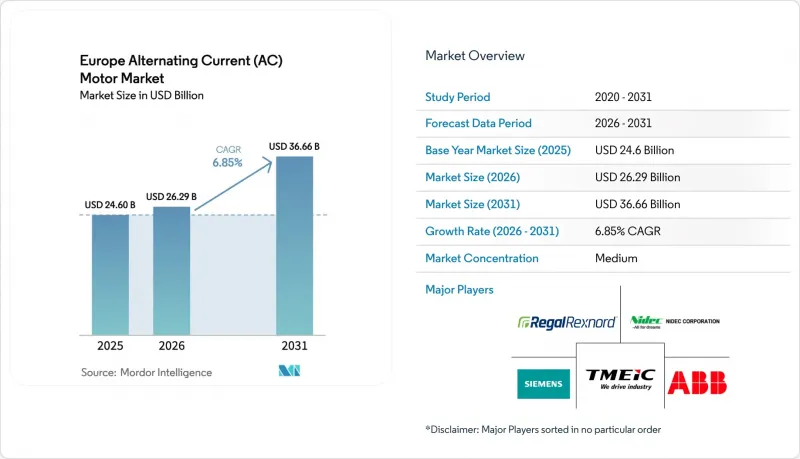
This report is Segmented by Type (Induction AC Motors, and Synchronous AC Motors), Power Rating (less Than 1 KW, 1-100 KW, and More), Voltage Class (Low Voltage, Medium Voltage, High Voltage), End-User Industry (Oil and Gas, Chemical and Petrochemical, Power Generation, Water and Wastewater, Metal and Mining, and More), and Geography. The Market Forecasts are Provided in Terms of Value (USD).
Europe Alternating Current (AC) Motor Market Trends and Insights
Accelerating Industrial Automation and IoT Adoption
European factories are incorporating smart drives that collect data on vibration, temperature, and load to enable predictive maintenance and optimize line changeovers. Early projects report double-digit energy savings and sub-four-year paybacks as asset performance systems shift from fixed-speed to variable-speed regimes supported by edge computing nodes. German automotive suppliers have led pilot deployments, specifying Ethernet-ready IE5 platforms that publish diagnostic tags directly to manufacturing execution systems for real-time quality loops. The Europe alternating current motor market benefits from the resulting replacement cycle for legacy induction units with sensor-rich, firmware-upgradable models. Tier-one vendors are responding with subscription-based analytics modules that bundle hardware, firmware, and artificial-intelligence monitoring in a single service contract.
Stringent Energy-Efficiency Regulations for Electric Motors
EU Regulation 2019/1781 elevated the minimum requirement for three-phase motors above 0.75 kW to IE3 and extended coverage to submersible and close-coupled configurations. Penalties for non-compliance, enforced through national surveillance authorities, have accelerated retrofit programs across chemical, food, and building services sites. Suppliers now differentiate on IE4 and IE5 lines marketed as "future-proof," while installers promote pay-per-savings contracting that sidesteps upfront capital hurdles. Certification-ready testing labs offer fast-track conformity assessments, giving domestically rooted brands an edge in the Europe alternating current motor market.
High Initial Procurement and Installation Costs
Premium IE4-plus motors cost 20-40% more than standard units, and the prerequisite variable-frequency drives can double a project's hardware bill. Retrofitting drives often necessitate switchboard upgrades, harmonic filters, and mechanical realignment, which can stretch payback models for small enterprises operating on tight margins. Energy-performance contracting mitigates sticker shock by spreading payments across multiple savings streams, but adoption remains uneven outside blue-chip industries. Until financing models mature, upfront economics will temper the pace at which the Europe alternating current motor market converts its installed base.
Other drivers and restraints analyzed in the detailed report include:
- Expansion of HVAC and Refrigeration Infrastructure
- Revival of Automotive Manufacturing and EV Powertrain Demand
- Rising Raw-Material Price Volatility (Copper, Rare Earths)
For complete list of drivers and restraints, kindly check the Table Of Contents.
Segment Analysis
Synchronous units controlled 27.32% of 2025 revenue yet are forecast for the highest 8.67% CAGR because precise torque response, low acoustic signature, and rising spindle-speed requirements outweigh higher capital costs in machine-tool, hydrogen, and HVAC drives. Integrated motor-drive packages that auto-tune power factors boost line-level efficiency and enable full-torque zero-speed starts that induction machines cannot match.
Induction units defend baseline duties such as fans, pumps, and conveyors thanks to their ruggedness and commoditized repair ecosystem. However, regulatory tightening, combined with predictive-maintenance preferences, is steadily redirecting orders to synchronous alternatives in the Europe alternating current motor market. ABB's MV Titanium concept, which embeds a medium-voltage inverter within the motor frame, illustrates how synchronous architectures are converging mechanical and electronic components to lower total ownership cost.
Sub-1 kW models dominate the volumes, accounting for 37.02% of the Europe alternating current motor market size in 2025. Yet the 101-500 kW slice is the fastest climber, expanding at 8.29% CAGR as cement, steel, and chemical sites electrify mechanical drives formerly powered by steam or hydraulics. Operators appreciate the ability to curtail idle loads through variable-torque algorithms and to synchronize multi-megawatt compressors directly with plant-wide energy-management systems.
In parallel, packages exceeding 500 kW win replacement business in legacy cogeneration plants and pumped-storage facilities, although growth is steadier due to longer project cycles. The power-rating spectrum, therefore, mirrors Europe's industrial makeup, with mid-sized sites modernizing toward net-zero objectives.
Complete Report Scope:
- By Type
- Induction AC Motors
- Single Phase
- Poly Phase
- Synchronous AC Motors
- DC Excited Rotor
- Permanent Magnet
- Hysteresis Motor
- Reluctance Motor
- Induction AC Motors
- By Power Rating
- less than 1 kW
- 1-100 kW
- 101-500 kW
- above 500 kW
- By Voltage Class
- Low Voltage (<1 kV)
- Medium Voltage (1-6 kV)
- High Voltage (>6 kV)
- By End-user Industry
- Oil and Gas
- Chemical and Petrochemical
- Power Generation
- Water and Wastewater
- Metal and Mining
- Food and Beverage
- Discrete Industries
- Other End-user Industries
- By Country
- United Kingdom
- Germany
- Italy
- France
- Russia
- Rest of Europe
List of Companies Covered in this Report:
- ABB Ltd.
- Siemens AG
- Nidec Corporation
- Regal Rexnord Corporation
- Toshiba Mitsubishi-Electric Industrial Systems Corporation
- WEG S.A.
- Leroy-Somer SAS
- Brook Crompton UK Ltd.
- Nord Drivesystems Group
- Bonfiglioli S.p.A.
- SEW-Eurodrive GmbH and Co KG
- TECO Electric Machinery Co., Ltd.
- VEM Gruppe
- Cantoni Group
- Wolong Electric Group Co., Ltd.
- Lafert Group
- Oemer S.p.A.
- Hoyer Motors A/S
- ZF Friedrichshafen AG
- Johnson Electric Holdings Limited
Additional Benefits:
- The market estimate (ME) sheet in Excel format
- 3 months of analyst support
TABLE OF CONTENTS
1 INTRODUCTION
- 1.1 Study Assumptions and Market Definition
- 1.2 Scope of the Study
2 RESEARCH METHODOLOGY
3 EXECUTIVE SUMMARY
4 MARKET LANDSCAPE
- 4.1 Market Overview
- 4.2 Market Drivers
- 4.2.1 Accelerating Industrial Automation and IoT Adoption
- 4.2.2 Stringent Energy Efficiency Regulations for Electric Motors
- 4.2.3 Expansion of HVAC and Refrigeration Infrastructure
- 4.2.4 Revival of Automotive Manufacturing and EV Powertrain Demand
- 4.2.5 Growing Adoption of High-Frequency Spindle Motors in European Machine Tool Re-shoring
- 4.2.6 Emergence of Hydrogen Electrolyzer Projects Requiring Large Synchronous Motors
- 4.3 Market Restraints
- 4.3.1 High Initial Procurement and Installation Costs
- 4.3.2 Rising Raw Material Prices Volatility (Copper, Rare Earths)
- 4.3.3 Competitive Pressure from Permanent Magnet DC and Servo Drives
- 4.3.4 Supply Chain Tightness in Insulated Lamination Steel for High-Efficiency Motors
- 4.4 Industry Value Chain Analysis
- 4.5 Impact of Macroeconomic Factors
- 4.6 Technological Outlook
- 4.7 Regulatory Landscape
- 4.8 Porter's Five Forces Analysis
- 4.8.1 Bargaining Power of Suppliers
- 4.8.2 Bargaining Power of Buyers / Consumers
- 4.8.3 Threat of New Entrants
- 4.8.4 Threat of Substitutes
- 4.8.5 Intensity of Competitive Rivalry
5 MARKET SIZE AND GROWTH FORECASTS (VALUE)
- 5.1 By Type
- 5.1.1 Induction AC Motors
- 5.1.1.1 Single Phase
- 5.1.1.2 Poly Phase
- 5.1.2 Synchronous AC Motors
- 5.1.2.1 DC Excited Rotor
- 5.1.2.2 Permanent Magnet
- 5.1.2.3 Hysteresis Motor
- 5.1.2.4 Reluctance Motor
- 5.1.1 Induction AC Motors
- 5.2 By Power Rating
- 5.2.1 less than 1 kW
- 5.2.2 1-100 kW
- 5.2.3 101-500 kW
- 5.2.4 above 500 kW
- 5.3 By Voltage Class
- 5.3.1 Low Voltage (<1 kV)
- 5.3.2 Medium Voltage (1-6 kV)
- 5.3.3 High Voltage (>6 kV)
- 5.4 By End-user Industry
- 5.4.1 Oil and Gas
- 5.4.2 Chemical and Petrochemical
- 5.4.3 Power Generation
- 5.4.4 Water and Wastewater
- 5.4.5 Metal and Mining
- 5.4.6 Food and Beverage
- 5.4.7 Discrete Industries
- 5.4.8 Other End-user Industries
- 5.5 By Country
- 5.5.1 United Kingdom
- 5.5.2 Germany
- 5.5.3 Italy
- 5.5.4 France
- 5.5.5 Russia
- 5.5.6 Rest of Europe
6 COMPETITIVE LANDSCAPE
- 6.1 Market Concentration
- 6.2 Strategic Moves
- 6.3 Market Share Analysis
- 6.4 Company Profiles (includes Global level Overview, Market level overview, Core Segments, Financials as available, Strategic Information, Market Rank/Share for key companies, Products and Services, and Recent Developments)
- 6.4.1 ABB Ltd.
- 6.4.2 Siemens AG
- 6.4.3 Nidec Corporation
- 6.4.4 Regal Rexnord Corporation
- 6.4.5 Toshiba Mitsubishi-Electric Industrial Systems Corporation
- 6.4.6 WEG S.A.
- 6.4.7 Leroy-Somer SAS
- 6.4.8 Brook Crompton UK Ltd.
- 6.4.9 Nord Drivesystems Group
- 6.4.10 Bonfiglioli S.p.A.
- 6.4.11 SEW-Eurodrive GmbH and Co KG
- 6.4.12 TECO Electric Machinery Co., Ltd.
- 6.4.13 VEM Gruppe
- 6.4.14 Cantoni Group
- 6.4.15 Wolong Electric Group Co., Ltd.
- 6.4.16 Lafert Group
- 6.4.17 Oemer S.p.A.
- 6.4.18 Hoyer Motors A/S
- 6.4.19 ZF Friedrichshafen AG
- 6.4.20 Johnson Electric Holdings Limited
7 MARKET OPPORTUNITIES AND FUTURE OUTLOOK

