PUBLISHER: Mordor Intelligence | PRODUCT CODE: 2125302

PUBLISHER: Mordor Intelligence | PRODUCT CODE: 2125302
Alternating Current (AC) Motor - Market Share Analysis, Industry Trends & Statistics, Growth Forecasts (2026 - 2031)
According to Mordor Intelligence, the alternating current motor market size is projected to expand from USD 18.23 billion in 2025 and USD 18.89 billion in 2026 to USD 22.24 billion by 2031, registering a CAGR of 3.32% between 2026 to 2031.
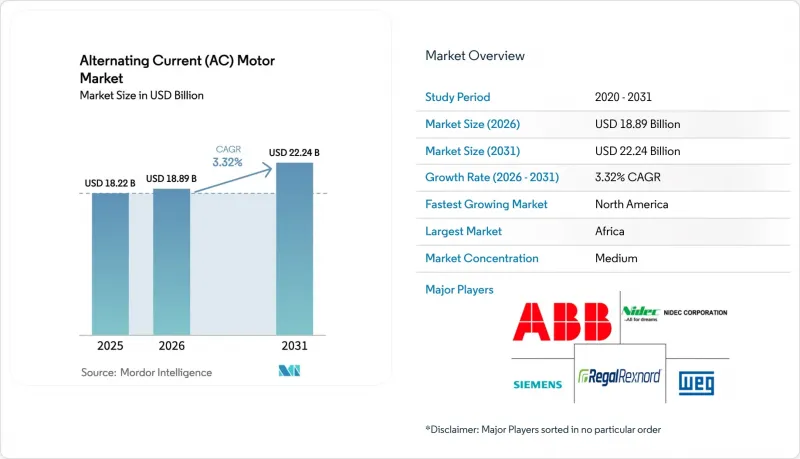
This report is Segmented by Motor Type (Induction AC Motors, and Synchronous AC Motors), Voltage Class (Low Voltage, Medium Voltage, and High Voltage), Power Rating (less Than 1 KW, 1 To 100 KW, and More), Efficiency Class (IE1, IE2, and More), End-User Industry (Oil and Gas, Chemicals, Power Generation, and More), and Geography. The Market Forecasts are Provided in Terms of Value (USD).
Global Alternating Current (AC) Motor Market Trends and Insights
Mandatory Energy-Efficiency Regulations Drive Accelerated Replacement Cycles
IE4 rules are now obligatory for motors above 0.75 kilowatts in the European Union, and IE3 minimums in China, the United States, and India are triggering early retirement of legacy IE1-IE2 fleets. Compliance converges global product lines on super-premium platforms, favoring suppliers with scale manufacturing and harmonized certifications. For end users, a 75-kilowatt IE4 motor running 7,000 hours per year saves close to USD 1,200 in electricity costs, recovering the upfront price delta in under 3 years. Utilities and process industries that spend 60% or more of their operating budgets on motor power are therefore locking in multi-year procurement pipelines. As a result, the alternating current (AC) motor market is witnessing a structural pivot toward higher-efficiency design as the regulatory floor continues to rise.
Rapid Industrial Automation and Robotics Uptake Reshapes Motor Demand
Global robot installations topped 540,000 units in 2024, embedding millions of permanent-magnet servo motors with sub-millisecond positional accuracy. Automotive and electronics assembly lines are shifting from pneumatic cylinders to servo actuation, cutting cycle times by more than 15% and energy draw by up to 50%. Collaborative-robot deployments are scaling fastest, requiring low-inertia frameless motors capable of a 10-millisecond safe-stop response. Warehouse automation adds further pull, with each autonomous mobile robot containing multiple small AC drives. Concentrated adoption in China, South Korea, and Japan ensures that Asia-Pacific remains the volume anchor of the alternating current (AC) motor market.
Copper and Rare-Earth Volatility Compresses Margins and Delays Orders
Copper traded between USD 8,000 and USD 10,500 per metric ton during 2024-2025, eroding the profitability of fixed-price contracts and prompting vendors to shorten quote validity to less than 30 days. Neodymium-iron-boron magnet prices rose 12-18% on tighter Chinese export quotas, raising material cost in permanent-magnet motors by up to USD 120 for a 20-kilowatt unit. In price-sensitive markets, buyers are back-specifying IE3 induction motors to sidestep rare-earth exposure, slowing the premium-efficiency trajectory of the alternating current (AC) motor market. Manufacturers are exploring ferrite-magnet or copper-rotor alternatives, but these options sacrifice torque density and complicate thermal design.
Other drivers and restraints analyzed in the detailed report include:
- Expansion of Renewable-Energy Assets Multiplies Auxiliary-Motor Demand
- HVAC/R Build-Out in Commercial Real Estate Sustains Baseline Growth
- High Upfront Cost of Premium-Efficiency Motors Limits Penetration in Capital-Constrained Segments
For complete list of drivers and restraints, kindly check the Table Of Contents.
Segment Analysis
Induction AC motors led the alternating current (AC) motor market in 2025 with a 67.23% revenue share, underpinned by their rugged construction and low maintenance needs. They dominate pumps, fans, and conveyors that run across every industrial floor. Synchronous technology, although smaller in volume, is advancing at a 3.68% CAGR because permanent-magnet rotors add up to four percentage points of efficiency at full load. Robot builders, machine-tool makers, and electric-vehicle OEMs now specify synchronous drives for the tight torque response and compact frames that magnets enable.
Policy pressure is amplifying the shift. IE4 rules in the European Union and proposed U.S. mandates for IE4 reward synchronous adopters, prompting global OEMs to harmonize product lines and streamline inventory. Minerals processors are pairing megawatt-class synchronous motors with medium-voltage silicon-carbide drives, trimming electrical losses and switchgear footprints IEC.CH. As life-cycle analyses place a premium on kilowatt-hour savings, the alternating current (AC) motor market size is likely to tilt further toward synchronous formats through the decade.
Low-voltage motors below 1 kV captured 84.23% of 2025 revenue, reflecting their ubiquity in HVAC, food processing, and packaging. Variable-frequency drives coupled to these units allow soft starts and energy-saving speed control. Medium-voltage platforms between 1 kV and 11 kV are, however, the fastest risers at a 3.89% CAGR, as oil, gas, and metals operators consolidate several low-voltage feeders into single high-horsepower shafts, slicing copper mass by as much as 30% per installation.
Efficiency mandates currently stop at 1 kV, giving project owners latitude to negotiate bespoke performance benchmarks that favor vendors able to verify field efficiency through digital twins. Silicon-carbide power devices now featured in 6.6 kV and 11 kV drives cut switching losses by half, enabling smaller heat sinks and cabinets. These space and energy benefits dovetail with refinery, LNG, and desalination megaprojects in the Middle East and Asia, cementing medium-voltage as a strategic growth segment of the alternating current (AC) motor market.
Complete Report Scope:
- By Motor Type
- Induction AC Motors
- Single-Phase
- Poly-Phase
- Synchronous AC Motors
- DC-Excited Rotor
- Permanent-Magnet
- Hysteresis
- Reluctance
- Induction AC Motors
- By Voltage Class
- Low Voltage (Less Than 1 kV)
- Medium Voltage (1 to 11 kV)
- High Voltage (More Than 11 kV)
- By Power Rating
- Less Than 1 kW
- 1 to 100 kW
- 100 to 500 kW
- Greater Than 500 kW
- By Efficiency Class
- IE1 (Standard)
- IE2 (High)
- IE3 (Premium)
- IE4 (Super-Premium)
- IE5 (Ultra-Premium)
- By End-User Industry
- Oil and Gas
- Chemicals and Petrochemicals
- Power Generation
- Water and Wastewater
- Metals and Mining
- Food and Beverage
- Discrete Manufacturing
- Other End-User Industries
- By Geography
- North America
- United States
- Canada
- Mexico
- South America
- Brazil
- Argentina
- Rest of South America
- Europe
- Germany
- United Kingdom
- France
- Russia
- Rest of Europe
- Asia-Pacific
- China
- Japan
- India
- South Korea
- Australia
- Rest of Asia-Pacific
- Middle East
- Saudi Arabia
- United Arab Emirates
- Rest of Middle East
- Africa
- South Africa
- Egypt
- Rest of Africa
- North America
Geography Analysis
Asia-Pacific produced 56.41% of global revenue in 2025, headlined by China's domestic output of more than 300 million units. Robot deployment density, 3.8 units per 1,000 workers in South Korea, locks in servo demand, while India's IE3 mandate for motors above 0.75 kW is driving an early replacement wave across textiles and steel. Japan commands premium pricing thanks to the rapid uptake of IE5 frames in precision equipment, and Australia's mining sector relies on >500 kW drives for haulage and crushing, boosting regional value intensity.
North America and Europe together delivered about 35% of 2025 revenue. The United States is mid-cycle on USD 50 billion in water-sector grants, with procurements peaking in 2025-2026, advancing the adoption of IE4 in municipal treatment works. Europe's Ecodesign Regulation 2019/1781 already requires IE4 to be down to 0.12 kW by mid-2025, tightening upgrade timetables for building services and light manufacturing. Germany alone accounted for 28% of European sales as its machinery exporters modernize servo footprints, while the United Kingdom is pivoting toward heat-pump compressors to decarbonize building heating.
Africa is the fastest-growing region, charting a 4.22% CAGR to 2031 on the back of USD 25 billion in African Development Bank electrification projects targeting Egypt, South Africa, and Nigeria. South African mines are retrofitting IE3-IE4 ventilators to curb power costs that exceed 40% of operating expense, and Egypt's planned industrial cities will need tens of thousands of motors for water and HVAC loads. Nigeria's new rail corridor is stimulating cement, food-processing, and textiles clusters. The Middle East adds steady volume from desalination and district-cooling, while South America's growth is anchored by Brazil, where local producer WEG leverages five-week lead times to outsell imports.
- ABB Ltd.
- Siemens AG
- WEG Equipamentos Eletricos S.A.
- Nidec Corporation
- Regal Rexnord Corporation
- Johnson Electric Holdings Limited
- Yaskawa Electric Corporation
- Rockwell Automation, Inc.
- Franklin Electric Co., Inc.
- Bosch Rexroth AG
- Kirloskar Electric Company Ltd.
- SEVA-tec GmbH
- Toshiba Corporation
- Mitsubishi Electric Corporation
- TECO Electric and Machinery Co., Ltd.
- Leroy-Somer Holding (Nidec)
- ATB Austria Antriebstechnik AG
- Getriebebau NORD GmbH and Co. KG
- Oriental Motor Co., Ltd.
- Brook Crompton UK Ltd.
Additional Benefits:
- The market estimate (ME) sheet in Excel format
- 3 months of analyst support
TABLE OF CONTENTS
1 INTRODUCTION
- 1.1 Study Assumptions and Market Definition
- 1.2 Scope of the Study
2 RESEARCH METHODOLOGY
3 EXECUTIVE SUMMARY
4 MARKET LANDSCAPE
- 4.1 Market Overview
- 4.2 Market Drivers
- 4.2.1 Mandatory Energy-Efficiency Regulations (IE3/IE4)
- 4.2.2 Rapid Industrial Automation and Robotics Uptake
- 4.2.3 Expansion of Renewable-Energy Assets (Wind, Solar)
- 4.2.4 HVAC/R Build-Out in Commercial Real Estate
- 4.2.5 Rise of Axial-Flux PM AC Motors in E-Mobility
- 4.2.6 AI-Enabled Predictive-Maintenance Ecosystems
- 4.3 Market Restraints
- 4.3.1 Volatile Copper and Rare-Earth Metal Prices
- 4.3.2 High Upfront Cost of Premium-Efficiency Motors
- 4.3.3 Power-Electronics (IGBT) Supply-Chain Bottlenecks
- 4.3.4 End-of-Life Recycling and Take-Back Compliance
- 4.4 Impact of Macroeconomic Factors on the Market
- 4.5 Industry Value / Supply-Chain Analysis
- 4.6 Regulatory Landscape and Standards
- 4.7 Technological Outlook (Edge and AI Analytics)
- 4.8 Porter's Five Forces Analysis
- 4.8.1 Bargaining Power of Suppliers
- 4.8.2 Bargaining Power of Buyers
- 4.8.3 Threat of New Entrants
- 4.8.4 Threat of Substitutes
- 4.8.5 Degree of Competition
5 MARKET SIZE AND GROWTH FORECASTS (VALUE)
- 5.1 By Motor Type
- 5.1.1 Induction AC Motors
- 5.1.1.1 Single-Phase
- 5.1.1.2 Poly-Phase
- 5.1.2 Synchronous AC Motors
- 5.1.2.1 DC-Excited Rotor
- 5.1.2.2 Permanent-Magnet
- 5.1.2.3 Hysteresis
- 5.1.2.4 Reluctance
- 5.1.1 Induction AC Motors
- 5.2 By Voltage Class
- 5.2.1 Low Voltage (Less Than 1 kV)
- 5.2.2 Medium Voltage (1 to 11 kV)
- 5.2.3 High Voltage (More Than 11 kV)
- 5.3 By Power Rating
- 5.3.1 Less Than 1 kW
- 5.3.2 1 to 100 kW
- 5.3.3 100 to 500 kW
- 5.3.4 Greater Than 500 kW
- 5.4 By Efficiency Class
- 5.4.1 IE1 (Standard)
- 5.4.2 IE2 (High)
- 5.4.3 IE3 (Premium)
- 5.4.4 IE4 (Super-Premium)
- 5.4.5 IE5 (Ultra-Premium)
- 5.5 By End-User Industry
- 5.5.1 Oil and Gas
- 5.5.2 Chemicals and Petrochemicals
- 5.5.3 Power Generation
- 5.5.4 Water and Wastewater
- 5.5.5 Metals and Mining
- 5.5.6 Food and Beverage
- 5.5.7 Discrete Manufacturing
- 5.5.8 Other End-User Industries
- 5.6 By Geography
- 5.6.1 North America
- 5.6.1.1 United States
- 5.6.1.2 Canada
- 5.6.1.3 Mexico
- 5.6.2 South America
- 5.6.2.1 Brazil
- 5.6.2.2 Argentina
- 5.6.2.3 Rest of South America
- 5.6.3 Europe
- 5.6.3.1 Germany
- 5.6.3.2 United Kingdom
- 5.6.3.3 France
- 5.6.3.4 Russia
- 5.6.3.5 Rest of Europe
- 5.6.4 Asia-Pacific
- 5.6.4.1 China
- 5.6.4.2 Japan
- 5.6.4.3 India
- 5.6.4.4 South Korea
- 5.6.4.5 Australia
- 5.6.4.6 Rest of Asia-Pacific
- 5.6.5 Middle East
- 5.6.5.1 Saudi Arabia
- 5.6.5.2 United Arab Emirates
- 5.6.5.3 Rest of Middle East
- 5.6.6 Africa
- 5.6.6.1 South Africa
- 5.6.6.2 Egypt
- 5.6.6.3 Rest of Africa
- 5.6.1 North America
6 COMPETITIVE LANDSCAPE
- 6.1 Market Concentration
- 6.2 Strategic Moves
- 6.3 Market Share Analysis
- 6.4 Vendor Ranking Analysis
- 6.5 Company Profiles (includes Global Level Overview, Market Level Overview, Core Segments, Financials as available, Strategic Information, Market Rank/Share, Products and Services, Recent Developments)
- 6.5.1 ABB Ltd.
- 6.5.2 Siemens AG
- 6.5.3 WEG Equipamentos Eletricos S.A.
- 6.5.4 Nidec Corporation
- 6.5.5 Regal Rexnord Corporation
- 6.5.6 Johnson Electric Holdings Limited
- 6.5.7 Yaskawa Electric Corporation
- 6.5.8 Rockwell Automation, Inc.
- 6.5.9 Franklin Electric Co., Inc.
- 6.5.10 Bosch Rexroth AG
- 6.5.11 Kirloskar Electric Company Ltd.
- 6.5.12 SEVA-tec GmbH
- 6.5.13 Toshiba Corporation
- 6.5.14 Mitsubishi Electric Corporation
- 6.5.15 TECO Electric and Machinery Co., Ltd.
- 6.5.16 Leroy-Somer Holding (Nidec)
- 6.5.17 ATB Austria Antriebstechnik AG
- 6.5.18 Getriebebau NORD GmbH and Co. KG
- 6.5.19 Oriental Motor Co., Ltd.
- 6.5.20 Brook Crompton UK Ltd.
7 MARKET OPPORTUNITIES AND FUTURE OUTLOOK
- 7.1 White-Space and Unmet-Need Assessment

