PUBLISHER: Mordor Intelligence | PRODUCT CODE: 2125346

PUBLISHER: Mordor Intelligence | PRODUCT CODE: 2125346
North America Programmatic Advertisement - Market Share Analysis, Industry Trends & Statistics, Growth Forecasts (2026 - 2031)
According to Mordor Intelligence, the North America programmatic advertisement market size was valued at USD 264.96 billion in 2025 and estimated to grow from USD 283.69 billion in 2026 to reach USD 399.16 billion by 2031, at a CAGR of 7.07% during the forecast period (2026-2031).
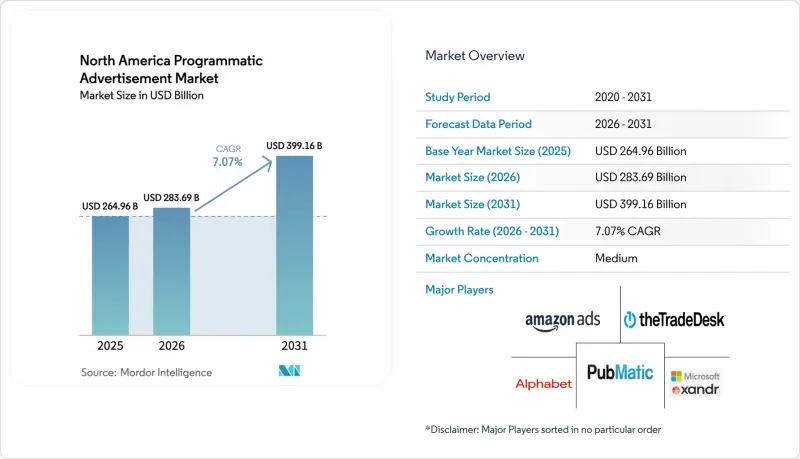
This report is Segmented by Trading Platform (Real-Time Bidding, Private Marketplace Guaranteed, and More), Advertising Media (Mobile Display and More), Enterprise Size (SMBs, Large Enterprises) and End-User Industry (Retail and E-Commerce, Automotive and More) and Country. The Market Sizes and Forecasts are Provided in Terms of Value (USD).
North America Programmatic Advertisement Market Trends and Insights
Surging CTV Ad-Spend Led by U.S. Streaming Platforms
Connected TV investment reached USD 21.45 billion in 2024 after a 16.2% jump tied to political campaigns and major sports broadcasts. Programmatic execution now accounts for 75% of CTV transactions as Disney, Roku, and Amazon expand real-time exchanges. Disney's decision to open its exchange to Amazon DSP combines contextual and purchase data, improving performance metrics for cross-screen campaigns. Advertiser confidence is evident, with 95% planning to sustain or lift CTV budgets in 2025. The Trade Desk's Ventura operating system aims to streamline the CTV supply chain, promising fewer intermediaries and better measurement
Retail Media Networks' First-Party Data Advantage
Retail media has become the third-largest channel worldwide and is forecast to exceed USD 233.89 billion in 2027. Amazon holds 75% of U.S. retail media ad revenue, but Walmart Connect grew 60% in 2024 as buyers diversify. Their closed-loop attribution links ad exposure to purchase outcomes, a capability traditional programmatic exchanges cannot match in a cookieless. Walmart's exploration of acquiring Vizio and its offsite push shows how retailers now compete head-on with demand-side platforms. The result is a structural rebalancing that pushes the North America programmatic advertisement market toward deeper data partnerships to defend share.
SPO Fees Compressing Publisher Margins
Complex supply chains allow intermediaries to capture up to 98% of a bid, leaving premium publishers with only 2% of spend in extreme cases. Fee variability often fails to correlate with content quality, straining sustainability for niche publishers. Buyers concentrate demand through preferred paths, further reducing competition and widening fee spreads. As revenues shrink, publishers pivot to direct sales and PMPs, accelerating consolidation within the North America programmatic advertisement market. Smaller outlets risk displacement if infrastructure cost reductions do not keep pace with rising take rates.
Other drivers and restraints analyzed in the detailed report include:
- AI-Optimised Real-Time Bidding Enhancing ROAS for SMBs
- Deprecation of Third-Party Cookies Accelerating Adoption of PMPs
- Fragmented CTV Identity Graphs Limiting Reach Extension
For complete list of drivers and restraints, kindly check the Table Of Contents.
Segment Analysis
Real-time bidding contributed 57.40% of spend in 2025, underscoring its central role in the North America programmatic advertisement market. Private marketplace guaranteed deals are rising at 9.36% CAGR as brands seek verified, high-quality environments that mitigate fraud risk. The shift elevates data quality and viewability over pure cost efficiency, pressing open exchanges to refine inventory vetting. Automated guaranteed agreements serve advertisers that need both flexibility and certainty, while unreserved fixed-rate transactions give publishers predictable yields during auction volatility. This blend of models positions PMPs as the premium growth engine even as RTB retains unmatched scale for long-tail inventory.
The migration to PMPs stems from advertisers' perception that brand safety, measurement, and transparency now outweigh bid-price savings. OpenX pioneered real-time guaranteed to fuse RTB speed with the certainty of guaranteed inventory. That hybrid design reflects a market need to reconcile efficiency with accountability. As a result, the North America programmatic advertisement market continues to perfect trading mechanics that combine scale, speed, and premium content stewardship.
Mobile display retained 45.85% share in 2025 because 5G coverage supports rich video and interactive formats that engage users on the go. Connected TV, while smaller, posts the fastest 12.21% CAGR thanks to programmatic infrastructure maturity across streaming platforms. Desktop display, digital audio, and digital out-of-home (DOOH) complement omnichannel plans by filling contextual gaps in home, commute, and public spaces. Programmatic video ad spend reached USD 19.93 billion, with 87.1% of mobile video already transacted through automated auctions. Integration of 5G and AI-driven creative makes immersive experiences viable, expanding the North America programmatic advertisement market into gaming and social ecosystems.
T-Mobile's USD 600 million purchase of DOOH specialist Vistar Media confirms telecom giants' ambitions in screen-agnostic advertising. The deal connects location data, 5G, and a network of 1.1 million screens, underscoring DOOH's revival. As convergence proceeds, planners allocate budgets fluidly across mobile, CTV, and DOOH to maximize incremental reach and frequency. These trends cement the North America programmatic advertisement market as a fully omnichannel discipline.
Complete Report Scope:
- By Trading Platform
- Real-Time Bidding (RTB)
- Private Marketplace Guaranteed
- Automated Guaranteed
- Unreserved Fixed-Rate
- By Advertising Media
- Mobile Display
- Desktop Display
- Connected TV (CTV)
- Digital Audio
- Digital Out-of-Home (DOOH)
- By Enterprise Size
- Large Enterprises
- Small and Mid-sized Businesses (SMBs)
- By End-user Industry
- Retail and E-commerce
- Automotive
- BFSI
- Media and Entertainment
- Healthcare and Pharma
- Travel and Hospitality
- By Country
- United States
- Canada
- Mexico
List of Companies Covered in this Report:
- Alphabet Inc. (Google Advertising)
- The Trade Desk Inc.
- Amazon Advertising (Amazon .com Inc.)
- Xandr (Microsoft Corp.)
- PubMatic Inc.
- Magnite Inc.
- MediaMath Inc.
- Adobe Advertising Cloud
- Roku OneView
- Index Exchange Inc.
- AdRoll (NextRoll Inc.)
- Amobee Inc.
- OpenX Technologies Inc.
- TripleLift Inc.
- Quantcast Corp.
- Verizon Media DSP (Yahoo)
- StackAdapt Inc.
- Centro (Basis Technologies)
- Viant Technology Inc.
- Criteo SA
Additional Benefits:
- The market estimate (ME) sheet in Excel format
- 3 months of analyst support
TABLE OF CONTENTS
1 INTRODUCTION
- 1.1 Study Assumptions and Market Definition
- 1.2 Scope of the Study
2 RESEARCH METHODOLOGY
3 EXECUTIVE SUMMARY
4 MARKET LANDSCAPE
- 4.1 Market Overview
- 4.2 Market Drivers
- 4.2.1 Surging CTV Ad-Spend Led by U.S. Streaming Platforms
- 4.2.2 Retail Media Networks First-party Data Advantage
- 4.2.3 AI-Optimised Real-Time Bidding Enhancing ROAS for SMBs
- 4.2.4 De-precation of Third-party Cookies Accelerating Adoption of PMPs
- 4.2.5 5G Roll-out Boosting Mobile Video Impressions
- 4.3 Market Restraints
- 4.3.1 SPO (Supply-Path Optimisation) Fees Compressing Publisher Margins
- 4.3.2 Fragmented CTV Identity Graphs Limiting Reach Extension
- 4.3.3 Data-privacy Litigation Risk (CCPA and Qubec Bill-64)
- 4.3.4 Ad-fraud Inflation in Open Exchanges
- 4.4 Regulatory Outlook
- 4.5 Technological Outlook
- 4.6 Porter's Five Forces Analysis
- 4.6.1 Bargaining Power of Suppliers
- 4.6.2 Bargaining Power of Buyers
- 4.6.3 Threat of New Entrants
- 4.6.4 Threat of Substitutes
- 4.6.5 Intensity of Competitive Rivalry
- 4.7 Industry Stakeholder Analysis
5 MARKET SIZE AND GROWTH FORECASTS (VALUE)
- 5.1 By Trading Platform
- 5.1.1 Real-Time Bidding (RTB)
- 5.1.2 Private Marketplace Guaranteed
- 5.1.3 Automated Guaranteed
- 5.1.4 Unreserved Fixed-Rate
- 5.2 By Advertising Media
- 5.2.1 Mobile Display
- 5.2.2 Desktop Display
- 5.2.3 Connected TV (CTV)
- 5.2.4 Digital Audio
- 5.2.5 Digital Out-of-Home (DOOH)
- 5.3 By Enterprise Size
- 5.3.1 Large Enterprises
- 5.3.2 Small and Mid-sized Businesses (SMBs)
- 5.4 By End-user Industry
- 5.4.1 Retail and E-commerce
- 5.4.2 Automotive
- 5.4.3 BFSI
- 5.4.4 Media and Entertainment
- 5.4.5 Healthcare and Pharma
- 5.4.6 Travel and Hospitality
- 5.5 By Country
- 5.5.1 United States
- 5.5.2 Canada
- 5.5.3 Mexico
6 COMPETITIVE LANDSCAPE
- 6.1 Strategic Developments
- 6.2 Vendor Positioning Analysis
- 6.3 Company Profiles (includes Market level overview, Core Segments, Financials as available, Strategic Information, Products and Services, and Recent Developments)
- 6.3.1 Alphabet Inc. (Google Advertising)
- 6.3.2 The Trade Desk Inc.
- 6.3.3 Amazon Advertising (Amazon .com Inc.)
- 6.3.4 Xandr (Microsoft Corp.)
- 6.3.5 PubMatic Inc.
- 6.3.6 Magnite Inc.
- 6.3.7 MediaMath Inc.
- 6.3.8 Adobe Advertising Cloud
- 6.3.9 Roku OneView
- 6.3.10 Index Exchange Inc.
- 6.3.11 AdRoll (NextRoll Inc.)
- 6.3.12 Amobee Inc.
- 6.3.13 OpenX Technologies Inc.
- 6.3.14 TripleLift Inc.
- 6.3.15 Quantcast Corp.
- 6.3.16 Verizon Media DSP (Yahoo)
- 6.3.17 StackAdapt Inc.
- 6.3.18 Centro (Basis Technologies)
- 6.3.19 Viant Technology Inc.
- 6.3.20 Criteo SA
7 MARKET OPPORTUNITIES AND FUTURE OUTLOOK
- 7.1 White-space and Unmet-need Assessment

