PUBLISHER: Mordor Intelligence | PRODUCT CODE: 2125432

PUBLISHER: Mordor Intelligence | PRODUCT CODE: 2125432
Middle East And Africa Programmatic Advertising - Market Share Analysis, Industry Trends & Statistics, Growth Forecasts (2026 - 2031)
According to Mordor Intelligence, the Middle East and Africa programmatic advertising market size is expected to grow from USD 20.05 billion in 2025 to USD 21.63 billion in 2026 and is forecast to reach USD 31.62 billion by 2031 at 7.89% CAGR over 2026-2031.
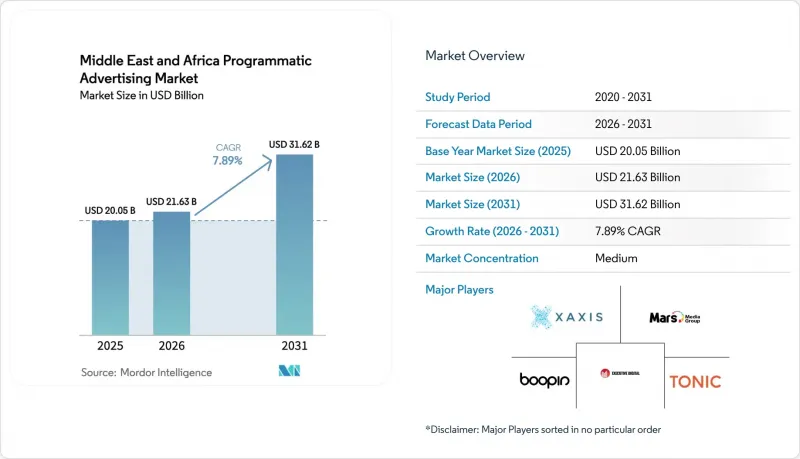
This report is Segmented by Trading Platform (Real-Time Bidding (RTB), Private Marketplace Guaranteed, and More), Advertising Media (Digital Display, Mobile Display), Ad Format (Display Banner, Online Video, and More), Enterprise Size (SMBs, Large Enterprises), Industry Vertical (Retail and E-Commerce, BFSI, and More). The Market Forecasts are Provided in Terms of Value (USD).
Middle East And Africa Programmatic Advertising Market Trends and Insights
Explosion of Mobile-First Consumers in GCC States
Mobile-first usage now defines consumer engagement, with 70% of UAE shoppers leveraging AI assistants, a 44% jump since 2024. Users spend 3.5 hours daily on social platforms, and 67% of TikTok viewers feel motivated to make in-app purchases. Advertisers gain granular audience signals that refine bid strategies across the Middle East and Africa programmatic advertising market. Retailers are prioritizing AI budgets to shorten the path to purchase and reduce cart abandonment. The UAE e-commerce market is projected to surpass AED 48.8 billion (USD 13.3 billion) by 2028, reinforcing the scale needed for advanced programmatic stacks. Mobile-centric DSPs such as InMobi are positioning for a USD 1 billion IPO to capitalize on this uptick.
Growing Adoption of CTV/OTT Advertising Inventory by MENA Broadcasters
Sixty-five percent of UAE residents stream content daily, accelerating migration of brand budgets toward addressable TV formats. Noon's IPL streams show how shoppable overlays fuse entertainment with impulse purchases. ArabyAds' alliance with LG Ad Solutions broadens supply while maintaining viewability standards. Dentsu's curated CTV marketplace posted an 18% lift in attention scores and reduced fraud by 60% compared with open exchanges. Netflix and Yahoo expanded programmatic sales, and Amazon Ads struck a Roku pact reaching 80% of global CTV homes, pulling incremental demand into the Middle East and Africa programmatic advertising market.
Limited Third-Party Cookie Alternatives on Local Publishers
Thirty percent of marketers remain ill-prepared for cookie deprecation, leading to over-reliance on contextual targeting. Local publishers often lack the capital to build first-party data tools, creating a two-speed ecosystem where global platforms win disproportionate budgets. Partnerships such as ArabyAds-Lotame aim to close the gap, yet uptake is uneven. Fragmented data-privacy frameworks add compliance overhead that smaller publishers struggle to manage. The imbalance restricts supply diversity within the Middle East and Africa programmatic advertising market and could dampen CPM growth for regional inventory.
Other drivers and restraints analyzed in the detailed report include:
- Cross-Border E-commerce Surge Boosting First-Party Data Use in UAE and KSA
- Telco-Led Identity Graph Initiatives in Africa
- Patchy 4G/5G Coverage Outside Tier-1 African Cities
For complete list of drivers and restraints, kindly check the Table Of Contents.
Segment Analysis
Real-Time Bidding contributed USD 8.88 billion, equating to 44.30% of the Middle East and Africa programmatic advertising market size in 2025. Advertisers favor RTB for auction efficiency and reach across fragmented publisher pools. Yet fraud concerns have heightened the appeal of Automated Guaranteed deals that lock premium slots at predictable CPMs. Automated Guaranteed is set for 10.34% CAGR, reflecting rising brand-safety expectations and the integration of supply-path optimization protocols. The Trade Desk's 25% revenue rise and Sincera acquisition demonstrate the pivot toward analytics that surface trustworthy paths and reduce hidden fees. PubMatic reports 55% of impressions now travel through optimized routes, underscoring a marketwide push for transparency.
Private Marketplace Guaranteed offers curated high-viewability contexts for auto, BFSI, and luxury brands. Unreserved Fixed-Rate deals remain relevant for performance marketers chasing cost control. Consolidation reshapes platform choices, as Outbrain's USD 1 billion Teads takeover broadens native and video bundles. Advertisers therefore weigh scale versus exclusivity in determining optimal trading mixes across the Middle East and Africa programmatic advertising market.
Digital Display retained 54.30% share led by omnichannel campaigns that repurpose creative across screens. Mobile Display is forecast to post 8.88% CAGR, propelled by smartphone adoption and green media innovations that cut emissions by 39% while boosting click-throughs by 10%. Telco data integrations deepen contextual accuracy, particularly in cookie-light environments. As the Middle East and Africa programmatic advertising market matures, brands align mobile budgets with AI-driven commerce journeys, meeting consumers in-app where purchase intent peaks. Desktop display remains vital for B2B and long-form content, yet its share continues to edge down as hybrid work pushes more user time into mobile ecosystems.
Media buyers increasingly demand cross-device frequency capping and unified measurement. Magnite's 23% CTV revenue rise signals demand for single-platform execution that blends CTV and mobile video. Media cost inflation has also nudged marketers toward supply-path pruning, elevating SSPs that guarantee viewable inventory at sustainable CPMs. The result is a more disciplined allocation of display budgets across the Middle East and Africa programmatic advertising market.
Complete Report Scope:
- By Trading Platform
- Real-Time Bidding (RTB)
- Private Marketplace Guaranteed
- Automated Guaranteed
- Unreserved Fixed-rate
- By Advertising Media
- Digital Display
- Mobile Display
- By Ad Format
- Display Banner
- Online Video
- Social Media
- CTV / OTT
- Audio (Streaming and Podcast)
- Digital-Out-of-Home (DOOH)
- Others
- By Enterprise Size
- Small and Medium Businesses (SMBs)
- Large Enterprises
- By Industry Vertical
- Retail and E-commerce
- BFSI
- Automotive
- Media and Entertainment
- Healthcare and Pharma
- Travel and Hospitality
- Telecom and IT
- Others
List of Companies Covered in this Report:
- Google LLC
- Amazon Ads (Amazon Inc.)
- Xaxis (GroupM)
- InMobi Pte Ltd
- The Trade Desk, Inc.
- Magnite, Inc.
- PubMatic, Inc.
- Adform A/S
- Criteo SA
- Mars Media Group
- Tonic International
- Hsoub
- AdFalcon
- Gamned!
- Adsterra
- MMP World Wide
- Dentsu Aegis Network MEA
- Omnicom Media Group MEA
- AdFalcon (Noor Telecom)
- Digital Turbine Inc.
- Executive Digital
- Boopin
Additional Benefits:
- The market estimate (ME) sheet in Excel format
- 3 months of analyst support
TABLE OF CONTENTS
1 INTRODUCTION
- 1.1 Study Assumptions and Market Definition
- 1.2 Scope of the Study
2 RESEARCH METHODOLOGY
3 EXECUTIVE SUMMARY
4 MARKET LANDSCAPE
- 4.1 Market Overview
- 4.2 Market Drivers
- 4.2.1 Explosion of Mobile-First Consumers in GCC States
- 4.2.2 Growing Adoption of CTV/OTT Advertising Inventory by MENA Broadcasters
- 4.2.3 Cross-border E-commerce Surge Boosting First-Party Data Use in UAE and KSA
- 4.2.4 Telco-led Identity Graph Initiatives in Africa (e.g., MTN, Vodacom)
- 4.2.5 Programmatic DOOH Roll-outs Around FIFA and Expo Events in MEA
- 4.2.6 AI Integration and Automation in Advertising Operations
- 4.3 Market Restraints
- 4.3.1 Limited Third-Party Cookie Alternatives on Local Publishers
- 4.3.2 Patchy 4G/5G Coverage Outside Tier-1 African Cities
- 4.3.3 Low Brand-safety Tool Penetration Elevating Fraud Risk
- 4.3.4 Fragmented Data-privacy Regulations Across MEA States
- 4.4 Regulatory Outlook
- 4.5 Porter's Five Forces Analysis
- 4.5.1 Bargaining Power of Suppliers
- 4.5.2 Bargaining Power of Buyers/Consumers
- 4.5.3 Threat of New Entrants
- 4.5.4 Threat of Substitute Products
- 4.5.5 Intensity of Competitive Rivalry
5 MARKET SIZE AND GROWTH FORECASTS (VALUE)
- 5.1 By Trading Platform
- 5.1.1 Real-Time Bidding (RTB)
- 5.1.2 Private Marketplace Guaranteed
- 5.1.3 Automated Guaranteed
- 5.1.4 Unreserved Fixed-rate
- 5.2 By Advertising Media
- 5.2.1 Digital Display
- 5.2.2 Mobile Display
- 5.3 By Ad Format
- 5.3.1 Display Banner
- 5.3.2 Online Video
- 5.3.3 Social Media
- 5.3.4 CTV / OTT
- 5.3.5 Audio (Streaming and Podcast)
- 5.3.6 Digital-Out-of-Home (DOOH)
- 5.3.7 Others
- 5.4 By Enterprise Size
- 5.4.1 Small and Medium Businesses (SMBs)
- 5.4.2 Large Enterprises
- 5.5 By Industry Vertical
- 5.5.1 Retail and E-commerce
- 5.5.2 BFSI
- 5.5.3 Automotive
- 5.5.4 Media and Entertainment
- 5.5.5 Healthcare and Pharma
- 5.5.6 Travel and Hospitality
- 5.5.7 Telecom and IT
- 5.5.8 Others
6 COMPETITIVE LANDSCAPE
- 6.1 Strategic Developments
- 6.2 Vendor Positioning Analysis
- 6.3 Company Profiles (includes Market level overview, Core Segments, Financials as available, Strategic Information, Products and Services, and Recent Developments)
- 6.3.1 Google LLC
- 6.3.2 Amazon Ads (Amazon Inc.)
- 6.3.3 Xaxis (GroupM)
- 6.3.4 InMobi Pte Ltd
- 6.3.5 The Trade Desk, Inc.
- 6.3.6 Magnite, Inc.
- 6.3.7 PubMatic, Inc.
- 6.3.8 Adform A/S
- 6.3.9 Criteo SA
- 6.3.10 Mars Media Group
- 6.3.11 Tonic International
- 6.3.12 Hsoub
- 6.3.13 AdFalcon
- 6.3.14 Gamned!
- 6.3.15 Adsterra
- 6.3.16 MMP World Wide
- 6.3.17 Dentsu Aegis Network MEA
- 6.3.18 Omnicom Media Group MEA
- 6.3.19 AdFalcon (Noor Telecom)
- 6.3.20 Digital Turbine Inc.
- 6.3.21 Executive Digital
- 6.3.22 Boopin
7 MARKET OPPORTUNITIES AND FUTURE OUTLOOK
- 7.1 White-space and Unmet-need Assessment

