PUBLISHER: Mordor Intelligence | PRODUCT CODE: 2125353

PUBLISHER: Mordor Intelligence | PRODUCT CODE: 2125353
United States Residential Heating Equipment - Market Share Analysis, Industry Trends & Statistics, Growth Forecasts (2026 - 2031)
According to Mordor Intelligence, the US residential heating equipment market size in 2026 is estimated at USD 31.63 billion, growing from 2025 value of USD 29.53 billion with 2031 projections showing USD 44.61 billion, growing at 7.12% CAGR over 2026-2031.
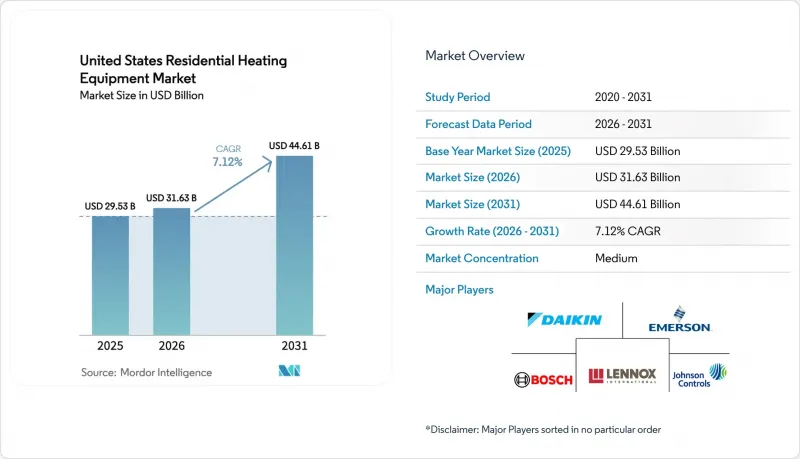
This report is Segmented by Product Type (Gas Furnaces, Electric Furnaces, Boilers, and More), Technology (Condensing, Non-Condensing, Variable-Speed Inverter, Smart Connected), End-User (Single-Family Detached Homes, Multi-Family Residential, and More), Distribution Channel (Replacement/Aftermarket, New Construction OEM). The Market Forecasts are Provided in Terms of Value (USD).
United States Residential Heating Equipment Market Trends and Insights
Federal Tax Credits and IRA Rebates for High-Efficiency Heat Pumps
Tax incentives now cover 30% of project costs up to USD 2,000, and low-to-moderate income households can tap additional rebates that raise total support beyond 50% of installed cost. New 2025 eligibility rules that require ENERGY STAR Most Efficient certification push manufacturers toward higher-performance compressors and inverter logic, shortening product-refresh cycles. An updated IRS qualified-manufacturer list features Carrier, Lennox, and Rheem, ensuring mainstream distribution of compliant models.
State-Level Electrification Building Codes
California's 2025 Building Energy Efficiency Standards obligate builders to install heat pumps in new homes beginning January 2026, a template Washington, Oregon, and New York are already adapting. Optional appendices in the 2024 IECC provide ready-made language that allows states to layer electric-ready requirements onto renovation permits, extending policy reach to the replacement market.
High Upfront Capital Cost Versus Baseline Gas Furnaces
Installed heat-pump prices run USD 8,000-15,000 compared with USD 4,000-8,000 for gas furnaces, and the gap endures even after credits. Additional expenses for panel upgrades and refrigerant handling prolong payback in low-gas-price regions. The American Council for an Energy-Efficient Economy notes that cost-effectiveness improves markedly in zones with fewer than 7,000 heating degree days.
Other drivers and restraints analyzed in the detailed report include:
- Cold-Climate Heat-Pump Technology Advances
- Aging Housing-Stock Replacement Cycle
- Skilled Labor Shortage for Heat-Pump Installation
For complete list of drivers and restraints, kindly check the Table Of Contents.
Segment Analysis
Gas furnaces accounted for 44.35% of the US Residential Heating Equipment market in 2025, yet cold-climate heat pumps are running an 10.78% CAGR that threatens to erode that share quickly. The US Residential Heating Equipment market size for cold-climate heat pumps is projected to widen substantially as the Department of Energy challenge proves viability at sub-zero temperatures. Hybrid systems that pair a heat pump with a secondary gas stage offer a migration path for homeowners wary of full electrification, and they preserve comfort during polar vortex events.
Federal credits of up to USD 2,000 on heat-pump water heaters are encouraging bundled space-and-water-heating retrofits, lifting average order value for contractors. Electric furnaces hold ground in renewable-rich states where time-of-use electricity rates track below seasonal gas pricing, while boilers see attrition except in legacy hydronic markets. Manufacturers that can supply both 240 V ducted and 120 V ductless formats occupy a stronger position with distributors eager to streamline stocking decisions.
Non-condensing platforms still represented 56.05% of the US Residential Heating Equipment market share in 2025, but impending federal minimum-efficiency updates skew orders toward condensing and inverter units. Variable-speed compressors are climbing at a 12.15% CAGR, enabling load-following operation that cuts cycling losses and unlocks demand-response payments worth USD 50-100 per year in select ISO territories.
The US Residential Heating Equipment market size for smart connected systems is set to accelerate as utilities offer bill credits to households that allow 2-hour temperature setbacks during grid stress. A2L compliance drives redesigns that integrate multi-sensor leak detection, while cloud analytics deliver predictive maintenance alerts that reduce truck rolls for service contractors. The transition phase favors OEMs that can certify a complete refrigerant-safe ecosystem, including recovery equipment and training modules.
Complete Report Scope:
- By Product Type
- Gas Furnaces
- Electric Furnaces
- Boilers
- Air and Water Heaters
- Heat Pumps
- Hybrid Systems
- Other Types
- By Technology
- Condensing
- Non-Condensing
- Variable-Speed Inverter
- Smart Connected
- By End-User
- Single-Family Detached Homes
- Multi-Family Residential
- Manufactured Housing
- Other Ed-users
- By Distribution Channel
- Replacement / Aftermarket
- New Construction (OEM)
List of Companies Covered in this Report:
- Carrier Global Corporation
- Trane Technologies plc
- Lennox International Inc.
- Daikin Industries Ltd.
- Rheem Manufacturing Company
- Johnson Controls International plc
- Bosch Thermotechnology Corp.
- Bradford White Corporation
- Burnham Holdings Inc.
- Mitsubishi Electric Trane HVAC US LLC
- American Standard Heating and Air Conditioning
- Emerson Electric Co.
- Honeywell International Inc. (Smart Controls)
- Nortek Global HVAC
- Navien Inc.
- Viessmann Manufacturing Co. (U.S.) Inc.
- Robert Bosch LLC
- WaterFurnace International Inc.
- LG Electronics USA - HVAC
- Panasonic USA - Heating and Cooling
Additional Benefits:
- The market estimate (ME) sheet in Excel format
- 3 months of analyst support
TABLE OF CONTENTS
1 INTRODUCTION
- 1.1 Study Assumptions and Market Definition
- 1.2 Scope of the Study
2 RESEARCH METHODOLOGY
3 EXECUTIVE SUMMARY
4 MARKET LANDSCAPE
- 4.1 Market Overview
- 4.2 Market Drivers
- 4.2.1 Federal tax credits and IRA rebates for high-efficiency heat pumps
- 4.2.2 State-level electrification building codes
- 4.2.3 Resale-value premium for ENERGY STAR-certified systems
- 4.2.4 Cold-climate heat-pump technology advances
- 4.2.5 Smart-thermostat enabled demand-response revenues
- 4.2.6 Aging housing-stock replacement cycle
- 4.3 Market Restraints
- 4.3.1 High upfront capital cost vs. baseline gas furnaces
- 4.3.2 Natural-gas price volatility complicating pay-back
- 4.3.3 Electric-grid constraints during extreme cold events
- 4.3.4 Skilled labor shortage for heat-pump installation
- 4.4 Value Chain Analysis
- 4.5 Regulatory Landscape
- 4.6 Technological Outlook
- 4.7 Porter's Five Forces Analysis
- 4.7.1 Bargaining Power of Suppliers
- 4.7.2 Bargaining Power of Buyers/Consumers
- 4.7.3 Threat of New Entrants
- 4.7.4 Threat of Substitutes
- 4.7.5 Intensity of Competitive Rivalry
- 4.8 Assessment of Macro Economic Trends on the Market
5 MARKET SIZE AND GROWTH FORECASTS (VALUES)
- 5.1 By Product Type
- 5.1.1 Gas Furnaces
- 5.1.2 Electric Furnaces
- 5.1.3 Boilers
- 5.1.4 Air and Water Heaters
- 5.1.5 Heat Pumps
- 5.1.6 Hybrid Systems
- 5.1.7 Other Types
- 5.2 By Technology
- 5.2.1 Condensing
- 5.2.2 Non-Condensing
- 5.2.3 Variable-Speed Inverter
- 5.2.4 Smart Connected
- 5.3 By End-User
- 5.3.1 Single-Family Detached Homes
- 5.3.2 Multi-Family Residential
- 5.3.3 Manufactured Housing
- 5.3.4 Other Ed-users
- 5.4 By Distribution Channel
- 5.4.1 Replacement / Aftermarket
- 5.4.2 New Construction (OEM)
6 COMPETITIVE LANDSCAPE
- 6.1 Market Concentration
- 6.2 Strategic Moves
- 6.3 Market Share Analysis
- 6.4 Company Profiles (includes Global-level Overview, Market-level Overview, Core Segments, Financials as available, Strategic Information, Market Rank/Share, Products and Services, Recent Developments)
- 6.4.1 Carrier Global Corporation
- 6.4.2 Trane Technologies plc
- 6.4.3 Lennox International Inc.
- 6.4.4 Daikin Industries Ltd.
- 6.4.5 Rheem Manufacturing Company
- 6.4.6 Johnson Controls International plc
- 6.4.7 Bosch Thermotechnology Corp.
- 6.4.8 Bradford White Corporation
- 6.4.9 Burnham Holdings Inc.
- 6.4.10 Mitsubishi Electric Trane HVAC US LLC
- 6.4.11 American Standard Heating and Air Conditioning
- 6.4.12 Emerson Electric Co.
- 6.4.13 Honeywell International Inc. (Smart Controls)
- 6.4.14 Nortek Global HVAC
- 6.4.15 Navien Inc.
- 6.4.16 Viessmann Manufacturing Co. (U.S.) Inc.
- 6.4.17 Robert Bosch LLC
- 6.4.18 WaterFurnace International Inc.
- 6.4.19 LG Electronics USA - HVAC
- 6.4.20 Panasonic USA - Heating and Cooling
7 MARKET OPPORTUNITIES AND FUTURE OUTLOOK
- 7.1 White-space and Unmet-Need Assessment

