PUBLISHER: Mordor Intelligence | PRODUCT CODE: 2125364

PUBLISHER: Mordor Intelligence | PRODUCT CODE: 2125364
Europe Food Platform-to-Consumer Delivery - Market Share Analysis, Industry Trends & Statistics, Growth Forecasts (2026 - 2031)
According to Mordor Intelligence, the Europe food platform-to-consumer delivery market size was valued at USD 77.72 billion in 2025 and estimated to grow from USD 83.07 billion in 2026 to reach USD 115.88 billion by 2031, at a CAGR of 6.89% during the forecast period (2026-2031).
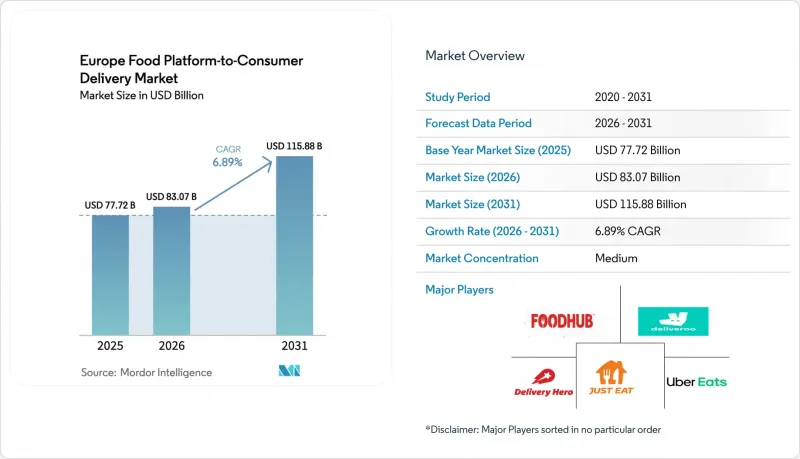
This report is Segmented by Business Model (Aggregator, Full Service), Device (Mobile Applications, Desktop / Web), Payment Method (Digital Wallets and UPI, Credit/Debit Cards, Cash On Delivery (COD)), Type of Food Delivery (Ready-To-Eat Meals and More), and Country. The Market Forecasts are Provided in Terms of Value (USD).
Europe Food Platform-to-Consumer Delivery Market Trends and Insights
Hyperlocal Fulfilment Centres Accelerating Delivery Speed
Micro-hubs positioned within 2-3 km of dense neighbourhoods enable consistent sub-20-minute service, boosting repeat orders and lowering last-mile costs across the Europe food platform-to-consumer delivery market. Paris alone handles more than 300,000 daily deliveries, and these hubs now complete 78% of drops with electric bikes or cargo trikes, aligning with zero-emission goals. AI-powered demand forecasting improves inventory turn, trims waste and raises courier utilisation, reinforcing profitability.
Subscription-Based Delivery Models Enhancing Loyalty
Delivery-club subscriptions have reached penetration of 15-20% among active users in mature markets and drive 2.7-fold higher ordering frequency than non-subscribers. The predictable revenue stream shields platforms from volatility in average order value while granular usage data deepens personalisation. Millennial and Gen Z households exhibit the highest adoption, indicating further runway as these cohorts' disposable income rises.
Rising Courier Acquisition Costs Amid Tighter Regulations
The EU directive classifying gig workers as employees raises fixed labour costs, social security contributions and administrative overheads. Spain's employee model increased operating expense by about 20% for major platforms, and Delivery Hero warned of a EUR 100 million (USD 109 million) EBITDA hit. Heightened cost pressures incentivise automation in dispatch, heavier shift scheduling and industry consolidation as smaller operators exit.
Other drivers and restraints analyzed in the detailed report include:
- Grocery Quick-Commerce Convergence With Meal Platforms
- Low-Emission Urban Logistics Regulatory Support
- Declining Average Order Value Amid Economic Pressures
For complete list of drivers and restraints, kindly check the Table Of Contents.
Segment Analysis
The Europe food platform-to-consumer delivery market size attributed to Aggregators stood at 64.30% in 2025. However, the Full-Service model's 8.55% CAGR is narrowing the gap as integrated logistics allow stricter control of customer experience. Urban density in Paris, Berlin and London favours Full-Service economics, while Aggregators retain advantage in suburban zones. Hybrid strategies that combine marketplace breadth with proprietary fleets are blurring traditional boundaries.
Mobile apps captured 89.20% of orders in 2025 and will compound at an 7.9% CAGR. Geolocation, biometric authentication and push notifications create frictionless journeys, raising conversion and retention metrics. Desktop interfaces still serve corporate and group orders, yet incremental AI capabilities such as voice ordering favour mobile environments where average basket sizes rose 12-18%.
Complete Report Scope:
- By Business Model
- Aggregator
- Full Service
- By Device
- Mobile Applications
- Desktop / Web
- By Payment Method
- Digital Wallets and UPI
- Credit/Debit Cards
- Cash on Delivery (COD)
- By Type of Food Delivery
- Ready-to-Eat Meals
- Cooked-to-Order Meals
- Groceries
- Other Type of Food Deliveries
- By Country
- United Kingdom
- Germany
- France
- Italy
- Spain
- Netherlands
- Rest of Europe
List of Companies Covered in this Report:
- Deliveroo plc
- Just Eat Takeaway.com N.V.
- Uber Technologies Inc. (Uber Eats)
- DoorDash Inc.
- Delivery Hero SE
- Glovoapp23, S.L.
- Wolt Enterprises Oy
- Bolt Technology OU (Bolt Food)
- Foodhub Limited
- Foodpanda GmbH
- Delivery Club LLC
- Getir Perakende Lojistik A.S.
- Gorillas Technologies GmbH
- GoBrands Inc. (Gopuff)
- JustKitchen Holdings Corp.
- Stuart Delivery Ltd.
- Yandex LLC (Yandex.Eats)
- Rebel Foods Services UK Ltd.
- Frichti SAS
- Smood SA
Additional Benefits:
- The market estimate (ME) sheet in Excel format
- 3 months of analyst support
TABLE OF CONTENTS
1 INTRODUCTION
- 1.1 Study Assumptions and Market Definition
- 1.2 Scope of the Study
2 RESEARCH METHODOLOGY
3 EXECUTIVE SUMMARY
4 MARKET LANDSCAPE
- 4.1 Market Overview
- 4.2 Market Drivers
- 4.2.1 Hyperlocal fulfilment centres accelerating delivery speed across Tier-1 European cities
- 4.2.2 Rise of subscription-based "delivery club" models improving customer lifetime value
- 4.2.3 Convergence of grocery quick-commerce with meal platforms in Western Europe
- 4.2.4 Regulatory support for low-emission urban logistics (e-bikes and e-scooters)
- 4.2.5 Integration of real-time data and AI for dynamic menu pricing
- 4.2.6 Millennial dual-income households' preference for convenience dining
- 4.3 Market Restraints
- 4.3.1 Rising courier acquisition costs amid tighter EU labour rules
- 4.3.2 Declining average order value as consumers trade down to discount grocers
- 4.3.3 Restaurant margin push-back reducing allowable platform commission rates
- 4.3.4 Stringent GDPR / Digital Markets Act limits on personalised upselling
- 4.4 Value Chain Analysis
- 4.5 Regulatory Outlook
- 4.6 Porter's Five Forces Analysis
- 4.6.1 Threat of New Entrants
- 4.6.2 Bargaining Power of Buyers
- 4.6.3 Bargaining Power of Suppliers
- 4.6.4 Threat of Substitutes
- 4.6.5 Intensity of Competitive Rivalry
- 4.7 Assessment of Macro Economic Trends on the Market
5 MARKET SIZE AND GROWTH FORECASTS (VALUES)
- 5.1 By Business Model
- 5.1.1 Aggregator
- 5.1.2 Full Service
- 5.2 By Device
- 5.2.1 Mobile Applications
- 5.2.2 Desktop / Web
- 5.3 By Payment Method
- 5.3.1 Digital Wallets and UPI
- 5.3.2 Credit/Debit Cards
- 5.3.3 Cash on Delivery (COD)
- 5.4 By Type of Food Delivery
- 5.4.1 Ready-to-Eat Meals
- 5.4.2 Cooked-to-Order Meals
- 5.4.3 Groceries
- 5.4.4 Other Type of Food Deliveries
- 5.5 By Country
- 5.5.1 United Kingdom
- 5.5.2 Germany
- 5.5.3 France
- 5.5.4 Italy
- 5.5.5 Spain
- 5.5.6 Netherlands
- 5.5.7 Rest of Europe
6 COMPETITIVE LANDSCAPE
- 6.1 Market Concentration
- 6.2 Strategic Moves
- 6.3 Market Share Analysis
- 6.4 Company Profiles {(includes Global level Overview, Market level overview, Core Segments, Financials as available, Strategic Information, Market Rank/Share for key companies, Products and Services, and Recent Developments)}
- 6.4.1 Deliveroo plc
- 6.4.2 Just Eat Takeaway.com N.V.
- 6.4.3 Uber Technologies Inc. (Uber Eats)
- 6.4.4 DoorDash Inc.
- 6.4.5 Delivery Hero SE
- 6.4.6 Glovoapp23, S.L.
- 6.4.7 Wolt Enterprises Oy
- 6.4.8 Bolt Technology OU (Bolt Food)
- 6.4.9 Foodhub Limited
- 6.4.10 Foodpanda GmbH
- 6.4.11 Delivery Club LLC
- 6.4.12 Getir Perakende Lojistik A.S.
- 6.4.13 Gorillas Technologies GmbH
- 6.4.14 GoBrands Inc. (Gopuff)
- 6.4.15 JustKitchen Holdings Corp.
- 6.4.16 Stuart Delivery Ltd.
- 6.4.17 Yandex LLC (Yandex.Eats)
- 6.4.18 Rebel Foods Services UK Ltd.
- 6.4.19 Frichti SAS
- 6.4.20 Smood SA
7 MARKET OPPORTUNITIES AND FUTURE OUTLOOK
- 7.1 White-space and Unmet-Need Assessment

