PUBLISHER: Mordor Intelligence | PRODUCT CODE: 2125433

PUBLISHER: Mordor Intelligence | PRODUCT CODE: 2125433
Asia-Pacific Food Platform-to-Consumer Delivery - Market Share Analysis, Industry Trends & Statistics, Growth Forecasts (2026 - 2031)
According to Mordor Intelligence, the Asia-Pacific food platform-to-Consumer delivery market size is expected to grow from USD 0.69 trillion in 2025 to USD 0.75 trillion in 2026 and is forecast to reach USD 1.09 trillion by 2031 at a 7.76% CAGR over 2026-2031.
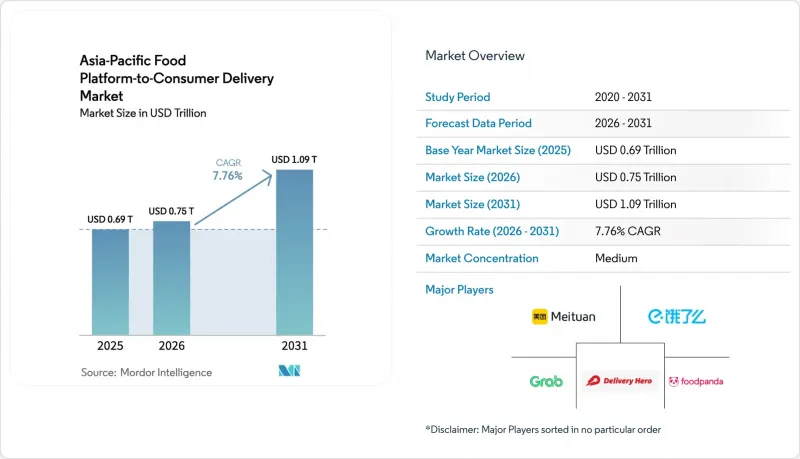
This report is Segmented by Business Model (Aggregator Model, Restaurant-To-Consumer Model, and Hybrid/Cloud-Kitchen-Owned), Order Platform (Mobile App, Website/Desktop, and Conversational), Delivery Time Promise (Standard Delivery, and Express/Q-Commerce), Consumer Segment (Household Users, and More), and Geography. The Market Forecasts are Provided in Terms of Value (USD).
Asia-Pacific Food Platform-to-Consumer Delivery Market Trends and Insights
Dark-Kitchen Networks Enabling Less than 30-Minute Fulfillment
Cloud kitchens have matured into the infrastructure spine that makes sub-30-minute delivery financially viable. Rebel Foods operates 450 facilities and secured USD 210 million from KKR in 2024 to expand into Indonesia and the Middle East, signaling institutional belief in asset-light networks that sit closer to demand. Hangry raised USD 10.5 million to seed secondary Indonesian cities where traditional restaurant density is thin, demonstrating the arbitrage opportunity in underserved locales. In China, Meituan has rolled out 500 autonomous vehicles completing 20 orders daily each, trimming last-mile cost by 30%. By decoupling production from dining space, dark kitchens let platforms reposition supply dynamically, compress delivery radii, and meet rising service levels without relying on partner compliance. The model resonates strongest in Tier-2 and Tier-3 clusters where smartphone uptake is surging but brick-and-mortar options lag.
Social-Commerce Gifting of Food Orders During Live-Stream Events
Live-stream retail generated USD 807 billion GMV in China during 2024, with food and beverage ranking second by volume. Ele.me's 2025 integration with Taobao Live allowed influencers to drop discount codes mid-broadcast, spiking new-user additions by 40% during campaign windows. South Korea's Baemin mirrored the feature through Naver Live, letting hosts curate meal bundles redeemable in a single click. Social gifting turns entertainment into frictionless checkout, moving marketing dollars from paid search toward influencer ecosystems that deliver higher conversion at lower cost. Because viewers treat vouchers as experiential gifts, average order values trend 12-15% above platform means, reinforcing the tactic's profitability.
Rising Rider-Wage Regulation and Social-Security Costs
Mandatory gig-worker protections are resetting labor economics. Malaysia's 2025 Gig Workers Bill obliges platforms to fund provident and social-security accounts, adding MYR 200-300 (USD 45-67) monthly per active rider. Singapore's Platform Workers Act requires work-injury coverage and representation rights, inflating per-order cost by 8-10%. India's phased Social Security Code enables states to classify gig couriers as employees, creating compliance uncertainty. In China, provincial enforcement of 2023 guidelines compels platforms to guarantee minimum wages and accident insurance. Operators thus face a margin squeeze: absorb the expense, pass it to restaurants, or risk demand elasticity by raising consumer fees.
Other drivers and restraints analyzed in the detailed report include:
- Explosive Smartphone Penetration in Tier-2 and Tier-3 APAC Cities
- Discount-Driven User Acquisition Battles Among Super-Apps
- Thin Unit Economics Amid Subsidy Wars
For complete list of drivers and restraints, kindly check the Table Of Contents.
Segment Analysis
Hybrid and cloud-kitchen-owned formats are expanding at a 9.40% CAGR through 2031, nearly triple the growth rate of the Asia-Pacific food platform-to-consumer delivery market. The aggregator structure still held 60.66% share in 2025, powered by incumbents such as Meituan, Zomato, and GrabFood, yet its dominance is slipping as operators chase restaurant-level margins once obscured by commissions. Rebel Foods' USD 210 million raise from KKR highlighted investor conviction that owned kitchens can scale across borders faster than marketplace listings. Zomato's take rate fell from 22% in FY23 to 19% in FY25 after chains demanded lower fees, illustrating shrinking pricing power. Platforms are responding by blending aggregation with proprietary supply, rerouting peak-hour demand to in-house brands, and using algorithmic load balancing to protect service-level agreements.
The Asia-Pacific food platform-to-consumer delivery market now prioritizes inventory control over homepage traffic. Swiggy Access runs 80 kitchens across 15 cities, filling demand voids where restaurant density is low. Meituan's autonomous van fleet further compresses last-mile cost, letting the company sustain promotional pricing without sacrificing contribution margin. Restaurant-to-consumer fleets from Domino's and KFC, which jointly held roughly 15% market share in 2025, affirm that direct channels can coexist with marketplace reach when data ownership is strategic. The hybrid blueprint therefore balances discovery scale with cost visibility, creating a defensible path to profitability.
Mobile applications captured 82.55% of the order share in 2025 and are growing at an 8.80% CAGR. Super-app designs that weave food delivery into payments, grocery, and ride-hailing extend session length and raise cross-sell probability. Grab recorded a 28% lift in multi-service usage when users ordered meals, while GoTo's 2024 tie-up with TikTok Shop embeds GoFood carts into short-video streams that 120 million Indonesians view daily. The Asia-Pacific food platform-to-consumer delivery market for mobile orders is projected to surpass USD 900 billion by 2031, underscoring the channel's centrality.
Website and desktop flows, once critical for corporate catering, slipped to 13% share in 2025 as mobile-first behavior mainstreamed. Conversational interfaces account for only 3% due to inconsistent voice recognition in regional dialects. Zomato's WhatsApp ordering experiment targets the 200 million Indian users without dedicated food apps, reflecting a fringe play to nudge digital migration. Meituan's predictive menu engine, which boosted order frequency by 14%, indicates that mobile supremacy now rests on data-driven personalization rather than raw convenience.
Complete Report Scope:
- By Business Model
- Aggregator Model
- Restaurant-to-Consumer Model
- Hybrid / Cloud-Kitchen-Owned
- By Order Platform
- Mobile App
- Website / Desktop
- Conversational (Chatbot / Call)
- By Delivery Time Promise
- Standard Delivery (Above 30 min)
- Express / Q-Commerce (<=30 min)
- By Consumer Segment
- Household Users
- Office / Corporate
- Students
- By Country
- China
- India
- Japan
- South Korea
- Australia
- South East Asia
- Rest of the Asia-Pacific
List of Companies Covered in this Report:
- Meituan Inc.
- ELEME Inc.
- Grab Holdings Inc.
- Delivery Hero SE
- Eternal Limited (Zomato)
- Swiggy Limited
- PT Aplikasi Karya Anak Bangsa (GoFood)
- Uber Technologies, Inc. (Uber Eats)
- Roofoods Ltd (Deliveroo)
- LINE MAN / Wongnai
- Woowa Brothers Co., Ltd. (Baemin)
- ShopeeFood Company Limited
- HungryPanda Ltd .
- Dunzo Digital Private Limited (Dunzo)
- Coupang Eats Services Ltd.
- HappyFresh Group
Additional Benefits:
- The market estimate (ME) sheet in Excel format
- 3 months of analyst support
TABLE OF CONTENTS
1 INTRODUCTION
- 1.1 Study Assumptions and Market Definition
- 1.2 Scope of the Study
2 RESEARCH METHODOLOGY
3 EXECUTIVE SUMMARY
4 MARKET LANDSCAPE
- 4.1 Market Overview
- 4.2 Market Drivers
- 4.2.1 Explosive Smartphone Penetration in Tier-2/3 APAC Cities
- 4.2.2 Affordability of 4G/5G Data Plans
- 4.2.3 Discount-driven User Acquisition Battles Among Super-apps
- 4.2.4 Rapid Urban Millennial Lifestyle Shifts
- 4.2.5 Dark-kitchen Networks Enabling Less than 30-min Fulfilment
- 4.2.6 Social-commerce Gifting of Food Orders During Live-stream Events
- 4.3 Market Restraints
- 4.3.1 Rising Rider-wage Regulation and Social-security Costs
- 4.3.2 Thin Unit Economics Amid Subsidy Wars
- 4.3.3 Stricter Data-localization and Privacy Rules
- 4.3.4 ESG Pressure on Single-use Packaging
- 4.4 Industry Value Chain Analysis
- 4.5 Regulatory Landscape
- 4.6 Technological Outlook
- 4.7 Porter's Five Forces
- 4.7.1 Threat of New Entrants
- 4.7.2 Bargaining Power of Buyers
- 4.7.3 Bargaining Power of Suppliers
- 4.7.4 Threat of Substitutes
- 4.7.5 Intensity of Competitive Rivalry
- 4.8 Investment Analysis
5 MARKET SIZE AND GROWTH FORECASTS (VALUE)
- 5.1 By Business Model
- 5.1.1 Aggregator Model
- 5.1.2 Restaurant-to-Consumer Model
- 5.1.3 Hybrid / Cloud-Kitchen-Owned
- 5.2 By Order Platform
- 5.2.1 Mobile App
- 5.2.2 Website / Desktop
- 5.2.3 Conversational (Chatbot / Call)
- 5.3 By Delivery Time Promise
- 5.3.1 Standard Delivery (Above 30 min)
- 5.3.2 Express / Q-Commerce (<=30 min)
- 5.4 By Consumer Segment
- 5.4.1 Household Users
- 5.4.2 Office / Corporate
- 5.4.3 Students
- 5.5 By Country
- 5.5.1 China
- 5.5.2 India
- 5.5.3 Japan
- 5.5.4 South Korea
- 5.5.5 Australia
- 5.5.6 South East Asia
- 5.5.7 Rest of the Asia-Pacific
6 COMPETITIVE LANDSCAPE
- 6.1 Market Concentration
- 6.2 Strategic Moves
- 6.3 Market Share Analysis
- 6.4 Company Profiles (includes Global Level Overview, Market Level Overview, Core Segments, Financials as available, Strategic Information, Market Rank/Share, Products and Services, Recent Developments)
- 6.4.1 Meituan Inc.
- 6.4.2 ELEME Inc.
- 6.4.3 Grab Holdings Inc.
- 6.4.4 Delivery Hero SE
- 6.4.5 Eternal Limited (Zomato)
- 6.4.6 Swiggy Limited
- 6.4.7 PT Aplikasi Karya Anak Bangsa (GoFood)
- 6.4.8 Uber Technologies, Inc. (Uber Eats)
- 6.4.9 Roofoods Ltd (Deliveroo)
- 6.4.10 LINE MAN / Wongnai
- 6.4.11 Woowa Brothers Co., Ltd. (Baemin)
- 6.4.12 ShopeeFood Company Limited
- 6.4.13 HungryPanda Ltd .
- 6.4.14 Dunzo Digital Private Limited (Dunzo)
- 6.4.15 Coupang Eats Services Ltd.
- 6.4.16 HappyFresh Group
7 MARKET OPPORTUNITIES AND FUTURE OUTLOOK
- 7.1 White-space and Unmet-Need Assessment

