PUBLISHER: Mordor Intelligence | PRODUCT CODE: 2125423

PUBLISHER: Mordor Intelligence | PRODUCT CODE: 2125423
Food Platform-to-Consumer Delivery - Market Share Analysis, Industry Trends & Statistics, Growth Forecasts (2026 - 2031)
According to Mordor Intelligence, the food platform to consumer delivery market size in 2026 is estimated at USD 467.67 billion, growing from 2025 value of USD 421.06 billion with 2031 projections showing USD 790.01 billion, growing at 11.07% CAGR over 2026-2031.
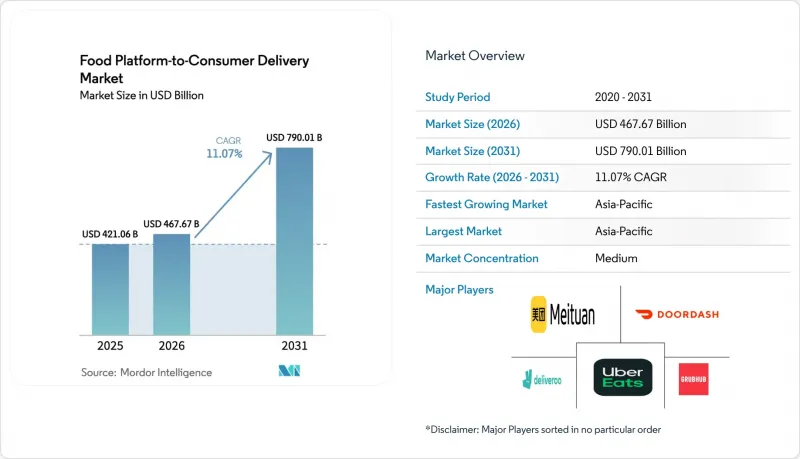
This report is Segmented by Business Model (Aggregator, Full Service), Device (Mobile Applications, Desktop / Web), Payment Method (Digital Wallets and UPI, Credit/Debit Cards, Cash On Delivery (COD)), Type of Food Delivery (Ready-To-Eat Meals and More), and Geography. The Market Forecasts are Provided in Terms of Value (USD).
Global Food Platform-to-Consumer Delivery Market Trends and Insights
Proliferation of Quick-Commerce "10-minute" Models in Tier-1 Asian & MENA Cities
Instant-delivery operators now position dark-stores within two-kilometer radii of key population nodes, raising monthly inventory turns above 15 and enabling sub-10-minute fulfillment. Meituan's Q1 2025 revenue rose to USD 12.1 billion, with 60% of non-food growth sourced from instant-delivery orders. High smartphone penetration, dense traffic corridors, and consumers' willingness to pay for convenience underpin the model. Order-density economics remain critical, as distributed micro-fulfillment footprints carry elevated fixed costs. Advanced demand-forecasting engines and real-time inventory synchronization are essential to sustain profitability at scale.
Bundled Loyalty & Subscription Programs Boosting Repeat Orders in North America
DoorDash's DashPass surpassed prior subscriber benchmarks in Q1 2025, contributing to USD 3 billion in revenue and raising purchase frequency by 40-60% among members. Monthly plans that bundle fee reductions with exclusive restaurant access have become a reliable retention lever as customer-acquisition costs escalate. Uber's membership tiers yield more than triple the spending of single-product users, underscoring the cross-sell potential within multi-service ecosystems. Subscriber data further improves segmentation accuracy, elevating customer lifetime value and informing targeted promotions.
Escalating Last-Mile Rider Insurance & Compliance Costs in EU
New EU directives oblige platforms to provide accident insurance and minimum-wage guarantees, elevating compliance outlays by 35-45% across primary markets. Insurance premiums alone have climbed 40-60% in Paris, Berlin, and Madrid, challenging smaller regional players that lack the scale to absorb incremental per-delivery costs. Administrative complexity grows as member states apply divergent rules, raising overheads for cross-border operators and prompting further consolidation.
Other drivers and restraints analyzed in the detailed report include:
- Rapid Cloud-Kitchen Expansion in Europe Backed by Private Equity
- Rising Demand for Healthy & Specialty Diet Platforms among Gen-Z Consumers
- City-level Commission Caps Compressing Margins
For complete list of drivers and restraints, kindly check the Table Of Contents.
Segment Analysis
The segment with aggregator operators controlling 60.95% of food platform to consumer delivery market share. Full-service rivals, however, are expanding at 14.39% CAGR and are set to narrow the gap by 2031. Integrated fleets allow direct control over courier quality, dynamic batching, and drop-density optimization, resulting in 15-20% shorter delivery times and superior Net Promoter Scores. DoorDash's Q1 2025 adjusted EBITDA reached USD 590 million after augmenting its autonomous van pilot in Arizona. Investors prefer the higher contribution margins and data moats tied to full-service logistics ecosystems.
Full-service models generate incremental earnings through layered fees, advertising services, and white-label logistics for grocers. Aggregators remain relevant for rapid geographic launches due to low upfront capital yet face mounting churn as restaurants demand fulfilment support and analytics dashboards. As margin pressure intensifies, leading aggregators are pivoting toward hybrid operations, acquiring courier assets, and co-locating ghost kitchens to emulate end-to-end control.
Mobile channels accounted for 85.60% of 2025 GMV. App-centric design capitalizes on GPS, biometrics, and real-time messaging, while 5G roll-out facilitates richer imagery and AR menu previews. AI-powered reorder prompts and voice-activated checkout streamline the path to purchase, raising conversion. Desktop portals now focus on large basket corporate orders, catering software, and partner analytics.
Mobile supremacy is reinforcing data advantages. Continuous telemetry on user movement, dwell time, and tap patterns enriches recommender systems, boosting average ticket by 8-10%. Nearly every major platform files patents for adaptive UI and automated dispatch orchestration, signifying an arms race in experiential differentiation. Cross-device experiences remain necessary for restaurants that manage menus on larger screens, yet mobile-first thinking guides feature roadmaps.
Complete Report Scope:
- By Business Model
- Aggregator
- Full Service
- By Device
- Mobile Applications
- Desktop / Web
- By Payment Method
- Digital Wallets and UPI
- Credit/Debit Cards
- Cash on Delivery (COD)
- By Type of Food Delivery
- Ready-to-Eat Meals
- Cooked-to-Order Meals
- Groceries
- Other Type of Food Deliveries
- By Geography
- North America
- United States
- Canada
- Mexico
- Europe
- Germany
- United Kingdom
- France
- Nordics
- Rest of Europe
- Asia-Pacific
- China
- India
- Japan
- Rest of Asia-Pacific
- South America
- Brazil
- Argentina
- Rest of South America
- Middle East
- Saudi Arabia
- United Arab Emirates
- Rest of Middle East
- Africa
- South Africa
- Rest of Africa
- North America
Geography Analysis
Asia-Pacific produced USD 178.53 billion in 2025 revenue and 42.40% of food platform to consumer delivery market share, expanding at 13.88% CAGR to 2031. China's super-app leaders bundle dining, grocery, ride-hailing, and payments, generating unrivaled cross-sell synergies. Meituan's net profit almost doubled year-over-year as the firm piloted international entries in Saudi Arabia and Brazil. India's ONDC processed a cumulative 7.1 million transactions by December 2024, 32.5% of which were food deliveries, validating the low-commission open-network thesis.
North America delivered USD 123.79 billion in 2025 sales and reflects a maturing arena distinguished by premium loyalty programs and early autonomy pilots. DoorDash achieved USD 193 million GAAP net income in Q1 2025, its second successive profitable quarter. Citywide fee caps and impending minimum-wage ordinances continue to compress contribution margins. Canadian provinces exhibit accelerated suburban penetration as drone pilots begin servicing low-density corridors. Europe realized USD 67.79 billion (EUR 61 billion; USD 67 billion) in 2025 turnover, yet growth remains uneven due to disparate regulatory frameworks. Delivery Hero recorded 16% revenue growth despite mandatory rider insurance in several markets. DoorDash's acquisition of Deliveroo introduces scaled synergies in the UK, France, and Italy while raising antitrust scrutiny. Latin America, led by Brazil, produced USD 32.42 billion in GMV, with iFood holding 80% share and facing potential disruption from Meituan's 2025 entry. Middle East and Africa combined for USD 18.53 billion, aided by rising smartphone use and improving digital-payment infrastructure, though last-mile logistics remain challenging outside capitals.
- Uber Technologies Inc. (Uber Eats)
- DoorDash Inc.
- Meituan Dianping
- Delivery Hero SE
- Just Eat Takeaway.com N.V.
- Zomato Ltd.
- Bundl Technologies Pvt Ltd. (Swiggy)
- Grab Holdings Ltd.
- Rappi Inc.
- iFood com Agencia de Restaurantes Online S.A.
- Ele.me (Alibaba Group Holding Ltd.)
- Postmates LLC
- Foodpanda (Growthpond SE)
- Deliveroo plc
- ChowNow Inc.
- Gojek Tech (GoFood)
- Talabat Middle East LLC
- Menulog Pty Ltd.
- Bolt Restaurant Platform
- Wolt Enterprises Oy
Additional Benefits:
- The market estimate (ME) sheet in Excel format
- 3 months of analyst support
TABLE OF CONTENTS
1 INTRODUCTION
- 1.1 Study Assumptions and Market Definition
- 1.2 Scope of the Study
2 RESEARCH METHODOLOGY
3 EXECUTIVE SUMMARY
4 MARKET LANDSCAPE
- 4.1 Market Overview
- 4.2 Market Drivers
- 4.2.1 Proliferation of Quick-Commerce "10-minute" models in Tier-1 Asian and MENA cities
- 4.2.2 Bundled Loyalty and Subscription Programs Boosting Repeat Orders in North America
- 4.2.3 Rapid Cloud-Kitchen Expansion in Europe Backed by Private Equity
- 4.2.4 Rising Demand for Healthy and Specialty Diet Platforms among Gen-Z Consumers
- 4.2.5 Government-led Open-Network for Digital Commerce (ONDC) rollout in India
- 4.2.6 Restaurant Workforce Shortages Pushing Operators toward Aggregators in OECD markets
- 4.3 Market Restraints
- 4.3.1 Escalating Last-Mile Rider Insurance and Compliance Costs in EU
- 4.3.2 City-level Commission Caps Compressing Margins Hinders the Market
- 4.3.3 Heightened Data-Privacy Litigation Risk under CPRA/GDPR
- 4.3.4 Volatile Rider Supply due to Gig-Worker Reclassification Drives Cost Spikes
- 4.4 Value Chain Analysis
- 4.5 Regulatory Outlook
- 4.6 Porter's Five Forces Analysis
- 4.6.1 Bargaining Power of Suppliers
- 4.6.2 Bargaining Power of Buyers/Consumers
- 4.6.3 Threat of New Entrants
- 4.6.4 Threat of Substitutes
- 4.6.5 Intensity of Competitive Rivalry
- 4.7 Investment Analysis
- 4.8 Assessment of Macro Economic Trends on the Market
- 4.9 Paradigm Shift from Phone to Online Ordering
5 MARKET SIZE AND GROWTH FORECASTS (VALUES)
- 5.1 By Business Model
- 5.1.1 Aggregator
- 5.1.2 Full Service
- 5.2 By Device
- 5.2.1 Mobile Applications
- 5.2.2 Desktop / Web
- 5.3 By Payment Method
- 5.3.1 Digital Wallets and UPI
- 5.3.2 Credit/Debit Cards
- 5.3.3 Cash on Delivery (COD)
- 5.4 By Type of Food Delivery
- 5.4.1 Ready-to-Eat Meals
- 5.4.2 Cooked-to-Order Meals
- 5.4.3 Groceries
- 5.4.4 Other Type of Food Deliveries
- 5.5 By Geography
- 5.5.1 North America
- 5.5.1.1 United States
- 5.5.1.2 Canada
- 5.5.1.3 Mexico
- 5.5.2 Europe
- 5.5.2.1 Germany
- 5.5.2.2 United Kingdom
- 5.5.2.3 France
- 5.5.2.4 Nordics
- 5.5.2.5 Rest of Europe
- 5.5.3 Asia-Pacific
- 5.5.3.1 China
- 5.5.3.2 India
- 5.5.3.3 Japan
- 5.5.3.4 Rest of Asia-Pacific
- 5.5.4 South America
- 5.5.4.1 Brazil
- 5.5.4.2 Argentina
- 5.5.4.3 Rest of South America
- 5.5.5 Middle East
- 5.5.5.1 Saudi Arabia
- 5.5.5.2 United Arab Emirates
- 5.5.5.3 Rest of Middle East
- 5.5.6 Africa
- 5.5.6.1 South Africa
- 5.5.6.2 Rest of Africa
- 5.5.1 North America
6 COMPETITIVE LANDSCAPE
- 6.1 Market Concentration
- 6.2 Strategic Moves
- 6.3 Market Share Analysis
- 6.4 Company Profiles (includes Global Level Overview, Market Level Overview, Core Segments, Financials as available, Strategic Information, Market Rank/Share for key companies, Products & Services, and Recent Developments)
- 6.4.1 Uber Technologies Inc. (Uber Eats)
- 6.4.2 DoorDash Inc.
- 6.4.3 Meituan Dianping
- 6.4.4 Delivery Hero SE
- 6.4.5 Just Eat Takeaway.com N.V.
- 6.4.6 Zomato Ltd.
- 6.4.7 Bundl Technologies Pvt Ltd. (Swiggy)
- 6.4.8 Grab Holdings Ltd.
- 6.4.9 Rappi Inc.
- 6.4.10 iFood com Agencia de Restaurantes Online S.A.
- 6.4.11 Ele.me (Alibaba Group Holding Ltd.)
- 6.4.12 Postmates LLC
- 6.4.13 Foodpanda (Growthpond SE)
- 6.4.14 Deliveroo plc
- 6.4.15 ChowNow Inc.
- 6.4.16 Gojek Tech (GoFood)
- 6.4.17 Talabat Middle East LLC
- 6.4.18 Menulog Pty Ltd.
- 6.4.19 Bolt Restaurant Platform
- 6.4.20 Wolt Enterprises Oy
7 MARKET OPPORTUNITIES AND FUTURE OUTLOOK
- 7.1 White-space and Unmet Need Assessment

