PUBLISHER: Mordor Intelligence | PRODUCT CODE: 2125384

PUBLISHER: Mordor Intelligence | PRODUCT CODE: 2125384
Multi-Stage Centrifugal Pumps - Market Share Analysis, Industry Trends & Statistics, Growth Forecasts (2026 - 2031)
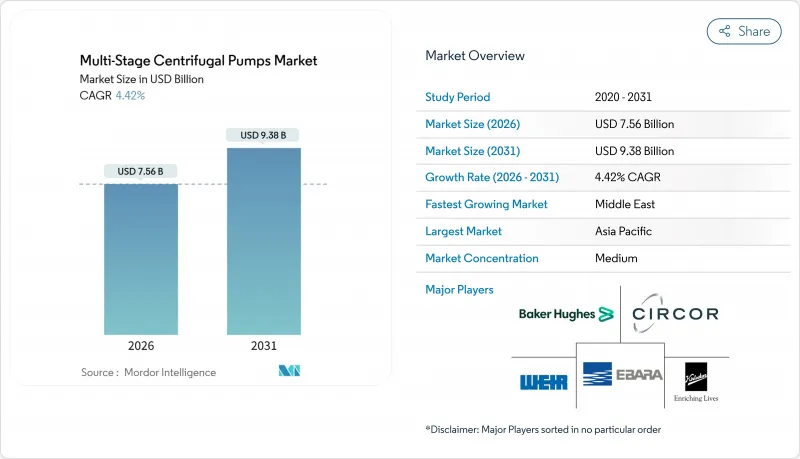
According to Mordor Intelligence, the multi-stage centrifugal pumps market size reached USD 7.56 billion in 2026 and is projected to climb to USD 9.38 billion by 2031, translating into a 4.42% CAGR through the forecast period.
This report is Segmented by Type (Horizontal Pumps, and Vertical Pumps), Stage (2-5 Stage, 6-10 Stage, and Above 10 Stage), Material (Cast Iron, Stainless Steel, Duplex and Super Duplex Steel, Other Materials), End-User Industry (Oil and Gas, Chemicals, Food and Beverage, and More), and Geography. The Market Forecasts are Provided in Terms of Value (USD), Based On Availability.
Global Multi-Stage Centrifugal Pumps Market Trends and Insights
Surging Water and Wastewater Infrastructure Spending
Public funding for pipe replacement and treatment upgrades is translating directly into demand for pressure-boosting multi-stage units. The United States Bipartisan Infrastructure Law earmarked USD 55 billion for water networks, and over 40% of municipal pumps in the country have surpassed 30-year service life. Similar momentum in Europe is led by Germany's EUR 2.5 billion (USD 2.67 billion) municipal program and supportive financing from the European Investment Bank. Compliance with new U.S. Department of Energy energy-index thresholds that took effect in 2025 is accelerating the swap-out of inefficient single-stage equipment. Together, these dynamics underpin the largest installed-base refresh ever seen in the segment, favoring horizontal configurations that simplify maintenance procedures.
Expansion of Desalination Projects in Water-Scarce Economies
Committed capital topping USD 100 billion across the Gulf Cooperation Council has catalyzed a wave of orders for high-pressure multi-stage pumps capable of operating at 60-80 bar. Flagship sites such as Yanbu 4 and Shuaibah 3 in Saudi Arabia each specify more than a dozen 14-stage duplex-steel models. Outside the Gulf, Egypt's Abu Qir plant and the United Arab Emirates' Hassyan project are adopting energy-recovery devices that cut pump power draw by a third. The material mix is shifting accordingly, with duplex and super duplex steels displacing 316L stainless steel as chloride-induced corrosion limits rise.
Volatility in Raw-Material Prices Raising Capex for OEMs
Nickel and chromium price spikes in 2025 lifted duplex-steel input costs by double digits, squeezing gross margins at suppliers locked into multi-year municipal contracts. Flowserve cited a 220-basis-point margin contraction in 2025 as it struggled to pass through higher alloy surcharges. Currency swings exacerbate planning risk, especially for European OEMs purchasing Asian forgings in U.S. dollars. Some manufacturers now hedge by bulk-buying stainless-steel castings and diversifying supplier bases, yet sustained volatility still weighs on near-term profitability.
Other drivers and restraints analyzed in the detailed report include:
- Increasing Deep-Well Oilfield Projects Requiring High-Head Pumping
- Shift Toward Energy-Efficient Pump Designs Driven by ESG Targets
- Intensifying Competition from Low-Cost Regional Manufacturers
For complete list of drivers and restraints, kindly check the Table Of Contents.
Segment Analysis
The vertical subsegment is projected to grow at 5.45% CAGR, a pace that outstrips the overall multi-stage centrifugal pumps market by more than 100 basis points. Horizontal models maintain a 61.0% multi-stage centrifugal pumps market share on the strength of lower installation expense in water treatment and industrial cooling duty. However, high-rise construction and offshore platform projects prioritize compact footprints, tipping procurement toward vertical stacks equipped with integrated drives. Wilo's Helix EXCEL line, introduced in 2025, saves 40% floor space relative to comparable horizontals, a decisive advantage in premium urban basements. Offshore wells reinforce the same preference; modular vertical assemblies fit 9-inch casings and can descend beyond 3,500 meters to lift fluids in Saudi Aramco's Marjan field. As end users shift to predictive maintenance, vibration sensors mounted on vertical axes offer cleaner data streams, supporting analytics platforms without costly retrofits.
Horizontal units will continue to dominate power-generation cooling circuits where inline layouts simplify turbine-driven back-up arrangements. Many public utilities own existing spare parts inventories geared toward horizontal pumps, tempering the conversion rate. Nevertheless, the steady rollout of high-density commercial towers in Asia and the Middle East will ensure that vertical solutions steadily erode horizontal share, particularly where building regulations cap mechanical-room footprints. Suppliers that deliver plug-and-play vertical skids with IE4 motors and cloud-ready controllers are positioned to outpace the broader multi-stage centrifugal pumps market.
Units carrying 2-5 impellers represented 45.2% of the multi-stage centrifugal pumps market size in 2025, but above-10-stage machines will advance at a 5.21% CAGR through 2031 as desalination, carbon-capture, and deep-reservoir oil lifts proliferate. Saudi Arabia's Yanbu 4 plant employs 14-stage pumps rated at 75 bar to offset the osmotic pressure of 45,000 ppm seawater, illustrating how multi-stage counts rise in tandem with salinity and head height. Similarly, Norway's Northern Lights carbon-capture system compresses liquefied CO2 to 150 bar using 16-stage compressors, a template for future sequestration hubs.
Mid-range 6-10 stage pumps remain workhorses in boiler feedwater and chemical processing, where balanced capital and operating costs matter more than peak discharge pressure. Yet each additional impeller adds mechanical complexity, so OEMs deploy ceramic-coated wear rings and thrust-balancing designs to sustain mean time between overhaul. Digital twins created during computational-fluid-dynamics simulations now predict internal recirculation patterns, enabling OEMs to fine-tune stage counts before casting billets, an emerging efficiency lever within the multi-stage centrifugal pumps market.
Complete Report Scope:
- By Type
- Horizontal Pumps
- Vertical Pumps
- By Stage
- 2-5 Stage
- 6-10 Stage
- Above 10 Stage
- By Material
- Cast Iron
- Stainless Steel
- Duplex and Super Duplex Steel
- Other Materials
- By End-User Industry
- Oil and Gas
- Chemicals
- Food and Beverage
- Water and Wastewater
- Power Generation
- Pharmaceuticals
- Metals and Mining
- Other End-User Industries
- By Geography
- North America
- United States
- Canada
- Mexico
- South America
- Brazil
- Argentina
- Rest of South America
- Europe
- Germany
- France
- United Kingdom
- Italy
- Russia
- Rest of Europe
- Asia Pacific
- China
- India
- Japan
- South Korea
- Rest of Asia Pacific
- Middle East
- Saudi Arabia
- United Arab Emirates
- Turkey
- Rest of Middle East
- Africa
- South Africa
- Nigeria
- Egypt
- Rest of Africa
- North America
Geography Analysis
Asia Pacific accounted for 36.7% of global revenue in 2025, buoyed by China's CNY 5.4 trillion (USD 740 billion) rural water program and India's Jal Jeevan Mission that linked 148 million homes to piped networks by December 2025. Government subsidies under India's PM-KUSUM scheme funded 180,000 solar-powered agricultural pumps, spotlighting a sizeable off-grid niche. Japan's Ministry of Health, Labour and Welfare earmarked JPY 1.2 trillion (USD 8.1 billion) to replace aging mains, implying elevated demand for small and mid-size units through 2028. Southeast Asian irrigation projects in Vietnam and Indonesia round out the region's near-term pipeline. Local manufacturers enjoy cost advantages, yet global brands preserve share in high-specification builds that require third-party certification.
The Middle East is forecast to register the fastest 5.62% CAGR across 2026-2031 as desalination and nuclear power construction drive high-pressure pump procurement. Saudi Arabia's Yanbu 4 and Shuaibah 3 plants, Qatar's Facility E, and the UAE's Hassyan project headline a dense order book for duplex-steel multistage units. Turkey's Akkuyu nuclear complex adds another 96 primary and secondary cooling pumps to regional demand. Financing from sovereign wealth funds and development banks mitigates commodity-price volatility, ensuring a steady tender cadence.
North America and Europe together represented 38% of 2025 turnovers, with sales propelled by lifecycle-driven replacements mandated by new energy-efficiency standards. The U.S. Department of Energy rules effective January 2025 and Europe's IE4 motor stipulations effective 2027 advance variable-speed multi-stage adoption. Latin America's expansion concentrates in Brazil and Argentina where irrigation and mining hold sway, whereas Africa's outlook is shaped by South Africa's Lesotho Highlands Water Project Phase II and Kenya's solar-pump irrigation program. Despite divergent baselines, all regions converge on a common requirement for higher efficiency and lower unplanned downtime, hallmarks of modern multi-stage centrifugal pumps market offerings.
- Kirloskar Brothers Limited
- Baker Hughes Company
- Circor International Inc.
- Ebara Corporation
- The Weir Group plc
- Grundfos Holding A/S
- Pentair plc
- Sulzer Ltd
- Tsurumi Manufacturing Co. Ltd
- Wilo SE
- Xylem Inc.
- KSB SE & Co. KGaA
- Flowserve Corporation
- Ruhrpumpen Group
- ANDRITZ AG
- SPX FLOW Inc.
- ITT Inc. (Goulds Pumps)
- Dab Pumps S.p.A.
- Shakti Pumps (India) Ltd
- Flowrox Oy
Additional Benefits:
- The market estimate (ME) sheet in Excel format
- 3 months of analyst support
TABLE OF CONTENTS
1 INTRODUCTION
- 1.1 Study Assumptions and Market Definition
- 1.2 Scope of the Study
2 RESEARCH METHODOLOGY
3 EXECUTIVE SUMMARY
4 MARKET LANDSCAPE
- 4.1 Market Overview
- 4.2 Market Drivers
- 4.2.1 Surging Water and Wastewater Infrastructure Spending in North America and Europe
- 4.2.2 Expansion of Desalination Projects in Water-Scarce Economies
- 4.2.3 Increasing Deep-Well Oilfield Projects Requiring High-Head Pumping
- 4.2.4 Shift Toward Energy-Efficient Pump Designs Driven by ESG Targets
- 4.2.5 Integration of IIoT-Enabled Predictive Maintenance Platforms
- 4.2.6 Growing Government Subsidies for Rural Irrigation in Asia Pacific
- 4.3 Market Restraints
- 4.3.1 Volatility in Raw Material Prices Raising Capex for OEMs
- 4.3.2 Intensifying Competition from Low-Cost Regional Manufacturers
- 4.3.3 Lengthy Certification Cycles in Nuclear and Power Applications
- 4.3.4 Rising Adoption of Alternative Positive-Displacement Pump Technologies
- 4.4 Industry Value-Chain Analysis
- 4.5 Regulatory Landscape
- 4.6 Technological Outlook
- 4.7 Porter's Five Forces Analysis
- 4.7.1 Bargaining Power of Suppliers
- 4.7.2 Bargaining Power of Buyers
- 4.7.3 Threat of New Entrants
- 4.7.4 Threat of Substitutes
- 4.7.5 Intensity of Competitive Rivalry
- 4.8 Impact of Macroeconomic Factors on the Market
5 MARKET SIZE AND GROWTH FORECASTS (VALUE)
- 5.1 By Type
- 5.1.1 Horizontal Pumps
- 5.1.2 Vertical Pumps
- 5.2 By Stage
- 5.2.1 2-5 Stage
- 5.2.2 6-10 Stage
- 5.2.3 Above 10 Stage
- 5.3 By Material
- 5.3.1 Cast Iron
- 5.3.2 Stainless Steel
- 5.3.3 Duplex and Super Duplex Steel
- 5.3.4 Other Materials
- 5.4 By End-User Industry
- 5.4.1 Oil and Gas
- 5.4.2 Chemicals
- 5.4.3 Food and Beverage
- 5.4.4 Water and Wastewater
- 5.4.5 Power Generation
- 5.4.6 Pharmaceuticals
- 5.4.7 Metals and Mining
- 5.4.8 Other End-User Industries
- 5.5 By Geography
- 5.5.1 North America
- 5.5.1.1 United States
- 5.5.1.2 Canada
- 5.5.1.3 Mexico
- 5.5.2 South America
- 5.5.2.1 Brazil
- 5.5.2.2 Argentina
- 5.5.2.3 Rest of South America
- 5.5.3 Europe
- 5.5.3.1 Germany
- 5.5.3.2 France
- 5.5.3.3 United Kingdom
- 5.5.3.4 Italy
- 5.5.3.5 Russia
- 5.5.3.6 Rest of Europe
- 5.5.4 Asia Pacific
- 5.5.4.1 China
- 5.5.4.2 India
- 5.5.4.3 Japan
- 5.5.4.4 South Korea
- 5.5.4.5 Rest of Asia Pacific
- 5.5.5 Middle East
- 5.5.5.1 Saudi Arabia
- 5.5.5.2 United Arab Emirates
- 5.5.5.3 Turkey
- 5.5.5.4 Rest of Middle East
- 5.5.6 Africa
- 5.5.6.1 South Africa
- 5.5.6.2 Nigeria
- 5.5.6.3 Egypt
- 5.5.6.4 Rest of Africa
- 5.5.1 North America
6 COMPETITIVE LANDSCAPE
- 6.1 Market Concentration
- 6.2 Strategic Moves
- 6.3 Market Share Analysis
- 6.4 Company Profiles {(includes Global Level Overview, Market Level Overview, Core Segments, Financials as Available, Strategic Information, Market Rank/Share for Key Companies, Products and Services, and Recent Developments)}
- 6.4.1 Kirloskar Brothers Limited
- 6.4.2 Baker Hughes Company
- 6.4.3 Circor International Inc.
- 6.4.4 Ebara Corporation
- 6.4.5 The Weir Group plc
- 6.4.6 Grundfos Holding A/S
- 6.4.7 Pentair plc
- 6.4.8 Sulzer Ltd
- 6.4.9 Tsurumi Manufacturing Co. Ltd
- 6.4.10 Wilo SE
- 6.4.11 Xylem Inc.
- 6.4.12 KSB SE & Co. KGaA
- 6.4.13 Flowserve Corporation
- 6.4.14 Ruhrpumpen Group
- 6.4.15 ANDRITZ AG
- 6.4.16 SPX FLOW Inc.
- 6.4.17 ITT Inc. (Goulds Pumps)
- 6.4.18 Dab Pumps S.p.A.
- 6.4.19 Shakti Pumps (India) Ltd
- 6.4.20 Flowrox Oy
7 MARKET OPPORTUNITIES AND FUTURE OUTLOOK
- 7.1 White-Space and Unmet-Need Assessment

