PUBLISHER: Mordor Intelligence | PRODUCT CODE: 2154840

PUBLISHER: Mordor Intelligence | PRODUCT CODE: 2154840
South America Centrifugal Pumps - Market Share Analysis, Industry Trends & Statistics, Growth Forecasts (2026 - 2031)
According to Mordor Intelligence, the South America centrifugal pumps market size was valued at USD 3.04 billion in 2025 and estimated to grow from USD 3.28 billion in 2026 to reach USD 4.72 billion by 2031, at a CAGR of 7.55% during the forecast period (2026-2031).
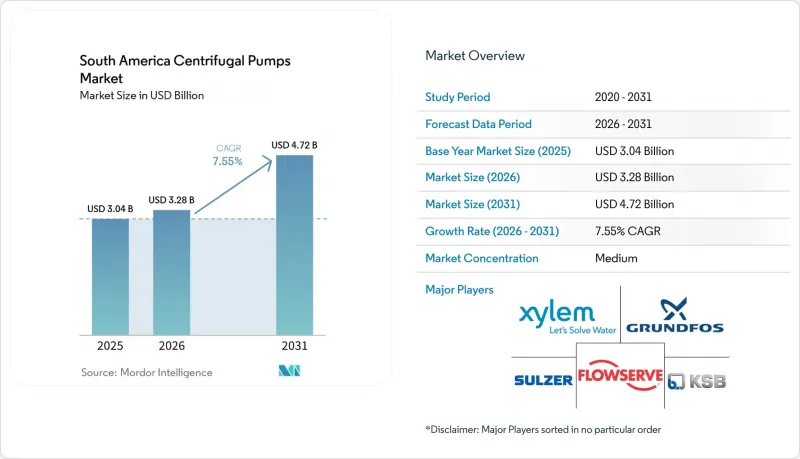
South America Centrifugal Pumps Market Trends and Insights
Brazil Sanitation Investment and Pump Replacement
Brazil's sanitation concession program is a major near-term driver of demand for the South America Centrifugal Pumps Market. Contracted investment under the sanitation framework exceeded USD 68 billion by February 2026. The framework seeks 99% potable-water coverage and 90% wastewater collection by 2033, even as more than 35 million people still lack potable-water access. Maranhao planned a concession covering 214 municipalities and USD 3.4 billion in investment. Para's statewide Aegea concession involved nearly USD 4 billion, while Santa Catarina's utility program involved more than USD 5.4 billion. These programs support both equipment deliveries and the ongoing service cycle that follows construction.
Offshore Oil and Gas and Refinery Expansion
Oil and gas investment supports demand for engineered pumping systems with demanding reliability and materials requirements. Refinery upgrades and deepwater developments support utility, transfer, and high-pressure pumping requirements. Such projects require equipment built for continuous process duty, corrosive fluids, and strict site safety procedures. Suppliers also need recognized engineering qualifications for critical service applications. Local technical support is important during installation, commissioning, and maintenance. These conditions raise the importance of capability beyond standard equipment supply.
Capital-Project Delays from Commodity-Price Volatility
Mining and energy projects can defer equipment purchases when commodity prices weaken or planning assumptions change. This affects the South America Centrifugal Pumps Market because large projects can represent substantial individual orders. A delayed mine expansion can delay water transfer, dewatering, and process-equipment packages simultaneously. High-altitude projects require designs that reflect water chemistry, solids exposure, elevation, and cooling conditions. Fiscal uncertainty can also lead public entities and state-linked companies to reallocate infrastructure budgets. Suppliers with broad installed bases are less exposed because service revenue can continue when new projects are postponed.
Other drivers and restraints analyzed in the detailed report include:
- Mining Dewatering and Tailings-Water Management
- Irrigation Modernization and Agribusiness Expansion
- Energy Consumption and Lifecycle-Cost Sensitivity
For complete list of drivers and restraints, kindly check the Table Of Contents.
Segment Analysis
Single-stage pumps accounted for 64.29% of revenue in 2025, supported by municipal water, heating and cooling, and general process uses. Their lower unit cost supports replacement purchases for large installed fleets. Routine maintenance is comparatively straightforward for local service providers. Brazilian and Argentine suppliers also have established supply chains for standard single-stage configurations. This availability helps customers manage downtime and replacement needs. Single-stage equipment remains important where duty conditions do not require several pressure stages. The South America Centrifugal Pumps Market continues to rely on this category for regular utility and process applications.
Multistage pumps are forecast to grow at an 8.13% CAGR from 2026 to 2031. High-head water transfer, reverse-osmosis feed systems, and offshore injection services support the South America Centrifugal Pumps Market size for multistage pumps. Coastal mining water systems need high-pressure equipment for long-distance transfer to elevated operations. The SADDN project demonstrates the demanding conditions of this operating environment. Refinery upgrades can also require stacked-stage pump packages for critical services. These units carry higher engineering requirements and support greater value per installation. Suppliers must provide technical support throughout the design, commissioning, and maintenance phases.
Radial-flow pumps accounted for 73.82% revenue share in 2025 within the South America Centrifugal Pumps Market. Their broad operating range supports oil and gas circuits, water utilities, chemical transfer, and general industrial duties. Operators can cover many applications with a limited range of radial-flow models. This simplifies inventory planning and spare-parts management. The design also suits customers who require consistent equipment performance across varied sites. Its leading position reflects the breadth of industrial and municipal applications across South America. Local and international manufacturers both participate in this established category.
Mixed-flow pumps are forecast to advance at an 8.43% CAGR through 2031. These systems are suited to high-volume services with low-to-moderate head requirements. Irrigation lift stations, mine dewatering systems, and urban stormwater facilities are relevant areas of demand. Domestic manufacturers can compete for industrial contracts by combining local manufacturing with certified supply chains. Their local production can also improve access to replacement parts. Axial-flow pumps remain focused on drainage and flood-control duties where very high flow and low head are
Complete Report Scope:
- By Stage
- Single-Stage Pumps
- Multistage Pumps
- By Pump Design
- Radial-Flow Pumps
- Mixed-Flow Pumps
- Axial-Flow Pumps
- By Impeller Type
- Open Impellers
- Semi-Open Impellers
- Enclosed Impellers
- By Application
- Water and Wastewater
- Chemicals and Petrochemicals
- HVAC and Building Services
- Oil and Gas
- Food and Beverages
- Mining and Metals
- Power Generation
- Pharmaceuticals and Biotechnology
- Other Applications
- By Geography
- Brazil
- Chile
- Argentina
- Rest of South America
List of Companies Covered in this Report:
- Grundfos Holding A/S
- Xylem Inc.
- Flowserve Corporation
- Sulzer Ltd
- KSB SE & Co. KGaA
- Wilo SE
- Ebara Corporation
- The Weir Group PLC
- ITT Inc.
- Baker Hughes Company
- Ruhrpumpen Group
- Pentair plc
- SPX FLOW, Inc.
- Kirloskar Brothers Limited
- Tsurumi Manufacturing Co., Ltd.
- ANDRITZ AG
- Torishima Pump Mfg. Co., Ltd.
- FAMAC Motobombas Ltda.
- IMBIL, Industria e Manutencao de Bombas ITA Ltda.
- Fabricadora de Bombas Industrias e Comercio Ltda.
- OMEL Bombas e Compressores Ltda.
- Capua Equipamentos Industriais Ltda.
Additional Benefits:
- The market estimate (ME) sheet in Excel format
- 3 months of analyst support
TABLE OF CONTENTS
1 INTRODUCTION
- 1.1 Study Assumptions and Market Definition
- 1.2 Scope of the Study
2 RESEARCH METHODOLOGY
3 EXECUTIVE SUMMARY
4 MARKET LANDSCAPE
- 4.1 Market Overview
- 4.2 Market Drivers
- 4.2.1 Brazil Sanitation Investment and Pump Replacement
- 4.2.2 Mining Dewatering and Tailings-Water Management
- 4.2.3 Offshore Oil and Gas and Refinery Expansion
- 4.2.4 Irrigation Modernization and Agribusiness Expansion
- 4.2.5 Energy-Efficiency Retrofits and Variable-Speed Adoption
- 4.2.6 Localized Engineering and Shorter Spare-Parts Lead Times
- 4.3 Market Restraints
- 4.3.1 Capital-Project Delays from Commodity-Price Volatility
- 4.3.2 Energy Consumption and Lifecycle-Cost Sensitivity
- 4.3.3 Cavitation from Poor System Design and Variable Water Quality
- 4.3.4 Low-Cost Local Competition and Imported Component Exposure
- 4.4 Impact of Macroeconomic Factors on the Market
- 4.5 Industry Value Chain Analysis
- 4.6 Regulatory Landscape
- 4.7 Technological Outlook
- 4.8 Porter's Five Forces Analysis
- 4.8.1 Bargaining Power of Suppliers
- 4.8.2 Bargaining Power of Buyers
- 4.8.3 Threat of New Entrants
- 4.8.4 Threat of Substitutes
- 4.8.5 Intensity of Competitive Rivalry
5 MARKET SIZE AND GROWTH FORECASTS (VALUE)
- 5.1 By Stage
- 5.1.1 Single-Stage Pumps
- 5.1.2 Multistage Pumps
- 5.2 By Pump Design
- 5.2.1 Radial-Flow Pumps
- 5.2.2 Mixed-Flow Pumps
- 5.2.3 Axial-Flow Pumps
- 5.3 By Impeller Type
- 5.3.1 Open Impellers
- 5.3.2 Semi-Open Impellers
- 5.3.3 Enclosed Impellers
- 5.4 By Application
- 5.4.1 Water and Wastewater
- 5.4.2 Chemicals and Petrochemicals
- 5.4.3 HVAC and Building Services
- 5.4.4 Oil and Gas
- 5.4.5 Food and Beverages
- 5.4.6 Mining and Metals
- 5.4.7 Power Generation
- 5.4.8 Pharmaceuticals and Biotechnology
- 5.4.9 Other Applications
- 5.5 By Geography
- 5.5.1 Brazil
- 5.5.2 Chile
- 5.5.3 Argentina
- 5.5.4 Rest of South America
6 COMPETITIVE LANDSCAPE
- 6.1 Market Concentration
- 6.2 Strategic Moves
- 6.3 Market Share Analysis
- 6.4 Company Profiles (includes Global Level Overview, Market Level Overview, Core Segments, Financials as available, Strategic Information, Market Rank/Share, Products and Services, Recent Developments)
- 6.4.1 Grundfos Holding A/S
- 6.4.2 Xylem Inc.
- 6.4.3 Flowserve Corporation
- 6.4.4 Sulzer Ltd
- 6.4.5 KSB SE & Co. KGaA
- 6.4.6 Wilo SE
- 6.4.7 Ebara Corporation
- 6.4.8 The Weir Group PLC
- 6.4.9 ITT Inc.
- 6.4.10 Baker Hughes Company
- 6.4.11 Ruhrpumpen Group
- 6.4.12 Pentair plc
- 6.4.13 SPX FLOW, Inc.
- 6.4.14 Kirloskar Brothers Limited
- 6.4.15 Tsurumi Manufacturing Co., Ltd.
- 6.4.16 ANDRITZ AG
- 6.4.17 Torishima Pump Mfg. Co., Ltd.
- 6.4.18 FAMAC Motobombas Ltda.
- 6.4.19 IMBIL, Industria e Manutencao de Bombas ITA Ltda.
- 6.4.20 Fabricadora de Bombas Industrias e Comercio Ltda.
- 6.4.21 OMEL Bombas e Compressores Ltda.
- 6.4.22 Capua Equipamentos Industriais Ltda.
7 MARKET OPPORTUNITIES AND FUTURE OUTLOOK
- 7.1 White-Space and Unmet-Need Assessment

