PUBLISHER: Mordor Intelligence | PRODUCT CODE: 2116778

PUBLISHER: Mordor Intelligence | PRODUCT CODE: 2116778
Middle East And Africa Centrifugal Pumps - Market Share Analysis, Industry Trends & Statistics, Growth Forecasts (2026 - 2031)
According to Mordor Intelligence, the centrifugal pumps market size in the Middle East and Africa is USD 2.94 billion in 2026 and is projected to reach USD 3.66 billion by 2031, translating into a 4.48% CAGR through the forecast period.
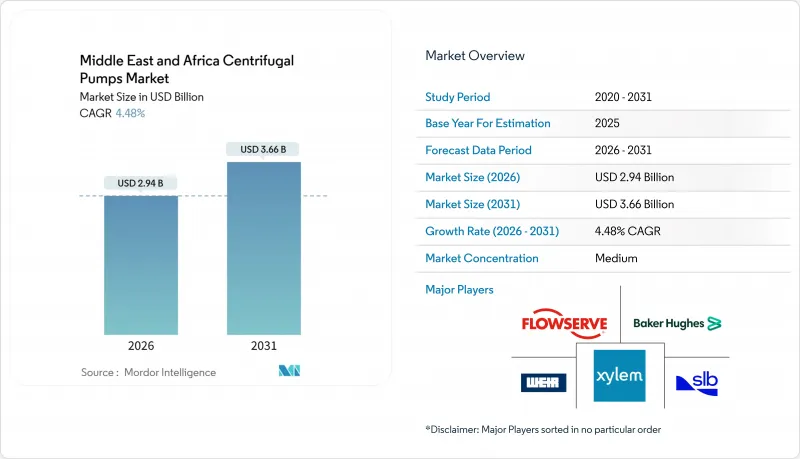
This report is Segmented by Flow Type (Axial, Radial, Mixed), Number of Stages (Single Stage, and Multi Stage), End-User Industry (Oil and Gas, Power, and More), Capacity Range (Micro (Below 500 Gpm), Small (500-1, 000 Gpm), Medium (1, 000-5, 000 Gpm), and More), Material (Cast Iron, Stainless Steel, and More), and Geography. The Market Forecasts are Provided in Terms of Value (USD).
Middle East And Africa Centrifugal Pumps Market Trends and Insights
Rapid Industrialization and Urbanization Uptick
Urban residents already make up 89% of the Gulf Cooperation Council population, a density that forces municipalities to commission new potable-water, sewage-treatment, and fire-protection assets at an estimated 12,000-15,000 units annually. Mega-projects such as NEOM in Saudi Arabia and Egypt's New Administrative Capital embed high-efficiency centrifugal pumps rated above 3,000 gpm in desalination and transmission loops. District cooling, deep-basement dewatering, and NFPA-20-compliant fire systems add further layers of demand. Designers are increasingly specifying variable-speed drives and corrosion-resistant alloys to manage energy use and chloride-rich conditions. Collectively, these city-building programs anchor a long pipeline of recurring orders that reinforce the Middle East And Africa centrifugal pumps market across both base-load infrastructure and auxiliary services.
Rising Investments in Urban Wastewater Treatment
Saudi Arabia's National Water Company is channeling USD 21 billion toward lifting wastewater throughput to 8.2 million m3/day by 2030. Kuwait's USD 2.4 billion Sulaibiya upgrade and South Africa's ZAR 3.2 billion Gauteng refurbishments underscore a region-wide shift toward higher treatment standards. Projects now favor membrane bioreactor or reverse-osmosis polishing, both of which demand low-pulsation, abrasion-resistant centrifugal pumps with stainless or duplex wetted parts. Variable-frequency drives are standard, cutting energy use 20%-30% while meeting ISO 50001 requirements. As utilities press to achieve 70% water reuse targets, the Middle East And Africa centrifugal pumps market gains exposure to long-term operations and maintenance contracts, enlarging lifetime revenue per installation.
Cavitation and Priming Failures in Deep-Well Installations
Static lifts above 300 m in Saudi fossil-aquifer zones produce low suction pressure, triggering vapor bubbles that erode impellers and trim efficiency by up to 25% within half a year. Similar issues in the UAE's Al Ain wells required retrofits involving variable-frequency drives and vacuum-priming systems, at an additional USD 8,000-12,000 per site. Horizontal fire-water pumps also miss start-up targets when air pockets linger in suction lines, compromising NFPA compliance. Although self-priming designs and condition monitoring can halve failure rates, the added capital outlay slows adoption among budget-strained operators and dilutes the momentum of the Middle East And Africa centrifugal pumps market.
Other drivers and restraints analyzed in the detailed report include:
- Expansion of Desalination Projects in Gulf Countries
- Accelerated Mining Projects in Africa's Copper Belt
- Chemical Compatibility Limitations with Sour Crudes
For complete list of drivers and restraints, kindly check the Table Of Contents.
Segment Analysis
Radial-flow pumps commanded 54.67% of the Middle East And Africa centrifugal pumps market in 2025, thanks to solid traction in municipal grids and HVAC cooling loops where heads rarely exceed 150 ft. Their straightforward hydraulics, broad supplier base, and compatibility with variable-speed drives reinforce procurement comfort. Mixed-flow configurations, however, are registering a 5.07% CAGR through 2031 as mining companies retrofit slurry circuits with hybrid impellers that tolerate 20%-30% solids without sacrificing efficiency. The Kamoa-Kakula expansion in the Democratic Republic of Congo typifies this pivot, specifying dozens of mixed-flow units for tailings discharge.
The design's lower net-positive suction head requirement reduces excavation depth in new pump-station builds, a critical advantage in Africa's shallow water tables. Flowserve's 2024 release of a semi-open impeller further lengthens maintenance intervals to six months. Radial pumps retain dominance in high-pressure desalination, achieving efficiencies above 80% at 1,000 psi, while axial-flow units continue to serve flood-control projects in Egypt's Nile Delta and Saudi date-palm irrigation where flows exceed 50,000 gpm. Collectively, these patterns sustain a balanced yet evolving Middle East And Africa centrifugal pumps market, in which mixed-flow technology is carving out a growing, high-margin niche.
Single-stage designs accounted for 62.31% of the centrifugal pump market in 2025 because their simplicity meets the majority of building-services and municipal-water applications. However, multi-stage models are advancing at a 4.86% CAGR, fueled by Saudi Arabia's Jafurah field, where 18-stage barrel pumps deliver 8,000 psi water-alternating-gas injection. Desalination's six- to eight-stage pumps feeding membranes at 1,200 psi represent another growth vein.
Sulzer's HiFlux diffuser reduced inter-stage losses by 12%, offering payback in less than two years for continuous-duty installations. Yet the rotor-dynamic complexity of more than 10 stages pushes OEMs to provide finite-element validation and field balancing. Single-stage pumps still dominate NFPA-20 fire systems, but rising skyscraper heights may tilt preferences toward twin-stage split-case units that maintain head at 150% rated capacity. For now, the Middle East And Africa centrifugal pumps market balances mature single-stage volumes with premium multi-stage value growth.
Complete Report Scope:
- By Flow Type
- Axial
- Radial
- Mixed
- By Number of Stages
- Single Stage
- Multi Stage
- By End-User Industry
- Oil and Gas
- Food and Beverages
- Water and Wastewater
- Pharmaceutical
- Power
- Construction
- Metal and Mining
- Other End-User Industries
- By Capacity Range
- Micro (Below 500 gpm)
- Small (500-1,000 gpm)
- Medium (1,000-5,000 gpm)
- Large (Above 5,000 gpm)
- By Material
- Cast Iron
- Stainless Steel
- Bronze
- Other Materials
- By Geography
- Middle East
- Saudi Arabia
- United Arab Emirates
- Rest of Middle East
- Africa
- South Africa
- Rest of Africa
- Middle East
List of Companies Covered in this Report:
- Baker Hughes Company
- Ebara Pumps Middle East FZE
- Flowserve Corporation
- KSB Middle East FZE
- Ruhrpumpen Group
- Schlumberger Limited
- Parker Hannifin Corp
- The Weir Group plc
- Dover Corporation
- Xylem Inc
- Sulzer Ltd
- Grundfos Gulf Distribution
- Kirloskar Brothers Ltd
- Torishima Pump Mfg Co Ltd
- Pentair plc
- Wilo Middle East FZE
- Atlas Copco AB
- SPX FLOW Inc
- Tsurumi Manufacturing Co Ltd
- Franklin Electric Co Inc
Additional Benefits:
- The market estimate (ME) sheet in Excel format
- 3 months of analyst support
TABLE OF CONTENTS
1 INTRODUCTION
- 1.1 Study Assumptions and Market Definition
- 1.2 Scope of the Study
2 RESEARCH METHODOLOGY
3 EXECUTIVE SUMMARY
4 MARKET LANDSCAPE
- 4.1 Market Overview
- 4.2 Market Drivers
- 4.2.1 Rapid Industrialization and Urbanization Uptick
- 4.2.2 Rising Investments in Urban Wastewater Treatment
- 4.2.3 Expansion of Desalination Projects in Gulf Countries
- 4.2.4 Accelerated Mining Projects in Africa's Copper Belt
- 4.2.5 Government-Led Oil and Gas Capacity Upgrades
- 4.2.6 Local Manufacturing Incentives for Pump Components
- 4.3 Market Restraints
- 4.3.1 Cavitation and Priming Failures in Deep-Well Installations
- 4.3.2 Chemical Compatibility Limitations with Sour Crudes
- 4.3.3 Price Volatility of Stainless-Steel and Alloy Inputs
- 4.3.4 Persistent Counterfeit Spare-Parts Supply Chain
- 4.4 Industry Value Chain Analysis
- 4.5 Regulatory Landscape
- 4.6 Technological Outlook
- 4.7 Impact of Macroeconomic Factors on the Market
- 4.8 Porter's Five Forces Analysis
- 4.8.1 Bargaining Power of Suppliers
- 4.8.2 Bargaining Power of Buyers
- 4.8.3 Threat of New Entrants
- 4.8.4 Threat of Substitutes
- 4.8.5 Intensity of Competitive Rivalry
5 MARKET SIZE AND GROWTH FORECASTS (VALUE)
- 5.1 By Flow Type
- 5.1.1 Axial
- 5.1.2 Radial
- 5.1.3 Mixed
- 5.2 By Number of Stages
- 5.2.1 Single Stage
- 5.2.2 Multi Stage
- 5.3 By End-User Industry
- 5.3.1 Oil and Gas
- 5.3.2 Food and Beverages
- 5.3.3 Water and Wastewater
- 5.3.4 Pharmaceutical
- 5.3.5 Power
- 5.3.6 Construction
- 5.3.7 Metal and Mining
- 5.3.8 Other End-User Industries
- 5.4 By Capacity Range
- 5.4.1 Micro (Below 500 gpm)
- 5.4.2 Small (500-1,000 gpm)
- 5.4.3 Medium (1,000-5,000 gpm)
- 5.4.4 Large (Above 5,000 gpm)
- 5.5 By Material
- 5.5.1 Cast Iron
- 5.5.2 Stainless Steel
- 5.5.3 Bronze
- 5.5.4 Other Materials
- 5.6 By Geography
- 5.6.1 Middle East
- 5.6.1.1 Saudi Arabia
- 5.6.1.2 United Arab Emirates
- 5.6.1.3 Rest of Middle East
- 5.6.2 Africa
- 5.6.2.1 South Africa
- 5.6.2.2 Rest of Africa
- 5.6.1 Middle East
6 COMPETITIVE LANDSCAPE
- 6.1 Market Concentration
- 6.2 Strategic Moves
- 6.3 Market Share Analysis
- 6.4 Company Profiles (includes Global Level Overview, Market Level Overview, Core Segments, Financials as Available, Strategic Information, Market Rank/Share for Key Companies, Products and Services, and Recent Developments)
- 6.4.1 Baker Hughes Company
- 6.4.2 Ebara Pumps Middle East FZE
- 6.4.3 Flowserve Corporation
- 6.4.4 KSB Middle East FZE
- 6.4.5 Ruhrpumpen Group
- 6.4.6 Schlumberger Limited
- 6.4.7 Parker Hannifin Corp
- 6.4.8 The Weir Group plc
- 6.4.9 Dover Corporation
- 6.4.10 Xylem Inc
- 6.4.11 Sulzer Ltd
- 6.4.12 Grundfos Gulf Distribution
- 6.4.13 Kirloskar Brothers Ltd
- 6.4.14 Torishima Pump Mfg Co Ltd
- 6.4.15 Pentair plc
- 6.4.16 Wilo Middle East FZE
- 6.4.17 Atlas Copco AB
- 6.4.18 SPX FLOW Inc
- 6.4.19 Tsurumi Manufacturing Co Ltd
- 6.4.20 Franklin Electric Co Inc
7 MARKET OPPORTUNITIES AND FUTURE OUTLOOK
- 7.1 White-Space and Unmet-Need Assessment

