PUBLISHER: Mordor Intelligence | PRODUCT CODE: 2125400

PUBLISHER: Mordor Intelligence | PRODUCT CODE: 2125400
Middle East And Africa Management Consulting Services - Market Share Analysis, Industry Trends & Statistics, Growth Forecasts (2026 - 2031)
According to Mordor Intelligence, the Middle East and Africa management consulting services market size is USD 12.13 billion in 2026 and is forecast to reach USD 21.59 billion by 2031, translating into a CAGR of 12.21% over the period.
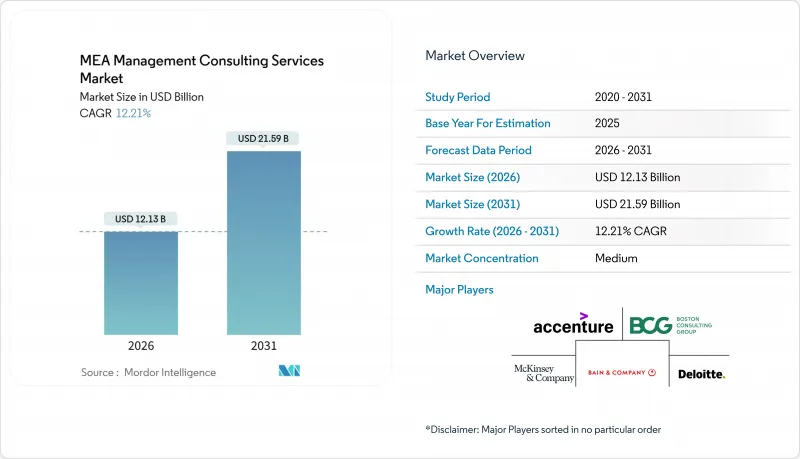
This report is Segmented by Service Type (Operations Consulting, Strategy Consulting, and More), Consulting Theme (Digital Transformation, ESG / Sustainability, and More), End-User Industry (Financial Services, and More), Enterprise (Large Enterprises and Small and Medium Enterprises), and Country. The Market Forecasts are Provided in Terms of Value (USD).
Middle East And Africa Management Consulting Services Market Trends and Insights
Digital-Transformation Budgets Rise Under GCC Vision Programs
Saudi Arabia has earmarked SAR 120 billion (USD 32 billion) for information-technology infrastructure between 2024-2029, including a mandate that 70% of government services migrate to cloud platforms by 2025. Ministries, therefore, turn to advisors for enterprise architecture design, legacy system migration, and change management. The United Arab Emirates is pursuing 100% digital service delivery under its Digital Government Strategy 2025, prompting complex tenders that favor firms with deep public-sector credentials. Qatar's Digital Agenda 2030 allocates QAR 8 billion (USD 2.2 billion) to smart-city pilots and AI-enabled citizen services, again bringing in consultants for multi-year strategic roles. Localization clauses that require in-country data residency and a nationalized workforce further tilt awards toward practices with local delivery hubs. Together, these initiatives ensure a steady pipeline for the Middle East and Africa management consulting services market.
Public-Sector Outsourcing of Strategy Formulation Accelerates
The Public Investment Fund in Saudi Arabia has engaged external advisors on more than 40 gigaprojects with combined capital outlays exceeding USD 500 billion. In 2024, the United Arab Emirates directed all federal entities with budgets above AED 500 million (USD 136 million) to conduct independent strategic reviews triennially, instantly creating a recurring need for third-party consultants. Egypt's Sovereign Fund outsourced feasibility studies for infrastructure and healthcare assets worth EGP 200 billion (USD 6.5 billion), while South Africa now obliges state-owned enterprises seeking turnaround funds to procure external advice. Although price-weighted procurement compresses margins, the volume and complexity of these mandates enlarge total spending, thereby widening the Middle East and Africa management consulting services market.
Shortage of Senior Bilingual Consultants Inflates Fee Rates
Demand for Arabic-English bilingual directors outpaces supply by roughly 30%, forcing firms to raise billing rates by up to 20% year on year. Emiratisation quotas in the United Arab Emirates require 2% of skilled roles to be held by nationals by 2026, spurring signing bonuses of AED 200,000 (USD 54,000). Saudi Arabia's Nitaqat program tightens domestic hiring targets, compelling firms to establish costly training academies. Higher fee structures and delivery delays temper the addressable demand for Middle East and Africa management consulting services.
Other drivers and restraints analyzed in the detailed report include:
- Private-Equity Deployment into Africa Boosts Demand for Due-Diligence Advisory
- Race for ESG and Green-Finance Compliance Consulting
- Procurement-Led Price Compression at State-Owned Enterprises
For complete list of drivers and restraints, kindly check the Table Of Contents.
Segment Analysis
The technology-advisory segment accounted for 29.11% of 2025 revenue, securing the largest share of the MEA management consulting services market. It is also projected to compound at 12.67% through 2031, marking it a cornerstone driver of the MEA management consulting services market size in absolute terms. Saudi Arabia's National Cybersecurity Authority mandated that all government agencies localize sensitive workloads by 2027, sparking USD 800 million in architecture and compliance engagements. The United Arab Emirates' AI Strategy 2031 aims to deploy machine learning across nine sectors, fueling high-margin advisory on data governance and bias testing.
Strategy consulting accounted for just under one-quarter of 2025 spend, buoyed by economic diversification agendas and African turnaround projects. Financial-advisory mandates clustered around privatizations and distressed-asset restructurings, securing an 18% share. Human-capital consulting supports workforce nationalization and hybrid-work transitions, while operations consulting attends to supply-chain and procurement redesign. Collectively, these service lines underscore the multi-disciplinary nature of the MEA management consulting services market.
Digital transformation accounted for 38.29% of thematic revenue in 2025, making it the largest pillar in the MEA management consulting services market. Within that umbrella, AI-driven transformation is poised to grow 12.88% a year to 2031, reflecting clients' shift from digitization to algorithmic automation. The MEA management consulting services market for operational-excellence programs remains sizable, though lean initiatives are plateauing as low-hanging efficiencies are realized.
Risk and compliance consulting thrives on proliferating data-protection statutes, while ESG mandates propel sustainability advisory. In 2025, the United Arab Emirates recorded the highest enterprise adoption rate for generative AI in the region at 42%. Saudi Arabia's USD 40 billion AI investment vehicle further inflates opportunity pipelines. These developments amplify demand for consultancies able to synthesize technology, regulatory, and change-management competencies.
Complete Report Scope:
- By Service Type
- Operations Consulting
- Strategy Consulting
- Financial Advisory
- Technology Advisory
- Human-Capital and Change Management
- By Consulting Theme
- Digital Transformation
- ESG / Sustainability
- Operational Excellence
- Risk and Compliance
- Other Themes
- By End-user Industry
- Financial Services
- Life Sciences and Healthcare
- IT and Telecommunications
- Government and Public Sector
- Energy and Utilities
- Retail and E-commerce
- By Enterprise
- Large Enterprises
- Small and Medium Enterprises
- By Country
- Saudi Arabia
- United Arab Emirates
- Qatar
- South Africa
- Egypt
- Nigeria
- Rest of the Middle East and Africa
List of Companies Covered in this Report:
- Accenture plc
- McKinsey & Company, Inc.
- The Boston Consulting Group, Inc.
- Bain & Company, Inc.
- Deloitte Touche Tohmatsu Limited
- Ernst & Young Global Limited
- PricewaterhouseCoopers LLP
- KPMG International Limited
- Strategy& LLC
- Oliver Wyman Group LLC
- Roland Berger GmbH
- Alvarez & Marsal Holdings, LLC
- Booz Allen Hamilton Inc.
- Arthur D. Little, Inc.
- L.E.K. Consulting LLC
- Arif Kitchlew Management Consultancy L.L.C.
- Proclipse Consulting Pvt. Ltd.
- Varri Consultancy OU
- Decision Management Consultants, Inc.
- Alpha Equity Management Consultancy L.L.C.
- Kaizen Consulting Group DMCC
- A&Z Management Consultants LLC
- Affility Consulting Ltd.
- NH Management Consulting LLC
- Kearney, Inc.
Additional Benefits:
- The market estimate (ME) sheet in Excel format
- 3 months of analyst support
TABLE OF CONTENTS
1 INTRODUCTION
- 1.1 Study Assumptions and Market Definition
- 1.2 Scope of the Study
2 RESEARCH METHODOLOGY
3 EXECUTIVE SUMMARY
4 MARKET LANDSCAPE
- 4.1 Market Overview
- 4.2 Market Drivers
- 4.2.1 Digital-Transformation Budgets Rise Under GCC Vision Programmes
- 4.2.2 Public-Sector Outsourcing of Strategy Formulation Accelerates
- 4.2.3 Private-Equity Deployment Into Africa Boosts Demand for Due-Diligence Advisory
- 4.2.4 Race for ESG and Green-Finance Compliance Consulting
- 4.2.5 GCCs Relocating to ME Drive Multi-Function Consulting Needs
- 4.2.6 SME Uptake of Online / Virtual Consulting Platforms Expands TAM
- 4.3 Market Restraints
- 4.3.1 Shortage of Senior Bilingual Consultants Inflates Fee Rates
- 4.3.2 Procurement-Led Price Compression at State-Owned Enterprises
- 4.3.3 Cross-Border Data Localisation Rules Complicate Multi-Country Projects
- 4.3.4 Fragmented Regulatory Licensing for Foreign-Owned Boutiques
- 4.4 Industry Value-Chain Analysis
- 4.5 Regulatory Landscape
- 4.6 Technological Outlook
- 4.7 Porter's Five Forces Analysis
- 4.7.1 Bargaining Power of Suppliers
- 4.7.2 Bargaining Power of Buyers
- 4.7.3 Threat of New Entrants
- 4.7.4 Threat of Substitutes
- 4.7.5 Intensity of Competitive Rivalry
- 4.8 Impact of Macroeconomic Factors on the Market
5 MARKET SIZE AND GROWTH FORECASTS (VALUE)
- 5.1 By Service Type
- 5.1.1 Operations Consulting
- 5.1.2 Strategy Consulting
- 5.1.3 Financial Advisory
- 5.1.4 Technology Advisory
- 5.1.5 Human-Capital and Change Management
- 5.2 By Consulting Theme
- 5.2.1 Digital Transformation
- 5.2.2 ESG / Sustainability
- 5.2.3 Operational Excellence
- 5.2.4 Risk and Compliance
- 5.2.5 Other Themes
- 5.3 By End-user Industry
- 5.3.1 Financial Services
- 5.3.2 Life Sciences and Healthcare
- 5.3.3 IT and Telecommunications
- 5.3.4 Government and Public Sector
- 5.3.5 Energy and Utilities
- 5.3.6 Retail and E-commerce
- 5.4 By Enterprise
- 5.4.1 Large Enterprises
- 5.4.2 Small and Medium Enterprises
- 5.5 By Country
- 5.5.1 Saudi Arabia
- 5.5.2 United Arab Emirates
- 5.5.3 Qatar
- 5.5.4 South Africa
- 5.5.5 Egypt
- 5.5.6 Nigeria
- 5.5.7 Rest of the Middle East and Africa
6 COMPETITIVE LANDSCAPE
- 6.1 Market Concentration
- 6.2 Strategic Moves
- 6.3 Market Share Analysis
- 6.4 Company Profiles (includes Global-level Overview, Market-level Overview, Core Segments, Financials as available, Strategic Information, Market Rank/Share, Products and Services, Recent Developments)
- 6.4.1 Accenture plc
- 6.4.2 McKinsey & Company, Inc.
- 6.4.3 The Boston Consulting Group, Inc.
- 6.4.4 Bain & Company, Inc.
- 6.4.5 Deloitte Touche Tohmatsu Limited
- 6.4.6 Ernst & Young Global Limited
- 6.4.7 PricewaterhouseCoopers LLP
- 6.4.8 KPMG International Limited
- 6.4.9 Strategy& LLC
- 6.4.10 Oliver Wyman Group LLC
- 6.4.11 Roland Berger GmbH
- 6.4.12 Alvarez & Marsal Holdings, LLC
- 6.4.13 Booz Allen Hamilton Inc.
- 6.4.14 Arthur D. Little, Inc.
- 6.4.15 L.E.K. Consulting LLC
- 6.4.16 Arif Kitchlew Management Consultancy L.L.C.
- 6.4.17 Proclipse Consulting Pvt. Ltd.
- 6.4.18 Varri Consultancy OU
- 6.4.19 Decision Management Consultants, Inc.
- 6.4.20 Alpha Equity Management Consultancy L.L.C.
- 6.4.21 Kaizen Consulting Group DMCC
- 6.4.22 A&Z Management Consultants LLC
- 6.4.23 Affility Consulting Ltd.
- 6.4.24 NH Management Consulting LLC
- 6.4.25 Kearney, Inc.
7 MARKET OPPORTUNITIES AND FUTURE OUTLOOK
- 7.1 White-Space and Unmet-Need Assessment

