PUBLISHER: Mordor Intelligence | PRODUCT CODE: 2117334

PUBLISHER: Mordor Intelligence | PRODUCT CODE: 2117334
Operations Advisory Service - Market Share Analysis, Industry Trends & Statistics, Growth Forecasts (2026 - 2031)
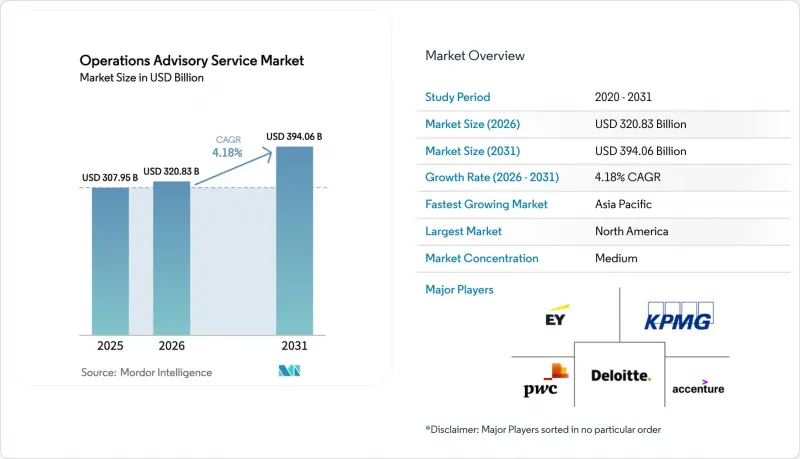
According to Mordor Intelligence, the operations advisory service market size is expected to grow from USD 307.95 billion in 2025 to USD 320.83 billion in 2026 and is forecast to reach USD 394.06 billion by 2031 at 4.18% CAGR over 2026-2031.
This report Segments the Industry Into by Organization Size (Large Enterprises, Small & Medium-Sized Enterprises), by Industry Vertical (BFSI, IT and Telecom, Manufacturing, Retail and E-Commerce, and Other), by Application (Supply Chain, Financial Operations, and Other), and by Geography (North America, South America, and More). The Market Forecasts are Provided in Terms of Value (USD).
Global Operations Advisory Service Market Trends and Insights
Rapid Post-Pandemic Supply-Chain Resilience Investments
Manufacturers, retailers, and logistics providers that endured capacity bottlenecks during 2020-2021 now fund multi-sourcing, near-shoring, and buffer-stock strategies that embed risk metrics alongside cost and service level targets. Advisory projects routinely layer digital control-towers with prescriptive analytics, unlocking 10-15% throughput gains and 5-10% landed-cost reductions without additional asset spend . A limited number of global enterprises have successfully institutionalized comprehensive end-to-end risk governance frameworks. These organizations have demonstrated the capability to sustain a multi-year pipeline by effectively integrating strategic modelling with tactical execution, ensuring alignment between long-term objectives and operational decision-making. North American and European corporations lead investment momentum, while tier-one Asian suppliers scale similar playbooks to remain preferred partners. The operations advisory service market, therefore, captures durable demand as companies convert emergency responses into systemic resilience programs.
Increasing Regulatory Complexity Across Global Operations
Cybersecurity disclosure rules, ESG reporting mandates, and shifting trade-sanctions regimes now intersect, forcing operations leaders to juggle compliance and productivity. The U.S. Securities and Exchange Commission's 2024 cybersecurity rule raised governance thresholds for issuers and advisers. The European Union's Corporate Sustainability Reporting Directive has intensified data-collection requirements across supply chains, compelling organizations to reassess their environmental, social, and governance (ESG) strategies. As a result, many surveyed companies are increasing their ESG budgets to ensure compliance and enhance sustainability performance. Advisory engagements are shifting from checklist audits to integrated programs that treat regulatory readiness as a competitive edge rather than a sunk cost. This dynamic propels the operations advisory service market as clients navigate multilayer frameworks spanning data protection, carbon accounting, and human-rights diligence.
Scarcity of Experienced Operations-Consulting Talent
The availability of hybrid skill sets that integrate process re-engineering, data-science literacy, and sector-specific expertise remains limited, creating a significant talent gap. Professionals with over a decade of experience in lean practices, artificial intelligence, and regulatory frameworks are commanding higher compensation levels, thereby exerting increased margin pressures on established firms. According to Korn Ferry's internal data, senior advisory roles have experienced double-digit fee inflation, prompting firms to accelerate the development of academy programs and establish partnerships with universities to address the talent shortage. However, the time required to develop proficiency in these roles often spans up to 24 months, resulting in short-term capacity limitations. These constraints are impeding the growth potential of the operations advisory service market in the near term.
Other drivers and restraints analyzed in the detailed report include:
- Cloud-Native ERP Migration Waves
- Digital-Twin Adoption for Process Optimisation
- Hyper-Automation Tools Cannibalising Classic Advisory
For complete list of drivers and restraints, kindly check the Table Of Contents.
Segment Analysis
Large enterprises generated 61.74% of 2025 billings inside the operations advisory service market, reflecting their need for global coordination across ERP migrations, supply-chain redesigns, and integrated ESG dashboards. Typical engagements span 18-36 months, manage hundreds of stakeholder touchpoints, and fuse legacy infrastructure with AI micro-services. These clients also pilot autonomous agents that reconcile inter-company transactions nightly, delivering real-time visibility to CFOs. Historical data show that during macro shocks, large enterprises sustain advisory spend to mitigate risk, stabilizing baseline revenue for the operations advisory service market.
SMEs post the fastest trajectory at 14.05% CAGR to 2031, enabled by cloud collaboration tools, standardized playbooks, and outcome-based pricing. Their shorter decision cycles-often champion-led rather than committee-driven-accelerate contract signatures and change adoption. SMEs also leverage advisory know-how to secure certifications or regulatory clearances needed for cross-border trade. Providers that package diagnostics into subscription portals capture disproportionate SME wallet share inside the operations advisory service market.
Complete Report Scope:
- By Organization Size
- Large Enterprises
- Small & Medium-Sized Enterprises
- By Industry Vertical
- BFSI
- IT and Telecom
- Manufacturing
- Retail and E-Commerce
- Public Sector
- Healthcare
- Others
- By Application
- Supply Chain
- Financial Operations
- Human Resource Operations
- Project Management
- Process Management
- Manufacturing Operations
- Others
- By Geography
- North America
- United States
- Canada
- Mexico
- South America
- Brazil
- Peru
- Chile
- Argentina
- Rest of South America
- Europe
- United Kingdom
- Germany
- France
- Spain
- Italy
- BENELUX
- NORDICS
- Rest of Europe
- Asia-Pacific
- India
- China
- Japan
- Australia
- South Korea
- South East Asia
- Rest of Asia-Pacific
- Middle East and Africa
- United Arab Emirates
- Saudi Arabia
- South Africa
- Nigeria
- Rest of Middle East and Africa
- North America
Geography Analysis
North America produced 39.02% of 2025 revenue across the operations advisory service market, underpinned by stringent regulatory regimes and leading adoption of AI-enabled operational modernization. Fortune 500 corporations accelerate generative-AI pilots for planning, risk scoring, and customer-service triage. Canada and Mexico contribute regional lift via supply-chain sovereignty investments and USMCA-driven compliance programs. Mature procurement functions and outcome-based contracting norms push advisers to deliver quantified value on every engagement, reinforcing competitive rigor within the operations advisory service market.
Asia-Pacific is projected to log a 12.74% CAGR to 2031, reflecting China's industrial-upgrade agenda, India's digital public-infrastructure builds, and Southeast Asia's manufacturing corridor expansions. Japanese automotive groups run digital-twin factories, and South Korean electronics conglomerates deploy autonomous production planners. Variability in regulatory maturity and local languages necessitates in-country alliances and culturally attuned change leadership, expanding partner ecosystems inside the operations advisory service market.
Europe maintains a robust share, anchored by Germany's Industry 4.0 initiatives and the EU's sustainability legislation. Advisory demand spans circular-economy roadmaps, carbon-neutral supply networks, and post-Brexit customs optimization in the United Kingdom. France and Italy focus on aerospace and luxury-goods modernization, while Nordic countries invest in renewable-energy operations and green-hydrogen value chains. Strict data-protection statutes encourage near-shore delivery hubs in Poland and Portugal, adding complexity yet boosting specialized employment throughout the operations advisory service market.
- Accenture
- Deloitte
- PwC
- Ernst & Young
- KPMG
- McKinsey & Company
- Bain & Company
- Boston Consulting Group
- IBM Consulting
- Cognizant
- Capgemini
- Infosys Consulting
- Tata Consultancy Services
- Kearney
- Alvarez & Marsal
- Grant Thornton
- Protiviti
- L.E.K. Consulting
- Roland Berger
- Oliver Wyman
Additional Benefits:
- The market estimate (ME) sheet in Excel format
- 3 months of analyst support
TABLE OF CONTENTS
1 Introduction
- 1.1 Study Assumptions & Market Definition
- 1.2 Scope of the Study
2 Research Methodology
3 Executive Summary
4 Market Landscape
- 4.1 Market Overview
- 4.2 Market Drivers
- 4.2.1 Rapid post-pandemic supply-chain resilience investments
- 4.2.2 Increasing regulatory complexity across global operations
- 4.2.3 Cloud-native ERP migration waves
- 4.2.4 Digital-twin adoption for process optimisation
- 4.2.5 Outcome-based fee models attractive to SMEs
- 4.2.6 ESG-linked operational transparency mandates
- 4.3 Market Restraints
- 4.3.1 Scarcity of experienced operations-consulting talent
- 4.3.2 Data-security concerns in remote advisory delivery
- 4.3.3 Hyper-automation tools cannibalising classic advisory
- 4.3.4 Pricing pressure from gig-talent & boutique firms
- 4.4 Value / Supply-Chain Analysis
- 4.5 Regulatory Landscape
- 4.6 Technological Outlook
- 4.7 Porter's Five Forces
- 4.7.1 Threat of New Entrants
- 4.7.2 Bargaining Power of Suppliers
- 4.7.3 Bargaining Power of Buyers
- 4.7.4 Threat of Substitute Services
- 4.7.5 Competitive Rivalry
5 Market Size & Growth Forecasts
- 5.1 By Organization Size
- 5.1.1 Large Enterprises
- 5.1.2 Small & Medium-Sized Enterprises
- 5.2 By Industry Vertical
- 5.2.1 BFSI
- 5.2.2 IT and Telecom
- 5.2.3 Manufacturing
- 5.2.4 Retail and E-Commerce
- 5.2.5 Public Sector
- 5.2.6 Healthcare
- 5.2.7 Others
- 5.3 By Application
- 5.3.1 Supply Chain
- 5.3.2 Financial Operations
- 5.3.3 Human Resource Operations
- 5.3.4 Project Management
- 5.3.5 Process Management
- 5.3.6 Manufacturing Operations
- 5.3.7 Others
- 5.4 By Geography
- 5.4.1 North America
- 5.4.1.1 United States
- 5.4.1.2 Canada
- 5.4.1.3 Mexico
- 5.4.2 South America
- 5.4.2.1 Brazil
- 5.4.2.2 Peru
- 5.4.2.3 Chile
- 5.4.2.4 Argentina
- 5.4.2.5 Rest of South America
- 5.4.3 Europe
- 5.4.3.1 United Kingdom
- 5.4.3.2 Germany
- 5.4.3.3 France
- 5.4.3.4 Spain
- 5.4.3.5 Italy
- 5.4.3.6 BENELUX
- 5.4.3.7 NORDICS
- 5.4.3.8 Rest of Europe
- 5.4.4 Asia-Pacific
- 5.4.4.1 India
- 5.4.4.2 China
- 5.4.4.3 Japan
- 5.4.4.4 Australia
- 5.4.4.5 South Korea
- 5.4.4.6 South East Asia
- 5.4.4.7 Rest of Asia-Pacific
- 5.4.5 Middle East and Africa
- 5.4.5.1 United Arab Emirates
- 5.4.5.2 Saudi Arabia
- 5.4.5.3 South Africa
- 5.4.5.4 Nigeria
- 5.4.5.5 Rest of Middle East and Africa
- 5.4.1 North America
6 Competitive Landscape
- 6.1 Market Concentration
- 6.2 Strategic Moves
- 6.3 Market Share Analysis
- 6.4 Company Profiles {(includes Global level Overview, Market level overview, Core Segments, Financials as available, Strategic Information, Market Rank/Share for key companies, Products & Services, and Recent Developments)}
- 6.4.1 Accenture
- 6.4.2 Deloitte
- 6.4.3 PwC
- 6.4.4 Ernst & Young
- 6.4.5 KPMG
- 6.4.6 McKinsey & Company
- 6.4.7 Bain & Company
- 6.4.8 Boston Consulting Group
- 6.4.9 IBM Consulting
- 6.4.10 Cognizant
- 6.4.11 Capgemini
- 6.4.12 Infosys Consulting
- 6.4.13 Tata Consultancy Services
- 6.4.14 Kearney
- 6.4.15 Alvarez & Marsal
- 6.4.16 Grant Thornton
- 6.4.17 Protiviti
- 6.4.18 L.E.K. Consulting
- 6.4.19 Roland Berger
- 6.4.20 Oliver Wyman
7 Market Opportunities & Future Outlook
- 7.1 AI-driven process-mining integration services
- 7.2 ESG-oriented operational benchmarking for mid-market firms

