PUBLISHER: Mordor Intelligence | PRODUCT CODE: 2123075

PUBLISHER: Mordor Intelligence | PRODUCT CODE: 2123075
US Management Consulting Services - Market Share Analysis, Industry Trends & Statistics, Growth Forecasts (2026 - 2031)
According to Mordor Intelligence, the US management consulting services market size reached USD 132.34 billion in 2026 and is projected to climb to USD 168.46 billion by 2031, advancing at a 4.94% CAGR over the forecast window.
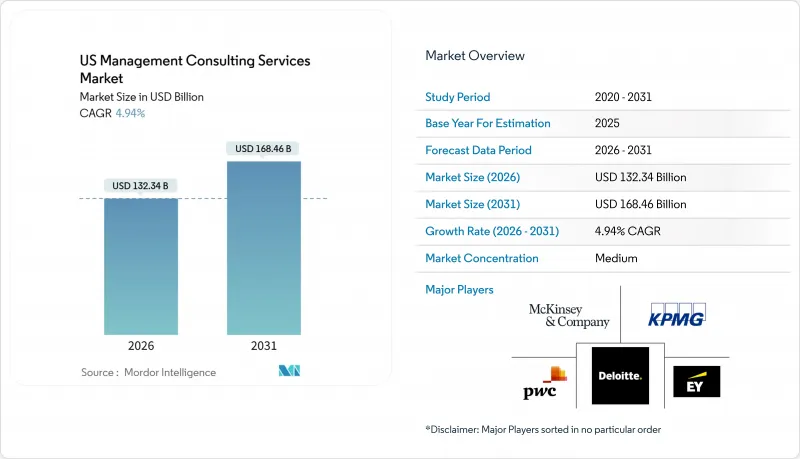
This report is Segmented by Service Type (Operations Consulting, Strategy Consulting, and More), Client Organization Size (Large Enterprises and Small and Medium Enterprises), Consulting Domain (Enterprise Strategy, Front-Office Transformation, and More), and End-User Industry (BFSI, Life Sciences and Healthcare, and More). The Market Forecasts are Provided in Terms of Value (USD).
US Management Consulting Services Market Trends and Insights
Digital-First Transformation Demand
Companies are consolidating previously siloed modernization projects into enterprise-wide programs that tie customer experience, supply-chain visibility, and workplace automation to a single investment thesis. Manufacturing clients are deploying Internet-of-Things sensors that cut unplanned downtime by up to 50%, yielding a quick ROI that justifies premium advisory fees. Banks are re-platforming core systems onto cloud-native stacks to meet real-time payment mandates, a path that demands both regulatory fluency and change-management discipline. The driver therefore tilts spend toward firms that integrate strategy, engineering, and managed services in a single engagement. As transformation programs grow in scope, boardrooms increasingly demand outcome-based contracts with dashboards tracking value capture in real time.
Generative-AI Copilots Creating Advisory White-Space
Large language models are automating research, slide production, and document review, reducing reliance on junior-consultant labor while creating new consulting demand in prompt engineering, model tuning, and AI governance. Boston Consulting Group expanded its BCG X unit in 2024, embedding machine-learning engineers in engagements to co-develop proprietary models rather than merely advising on vendor selection. Accenture disclosed generative-AI bookings in excess of USD 3 billion for fiscal 2024, a signal that clients want end-to-end build services, not PowerPoint recommendations. Outcome-based pricing is becoming feasible because AI provides live telemetry on productivity gains, allowing fees to flex with realized benefits. Yet the same technology commoditizes lower-value tasks, compelling firms to reskill juniors for higher-order synthesis and C-suite facilitation.
Consulting Talent Wage Inflation
Median partner compensation climbed to USD 672,000 in 2024, with strategy partners fetching roughly USD 1.07 million, far outpacing the 3.9% salary-budget increase that The Conference Board projected for 2025. Private-equity firms and technology giants are poaching seasoned advisors to steer portfolio-company transformations, inflating wage benchmarks and driving partner churn 49% above historical norms. Immigration policy adds pressure: the 2024 shift to a wage-weighted H-1B selection process raises salary floors for international hires. To preserve margins, consultancies are automating repetitive tasks, rebalancing staffing pyramids, and experimenting with offshore delivery centers in lower-cost locales.
Other drivers and restraints analyzed in the detailed report include:
- Regulatory-Driven Advisory Spend
- Ecosystem-Led Consulting Partnerships With Hyperscalers
- Client In-House Consulting Build-Outs
For complete list of drivers and restraints, kindly check the Table Of Contents.
Segment Analysis
The US management consulting services market size for Technology Advisory is on track to expand at a 5.88% CAGR to 2031, outpacing legacy practices anchored in pure strategy. Clients are channeling budgets toward cloud architecture, cybersecurity hardening, and generative-AI integration, areas where execution speed outweighs theoretical frameworks. Strategy Consulting, while still holding 28.36% of 2025 revenue, sees growth moderating as companies internalize strategic planning and reserve external spend for complex market entry or M&A due diligence. Operations Consulting finds renewed momentum through digital twins and predictive maintenance that reduce working capital, while Financial Advisory benefits from capital-optimization mandates tied to Basel III and emerging ESG disclosure rules. HR Consulting is pivoting to workforce analytics platforms that map skills gaps, and Risk and Compliance Consulting remains a steady revenue stream amid regulatory volatility. The convergence of cloud, AI, and cyber requires integrated advisory offerings, pushing firms to own both blueprint and build phases, an approach validated by Accenture's roll-up of Oracle and Workday specialists between 2024 and 2025.
Client expectations have evolved from slide decks to continuous value delivery; as-a-service contracts grew 24% year-over-year in first-half 2024, highlighting appetite for consumption-based models that spread cost with benefit accrual. Technology Advisory engagements now bundle architecture, implementation, and managed services under outcome-based pricing, tying consultant compensation to productivity metrics such as defect-rate reduction or cycle-time compression. The push for rapid deployment favors firms with deep cloud alliances, proprietary accelerators, and multidisciplinary pods that merge strategists, engineers, and change managers into one team.
Small and Medium Enterprises are growing their share of the US management consulting services market at a 5.96% CAGR through 2031 as cloud platforms democratize access to analytics and advisory tooling. Modular engagements let SMEs buy targeted expertise, regulatory filings, vendor selection, or digital-marketing optimization, instead of full-blown transformation programs. Outcome-based pricing resonates with cash-constrained clients willing to share upside rather than fund hourly retainers. SaaS analytics tools enable internal pre-work, so consulting hours focus on higher-value judgment rather than data collection. The trend lowers entry barriers and spawns specialized boutiques that cater exclusively to the mid-market with verticalized playbooks and rapid-deployment kits.
Large Enterprises, however, still command the lion's share of spend, maintaining 72.16% of 2025 outlays. Their complex footprints, multi-regulatory exposure, and legacy system entanglements require multi-year programs staffed with cross-disciplinary teams. Vendor consolidation is a recurring theme: clients want a single master services agreement covering strategy, build, and run phases, with milestone-based payments that tie fees to measurable key-performance indicators. Accenture's sequential acquisitions of Inspirage, Namos Solutions, and Cientra illustrate how scale players bolster end-to-end coverage to remain on preferred-vendor rosters. Large Enterprises also demand transparent value dashboards, prompting consultancies to integrate telemetry tools that quantify ROI in near real time.
Complete Report Scope:
- By Service Type
- Operations Consulting
- Strategy Consulting
- Financial Advisory
- Technology Advisory
- HR Consulting
- Risk and Compliance Consulting
- Other Service Type
- By Client Organisation Size
- Large Enterprises
- Small and Medium Enterprises
- By Consulting Domain
- Enterprise Strategy
- Front-Office Transformation
- Supply-Chain and Operations
- Digital Transformation
- Cyber-Risk and Regulation
- MandA and Restructuring
- Other Consulting Domain
- By End-User Industry
- BFSI
- Life Sciences and Healthcare
- IT and Telecommunications
- Manufacturing and Industrial
- Other End-User Industry
List of Companies Covered in this Report:
- Deloitte
- PwC
- Accenture
- McKinsey and Company
- EY
- KPMG
- Boston Consulting Group
- Bain and Company
- Booz Allen Hamilton
- Kearney
- IBM Consulting
- Cognizant Consulting
- Grant Thornton
- Oliver Wyman
- Protiviti
- Alvarez and Marsal
- L.E.K. Consulting
- Huron Consulting Group
- Guidehouse
- Slalom
- West Monroe Partners
- Publicis Sapient
Additional Benefits:
- The market estimate (ME) sheet in Excel format
- 3 months of analyst support
TABLE OF CONTENTS
1 INTRODUCTION
- 1.1 Study Assumptions and Market Definition
- 1.2 Scope of the Study
2 RESEARCH METHODOLOGY
3 EXECUTIVE SUMMARY
4 MARKET LANDSCAPE
- 4.1 Market Overview
- 4.2 Market Drivers
- 4.2.1 Digital-first transformation demand
- 4.2.2 Regulatory-driven advisory spend
- 4.2.3 Cost-out and operational excellence focus
- 4.2.4 Generative-AI copilots creating advisory white-space
- 4.2.5 Outcome-based pricing uptake
- 4.2.6 Mid-market talent gaps outsourcing to consultants
- 4.3 Market Restraints
- 4.3.1 Consulting talent wage inflation
- 4.3.2 Client in-house consulting build-outs
- 4.3.3 Big-4 antitrust scrutiny and audit/consulting split risk
- 4.3.4 GenAI commoditising research-heavy tasks
- 4.4 Supply-Chain Analysis
- 4.5 Regulatory Landscape
- 4.6 Technological Outlook
- 4.7 Porter's Five Force Analysis
- 4.7.1 Bargaining Power of Suppliers
- 4.7.2 Bargaining Power of Buyers
- 4.7.3 Threat of New Entrants
- 4.7.4 Threat of Substitutes
- 4.7.5 Intensity of Competitive Rivalry
- 4.8 Assessment of Impact of Macro-Economic Factors
5 MARKET SIZE AND GROWTH FORECASTS (VALUE)
- 5.1 By Service Type
- 5.1.1 Operations Consulting
- 5.1.2 Strategy Consulting
- 5.1.3 Financial Advisory
- 5.1.4 Technology Advisory
- 5.1.5 HR Consulting
- 5.1.6 Risk and Compliance Consulting
- 5.1.7 Other Service Type
- 5.2 By Client Organisation Size
- 5.2.1 Large Enterprises
- 5.2.2 Small and Medium Enterprises
- 5.3 By Consulting Domain
- 5.3.1 Enterprise Strategy
- 5.3.2 Front-Office Transformation
- 5.3.3 Supply-Chain and Operations
- 5.3.4 Digital Transformation
- 5.3.5 Cyber-Risk and Regulation
- 5.3.6 MandA and Restructuring
- 5.3.7 Other Consulting Domain
- 5.4 By End-User Industry
- 5.4.1 BFSI
- 5.4.2 Life Sciences and Healthcare
- 5.4.3 IT and Telecommunications
- 5.4.4 Manufacturing and Industrial
- 5.4.5 Other End-User Industry
6 COMPETITIVE LANDSCAPE
- 6.1 Market Concentration
- 6.2 Strategic Moves
- 6.3 Market Share Analysis
- 6.4 Company Profiles (includes Global Level Overview, Market Level Overview, Core Segments, Financials as Available, Strategic Information, Market Rank/Share for Key Companies, Products and Services, and Recent Developments)
- 6.4.1 Deloitte
- 6.4.2 PwC
- 6.4.3 Accenture
- 6.4.4 McKinsey and Company
- 6.4.5 EY
- 6.4.6 KPMG
- 6.4.7 Boston Consulting Group
- 6.4.8 Bain and Company
- 6.4.9 Booz Allen Hamilton
- 6.4.10 Kearney
- 6.4.11 IBM Consulting
- 6.4.12 Cognizant Consulting
- 6.4.13 Grant Thornton
- 6.4.14 Oliver Wyman
- 6.4.15 Protiviti
- 6.4.16 Alvarez and Marsal
- 6.4.17 L.E.K. Consulting
- 6.4.18 Huron Consulting Group
- 6.4.19 Guidehouse
- 6.4.20 Slalom
- 6.4.21 West Monroe Partners
- 6.4.22 Publicis Sapient
7 MARKET OPPORTUNITIES AND FUTURE OUTLOOK
- 7.1 White-space and Unmet-Need Assessment

