PUBLISHER: Mordor Intelligence | PRODUCT CODE: 2125425

PUBLISHER: Mordor Intelligence | PRODUCT CODE: 2125425
Spain Ultrasound Devices - Market Share Analysis, Industry Trends & Statistics, Growth Forecasts (2026 - 2031)
According to Mordor Intelligence, the Spain ultrasound devices market size is expected to grow from USD 221.98 million in 2025 to USD 228.73 million in 2026 and is forecast to reach USD 265.67 million by 2031 at 3.04% CAGR over 2026-2031.
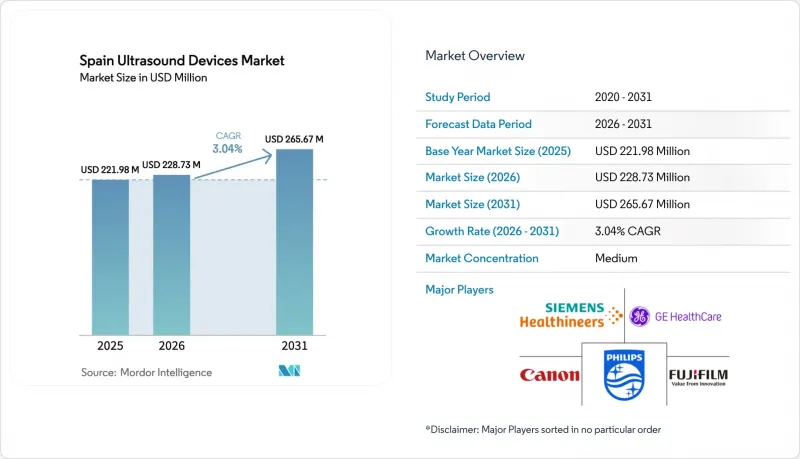
This report is Segmented by Application (Anesthesiology, Cardiology, Gynecology/Obstetrics, Musculoskeletal, and More), Technology (2D Ultrasound Imaging, 3D & 4D Ultrasound Imaging, Doppler Imaging, and More), Portability (Stationary Systems, and More), End User (Public Hospitals, Private Hospitals & Clinics, and More). The Market Forecasts are Provided in Terms of Value (USD) and Volume (Units).
Spain Ultrasound Devices Market Trends and Insights
Aging population and chronic disease burden
Rising life expectancy lifts ultrasound demand across cardiology, endocrinology, and musculoskeletal care. The European Central Bank projects aging-related health costs to climb by 7 percentage points of GDP by 2070, placing diagnostic efficiency at the center of budget planning. AI-assisted muscle assessment already achieves 82.3% accuracy in detecting malnutrition-linked sarcopenia, illustrating how advanced algorithms help physicians manage geriatric syndromes with limited scan time.
Point-of-care and handheld ultrasound uptake
The Andalusian health service has trained more than 1,000 primary-care clinicians in abdominal scanning, reinforcing policy momentum for bedside imaging programs. Comparative evaluations of devices like Vscan Air and SonoEye confirm diagnostic performance on par with full-size consoles, encouraging hospitals to adopt "probe-first" triage pathways. Structured POCUS guidance from WONCA Europe underscores the technology's role in closing rural care gaps.
EU MDR and AEMPS approval timelines
Low certification throughput under the new regulation has extended market-entry cycles. The Medical Device Coordination Group noted backlog risks through 2025, prompting manufacturers to reroute launch budgets toward post-market surveillance rather than innovation. Spain's AEMPS adds localized clinical data requirements, stretching smaller companies' resources.
Other drivers and restraints analyzed in the detailed report include:
- Oncology and cardiac service capacity build-outs
- AI-enabled workflow optimization
- Public procurement price pressure
For complete list of drivers and restraints, kindly check the Table Of Contents.
Segment Analysis
Radiology remained the largest contributor, holding 37.42% of Spain ultrasound devices market share in 2025. Critical Care, while smaller, is projected to deliver a 5.87% CAGR thanks to mandatory ultrasound competencies in intensive-care residency programs. Spain ultrasound devices market size for critical care is on track to bridge the capacity gap created by rising admissions of multimorbid elderly patients. Hospitals equip shock management teams with handheld probes that facilitate rapid fluid-status checks and cardiac function snapshots. Meanwhile, cardiology leverages electronic consultation models to accelerate echo interpretation, and gynecology/obstetrics integrates AI Doppler analytics to shorten prenatal visits. Musculoskeletal and rheumatology practitioners have raised ultrasound adoption to 90% of practice units, reflecting clinician comfort with in-office joint evaluation. Urology and vascular labs seize focused ultrasound for non-invasive ablation, and emergency departments rely on portable scanners for rule-out protocols in trauma bays.
Spain ultrasound devices market participants recognize that cross-department sharing of consoles boosts utilization rates, a key tender criterion. Structured accreditation from the Spanish Society of Intensive Medicine underpins consistent image quality, while AI decision support reduces inter-observer variability. As reimbursement moves toward bundled-care models, multispecialty ultrasound applications will remain central to cost-containment strategies.
3D & 4D imaging secured 41.12% of Spain ultrasound devices market size in 2025, driven by obstetric volume and oncologic staging needs. High-intensity Focused Ultrasound is poised for a 5.36% CAGR, reflecting Instituto Cartuja's success with MRgFUS uterine fibroid therapy and the CE extension for adenomyosis. Spain ultrasound devices market stakeholders note that HIFU's non-invasive nature lowers postoperative stays, aligning with value-based care metrics. Conventional 2D imaging persists in primary care, where the Canary Islands deployment verifies its relevance for broad access. Doppler innovation accelerates through AI auto-classification that trims fetal-monitoring workflow time. Wireless and smartphone-linked probes broaden research participation and support remote training, offsetting the shortage of academic sonographers.
Developers focus on open-source operating systems that cut licensing expenses and encourage agile upgrades. This orientation complements Spain's need for long hardware life cycles and future-proofed connectivity amid evolving MDR software classifications.
Complete Report Scope:
- By Application
- Anesthesiology
- Cardiology
- Gynecology / Obstetrics
- Musculoskeletal
- Radiology
- Critical Care
- Urology
- Vascular
- Other Applications
- By Technology
- 2D Ultrasound Imaging
- 3D & 4D Ultrasound Imaging
- Doppler Imaging
- High-Intensity Focused Ultrasound
- Other Technologies
- By Portability
- Stationary Systems
- Portable Cart-based Systems
- Hand-held / Pocket Devices
- By End User
- Public Hospitals
- Private Hospitals & Clinics
- Diagnostic Imaging Centres
- Home Healthcare Settings
- Other End Users
List of Companies Covered in this Report:
- GE Healthcare
- Siemens Healthineers
- Koninklijke Philips
- Canon
- FUJIFILM
- Mindray Medical
- Samsung Group
- Esaote
- Hologic
- Carestream Health
- Butterfly Network
- Sonoscape Medical
- Chison Medical Imaging
- Hitachi
- Terason
- Alpinion Medical
- Clarius Mobile Health
- Analogic
- Shenzhen Wisonic Medical
- Supersonic Imagine
Additional Benefits:
- The market estimate (ME) sheet in Excel format
- 3 months of analyst support
TABLE OF CONTENTS
1 Introduction
- 1.1 Study Assumptions & Market Definition
- 1.2 Scope of the Study
2 Research Methodology
3 Executive Summary
4 Market Landscape
- 4.1 Market Overview
- 4.2 Market Drivers
- 4.2.1 Aging Population & Chronic Disease Burden
- 4.2.2 Expansion of Point-of-Care & Handheld Ultrasound Adoption
- 4.2.3 National Oncology & Cardiac Service-Capacity Build-Outs
- 4.2.4 AI-Enabled Workflow Optimization in Spanish Hospitals
- 4.2.5 Post-COVID Bedside Imaging Protocols Becoming Standard
- 4.2.6 Tele-Ultrasound Pilots in Spain's Remote Islands
- 4.3 Market Restraints
- 4.3.1 Stringent EU MDR & Spanish AEMPS Approval Timelines
- 4.3.2 Public Procurement Price Pressure
- 4.3.3 Shortage of Accredited Sonographers
- 4.3.4 Hospital CAPEX Reallocation Post-COVID
- 4.4 Regulatory Landscape
- 4.5 Technological Outlook
- 4.6 Porter's Five Forces Analysis
- 4.6.1 Threat of New Entrants
- 4.6.2 Bargaining Power of Buyers
- 4.6.3 Bargaining Power of Suppliers
- 4.6.4 Threat of Substitute Products
- 4.6.5 Intensity of Competitive Rivalry
5 Market Size & Growth Forecasts (Value & Volume)
- 5.1 By Application
- 5.1.1 Anesthesiology
- 5.1.2 Cardiology
- 5.1.3 Gynecology / Obstetrics
- 5.1.4 Musculoskeletal
- 5.1.5 Radiology
- 5.1.6 Critical Care
- 5.1.7 Urology
- 5.1.8 Vascular
- 5.1.9 Other Applications
- 5.2 By Technology
- 5.2.1 2D Ultrasound Imaging
- 5.2.2 3D & 4D Ultrasound Imaging
- 5.2.3 Doppler Imaging
- 5.2.4 High-Intensity Focused Ultrasound
- 5.2.5 Other Technologies
- 5.3 By Portability
- 5.3.1 Stationary Systems
- 5.3.2 Portable Cart-based Systems
- 5.3.3 Hand-held / Pocket Devices
- 5.4 By End User
- 5.4.1 Public Hospitals
- 5.4.2 Private Hospitals & Clinics
- 5.4.3 Diagnostic Imaging Centres
- 5.4.4 Home Healthcare Settings
- 5.4.5 Other End Users
6 Competitive Landscape
- 6.1 Market Concentration
- 6.2 Market Share Analysis
- 6.3 Company Profiles (includes Global Level Overview, Market Level Overview, Core Segments, Financials as Available, Strategic Information, Market Rank/Share for Key Companies, Products & Services, and Recent Developments)
- 6.3.1 GE Healthcare
- 6.3.2 Siemens Healthineers AG
- 6.3.3 Koninklijke Philips N.V.
- 6.3.4 Canon Medical Systems Corporation
- 6.3.5 Fujifilm Holdings Corporation
- 6.3.6 Mindray Medical
- 6.3.7 Samsung Medison
- 6.3.8 Esaote SpA
- 6.3.9 Hologic Inc.
- 6.3.10 Carestream Health
- 6.3.11 Butterfly Network
- 6.3.12 Sonoscape Medical
- 6.3.13 Chison Medical Imaging
- 6.3.14 Hitachi Ltd.
- 6.3.15 Terason
- 6.3.16 Alpinion Medical
- 6.3.17 Clarius Mobile Health
- 6.3.18 Analogic Corporation
- 6.3.19 Shenzhen Wisonic Medical
- 6.3.20 Supersonic Imagine
7 Market Opportunities & Future Outlook
- 7.1 White-space & Unmet-Need Assessment

