PUBLISHER: Mordor Intelligence | PRODUCT CODE: 2125426

PUBLISHER: Mordor Intelligence | PRODUCT CODE: 2125426
United Kingdom Ultrasound Devices - Market Share Analysis, Industry Trends & Statistics, Growth Forecasts (2026 - 2031)
According to Mordor Intelligence, the United Kingdom ultrasound devices market size is expected to grow from USD 434.41 million in 2025 to USD 450.87 million in 2026 and is forecast to reach USD 543.02 million by 2031 at 3.79% CAGR over 2026-2031.
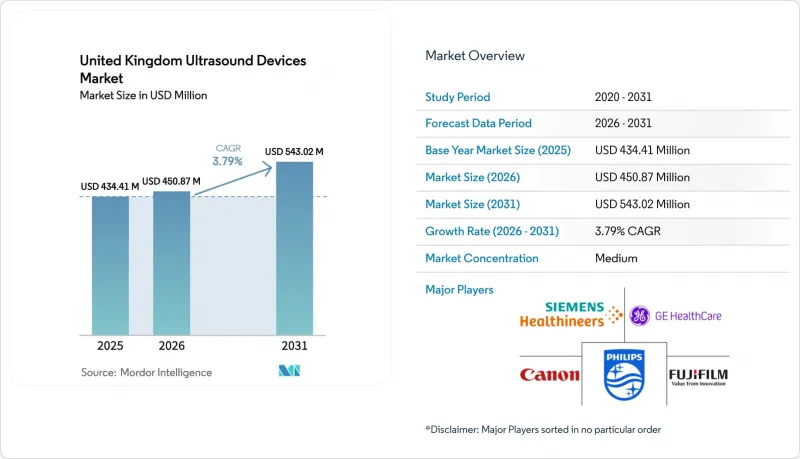
This report is Segmented by Application (Anesthesiology, Cardiology, Gynecology/Obstetrics, Radiology, and More), Technology (2D Ultrasound Imaging, 3D and 4D Ultrasound Imaging, Doppler Imaging, High-Intensity Focused Ultrasound, Other Technologies), Portability (Stationary Systems, and More), End User (NHS Hospitals, and More). The Market Forecasts are Provided in Terms of Value (USD).
United Kingdom Ultrasound Devices Market Trends and Insights
Increasing Burden of Chronic Diseases
England is projected to have 9.3 million residents living with major illness by 2040, with deprived communities bearing 80% of the additional burden. Cardiovascular conditions alone affect about 2.3 million people, prompting greater reliance on echocardiography and vascular studies. Cancer incidence is expected to climb from 420,000 new cases in 2025 to 506,000 by 2040, reinforcing the centrality of ultrasound in non-invasive tumour staging and therapy monitoring. The cumulative effect is sustained demand for advanced transducers, contrast-enhanced studies, and AI-guided acquisition routines across secondary and primary care.
Rapid Adoption of Hand-Held Ultrasound for Rural & Home Diagnostics
Miniaturisation combined with real-time AI feedback is encouraging remote scanning in paramedic units, care homes, and patient residences. Twenty percent of UK clinicians already use AI in diagnostics, and 35% of NHS AI implementations now sit in imaging workflows. Caption Health's home-based heart scan pilot illustrates how integrated algorithms reduce operator dependency, bridging workforce shortages while cutting hospital footfall.
Stringent Regulations Prolonging Product Approvals
The MHRA's new device framework, effective from Summer 2025, mandates risk-proportionate surveillance and formalises international recognition pathways. While alignment with Australian, Canadian, US, and EU certificates may shorten duplicate assessments, additional post-market reporting can extend total time-to-market for novel probes and software. Firms with deep regulatory benches will absorb the complexity more easily than start-ups, potentially tempering innovation velocity.
Other drivers and restraints analyzed in the detailed report include:
- Technological Advancements in Ultrasound Devices & Rising Diagnostic Usage
- Growing Private Fertility Clinic Segment Driving OB/GYN Ultrasound Upgrades
- Shortage of Sonographers Causing Under-utilisation of Installed Base
For complete list of drivers and restraints, kindly check the Table Of Contents.
Segment Analysis
Radiology/general imaging retained 32.42% ultrasound devices market share in 2025, anchored by abdominal and small-parts examinations across NHS hospitals. Cardiology, however, is projected to outpace all other specialties at a 6.73% CAGR, propelled by microvascular imaging breakthroughs and increasing heart-failure screening in primary care. Ultrasound localisation microscopy enables wall-motion and perfusion analysis once reserved for MRI, broadening echocardiography's clinical utility. Over the forecast, cardiology's contribution to ultrasound devices market size is expected to add nearly USD 18 million, intensifying competition among vendors for premium cardiac probes.
Obstetrics & gynecology remains a mature but lucrative field. Home-based fetal growth monitoring trials underline how widespread AI integration may unlock new consumer-direct revenue streams. Critical care and anesthesiology segments increasingly rely on point-of-care systems for fast-track procedural guidance, sustaining baseline demand for robust portable consoles.
3D & 4D modalities commanded 47.85% share of ultrasound devices market size in 2025, supported by obstetric and structural-heart imaging workflows. Yet their growth is moderating as replacement cycles lengthen. By contrast, HIFU will expand at 8.09% CAGR, capturing oncology centres seeking organ-sparing alternatives to surgery. Ablatherm and Sonablate 500 platforms demonstrate 95% freedom from clinically significant prostate cancer, accelerating adoption in both private and NHS settings.
Doppler and contrast-enhanced imaging maintain relevance for hepatic lesions and vascular assessments, while AI post-processing packages elevate 2-D systems through automated vessel tracking and plaque quantification. Vendors are bundling advanced software to retain customers transitioning to mid-range consoles as budget pressures persist.
Complete Report Scope:
- By Application
- Anesthesiology
- Cardiology
- Gynecology/Obstetrics
- Radiology
- Critical Care & Emergency Medicine
- Other Applications
- By Technology
- 2-D Ultrasound Imaging
- 3-D & 4-D Ultrasound Imaging
- Doppler Imaging
- High-Intensity Focused Ultrasound (HIFU)
- Other Technologies
- By Portability
- Stationary Systems
- Portable Laptop-Based Systems
- Handheld/Pocket Ultrasound Devices
- By End User
- NHS Hospitals
- Private Hospitals & Clinics
- Diagnostic Imaging Centres
- Ambulatory Surgical Centres
- Other End Users
List of Companies Covered in this Report:
- GE Healthcare
- Siemens Healthineers
- Koninklijke Philips
- Canon
- Mindray
- FUJIFILM
- Samsung Medison (Samsung Electronics)
- Esaote
- Hologic
- Butterfly Network Inc.
- Clarius Mobile Health Corp.
- Hitachi
- Analogic Corp.
- Sonosite Inc.
- Supersonic Imagine SA
- Terason (Teratech Corp.)
- Alpinion Medical Systems
- Carestream Health
- Beckton Dickinson
- Shenzhen SonoScape Medical Corp.
Additional Benefits:
- The market estimate (ME) sheet in Excel format
- 3 months of analyst support
TABLE OF CONTENTS
1 Introduction
- 1.1 Study Assumptions & Market Definition
- 1.2 Scope of the Study
2 Research Methodology
3 Executive Summary
4 Market Landscape
- 4.1 Market Overview
- 4.2 Market Drivers
- 4.2.1 Increasing Burden of Chronic Diseases
- 4.2.2 Rapid Adoption of Handheld Ultrasound for Rural & Home Diagnostics
- 4.2.3 Technological Advancements in Ultrasound Devices and Rising Usage of Ultrasound Devices in Disease Diagnosis
- 4.2.4 Growing Private Fertility Clinic Segment Driving OB/GYN Ultrasound Upgrades
- 4.2.5 Expansion of NHS Diagnostic Imaging Modernization Programs
- 4.2.6 Rising Focus on Women's Health & Fertility Monitoring
- 4.3 Market Restraints
- 4.3.1 Stringent Regulations Prolonging Product Approvals
- 4.3.2 Shortage of Sonographers Causing Under-utilisation of Installed Base
- 4.3.3 Budget Constraints in Community & Rural Healthcare Settings
- 4.3.4 Competition from Lower-Cost Imaging Alternatives
- 4.4 Technological Outlook
- 4.5 Porter's Five Forces Analysis
- 4.5.1 Threat of New Entrants
- 4.5.2 Bargaining Power of Buyers
- 4.5.3 Bargaining Power of Suppliers
- 4.5.4 Threat of Substitutes
- 4.5.5 Intensity of Competitive Rivalry
5 Market Size & Growth Forecasts (Value in USD)
- 5.1 By Application
- 5.1.1 Anesthesiology
- 5.1.2 Cardiology
- 5.1.3 Gynecology/Obstetrics
- 5.1.4 Radiology
- 5.1.5 Critical Care & Emergency Medicine
- 5.1.6 Other Applications
- 5.2 By Technology
- 5.2.1 2-D Ultrasound Imaging
- 5.2.2 3-D & 4-D Ultrasound Imaging
- 5.2.3 Doppler Imaging
- 5.2.4 High-Intensity Focused Ultrasound (HIFU)
- 5.2.5 Other Technologies
- 5.3 By Portability
- 5.3.1 Stationary Systems
- 5.3.2 Portable Laptop-Based Systems
- 5.3.3 Handheld/Pocket Ultrasound Devices
- 5.4 By End User
- 5.4.1 NHS Hospitals
- 5.4.2 Private Hospitals & Clinics
- 5.4.3 Diagnostic Imaging Centres
- 5.4.4 Ambulatory Surgical Centres
- 5.4.5 Other End Users
6 Competitive Landscape
- 6.1 Market Concentration
- 6.2 Market Share Analysis
- 6.3 Company Profiles (includes Global level Overview, Market level overview, Core Segments, Financials as available, Strategic Information, Market Rank/Share for key companies, Products & Services, and Recent Developments)
- 6.3.1 GE HealthCare
- 6.3.2 Siemens Healthineers AG
- 6.3.3 Koninklijke Philips N.V.
- 6.3.4 Canon Medical Systems Corporation
- 6.3.5 Mindray Medical International Ltd.
- 6.3.6 Fujifilm Holdings Corporation
- 6.3.7 Samsung Medison (Samsung Electronics)
- 6.3.8 Esaote SpA
- 6.3.9 Hologic Inc.
- 6.3.10 Butterfly Network Inc.
- 6.3.11 Clarius Mobile Health Corp.
- 6.3.12 Hitachi Ltd.
- 6.3.13 Analogic Corp.
- 6.3.14 Sonosite Inc.
- 6.3.15 Supersonic Imagine SA
- 6.3.16 Terason (Teratech Corp.)
- 6.3.17 Alpinion Medical Systems
- 6.3.18 Carestream Health
- 6.3.19 Becton, Dickinson & Company
- 6.3.20 Shenzhen SonoScape Medical Corp.
7 Market Opportunities & Future Outlook
- 7.1 White-Space & Unmet-Need Assessment

