PUBLISHER: Mordor Intelligence | PRODUCT CODE: 2125427

PUBLISHER: Mordor Intelligence | PRODUCT CODE: 2125427
United States Ultrasound Devices - Market Share Analysis, Industry Trends & Statistics, Growth Forecasts (2026 - 2031)
According to Mordor Intelligence, the United States ultrasound devices market size was valued at USD 3.11 billion in 2025 and estimated to grow from USD 3.27 billion in 2026 to reach USD 4.22 billion by 2031, at a CAGR of 5.21% during the forecast period (2026-2031).
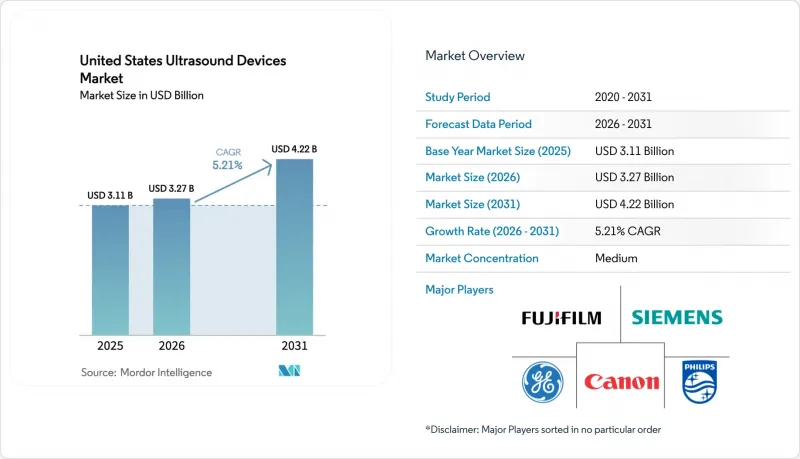
This report is Segmented by Application (Anesthesiology, Cardiology, Gynecology/Obstetrics, and More), Technology (2D Ultrasound Imaging, 3D & 4D Ultrasound Imaging, Doppler Imaging, and More), Portability (Stationary Systems, and More), End User (Hospitals & Clinics, and More), and Region (Northeast, Midwest, South, West). The Market Forecasts are Provided in Terms of Value (USD).
United States Ultrasound Devices Market Trends and Insights
Shift toward Outpatient Imaging Reimbursement
Medicare increased outpatient imaging payments by 2.9% in 2025, encouraging procedure migration from inpatient suites to ambulatory sites. Hospital groups consequently favor compact cart systems that clear corridors quickly and process higher patient volumes. Joint ventures such as Smith+Nephew and JointVue equip orthopedic centers with 3D ultrasound navigation that bypasses ionizing radiation. Purchasing committees now rank scanners on throughput metrics and cost-per-scan figures, giving an edge to vendors that bundle analytics dashboards with service contracts in the United States ultrasound devices market.
AI-Driven Workflow Optimization
Only 81,080 diagnostic medical sonographers serve the entire country, so machine-learning guidance is indispensable. GE HealthCare and NVIDIA co-developed autonomous protocols on the Isaac platform that cut rescans by up to 30% while improving measurement consistency. Fujifilm Sonosite's Voice Assist lets users issue commands without touching the console, preserving sterile fields in operating rooms. Software upgrades rather than new hardware now represent the most expedient path to value, pushing hospitals to sign multi-year subscription agreements that stabilize vendor revenues within the United States ultrasound devices market.
Regulatory Delays Due to FDA 510(k) Backlog
Section 524B of the FD&C Act now requires extensive cybersecurity documentation, including a software bill of materials, for every connected scanner. Artificial intelligence modules must submit algorithm drift data, stretching review cycles well beyond historic norms. Smaller companies face longer time-to-revenue and may cede ground to legacy manufacturers that maintain in-house regulatory teams. The United States ultrasound devices market therefore risks slower innovation diffusion, particularly for high-growth therapeutic applications.
Other drivers and restraints analyzed in the detailed report include:
- Proliferation of Handheld Ultrasound Devices
- Bundled Ultrasound Integration in Cardiology Procedures
- Capital Expenditure Deferrals by Hospitals
For complete list of drivers and restraints, kindly check the Table Of Contents.
Segment Analysis
Radiology held 37.18% of the United States ultrasound devices market share in 2025 through high-volume diagnostic protocols. Critical care, advancing at a 6.42% CAGR, benefits from bedside assessments that shorten intensive-care stays. Cardiology usage broadens under bundled payment models that reward integrated echocardiography and hemodynamic monitoring. Musculoskeletal imaging grows as sports clinics adopt real-time guidance for injections. Urology accelerates after new CPT codes validated ultrasound-guided ablation. Vascular screening remains steady as Medicare funds preventive programs, sustaining baseline demand for the United States ultrasound devices market.
The United States ultrasound devices market size for radiology is projected to expand moderately as workflow improvement tools extract more scans per machine, while critical care gains incremental budget share from emergency departments. Handheld devices lead adoption curves, yet multi-probe cart systems remain indispensable for high-resolution abdominal and pelvic exams. Vendors now bundle elastography and artificial intelligence packages to raise average selling prices despite budget constraints, reinforcing platform stickiness in hospital radiology suites.
3D and 4D platforms captured 42.05% share through superior spatial rendering that enhances obstetric and cardiac diagnostics. High-intensity focused ultrasound, at 5.89% CAGR, transitions from experimental oncology to reimbursed prostate and uterine fibroid therapies. Doppler remains essential for vascular flow studies, and 2D persists in low-acuity settings due to cost advantages.
United States ultrasound devices market size for therapeutic HIFU remains small but accelerates as clinical evidence broadens. FDA reclassification of select therapeutic probes to Class II lowers entry barriers, and academic centers race to secure first-mover advantage. Established vendors integrate thermal dose monitoring, while niche start-ups license beam-forming software. This dual-path innovation sustains price diversity and supports multi-segment growth within the United States ultrasound devices industry.
Complete Report Scope:
- By Application
- Anesthesiology
- Cardiology
- Gynecology / Obstetrics
- Musculoskeletal
- Radiology
- Critical Care
- Urology
- Vascular
- Other Applications
- By Technology
- 2D Ultrasound Imaging
- 3D & 4D Ultrasound Imaging
- Doppler Imaging
- High-Intensity Focused Ultrasound
- Other Technologies
- By Portability
- Stationary Systems
- Portable Cart-based Systems
- Hand-held / Pocket Devices
- By End User
- Hospitals & Clinics
- Diagnostic Imaging Centers
- Ambulatory Surgical Centers
- Other End Users
- By Region
- Northeast
- Midwest
- South
- West
List of Companies Covered in this Report:
- GE Healthcare
- Siemens Healthineers
- Koninklijke Philips
- Canon
- FUJIFILM
- Samsung Group
- Mindray Medical Intl.
- Butterfly Network
- Clarius Mobile Health
- Analogic
- Hitachi Healthcare
- Terason Ultrasound
- BK Medical (GE)
- Esaote
- Hologic (AIT)
- Zoll Medical
- EchoNous
- Caption Health
- Exo Imaging
Additional Benefits:
- The market estimate (ME) sheet in Excel format
- 3 months of analyst support
TABLE OF CONTENTS
1 Introduction
- 1.1 Study Assumptions & Market Definition
- 1.2 Scope of the Study
2 Research Methodology
3 Executive Summary
4 Market Landscape
- 4.1 Market Overview
- 4.2 Market Drivers
- 4.2.1 Shift Toward Outpatient Imaging Reimbursement
- 4.2.2 AI-Driven Workflow Optimization
- 4.2.3 Proliferation of Handheld Ultrasound Devices
- 4.2.4 Bundled Ultrasound Integration in Cardiology Procedures
- 4.2.5 OEM Financing & Leasing Programs
- 4.2.6 Telehealth Expansion Supporting Remote Ultrasound
- 4.3 Market Restraints
- 4.3.1 Regulatory Delays Due to FDA 510(k) Backlog
- 4.3.2 Capital Expenditure Deferrals by Hospitals
- 4.3.3 Rising Cybersecurity Compliance Costs
- 4.3.4 Fragmented Reimbursement Landscape
- 4.4 Regulatory Landscape
- 4.5 Technological Outlook
- 4.6 Porter's Five Forces Analysis
- 4.6.1 Threat of New Entrants
- 4.6.2 Bargaining Power of Buyers
- 4.6.3 Bargaining Power of Suppliers
- 4.6.4 Threat of Substitute Products
- 4.6.5 Intensity of Competitive Rivalry
5 Market Size & Growth Forecasts (Value & Volume)
- 5.1 By Application
- 5.1.1 Anesthesiology
- 5.1.2 Cardiology
- 5.1.3 Gynecology / Obstetrics
- 5.1.4 Musculoskeletal
- 5.1.5 Radiology
- 5.1.6 Critical Care
- 5.1.7 Urology
- 5.1.8 Vascular
- 5.1.9 Other Applications
- 5.2 By Technology
- 5.2.1 2D Ultrasound Imaging
- 5.2.2 3D & 4D Ultrasound Imaging
- 5.2.3 Doppler Imaging
- 5.2.4 High-Intensity Focused Ultrasound
- 5.2.5 Other Technologies
- 5.3 By Portability
- 5.3.1 Stationary Systems
- 5.3.2 Portable Cart-based Systems
- 5.3.3 Hand-held / Pocket Devices
- 5.4 By End User
- 5.4.1 Hospitals & Clinics
- 5.4.2 Diagnostic Imaging Centers
- 5.4.3 Ambulatory Surgical Centers
- 5.4.4 Other End Users
- 5.5 By Region
- 5.5.1 Northeast
- 5.5.2 Midwest
- 5.5.3 South
- 5.5.4 West
6 Competitive Landscape
- 6.1 Market Concentration
- 6.2 Market Share Analysis
- 6.3 Company Profiles (includes Global Level Overview, Market Level Overview, Core Segments, Financials as Available, Strategic Information, Market Rank/Share for Key Companies, Products & Services, and Recent Developments)
- 6.3.1 GE Healthcare
- 6.3.2 Siemens Healthineers AG
- 6.3.3 Koninklijke Philips N.V.
- 6.3.4 Canon Medical Systems
- 6.3.5 Fujifilm Holdings Corporation
- 6.3.6 Samsung Medison
- 6.3.7 Mindray Medical Intl.
- 6.3.8 Butterfly Network
- 6.3.9 Clarius Mobile Health
- 6.3.10 Analogic Corporation
- 6.3.11 Hitachi Healthcare
- 6.3.12 Terason Ultrasound
- 6.3.13 BK Medical (GE)
- 6.3.14 Esaote SpA
- 6.3.15 Hologic (AIT)
- 6.3.16 Zoll Medical
- 6.3.17 EchoNous
- 6.3.18 Caption Health
- 6.3.19 Exo Imaging
7 Market Opportunities & Future Outlook
- 7.1 White-space & Unmet-Need Assessment

