PUBLISHER: Mordor Intelligence | PRODUCT CODE: 2125463

PUBLISHER: Mordor Intelligence | PRODUCT CODE: 2125463
Commercial Boilers - Market Share Analysis, Industry Trends & Statistics, Growth Forecasts (2026 - 2031)
According to Mordor Intelligence, the commercial boilers market size was valued at USD 16.78 billion in 2025 and estimated to grow from USD 17.37 billion in 2026 to reach USD 20.65 billion by 2031, at a CAGR of 3.53% during the forecast period (2026-2031).
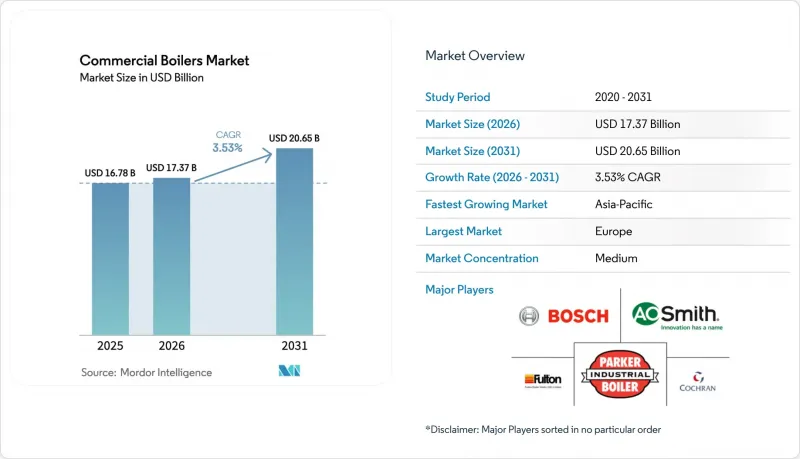
This report is Segmented by Fuel Type (Natural Gas, Oil, Coal, Biomass, Electric, and More), Technology (Condensing, Non-Condensing, Hybrid Boiler-Heat-Pump, and More), Capacity (Less Than 10 MMBtu/Hr, 10-50 MMBtu/Hr, and More), End-User Industries (Offices, Healthcare, Educational Institutions, Hospitality and Lodging, and More), and Geography. The Market Forecasts are Provided in Terms of Value (USD).
Global Commercial Boilers Market Trends and Insights
Government Efficiency and NOx Emission Mandates Drive Technology Transitions
National and sub-national agencies have compressed compliance timetables, prompting immediate redesign of combustion platforms. The U.S. Department of Energy estimates commercial packaged-boiler standards will save 0.27 quadrillion Btu over three decades. California's South Coast AQMD projects daily NOx cuts of 2.07 tons for water-heaters under its proposed zero-NOx rules, forcing OEMs to pivot toward condensing combustion and advanced digital controls. Federal procurement rules now require 90% fossil-fuel reductions in new public buildings by FY 2029, pushing private owners to mirror specification choices. These mandates collectively lift the share of hybrid and electric offerings within the overall commercial boilers market.
Rising Commercial Space-Heating Demand in Cold Regions Sustains Market Foundation
Northern-latitude office towers, hospitals and hyperscale data centers continue to rely on high-capacity hydronic systems even as insulation standards tighten. Adoption of the 2021 International Energy Conservation Code has raised upfront construction costs by USD 7,229 per unit but delivers USD 963 annual savings, reinforcing lifecycle-based purchasing decisions. Louisville Gas and Electric's 2024 plan cites data-center projects as a trigger for fresh capacity procurement starting 2025, a trend mirrored in Canada and Scandinavia. Cold-climate performance requirements favor condensing units that maintain efficiency at low return-water temperatures, giving technology-rich suppliers a competitive edge.
High Upfront Capex vs Alternatives Constrains Adoption Rates
DOE's Commercial Building Heat Pump Accelerator highlights potential 50% energy-cost savings from rooftop heat-pump units, undercutting premium boiler packages in payback comparisons. Electric boilers often need substantial service-panel upgrades, compounding first-cost hurdles, especially for small businesses. Utility incentives increasingly prioritize electrification, deepening the price gap. Consequently, the commercial boilers market must rely on lifecycle-cost messaging and bundled service contracts to counter sticker-shock concerns in cost-sensitive geographies.
Other drivers and restraints analyzed in the detailed report include:
- Shift Toward Cost-Effective Natural-Gas Boilers Maintains Market Dominance
- Retrofit Boom for Hydrogen-Ready and Hybrid Heat-Pump Boilers Creates Premium Segments
- Heat-Pump Substitution in Decarbonization Road-Maps Threatens Market Share
For complete list of drivers and restraints, kindly check the Table Of Contents.
Segment Analysis
Natural gas commanded 56.92% of commercial boilers market share in 2025 on the back of established distribution networks and predictable fuel pricing. The commercial boilers market size for electric units is forecast to swell alongside a 4.05% CAGR, propelled by zero-emission procurement mandates and data-center electrification strategies. Hydrogen-ready gas models and biomass units occupy niche demand pockets where policy incentives align with regional feedstock availability. OEMs cultivating hybrid systems hedge exposure to long-term gas-grid uncertainty while capturing premium efficiency margins.
Electric-boiler vendors highlight low maintenance and rapid modulation, but building owners must often reinforce electrical infrastructure, pushing many toward staged retrofits. Oil-fired variants continue in remote areas lacking gas lines, though environmental policies limit new installs. The fuel-type hierarchy thus reflects regional utility economics rather than pure technology merit, sustaining gas leadership through the mid-term while electric penetration accelerates.
Non-condensing designs accounted for 61.20% of revenue in 2025, a legacy of simpler installation and lower capital costs. Nonetheless, condensing models are on course for the fastest 4.95% CAGR, bolstered by minimum efficiency thresholds embedded in U.S. and EU regulations. The commercial boilers market size for condensing units is set to expand steadily as rebates narrow the upfront premium. Digital combustion management has become standard, integrating IoT sensors and cloud-based analytics for predictive maintenance.
Hybrid heat-pump-boiler platforms address peak-load flexibility and cold-climate performance, offering specifiers a compliance bridge. High-voltage electrode boilers occupy a specialist niche, serving semiconductor fabs and data centers where precise control and near-instant steam rise times matter. Across technologies, integration with building-automation protocols per ASHRAE 231P enhances lifecycle performance and positions advanced suppliers for service-contract revenues.
Complete Report Scope:
- By Pressure
- High Pressure
- Medium Pressure
- Low Pressure
- By Stage/Configuration
- Single-Stage
- Multistage
- High-Speed Turbo
- Integrally Geared
- By Drive Type
- Direct Drive
- Belt Drive
- Integrated VSD Drive
- Magnetic-Bearing Drive
- By End-use Industry
- Mining
- Cement
- Pulp and Paper
- Construction
- Steel
- Chemicals and Petrochemicals
- Power Generation
- Water and Wastewater Treatment
- Food and Beverage
- HVAC and Commercial Buildings
- Other Industries
- By Geography
- North America
- United States
- Canada
- Mexico
- South America
- Brazil
- Argentina
- Rest of South America
- Europe
- Germany
- United Kingdom
- France
- Italy
- Russia
- Rest of Europe
- Asia-Pacific
- China
- Japan
- India
- South Korea
- ASEAN
- Rest of Asia-Pacific
- Middle East and Africa
- Middle East
- Saudi Arabia
- United Arab Emirates
- Rest of Middle East
- Africa
- South Africa
- Nigeria
- Rest of Africa
- Middle East
- North America
Geography Analysis
Europe retained a 37.35% share of the commercial boilers market in 2025, underpinned by the EU's Energy Performance of Buildings Directive mandating zero-emission new builds from 2030. Germany delayed its fossil-fuel boiler ban from 2024 to 2028 and the UK to 2035, yet manufacturers continue scaling hydrogen-ready lines. Agora Energiewende notes that gas boilers remain the region's most common appliance but forecasts rapid heat-pump gains in France and Germany as subsidies intensify. Viessmann's 20% hydrogen-blend modules demonstrate how incremental adaptations preserve existing infrastructure while meeting interim targets.
Asia-Pacific, registering a brisk 3.98% CAGR, benefits from ongoing commercial-construction booms and updated efficiency standards, notably China's April 2024 specification for industrial boilers. Indian supplier Thermax logged USD 1.25 billion sales and commissioned high-capacity units for a Middle-East refinery, underscoring regional cross-border opportunities. Japan and South Korea push condensing-technology adoption through utility rebates, whereas Southeast Asia prioritizes distributed biomass systems where agri-residue feedstock is abundant.
North America remains pivotal despite electrification headwinds. The DOE Heat-Pump Accelerator competes directly with gas boilers, yet A.O. Smith's 2024 results show 8% boiler-line growth, affirming enduring demand in HVAC retrofits. State-level divergence-California's impending NOx cap versus Texas's emphasis on gas reliability-forces suppliers to maintain region-specific product roadmaps. Climate variability and differentiated utility rates ensure continued pluralism in fuel choices.
- Atlas Copco AB
- Howden Group
- Ingersoll Rand Inc. (Gardner Denver)
- Kaeser Kompressoren SE
- Aerzen Maschinenfabrik GmbH
- Sulzer Ltd.
- EBARA Corp.
- Piller Blowers and Compressors
- Boldrocchi Group
- Aeromeccanica Stranich SpA
- Illinois Blower Inc.
- Spencer Turbine Company
- Continental Blower LLC
- Atlantic Blowers LLC
- Alfotech Fans
- Aerotek Equipment
- Lontra Ltd.
- Xylem Inc. (Flygt)
- Tuthill Corp.
- Multi-Wing Group
Additional Benefits:
- The market estimate (ME) sheet in Excel format
- 3 months of analyst support
TABLE OF CONTENTS
1 INTRODUCTION
- 1.1 Study Assumptions and Market Definition
- 1.2 Scope of the Study
2 RESEARCH METHODOLOGY
3 EXECUTIVE SUMMARY
4 MARKET LANDSCAPE
- 4.1 Market Overview
- 4.2 Market Drivers
- 4.2.1 Energy-efficiency regulations and retrofits
- 4.2.2 Expansion of global wastewater treatment capacity
- 4.2.3 Chemical and petrochemical capacity build-out in Asia-Pacific
- 4.2.4 Biogas and hydrogen blending projects need corrosion-resistant blowers
- 4.2.5 OEM-integrated IIoT blower packages for predictive maintenance
- 4.2.6 Urban low-noise incentives for HVAC upgrades
- 4.3 Market Restraints
- 4.3.1 High capital and maintenance cost of high-speed turbo blowers
- 4.3.2 Competition from alternative blower technologies
- 4.3.3 Critical-alloy price volatility
- 4.3.4 Shortage of magnetic-bearing service technicians
- 4.4 Industry Ecosystem Analysis
- 4.5 Technological Outlook
- 4.6 Porter's Five Forces Analysis
- 4.6.1 Threat of New Entrants
- 4.6.2 Bargaining Power of Buyers
- 4.6.3 Bargaining Power of Suppliers
- 4.6.4 Threat of Substitute Products
- 4.6.5 Intensity of Competitive Rivalry
5 MARKET SIZE AND GROWTH FORECASTS (VALUES)
- 5.1 By Pressure
- 5.1.1 High Pressure
- 5.1.2 Medium Pressure
- 5.1.3 Low Pressure
- 5.2 By Stage/Configuration
- 5.2.1 Single-Stage
- 5.2.2 Multistage
- 5.2.3 High-Speed Turbo
- 5.2.4 Integrally Geared
- 5.3 By Drive Type
- 5.3.1 Direct Drive
- 5.3.2 Belt Drive
- 5.3.3 Integrated VSD Drive
- 5.3.4 Magnetic-Bearing Drive
- 5.4 By End-use Industry
- 5.4.1 Mining
- 5.4.2 Cement
- 5.4.3 Pulp and Paper
- 5.4.4 Construction
- 5.4.5 Steel
- 5.4.6 Chemicals and Petrochemicals
- 5.4.7 Power Generation
- 5.4.8 Water and Wastewater Treatment
- 5.4.9 Food and Beverage
- 5.4.10 HVAC and Commercial Buildings
- 5.4.11 Other Industries
- 5.5 By Geography
- 5.5.1 North America
- 5.5.1.1 United States
- 5.5.1.2 Canada
- 5.5.1.3 Mexico
- 5.5.2 South America
- 5.5.2.1 Brazil
- 5.5.2.2 Argentina
- 5.5.2.3 Rest of South America
- 5.5.3 Europe
- 5.5.3.1 Germany
- 5.5.3.2 United Kingdom
- 5.5.3.3 France
- 5.5.3.4 Italy
- 5.5.3.5 Russia
- 5.5.3.6 Rest of Europe
- 5.5.4 Asia-Pacific
- 5.5.4.1 China
- 5.5.4.2 Japan
- 5.5.4.3 India
- 5.5.4.4 South Korea
- 5.5.4.5 ASEAN
- 5.5.4.6 Rest of Asia-Pacific
- 5.5.5 Middle East and Africa
- 5.5.5.1 Middle East
- 5.5.5.1.1 Saudi Arabia
- 5.5.5.1.2 United Arab Emirates
- 5.5.5.1.3 Rest of Middle East
- 5.5.5.2 Africa
- 5.5.5.2.1 South Africa
- 5.5.5.2.2 Nigeria
- 5.5.5.2.3 Rest of Africa
- 5.5.5.1 Middle East
- 5.5.1 North America
6 COMPETITIVE LANDSCAPE
- 6.1 Market Concentration
- 6.2 Strategic Moves
- 6.3 Market Share Analysis
- 6.4 Company Profiles (includes Global level Overview, Market level overview, Core Segments, Financials as available, Strategic Information, Market Rank/Share for key companies, Products and Services, and Recent Developments)
- 6.4.1 Atlas Copco AB
- 6.4.2 Howden Group
- 6.4.3 Ingersoll Rand Inc. (Gardner Denver)
- 6.4.4 Kaeser Kompressoren SE
- 6.4.5 Aerzen Maschinenfabrik GmbH
- 6.4.6 Sulzer Ltd.
- 6.4.7 EBARA Corp.
- 6.4.8 Piller Blowers and Compressors
- 6.4.9 Boldrocchi Group
- 6.4.10 Aeromeccanica Stranich SpA
- 6.4.11 Illinois Blower Inc.
- 6.4.12 Spencer Turbine Company
- 6.4.13 Continental Blower LLC
- 6.4.14 Atlantic Blowers LLC
- 6.4.15 Alfotech Fans
- 6.4.16 Aerotek Equipment
- 6.4.17 Lontra Ltd.
- 6.4.18 Xylem Inc. (Flygt)
- 6.4.19 Tuthill Corp.
- 6.4.20 Multi-Wing Group
7 MARKET OPPORTUNITIES AND FUTURE OUTLOOK
- 7.1 White-space and Unmet-Need Assessment

