PUBLISHER: Mordor Intelligence | PRODUCT CODE: 2125472

PUBLISHER: Mordor Intelligence | PRODUCT CODE: 2125472
Europe Wood Pellet - Market Share Analysis, Industry Trends & Statistics, Growth Forecasts (2026 - 2031)
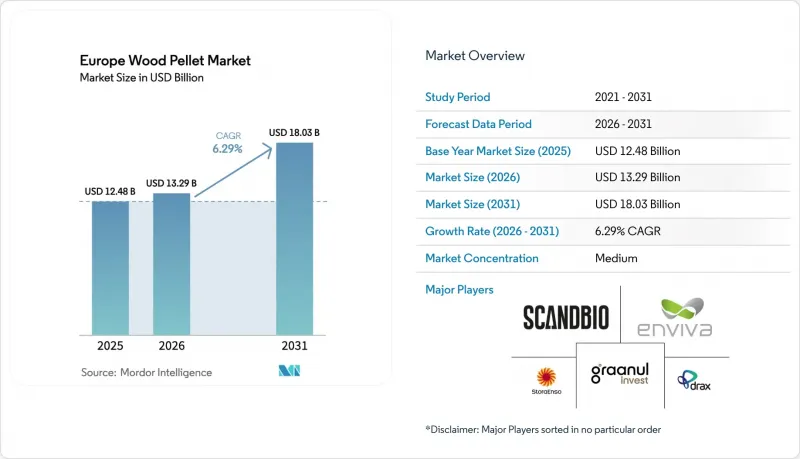
According to Mordor Intelligence, the Europe wood pellet market size is projected to be USD 12.48 billion in 2025, USD 13.29 billion in 2026, and reach USD 18.03 billion by 2031, growing at a CAGR of 6.29% from 2026 to 2031.
This report is Segmented by Feedstock (Forest/Wood Residue, Agricultural Residue, and Energy-Crop and Sawdust Mix), Grade (Utility-Grade, Premium-Grade, Standard-Grade, and More), Application (Heating, Combined Heat and Power, and More), End-User (Residential, Industrial and Utility, and More), and Geography (United Kingdom, Germany, France, Spain, NORDIC Countries, Russia, and Rest of Europe).
Europe Wood Pellet Market Trends and Insights
Robust Residential Heating Demand Amid Record Fossil-Fuel Prices
Gas prices in Europe stayed elevated through 2024, making wood pellets a cost-competitive option for space heating in single-family homes and small businesses. Austria maintained solid boiler installations thanks to unchanged incentives, while Germany and France still absorbed considerable volumes despite subsidy revisions. ENplus certification encouraged cross-border pellet trade by guaranteeing burn quality. The share of residential demand reached 7% of total European consumption in 2024. Although Germany's August 2024 BEG reform curtailed standalone biomass subsidies, residential suppliers are smoothing earnings by expanding into appliance financing and doorstep retail programs. Vertical integration is therefore becoming essential to offset the inherent volatility of spot-based sales.
Accelerated Coal-to-Biomass Conversion of EU Power Plants
Drax Group's restart of Unit 4 in 2024 injected about 3 million t of extra pellet demand and revived UK biomass electricity output. New projects, such as ArcelorMittal's Torero facility in Belgium, illustrate biomass applications in hard-to-abate industries by delivering bio-coal to steel blast furnaces. Spain's La Robla plant, backed by the European Investment Bank, shifted to domestic agricultural residues, cutting logistics emissions and broadening feedstock flexibility. Retrofit economics remain favorable because existing grid connections and turbines are reused, but post-2027 policy uncertainty in the UK may halve offtake, underscoring the need for diversified demand portfolios. EU cascading-use principles, which prioritize residues over roundwood, likewise cap future supply scalability.
Termination of National Pellet Boiler Subsidies and Heat-Pump Competition
Germany scrapped standalone biomass incentives in August 2024, causing a 55% plunge in boiler sales from 2023 to 2024. France recorded an even steeper 73% drop as incentives shifted toward electric heat pumps. The Netherlands stopped subsidizing biomass heat in new homes, funneling funds exclusively to electrification. Accelerated manufacturing scale in China lowered heat-pump equipment prices by 15-20%, eroding pellets' cost advantage. Urban air-quality rules also tightened particulate limits, limiting pellet uptake in dense areas. Together, subsidy withdrawal and cheaper electric alternatives weaken residential demand, forcing producers to rely more heavily on industrial buyers that negotiate longer-term contracts at thinner margins.
Other drivers and restraints analyzed in the detailed report include:
- New EU-ETS Incentives for Negative-Emission BECCS Projects
- Surge in Heat-Pump / Pellet-Hybrid Boiler Retrofits
- Feed-Wood Fiber Scarcity, Price Spikes, and EUDR Compliance Costs
For complete list of drivers and restraints, kindly check the Table Of Contents.
Segment Analysis
Forest and wood residues generated 70.2% of the European wood pellet market size in 2025, reflecting robust sawmill networks and mature ENplus logistics. Agricultural residues, however, are rising at a 7.8% CAGR, aided by mobile pelletizing platforms that shrink transport energy by 38%. Spain's La Robla plant validated local straw sourcing to cut supply-chain emissions. Even though agricultural streams carry higher ash (2-5%) and lower energy density, the EU Deforestation Regulation treats them preferentially, spurring trial blends at CHP units. Producers are adopting advanced sieving and additive dosing to manage quality variability, signaling a longer-term pivot toward multi-feedstock procurement strategies.
Over 2026-2031, forest residues will still underpin the European wood pellet market, but agricultural inputs provide the incremental growth needed to meet utility demand while easing pressure on over-harvested forests. Blending also hedges against residue shortages when housing cycles slow sawmill output. Stakeholders that can certify diverse feedstock pools stand to capture new contracts as utilities seek compliance-ready pellets.
Utility-grade white pellets accounted for 55.8% of the European wood pellet market share in 2025, supplying large-scale power projects that value low delivered cost over premium specs. The European wood pellet market size for torrefied variants is expanding at a 9.4% CAGR, catalyzed by ANDRITZ's 60,000 t Joensuu Biocoal plant in Finland. Torrefaction raises energy density to 22-28 GJ t, enabling coal-plant co-firing without major retrofit. Early adopters include ArcelorMittal, which feeds torrefied pellets into steel furnaces, demonstrating cross-sector potential. Capital intensity remains EUR 100-150 t cap, so deployment concentrates near residue-rich clusters where CHP waste heat can supply the drying step. As more European coal units face retirement, utilities weigh torrefaction as a transitional decarbonization pathway.
Industry consensus sees torrefied pellets reaching double-digit share by 2031, particularly in Northern and Central Europe, where coal assets represent dispatchable capacity. Standard and premium grades will maintain relevance in residential boilers, but growth moderates as hybrids and heat pumps take hold. Manufacturers that diversify across grade portfolios will mitigate demand swings while capturing high-margin torrefied contracts.
Complete Report Scope:
- By Feedstock
- Forest/Wood Residue
- Agricultural Residue
- Energy-Crop and Sawdust Mix
- By Grade
- Utility-Grade (White)
- Premium-Grade
- Standard-Grade
- Torrefied "Black" Pellets
- By Application
- Heating
- Power Generation
- Combined Heat and Power (CHP)
- By End-user
- Residential
- Commercial
- Industrial and Utility
- Animal Bedding
- By Geography
- United Kingdom
- Germany
- France
- Spain
- NORDIC Countries
- Russia
- Rest of Europe
List of Companies Covered in this Report:
- Stora Enso Oyj
- Enviva Inc.
- AS Graanul Invest
- Drax Group plc
- Segezha Group PJSC
- Svenska Cellulosa AB (SCA)
- German Pellets GmbH
- Pure Biofuel Ltd
- Pfeifer Group
- Erdenwerk Gregor Ziegler GmbH
- Scandbio AB
- RZ Pellets GmbH
- Ante-Holz GmbH
- CM Biomass Partners A/S
- Lignetics of Idaho Inc.
- Wismar Pellets GmbH
- Vida AB
- Balcas Energy
- Burpellet SL
- FRP Pellets SpA
Additional Benefits:
- The market estimate (ME) sheet in Excel format
- 3 months of analyst support
TABLE OF CONTENTS
1 Introduction
- 1.1 Study Assumptions & Market Definition
- 1.2 Scope of the Study
2 Research Methodology
3 Executive Summary
4 Market Landscape
- 4.1 Market Overview
- 4.2 Market Drivers
- 4.2.1 Robust residential-heating demand amid record fossil-fuel prices
- 4.2.2 Accelerated coal-to-biomass conversion of EU power plants
- 4.2.3 New EU-ETS incentives for negative-emission BECCS projects
- 4.2.4 Surge in heat-pump / pellet-hybrid boiler retrofits
- 4.2.5 Fast-track permitting for post-Russia supply-chain localization
- 4.3 Market Restraints
- 4.3.1 Termination of national pellet boiler subsidies in core markets
- 4.3.2 Rising competition from heat-pump only solutions
- 4.3.3 Feed-wood fibre scarcity & price spikes post-Ukraine war
- 4.3.4 EUDR sustainability compliance costs
- 4.4 Supply-Chain Analysis
- 4.5 Regulatory Landscape
- 4.6 Technological Outlook
- 4.7 Porter's Five Forces
- 4.7.1 Bargaining Power of Suppliers
- 4.7.2 Bargaining Power of Consumers
- 4.7.3 Threat of New Entrants
- 4.7.4 Threat of Substitute Products & Services
- 4.7.5 Intensity of Competitive Rivalry
5 Market Size & Growth Forecasts
- 5.1 By Feedstock
- 5.1.1 Forest/Wood Residue
- 5.1.2 Agricultural Residue
- 5.1.3 Energy-Crop and Sawdust Mix
- 5.2 By Grade
- 5.2.1 Utility-Grade (White)
- 5.2.2 Premium-Grade
- 5.2.3 Standard-Grade
- 5.2.4 Torrefied "Black" Pellets
- 5.3 By Application
- 5.3.1 Heating
- 5.3.2 Power Generation
- 5.3.3 Combined Heat and Power (CHP)
- 5.4 By End-user
- 5.4.1 Residential
- 5.4.2 Commercial
- 5.4.3 Industrial and Utility
- 5.4.4 Animal Bedding
- 5.5 By Geography
- 5.5.1 United Kingdom
- 5.5.2 Germany
- 5.5.3 France
- 5.5.4 Spain
- 5.5.5 NORDIC Countries
- 5.5.6 Russia
- 5.5.7 Rest of Europe
6 Competitive Landscape
- 6.1 Market Concentration
- 6.2 Strategic Moves (M&A, Partnerships, PPAs)
- 6.3 Market Share Analysis (Market Rank/Share for key companies)
- 6.4 Company Profiles (includes Global level Overview, Market level overview, Core Segments, Financials as available, Strategic Information, Products & Services, and Recent Developments)
- 6.4.1 Stora Enso Oyj
- 6.4.2 Enviva Inc.
- 6.4.3 AS Graanul Invest
- 6.4.4 Drax Group plc
- 6.4.5 Segezha Group PJSC
- 6.4.6 Svenska Cellulosa AB (SCA)
- 6.4.7 German Pellets GmbH
- 6.4.8 Pure Biofuel Ltd
- 6.4.9 Pfeifer Group
- 6.4.10 Erdenwerk Gregor Ziegler GmbH
- 6.4.11 Scandbio AB
- 6.4.12 RZ Pellets GmbH
- 6.4.13 Ante-Holz GmbH
- 6.4.14 CM Biomass Partners A/S
- 6.4.15 Lignetics of Idaho Inc.
- 6.4.16 Wismar Pellets GmbH
- 6.4.17 Vida AB
- 6.4.18 Balcas Energy
- 6.4.19 Burpellet SL
- 6.4.20 FRP Pellets SpA
7 Market Opportunities & Future Outlook
- 7.1 White-space & Unmet-need Assessment

