PUBLISHER: Mordor Intelligence | PRODUCT CODE: 2125628

PUBLISHER: Mordor Intelligence | PRODUCT CODE: 2125628
Steam Turbine MRO - Market Share Analysis, Industry Trends & Statistics, Growth Forecasts (2026 - 2031)
According to Mordor Intelligence, the steam turbine MRO market size is expected to grow from USD 22.56 billion in 2025 to USD 23.65 billion in 2026 and is forecast to reach USD 29.21 billion by 2031 at 4.31% CAGR over 2026-2031.
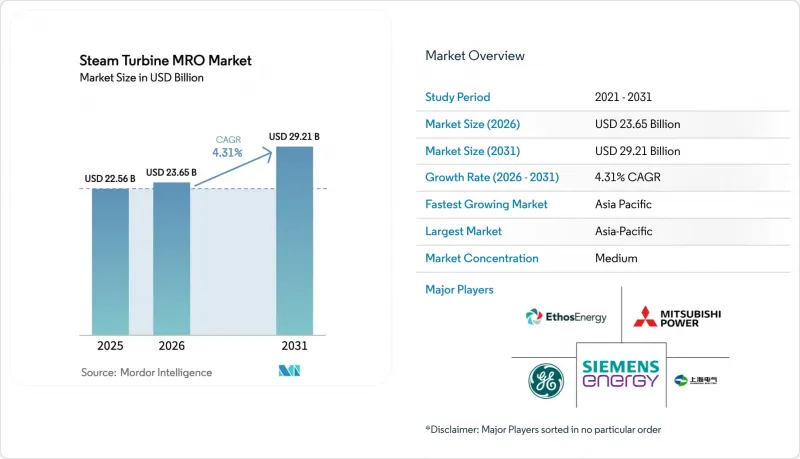
This report is Segmented by Capacity (Below 300 MW, 300 To 600 MW, and Above 600 MW), Plant Fuel (Coal, Natural Gas, Nuclear, and Biomass/Waste-to-Energy), Service Type (Maintenance, Repair, and Overhaul), End-User Industry (Power Generation, Oil and Gas, and Industrial and Other), and Geography (North America, Europe, Asia-Pacific, South America, and Middle East and Africa).
Global Steam Turbine MRO Market Trends and Insights
Aging Global Thermal-Power Fleet Lifecycle Extension
The median U.S. coal unit age reached 44 years in 2024, and owners are choosing 50-60 year life extensions that call for rotor re-boring, creep assessments, and 3D aerodynamic blade retrofits, typically restoring 80-90% original efficiency at one-third of new-build capital. NTPC extended fifteen Indian units totaling 3.8 GW in 2025 under a Bharat Heavy Electricals contract covering metallurgy upgrades and advanced seals. China mirrors the pattern, retrofitting pre-2010 subcritical plants with upgraded seals and low-pressure stage replacements to meet 2030 carbon-intensity targets while deferring decommissioning.
Expansion of Combined-Cycle & Advanced Ultra-Supercritical Plants
Steam temperatures above 600 °C in these units accelerate creep, doubling inspection frequency versus legacy subcritical fleets. Japan's J-POWER introduced nickel-based 650 °C blades in 2024, requiring specialist weld repair unserved by most independents. China added 28 GW of ultra-supercritical capacity in 2025, and mandated 12,000-hour inspections, raising overhaul incidence. Siemens Energy's 15-year Qurayyah LTSA in Saudi Arabia demonstrates how high-efficiency assets lock in long-duration MRO cash flows immediately after commissioning.
Accelerated Retirement of Coal Assets in OECD
EIA data show 23 GW of U.S. coal shut in 2024, with another 14 GW slated by 2029, eliminating large swaths of addressable MRO volume. The U.K. closed its last coal station in 2024, and Germany debates pulling its 2038 exit forward to 2030, squeezing European service demand. IEA forecasts a 40% decline in OECD coal capacity by 2035, a contraction that disproportionately hurts independents unable to pivot to gas or nuclear.
Other drivers and restraints analyzed in the detailed report include:
- OEM Long-Term Service Agreement Boom
- Predictive-Maintenance Digital Twins Adoption
- High Outage CAPEX & Downtime for Major Overhauls
For complete list of drivers and restraints, kindly check the Table Of Contents.
Segment Analysis
In 2025, 300-600 MW units accounted for 50.5% of the steam turbine MRO market share thanks to the vast 1990s subcritical coal fleet. Above-600 MW turbines will post a 5.1% CAGR to 2031, lifting the steam turbine MRO market size for this bracket as China, India, and Japan deploy ultra-supercritical designs that demand nickel-alloy repairs and phased-array ultrasonic inspections.
Mid-range units are far from obsolete; J-POWER lifted four 600 MW subcritical units' efficiency 2.3 points by swapping low-pressure stages for 3D blades in 2025, underscoring retrofit economics over retirement. Below-300 MW machines face parts shortages and early retirement, producing only 14% of MRO revenue on 22% of capacity in the United States.
Coal plants generated 60.1% of global spend in 2025 and underpin the steam turbine MRO market despite OECD retirements, because Asia runs 1,900 GW of coal capacity. Nuclear work will outpace all fuels at 5.5% CAGR after NRC and ASN approvals push U.S. and French reactors to 80-year lives, swelling steam-generator swaps and rotor re-boring scopes that expand the steam turbine MRO market size for nuclear sites.
Natural-gas combined-cycle fleets carry 25% of spending and will grow 4.8% CAGR, buoyed by Middle-East megaproject LTSAs. Biomass and WtE plants remain niche yet require corrosion-resistant coatings, a specialized repair opportunity.
Complete Report Scope:
- By Capacity
- Below 300 MW
- 300 to 600 MW
- Above 600 MW
- By Plant Fuel
- Coal
- Natural Gas
- Nuclear
- Biomass/Waste-to-Energy
- By Service Type
- Maintenance
- Repair
- Overhaul
- By End-user Industry
- Power Generation
- Oil and Gas (Up-/Mid-/Down-stream)
- Industrial and Other
- By Geography
- North America
- United States
- Canada
- Mexico
- Europe
- Germany
- United Kingdom
- France
- Italy
- NORDIC Countries
- Russia
- Rest of Europe
- Asia-Pacific
- China
- India
- Japan
- South Korea
- ASEAN Countries
- Rest of Asia-Pacific
- South America
- Brazil
- Argentina
- Rest of South America
- Middle East and Africa
- Saudi Arabia
- United Arab Emirates
- South Africa
- Egypt
- Rest of Middle East and Africa
- North America
Geography Analysis
Asia-Pacific controlled 49.6% of 2025 revenue and is projected to deliver a 5.8% CAGR to 2031 as China, India, and Southeast Asia expand ultra-supercritical and combined-cycle fleets. State Grid contracts for 78 GW of Chinese ultra-supercritical capacity already rely on domestic repair houses that possess nickel-alloy weld and phased-array UT capabilities, compressing foreign OEM share. India's 3.8 GW NTPC refurbishment award to Bharat Heavy Electricals showcases the large-scale lifecycle-extension pipeline through the next decade.
North America's growth is slowing down as coal closures offset nuclear life-extension gains; however, 250 GW of combined-cycle capacity anchors a robust LTSA base. Europe's market is propelled by French nuclear upgrades and German CCGT build-outs to firm renewables. The Middle East and Africa market growth is fueled by Qurayyah, Al Dhafra, and New Capital mega-contracts linking LTSAs with digital-twin analytics. South America's 6% slice benefits from Brazilian hydro-thermal hybrid upgrades and Argentine cogeneration tied to Vaca Muerta shale gas.
- GE Vernova
- Siemens Energy
- Mitsubishi Power
- Shanghai Electric
- Harbin Electric
- Dongfang Turbine
- Bharat Heavy Electricals
- Baker Hughes
- Sulzer
- EthosEnergy
- Elliott Group
- Triveni Turbine
- Doosan Enerbility
- MAN Energy Solutions
- Toshiba Energy Systems
- Ansaldo Energia
- Fuji Electric
- Voith Turbo
- Kessels Steam Turbines
- TMS Turbomaschinenservice
Additional Benefits:
- The market estimate (ME) sheet in Excel format
- 3 months of analyst support
TABLE OF CONTENTS
1 Introduction
- 1.1 Study Assumptions & Market Definition
- 1.2 Scope of the Study
2 Research Methodology
3 Executive Summary
4 Market Landscape
- 4.1 Market Overview
- 4.2 Market Drivers
- 4.2.1 Aging global thermal-power fleet lifecycle extension
- 4.2.2 Expansion of combined-cycle & advanced ultra-supercritical plants
- 4.2.3 OEM long-term service agreement (LTSA) boom
- 4.2.4 Predictive-maintenance digital twins adoption
- 4.2.5 Decarbonization retrofits incl. H2 / NH3 co-firing
- 4.2.6 Rise of industrial micro-CHP in emerging markets
- 4.3 Market Restraints
- 4.3.1 Accelerated retirement of coal assets in OECD
- 4.3.2 High outage CAPEX & downtime for major overhauls
- 4.3.3 OEM software lock-in limiting independents
- 4.3.4 Scarcity of legacy spare parts <300 MW units
- 4.4 Supply-Chain Analysis
- 4.5 Regulatory Landscape
- 4.6 Technological Outlook
- 4.7 Porter's Five Forces
- 4.7.1 Threat of New Entrants
- 4.7.2 Bargaining Power of Suppliers
- 4.7.3 Bargaining Power of Buyers
- 4.7.4 Threat of Substitutes
- 4.7.5 Competitive Rivalry
- 4.8 Long-Term Service Agreement (LTSA) Trend Analysis
5 Market Size & Growth Forecasts
- 5.1 By Capacity
- 5.1.1 Below 300 MW
- 5.1.2 300 to 600 MW
- 5.1.3 Above 600 MW
- 5.2 By Plant Fuel
- 5.2.1 Coal
- 5.2.2 Natural Gas
- 5.2.3 Nuclear
- 5.2.4 Biomass/Waste-to-Energy
- 5.3 By Service Type
- 5.3.1 Maintenance
- 5.3.2 Repair
- 5.3.3 Overhaul
- 5.4 By End-user Industry
- 5.4.1 Power Generation
- 5.4.2 Oil and Gas (Up-/Mid-/Down-stream)
- 5.4.3 Industrial and Other
- 5.5 By Geography
- 5.5.1 North America
- 5.5.1.1 United States
- 5.5.1.2 Canada
- 5.5.1.3 Mexico
- 5.5.2 Europe
- 5.5.2.1 Germany
- 5.5.2.2 United Kingdom
- 5.5.2.3 France
- 5.5.2.4 Italy
- 5.5.2.5 NORDIC Countries
- 5.5.2.6 Russia
- 5.5.2.7 Rest of Europe
- 5.5.3 Asia-Pacific
- 5.5.3.1 China
- 5.5.3.2 India
- 5.5.3.3 Japan
- 5.5.3.4 South Korea
- 5.5.3.5 ASEAN Countries
- 5.5.3.6 Rest of Asia-Pacific
- 5.5.4 South America
- 5.5.4.1 Brazil
- 5.5.4.2 Argentina
- 5.5.4.3 Rest of South America
- 5.5.5 Middle East and Africa
- 5.5.5.1 Saudi Arabia
- 5.5.5.2 United Arab Emirates
- 5.5.5.3 South Africa
- 5.5.5.4 Egypt
- 5.5.5.5 Rest of Middle East and Africa
- 5.5.1 North America
6 Competitive Landscape
- 6.1 Market Concentration
- 6.2 Strategic Moves (M&A, Partnerships, PPAs)
- 6.3 Market Share Analysis (Market Rank/Share for key companies)
- 6.4 Company Profiles (includes Global level Overview, Market level overview, Core Segments, Financials as available, Strategic Information, Products & Services, and Recent Developments)
- 6.4.1 GE Vernova
- 6.4.2 Siemens Energy
- 6.4.3 Mitsubishi Power
- 6.4.4 Shanghai Electric
- 6.4.5 Harbin Electric
- 6.4.6 Dongfang Turbine
- 6.4.7 Bharat Heavy Electricals
- 6.4.8 Baker Hughes
- 6.4.9 Sulzer
- 6.4.10 EthosEnergy
- 6.4.11 Elliott Group
- 6.4.12 Triveni Turbine
- 6.4.13 Doosan Enerbility
- 6.4.14 MAN Energy Solutions
- 6.4.15 Toshiba Energy Systems
- 6.4.16 Ansaldo Energia
- 6.4.17 Fuji Electric
- 6.4.18 Voith Turbo
- 6.4.19 Kessels Steam Turbines
- 6.4.20 TMS Turbomaschinenservice
7 Market Opportunities & Future Outlook
- 7.1 White-Space & Unmet-Need Assessment

