PUBLISHER: Mordor Intelligence | PRODUCT CODE: 2125669

PUBLISHER: Mordor Intelligence | PRODUCT CODE: 2125669
North America Medium Voltage Switchgear - Market Share Analysis, Industry Trends & Statistics, Growth Forecasts (2026 - 2031)
According to Mordor Intelligence, the North America medium voltage switchgear market size is estimated at USD 8.25 billion in 2026, and is expected to reach USD 9.71 billion by 2031, at a CAGR of 3.30% during the forecast period (2026-2031).
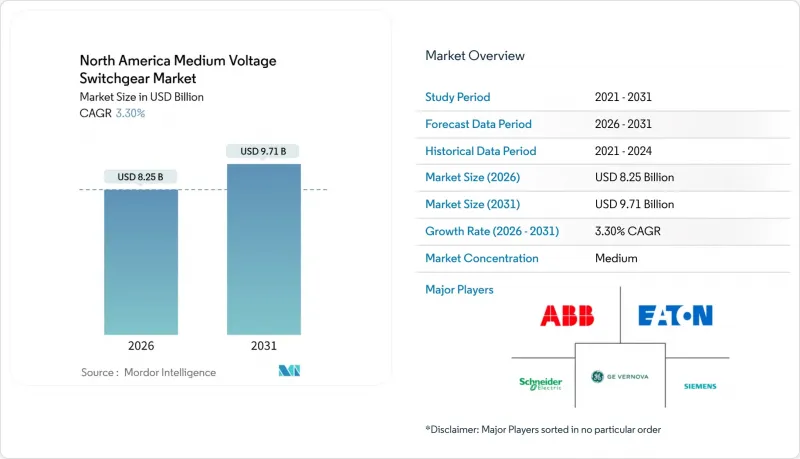
This report is Segmented by Insulation (Gas Insulated Switchgear, Air Insulated Switchgear, and Others), Current Type (AC Switchgear and DC Switchgear), Installation (Indoor and Outdoor), End-User (Utilities, Residential, Commercial, and Industrial), and Geography (United States, Canada, and Mexico). The Market Sizes and Forecasts are Provided in Terms of Value (USD).
North America Medium Voltage Switchgear Market Trends and Insights
Grid-Modernization Investments Under IIJA and Provincial Upgrade Programs
Federal and provincial funding is accelerating substation upgrades that favor modular GIS over legacy air-insulated units. The IIJA's USD 10.5 billion GRIP program steers utilities toward resilience rather than simple capacity expansion, and recipients such as the Tennessee Valley Authority have specified vacuum circuit breakers with remote-monitoring capability for extreme-weather hardening. Ontario's Grid Innovation Fund allocated CAD 400 million (USD 295 million) in 2025 for IEC 61850-ready switchgear to integrate distributed energy resources. Southern utilities in hurricane zones are prioritizing outdoor-rated equipment with corrosion-resistant coatings, whereas northern operators prefer indoor GIS to avoid freeze-thaw stress. Compressed award timelines are shortening vendor selection windows, rewarding OEMs with U.S. or Canadian inventory. As grid-hardening mandates widen, the North America medium voltage switchgear market will increasingly pivot toward compact, digitally enabled platforms that comply with new interoperability standards.
Rapid Capacity Build-Out of Hyperscale Data Centers
Artificial-intelligence workloads are reshaping medium-voltage load profiles, with single racks now consuming up to 600 kW. ABB and Eaton introduced 800 V DC switchgear in 2025 to serve edge data centers where real estate costs exceed USD 200 per square foot. U.S. data-center capacity is forecast to triple to 90 GW by 2030, yet interconnection queues in Virginia and Texas already exceed two years. Developers are responding by pairing on-site generation, often natural-gas peakers or battery storage, with dedicated medium-voltage switchgear. The result is a bifurcated demand curve: hyperscalers bypass utility substations with on-site 34.5 kV rings, while smaller colocation providers remain grid-connected and must satisfy NERC cybersecurity rules. This divergence supports sustained growth in the North America medium voltage switchgear market among vendors that can supply both AC and DC architectures with integrated protection and compliance features.
Prolonged GIS Lead Times From Cast-Resin Shortages
Global epoxy feedstock disruptions continue to lengthen custom GIS lead times to 12-18 months, double the 6-9 months typical of air-insulated switchgear. ABB and Schneider Electric now pre-build GIS modules for common voltage classes, yet bespoke protection or bus configurations still require fresh casting, pushing delivery well into 2027 for projects ordered in 2025. Cast-resin prices rose 18% between 2024 and 2025, prompting surcharge pass-throughs that erode GIS's total-cost-of-ownership edge in non-space-constrained sites. Some utilities pivot to outdoor AIS for greenfield builds, accepting larger land parcels to sidestep resin bottlenecks. Unless supply recovers, the North America medium voltage switchgear market faces a near-term cap on GIS volume growth.
Other drivers and restraints analyzed in the detailed report include:
- Utility Commitments to SF6-Free Eco-Efficient Switchgear
- Community-Scale Solar Plus Storage Growth
- Skilled-Labor Gaps in Commissioning and Maintenance
For complete list of drivers and restraints, kindly check the Table Of Contents.
Segment Analysis
Gas-insulated switchgear secured 58.8% revenue share in 2025 within the North America medium voltage switchgear market, reflecting its 60%-70% footprint advantage in dense urban substations. The segment benefits further as utilities pursue SF6-free replacements to meet state mandates. Air-insulated units retain cost leadership in rural builds where land is cheap. The "Others" category, covering solid-state and hybrid breakers, is projected to grow at an 8.5% CAGR through 2031, the industry's fastest across insulation types, thanks to utilities piloting sub-cycle fault-current-limiting solutions.
Solid-state prototypes with silicon-carbide semiconductors from ABB and Eaton cut interruption time to microseconds, minimizing voltage sags for sensitive data-center loads. Hybrid platforms marry mechanical contacts for steady-state operation with electronic devices for fault clearing, enabling gradual migration toward solid-state architectures. In Canada, high wildlife-induced fault rates spur tests of hybrid reclosers designed for distribution grids. As a result, the North America medium voltage switchgear market will likely see GIS remain dominant in space-constrained settings, AIS rule in low-cost greenfield sites, and hybrid technologies blossom in reliability-critical nodes, the three designs coexisting rather than converging.
AC equipment retained an 85.2% share of the North America medium voltage switchgear market size in 2025, underscoring the legacy AC grid architecture. Yet DC switchgear will record a 5.9% CAGR through 2031 on data-center, renewables, and battery-storage demand. ABB's 800 V DC lineup trims cooling loads by 10%-15% in hyperscale facilities, a clear operating-expense benefit. Battery storage and solar plants that natively produce DC further reduce conversion losses when interconnected via medium-voltage DC switchgear.
Standards lag remains a hurdle, with IEEE and ANSI guidance trailing IEC 61660 for DC testing. Certification ambiguity slows U.S. utility adoption, although military and campus microgrids already specify DC loops to bolster resilience. Within the North America medium voltage switchgear industry, AC platforms will continue to dominate utility and industrial orders, but DC volumes will climb steadily where efficiency and space are premium concerns.
Complete Report Scope:
- By Insulation
- Gas Insulated Switchgear (GIS)
- Air Insulated Switchgear (AIS)
- Others
- By Current Type
- AC Switchgear
- DC Switchgear
- By Installation
- Indoor
- Outdoor
- By End-User
- Utilities
- Residential
- Commercial
- Industrial
- By Geography
- United States
- Canada
- Mexico
List of Companies Covered in this Report:
- ABB Ltd
- Siemens AG
- Schneider Electric SE
- Eaton Corporation plc
- General Electric (GE Vernova)
- Mitsubishi Electric Power Products Inc (MEPPI)
- Powell Industries Inc
- WEG SA
- Myers Power Products Inc
- AZZ Inc
- Hyosung Heavy Industries
- Hitachi Energy
- Toshiba International Corp
- NOJA Power
- ABB Trench Ltd (Canada)
- SEL Schweitzer Engineering Laboratories
- G&W Electric
- RESA Power
- Spike Electric
- S&C Electric Company
Additional Benefits:
- The market estimate (ME) sheet in Excel format
- 3 months of analyst support
TABLE OF CONTENTS
1 Introduction
- 1.1 Study Assumptions & Market Definition
- 1.2 Scope of the Study
2 Research Methodology
3 Executive Summary
4 Market Landscape
- 4.1 Market Overview
- 4.2 Market Drivers
- 4.2.1 Grid-modernization investments under IIJA & provincial upgrade programs
- 4.2.2 Rapid capacity build-out of hyperscale data-centres (AI workloads)
- 4.2.3 Utility commitments to SF6-free eco-efficient switchgear
- 4.2.4 Surge in medium-voltage equipment for community-scale solar + storage
- 4.2.5 Accelerated electrification of commercial vehicle depots (5-35 kV)
- 4.3 Market Restraints
- 4.3.1 Prolonged GIS lead-times from global cast-resin shortages
- 4.3.2 Skilled-labor gaps in switchgear commissioning & maintenance
- 4.3.3 Cyber-security compliance costs (NERC CIP, CSA CIP)
- 4.4 Supply-Chain Analysis
- 4.5 Regulatory Landscape
- 4.6 Technological Outlook
- 4.7 Porter's Five Forces
- 4.7.1 Bargaining Power of Suppliers
- 4.7.2 Bargaining Power of Consumers
- 4.7.3 Threat of New Entrants
- 4.7.4 Threat of Substitute Products & Services
- 4.7.5 Intensity of Competitive Rivalry
5 Market Size & Growth Forecasts
- 5.1 By Insulation
- 5.1.1 Gas Insulated Switchgear (GIS)
- 5.1.2 Air Insulated Switchgear (AIS)
- 5.1.3 Others
- 5.2 By Current Type
- 5.2.1 AC Switchgear
- 5.2.2 DC Switchgear
- 5.3 By Installation
- 5.3.1 Indoor
- 5.3.2 Outdoor
- 5.4 By End-User
- 5.4.1 Utilities
- 5.4.2 Residential
- 5.4.3 Commercial
- 5.4.4 Industrial
- 5.5 By Geography
- 5.5.1 United States
- 5.5.2 Canada
- 5.5.3 Mexico
6 Competitive Landscape
- 6.1 Market Concentration
- 6.2 Strategic Moves (M&A, Partnerships, PPAs)
- 6.3 Market Share Analysis (Market Rank/Share for key companies)
- 6.4 Company Profiles (includes Global level Overview, Market level overview, Core Segments, Financials as available, Strategic Information, Products & Services, and Recent Developments)
- 6.4.1 ABB Ltd
- 6.4.2 Siemens AG
- 6.4.3 Schneider Electric SE
- 6.4.4 Eaton Corporation plc
- 6.4.5 General Electric (GE Vernova)
- 6.4.6 Mitsubishi Electric Power Products Inc (MEPPI)
- 6.4.7 Powell Industries Inc
- 6.4.8 WEG SA
- 6.4.9 Myers Power Products Inc
- 6.4.10 AZZ Inc
- 6.4.11 Hyosung Heavy Industries
- 6.4.12 Hitachi Energy
- 6.4.13 Toshiba International Corp
- 6.4.14 NOJA Power
- 6.4.15 ABB Trench Ltd (Canada)
- 6.4.16 SEL Schweitzer Engineering Laboratories
- 6.4.17 G&W Electric
- 6.4.18 RESA Power
- 6.4.19 Spike Electric
- 6.4.20 S&C Electric Company
7 Market Opportunities & Future Outlook
- 7.1 White-space & Unmet-Need Assessment

