PUBLISHER: Mordor Intelligence | PRODUCT CODE: 2125694

PUBLISHER: Mordor Intelligence | PRODUCT CODE: 2125694
US Air Freight Transport - Market Share Analysis, Industry Trends & Statistics, Growth Forecasts (2026 - 2031)
According to Mordor Intelligence, US air freight transport market size in 2026 is estimated at USD 51.99 billion, growing from 2025 value of USD 49.85 billion with 2031 projections showing USD 64.11 billion, growing at 4.29% CAGR over 2026-2031.
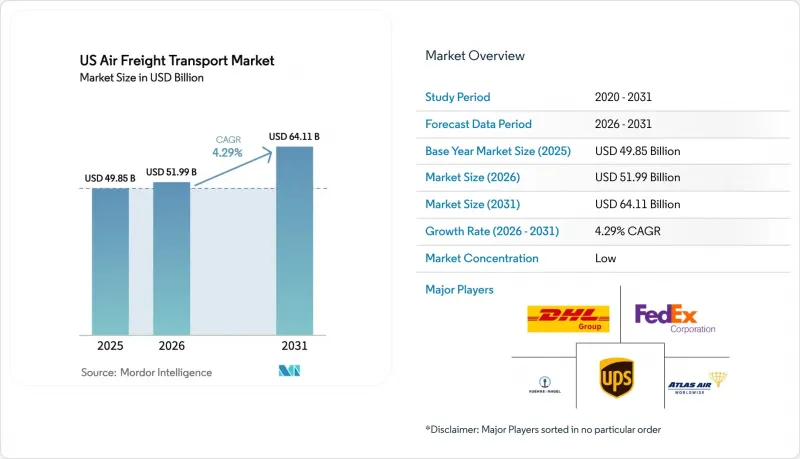
This report is Segmented by Service Type (Freight Transport (Cargo/CEP), Freight Forwarding and More), by Destination (Domestic and More), by Carrier Type (Belly Cargo and Freighter), by Cargo Type (General Cargo and Special Cargo), by End-User Industry (E-Commerce & Retail, Manufacturing & Automotive and More), by Region (Northeast, and More). The Market Forecasts are Provided in Terms of Value (USD).
US Air Freight Transport Market Trends and Insights
Cross-border e-commerce two-day delivery boom led by U.S.-Asia parcels
Consumer expectations have converged on two-day fulfillment, with 90% of US shoppers naming that window as baseline and 30% already demanding same-day service on overseas orders. E-commerce now drives more than half the transpacific tonnage, making it the fulcrum of the US air freight transport market. The segment's USD 1.06 trillion revenue potential in 2024, coupled with a 7.4% 2025-2028 CAGR, is compelling carriers to up-gauge cross-dock capacity, integrate customs pre-clearance, and co-locate last-mile sorting inside airport perimeters. Fulfillment speed is becoming a differentiator, nudging airlines to favor freighter schedules over belly space to avoid passenger-driven slot curfews and baggage conflicts.
Semiconductor & electronics reshoring across U.S.-Mexico corridor
Nearshoring investment commitments topping USD 31 billion in Mexico in 2023 have catalyzed a high-value corridor for wafer fabs and printed circuit assemblies. Forty percent of a finished Mexican export's content originates in the US, a stark contrast with the 4% value add from China. This tight co-production loop depends on overnight air bridges linking maquiladora clusters with US design centers, reinforcing the long-term relevance of the US air freight transport market for high-tech just-in-time flows.
Belly-capacity resurgence squeezing yields post-pandemic
Passenger recovery has re-introduced dormant wide-body underbellies, lifting global capacity by 2% in late 2024 against 11% freight demand growth. As airlines re-activate Airbus A350 and Boeing 787 fleets, shippers regain rate leverage, eroding freighter premiums. The International Air Transport Association projects a deceleration to 5.8% global volume growth in 2025, with cargo revenues falling to USD 111 billion. This softens the earnings outlook for the US air freight transport market despite sustained trade growth.
Other drivers and restraints analyzed in the detailed report include:
- Temperature-controlled biologics & cell-gene therapies growth
- Airport cargo-city investments (MIA, DFW, RFD) expanding throughput
- Tariff and de-minimis crackdown causing customs delays for e-commerce
For complete list of drivers and restraints, kindly check the Table Of Contents.
Segment Analysis
Freight transport commanded 46.62% of the US air freight transport market share in 2025 on the strength of established hub-and-spoke courier networks. The segment's scale provides baseline volumes that anchor aircraft utilization. Yet value-added services-from customs brokerage to insurance-will grow 5.05% annually, outstripping the broader US air freight transport market. Forwarders are bundling duty automation tools with compliance audits to help e-merchants confront rule changes on de-minimis entries. UPS's plan to double healthcare revenue exemplifies the margin upside in specialized advisory and cold-chain orchestration, which often carries mark-ups 3-4 percentage points above line-haul.
As regulatory hurdles multiply, shippers prize single-invoice solutions that collapse brokerage, labeling, and last-mile into one contract. That preference positions integrators and tech-enabled 4PLs to capture a larger share of the US air freight transport market, even if pure lift revenues flatten. Over the forecast period, the US air freight transport market size tied to consulting, packaging, and IoT tracking could top USD 8.27 billion, reinforcing the service pivot away from commoditized tonnage.
Domestic lift still represents 61.35% of the US air freight transport market size in 2025, due to Alaska, Hawaii, and coast-to-coast fulfillment patterns. Growth, however, tilts to cross-border lanes, which are tracking a 4.5% CAGR. Transpacific e-commerce volumes and northbound flows from Mexico dominate this acceleration. Asia-North America already accounts for a quarter of global air cargo; with online orders rising, that share may climb toward one-third by the decade's midpoint.
Ground haulage competes fiercely on sub-1,000-mile domestic moves, but for apparel, electronics, and biologics, air freight remains the only mode that satisfies two-day service-level agreements. The interplay between US gateways and Mexican maquila cities also underscores the momentum: USD 656 billion in bilateral trade flowed in the first 11 months of 2023, a figure boosting the international slice of the US air freight transport market.
Complete Report Scope:
- By Service Type
- Freight Transport (Cargo/CEP)
- Freight Forwarding
- Other Value-Added Services (Customs brokerage, insurance, etc.)
- By Destination
- Domestic
- International
- By Carrier Type
- Belly Cargo
- Freighter
- By Cargo Type
- General Cargo
- Special Cargo
- By End-Use Industry
- E-commerce & Retail
- Manufacturing & Automotive
- Healthcare & Pharmaceuticals
- Perishables & Fresh Produce
- High-Tech & Electronics
- By Region (United States)
- Northeast
- Midwest
- Southeast
- Southwest
- West
List of Companies Covered in this Report:
- UPS (United Parcel Service Inc.)
- FedEx Corp.
- DHL (Deutsche Post AG)
- Atlas Air Worldwide Holdings
- Kuehne + Nagel
- DSV A/S
- Expeditors International
- C.H. Robinson Worldwide
- Nippon Express
- CEVA Logistics (CMA-CGM)
- Kerry Logistics
- American Airlines Cargo
- Maersk Air Cargo
- Polar Air Cargo
- Kalitta Air
- Southwest Airlines Cargo
- Delta Cargo
- XPO Logistics
- United Airlines Cargo
- Forward Air*
Additional Benefits:
- The market estimate (ME) sheet in Excel format
- 3 months of analyst support
TABLE OF CONTENTS
1 Introduction
- 1.1 Study Assumptions & Market Definition
- 1.2 Scope of the Study
2 Research Methodology
3 Executive Summary
4 Market Landscape
- 4.1 Market Overview
- 4.2 Market Drivers
- 4.2.1 Cross-border e-commerce two-day delivery boom led by U.S.-Asia parcels
- 4.2.2 Semiconductor & electronics reshoring across U.S.-Mexico corridor
- 4.2.3 Open-Skies bilateral expansion unlocking new all-cargo routings
- 4.2.4 Temperature-controlled biologics & cell-gene therapies growth
- 4.2.5 Near-shoring of automotive/aerospace parts requiring JIT airlift
- 4.2.6 Airport cargo-city investments (MIA, DFW, RFD) expanding throughput
- 4.3 Market Restraints
- 4.3.1 Belly-capacity resurgence squeezing yields post-pandemic
- 4.3.2 Cargo-hub labor shortages & wage inflation
- 4.3.3 Tariff & de-minimis crackdown causing customs delays for e-commerce
- 4.3.4 SAF blending mandates elevating fuel cost base
- 4.4 Value / Supply-Chain Analysis
- 4.5 Regulatory or Technological Outlook
- 4.6 Porter's Five Forces
- 4.6.1 Threat of New Entrants
- 4.6.2 Bargaining Power of Buyers
- 4.6.3 Bargaining Power of Suppliers
- 4.6.4 Threat of Substitutes
- 4.6.5 Degree of Competition
- 4.7 Technology Snapshot & Digital Trends
- 4.8 Spotlight on Key Commodities Transported by Air
- 4.9 Elaboration on Air-Freight Rates
- 4.10 Spotlight on Heavy Cargo / Project Logistics
- 4.11 Insights into Ground-Handling Equipment
- 4.12 Standards & Regulations - Dangerous Goods
- 4.13 Cold-Chain Logistics in Air Cargo
- 4.14 Impact of Geopolitics & Pandemic
5 Market Size & Growth Forecasts (Value)
- 5.1 By Service Type
- 5.1.1 Freight Transport (Cargo/CEP)
- 5.1.2 Freight Forwarding
- 5.1.3 Other Value-Added Services (Customs brokerage, insurance, etc.)
- 5.2 By Destination
- 5.2.1 Domestic
- 5.2.2 International
- 5.3 By Carrier Type
- 5.3.1 Belly Cargo
- 5.3.2 Freighter
- 5.4 By Cargo Type
- 5.4.1 General Cargo
- 5.4.2 Special Cargo
- 5.5 By End-Use Industry
- 5.5.1 E-commerce & Retail
- 5.5.2 Manufacturing & Automotive
- 5.5.3 Healthcare & Pharmaceuticals
- 5.5.4 Perishables & Fresh Produce
- 5.5.5 High-Tech & Electronics
- 5.6 By Region (United States)
- 5.6.1 Northeast
- 5.6.2 Midwest
- 5.6.3 Southeast
- 5.6.4 Southwest
- 5.6.5 West
6 Competitive Landscape
- 6.1 Market Concentration
- 6.2 Strategic Moves
- 6.3 Market Share Analysis
- 6.4 Company Profiles {(includes Global level Overview, Market level overview, Core Segments, Financials as available, Strategic Information, Market Rank/Share for key companies, Products & Services, and Recent Developments)}
- 6.4.1 UPS (United Parcel Service Inc.)
- 6.4.2 FedEx Corp.
- 6.4.3 DHL (Deutsche Post AG)
- 6.4.4 Atlas Air Worldwide Holdings
- 6.4.5 Kuehne + Nagel
- 6.4.6 DSV A/S
- 6.4.7 Expeditors International
- 6.4.8 C.H. Robinson Worldwide
- 6.4.9 Nippon Express
- 6.4.10 CEVA Logistics (CMA-CGM)
- 6.4.11 Kerry Logistics
- 6.4.12 American Airlines Cargo
- 6.4.13 Maersk Air Cargo
- 6.4.14 Polar Air Cargo
- 6.4.15 Kalitta Air
- 6.4.16 Southwest Airlines Cargo
- 6.4.17 Delta Cargo
- 6.4.18 XPO Logistics
- 6.4.19 United Airlines Cargo
- 6.4.20 Forward Air*
7 Market Opportunities & Future Outlook

