PUBLISHER: Mordor Intelligence | PRODUCT CODE: 2157027

PUBLISHER: Mordor Intelligence | PRODUCT CODE: 2157027
Indonesia Air Freight Transport - Market Share Analysis, Industry Trends & Statistics, Growth Forecasts (2026 - 2031)
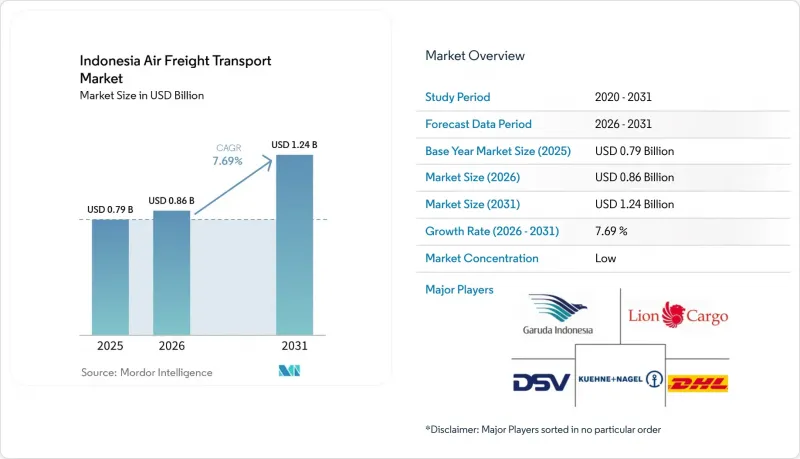
According to Mordor Intelligence, the Indonesia air freight transport market size was valued at USD 0.79 billion in 2025, and is estimated to grow from USD 0.86 billion in 2026 to reach USD 1.24 billion by 2031, at a CAGR of 7.69% during the forecast period (2026-2031).
Indonesia Air Freight Transport Market Trends and Insights
E-Commerce and Time-Definite Delivery Expansion
The Indonesia air freight transport market benefits when online sellers need delivery commitments that sea and road networks cannot meet across distant islands. Demand is no longer concentrated only in major Java cities, because logistics access is broadening in Sumatra, Kalimantan, and Sulawesi. This creates a wider base of parcels and commercial shipments that require dependable uplift between islands. Airlines and forwarders need to manage short delivery windows, variable daily volumes, and service recovery when an onward flight is delayed. The operational need is not limited to moving a parcel from one airport to another, because sellers also need a predictable handover to local delivery networks after arrival. The shift supports investments in booking systems, airport handling, and scheduled services that can respond to uneven demand without making service commitments unreliable. It also makes service reliability more important for the Indonesia air freight transport market, since a missed connection can affect delivery across several island legs.
Archipelago Connectivity And Inter-Island Service Need
Indonesia has more than 17,000 islands spread across a wide maritime area, which limits the practical reach of road and rail distribution. Eastern Indonesia, including Sulawesi, Papua, and the Maluku Islands, has fewer surface transport links than Java and faces longer transport distances between population centers. Air services are therefore necessary for urgent, high-value, or perishable cargo where slower movement is not suitable. As healthcare distributors, seafood exporters, and electronics businesses extend their operations eastward, the need for regular cargo flights can increase and provide a clearer case for dedicated capacity. The Maleo Airport upgrade in Central Sulawesi extended the runway by 300 meters and improved cargo handling, allowing larger aircraft to serve the area. Such improvements can make new freight routes commercially viable, give local producers access to more regular services, and support the Indonesia air freight transport market outside established gateways.
Aircraft Serviceability And Fleet Availability Constraints
Fleet availability remains important because cargo schedules depend on aircraft that can enter service consistently and connect remote destinations without frequent cancellation. Smaller routes can be affected more severely when an aircraft is unavailable, because substitute capacity may not be readily available, and customers may have few practical alternatives. Maintenance lead times and the foreign-currency cost of aircraft parts add pressure to operating budgets and affect decisions on aircraft use. These constraints are especially relevant for older aircraft that serve short-runway routes in outer-island locations. A planned maintenance, repair, and overhaul hub at Kertajati offers a longer-term response, but it does not immediately resolve near-term serviceability limits.
Other drivers and restraints analyzed in the detailed report include:
- Electronics, Semiconductor, And Automotive Export Recovery
- Healthcare, Pharmaceutical, And Cold-Chain Intensity
- Aviation-Turbine-Fuel, Foreign-Exchange, And Spare-Parts Cost Exposure
For complete list of drivers and restraints, kindly check the Table Of Contents.
Segment Analysis
Freight transport (cargo/CEP) held 71.25% of the Indonesia air freight transport market share in 2025, making it the largest service category in the market, while other value-added services are forecast to register at a 9.78% CAGR through 2031. Freight forwarding remains important because it coordinates shipments that use air, sea, and road links. Customs brokerage, insurance, and specialty handling are included within the growing value-added category. Shippers increasingly need visibility, compliance support, and protection against cargo loss alongside physical transport. This changes the revenue model from a transport-only transaction to a broader service relationship.
The Indonesia air freight transport industry can gain more value when providers combine cargo movement with documentation and tracking that remains available throughout the shipment journey. Such services can help customers manage customs processes, insurance needs, special handling instructions, and delivery evidence through one provider rather than several separate parties. Heavy shipments also need a clear commercial option when they exceed standard express parcel thresholds but still require time-definite air movement. Digital shipment visibility can reduce uncertainty for cargo owners by making handoffs and movement status easier to follow. The fastest-growing service area shows why transport providers need operational, customer-service, and compliance capabilities in addition to aircraft access, because the customer's requirement often covers export documentation, cargo acceptance, regulatory checks, insurance, customs coordination, tracking, and delivery confirmation, as well as the flight itself. This need is especially relevant for exporters that coordinate documents and cargo movement across an Indonesian origin, an international gateway, and a foreign destination.
Domestic routes accounted for 55.26% of the Indonesia air freight transport market size in 2025, reflecting the central role of inter-island distribution, while international routes are forecast to expand at an 8.87% CAGR through 2031. Domestic shipments serve consumer markets and commercial activity across islands that do not have continuous road or rail connections. International traffic is supported by electronics, pharmaceuticals, and e-commerce exports moving through Jakarta and Batam.
International expansion can improve the wider air cargo network when carriers add frequencies on trade lanes and make their capacity visible to more freight forwarders. Inbound aircraft can provide capacity that supports domestic redistribution after international cargo is unloaded and processed at the gateway. Garuda Indonesia Cargo listed its international cargo capacity exclusively on WebCargo by Freightos in September 2025. The listing covered routes to Singapore, Tokyo, Jeddah, Shanghai, Sydney, and Hong Kong. It gave freight forwarders access to real-time booking for these services and reduced the reliance on manual capacity inquiries. Network quality can improve when international carriers and integrators build stronger operations at Indonesian gateways, because domestic customers can use better-connected airport facilities and schedules, and because greater international frequency can improve access to capacity, ground handling, information, and onward connections that support the national distribution network.
Complete Report Scope:
- By Service
- Freight Transport (Cargo/CEP)
- Freight Forwarding
- Other Value-Added Services (Customs Brokerage, Insurance, etc.)
- By Destination
- Domestic
- International
- By Carrier Type
- Belly Cargo
- Freighter
- By Cargo Type
- General Cargo
- Reefer Cargo
- Special Cargo (Dangerous, High Value, Oversized, etc.)
- By End-User Industry
- E-commerce and Retail
- Manufacturing and Automotive
- Healthcare and Pharmaceuticals
- Perishables and Fresh Produce
- High-Tech and Electronics
- Others
- By Region
- Java (Jakarta & BOD)
- Sumatra
- Kalimantan
- Sulawesi
- Bali and Nusa Tenggara
- Papua Region and Maluku Islands
List of Companies Covered in this Report:
- Garuda Indonesia Cargo
- Lion Air Cargo
- DHL Group
- Kuehne+Nagel
- DSV A/S (Including DB Schenker)
- FedEx
- UPS
- Cathay Cargo
- Singapore Airlines Cargo
- Rhenus Logistics
- CEVA Logistics (CMA CGM Group)
- NX Group / PT NX Lemo Indonesia Logistik
- Expeditors International Indonesia
- GEODIS
- Yusen Logistics
- A.P. Moller - Maersk A/S
- Turkish Cargo
- China Airlines Cargo
- JAL Cargo
- Emirates SkyCargo
- BBN Airlines Indonesia
- Cardig Air
Additional Benefits:
- The market estimate (ME) sheet in Excel format
- 3 months of analyst support
TABLE OF CONTENTS
1 INTRODUCTION
- 1.1 Study Assumptions and Market Definition
- 1.2 Scope of the Study
2 RESEARCH METHODOLOGY
3 EXECUTIVE SUMMARY
- 3.1 Market Size, Growth, and Forecast Outlook
- 3.2 Key Demand Drivers and Air Cargo Trends
- 3.3 Major Air Freight Corridors and Demand Concentration
- 3.4 Competitive Landscape and Leading Air Freight Providers
4 MARKET LANDSCAPE
- 4.1 Market Overview and Importance of Air Freight Transportation
- 4.2 Market Drivers
- 4.2.1 E-Commerce and Time-Definite Delivery Expansion
- 4.2.2 Archipelago Connectivity and Inter-Island Service Need
- 4.2.3 Electronics, Semiconductor, and Automotive Export Recovery
- 4.2.4 Healthcare, Pharmaceutical, and Cold-Chain Intensity
- 4.2.5 Airport Cargo-Terminal Modernization and Network Expansion
- 4.2.6 Digital Customs and Shipment-Visibility Adoption
- 4.3 Market Restraints
- 4.3.1 Aircraft Serviceability and Fleet Availability Constraints
- 4.3.2 Aviation-Turbine-Fuel, Foreign-Exchange, and Spare-Parts Cost Exposure
- 4.3.3 High Inter-Island Cargo Charges and Inconsistent Volumetric-Weight Rules
- 4.3.4 Uneven Cold-Chain and Cargo-Handling Capability Outside Major Gateways
- 4.4 Value Chain Structure and Supply Dynamics Analysis
- 4.5 Regulatory Framework for Air Freight Operations
- 4.6 Technology Adoption in Air Cargo Management
- 4.7 Airport Cargo Infrastructure and Handling Capacity Development
- 4.8 Air Freight Rates and Operating Cost Trends
- 4.9 Air Cargo Route Network and Capacity Expansion
- 4.10 Seasonality and Peak Air Cargo Demand Patterns
- 4.11 Porter's Five Forces Analysis
- 4.11.1 Threat of New Entrants
- 4.11.2 Bargaining Power of Buyers and Consumers
- 4.11.3 Bargaining Power of Suppliers
- 4.11.4 Threat of Substitute Services
- 4.11.5 Intensity of Competitive Rivalry
- 4.12 Impact of Geo-Political Events on Supply Chain Shifts
5 MARKET SIZE AND GROWTH FORECASTS
- 5.1 By Service
- 5.1.1 Freight Transport (Cargo/CEP)
- 5.1.2 Freight Forwarding
- 5.1.3 Other Value-Added Services (Customs Brokerage, Insurance, etc.)
- 5.2 By Destination
- 5.2.1 Domestic
- 5.2.2 International
- 5.3 By Carrier Type
- 5.3.1 Belly Cargo
- 5.3.2 Freighter
- 5.4 By Cargo Type
- 5.4.1 General Cargo
- 5.4.2 Reefer Cargo
- 5.4.3 Special Cargo (Dangerous, High Value, Oversized, etc.)
- 5.5 By End-User Industry
- 5.5.1 E-commerce and Retail
- 5.5.2 Manufacturing and Automotive
- 5.5.3 Healthcare and Pharmaceuticals
- 5.5.4 Perishables and Fresh Produce
- 5.5.5 High-Tech and Electronics
- 5.5.6 Others
- 5.6 By Region
- 5.6.1 Java (Jakarta & BOD)
- 5.6.2 Sumatra
- 5.6.3 Kalimantan
- 5.6.4 Sulawesi
- 5.6.5 Bali and Nusa Tenggara
- 5.6.6 Papua Region and Maluku Islands
6 COMPETITIVE LANDSCAPE
- 6.1 Market Concentration
- 6.2 Strategic Moves
- 6.3 Market Share Analysis
- 6.4 Company Profiles (includes Global Level Overview, Market Level Overview, Core Segments, Financials as available, Strategic Information, Geographic Coverage, Products and Services, Recent Developments)
- 6.4.1 Garuda Indonesia Cargo
- 6.4.2 Lion Air Cargo
- 6.4.3 DHL Group
- 6.4.4 Kuehne+Nagel
- 6.4.5 DSV A/S (Including DB Schenker)
- 6.4.6 FedEx
- 6.4.7 UPS
- 6.4.8 Cathay Cargo
- 6.4.9 Singapore Airlines Cargo
- 6.4.10 Rhenus Logistics
- 6.4.11 CEVA Logistics (CMA CGM Group)
- 6.4.12 NX Group / PT NX Lemo Indonesia Logistik
- 6.4.13 Expeditors International Indonesia
- 6.4.14 GEODIS
- 6.4.15 Yusen Logistics
- 6.4.16 A.P. Moller - Maersk A/S
- 6.4.17 Turkish Cargo
- 6.4.18 China Airlines Cargo
- 6.4.19 JAL Cargo
- 6.4.20 Emirates SkyCargo
- 6.4.21 BBN Airlines Indonesia
- 6.4.22 Cardig Air
7 MARKET OPPORTUNITIES AND FUTURE OUTLOOK
- 7.1 White-Space Opportunities and Unmet Air Cargo Needs
- 7.2 High-Potential End-User and Regional Growth Opportunities
- 7.3 Strategic Growth Priorities Across Air Freight Ecosystem
- 7.4 Future Market Outlook and Emerging Cargo Demand Pockets
8 APPENDIX

