PUBLISHER: Mordor Intelligence | PRODUCT CODE: 2125695

PUBLISHER: Mordor Intelligence | PRODUCT CODE: 2125695
Lamps And Lighting - Market Share Analysis, Industry Trends & Statistics, Growth Forecasts (2026 - 2031)
According to Mordor Intelligence, lamps and lighting market size in 2026 is estimated at USD 139.57 billion, growing from 2025 value of USD 134.14 billion with 2031 projections showing USD 170.25 billion, growing at 4.05% CAGR over 2026-2031.
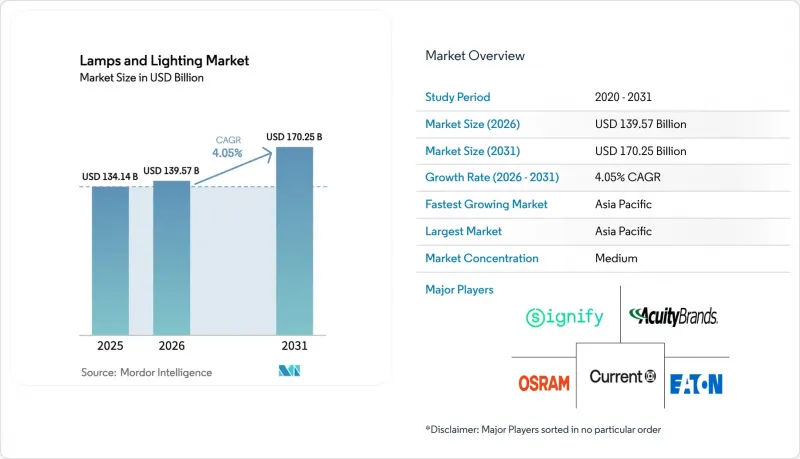
This report Segments the Industry Into by Product (Table & Floor Lamps, Ceiling Lights & Chandeliers, Wall-Mounted Fixtures, and More), by Light Source (LED, Fluorescent, Incandescent, and More), by Application (Residential, Commercial, Industrial & Warehouse, and More), by Geography (North America, South America, and More), and More Segments. The Market Forecasts are Provided in Terms of Value (USD).
Global Lamps And Lighting Market Trends and Insights
Surging secondary-replacement demand for LED lamps
The industry forecasts a secondary-replacement demand of 5.8 billion units in 2024, with peak replacement activity anticipated between 2025 and 2028 as fixtures approach their operational lifespans of 25,000-40,000 hours . Consumer preferences have shifted beyond basic LED replacements, with increasing demand for advanced features such as higher color rendering index (CRI), wireless dimming capabilities, and voice-activated controls. This growing emphasis on premium functionalities has contributed to price stabilization, even as the average selling prices (ASPs) for standard lamps continue to decline. Additionally, the trend has driven the adoption of service contracts, as facility managers increasingly opt for subscription-based models that ensure consistent on-site operational uptime. These developments highlight a broader industry movement toward value-added solutions and long-term service reliability.
Government-mandated fluorescent & halogen phase-outs
California halted fluorescent sales on 1 January 2025, while the EU's RoHS directive banned mercury-containing fluorescents on 24 February 2025 . Canada's implementation of its Minamata Convention-aligned phase-out in 2026 represents a pivotal regulatory development for the lighting market. These synchronized bans will necessitate that channel partners accelerate the clearance of outdated inventory and fully transition to LED-based solutions. The regulatory certainty provided by this policy framework allows manufacturers to strategically scale their solid-state production capacities to meet anticipated demand. This harmonized approach across regions ensures a consistent and efficient phase-out of less efficient lighting technologies, fostering long-term market predictability. By 2030, these measures are projected to deliver significant energy savings, with the European Union expected to conserve 34 TWh of electricity annually, reinforcing the market's shift toward high-efficiency lighting products.
Commodity-price pressure eroding LED margins
China's potential export restrictions on gallium and germanium are expected to significantly impact the cost structures within the semiconductor market, with the USGS estimating a potential GDP loss of USD 3.4 billion. The planned 25% tariffs by the United States on rare-earth magnets further exacerbate concerns, creating additional pressure on supply chains and pricing dynamics. In response to these challenges, LED manufacturers are adopting strategic measures such as securing alternative supply sources, modifying phosphor formulations, and forming partnerships with recycling firms to mitigate risks. Smaller market participants, constrained by limited economies of scale, may face heightened financial pressures, leading to potential market exits or consolidation activities. Such developments could result in increased market concentration, particularly within mid-tier segments, altering competitive dynamics in the industry.
Other drivers and restraints analyzed in the detailed report include:
- Rapid retrofit programs in commercial real estate
- PoE and smart-building integration
- Supply-chain risks for rare-earth phosphors
For complete list of drivers and restraints, kindly check the Table Of Contents.
Segment Analysis
The LED segment accounted for 63.45% of 2025 revenue, underscoring its status as the mainstream engine of the lamps and lighting market. Continuous efficiency gains, declining ASPs, and maturing smart-control ecosystems sustain its leadership. Other Light Sources-HID, OLED, and laser-collectively deliver the swiftest 6.05% CAGR by serving high-power, display, and specialty niches that LEDs do not yet fully cover. Regulatory deadlines hasten fluorescent decline, while incandescent and halogen lights persist only in decorative or high-heat applications. Technology convergence is evident as micro-LED prototypes transition from display labs to general illumination pilot lines.Quantum-dot color-conversion and high-CRI phosphor blends now enable LED products to match or surpass halogen color quality, eroding remaining barriers to full adoption. Nichia's H6 series delivers Ra >= 90 at high efficacy, widening the premium range available to designers. The lamps and lighting market size for LEDs is projected to expand at a steady pace, given these technical advances. Suppliers also bundle embedded Bluetooth or Matter chips, lowering integration costs for smart-home ecosystems. As full-spectrum and tunable white options proliferate, LEDs are set to capture incremental share from specialized sources, reinforcing their position as the reference platform.
Ceiling Lights & Chandeliers contributed 31.30% of worldwide revenue in 2025 and remain central to building energy strategies because they provide baseline illumination. Fixture OEMs integrate sensors and radios directly into troffers and downlights, making the ceiling grid the digital nervous system for occupancy and daylight harvesting. Table & Floor Lamps, though smaller, are on track for the quickest 5.05% CAGR as remote work normalizes and consumers seek personalized task lighting. Portable designs with battery backup and wireless charging slots differentiate premium offerings during blackout-prone weather seasons.Wall-mounted and track systems flourish in hospitality and retail where accent lighting shapes brand ambience. Light-bulb sockets still support retrofit demand, but form factors shift toward lamps that natively host color-tunable LEDs. The lamps and lighting market continues to pivot from commodity bulb replacement to connected luminaires that integrate seamlessly with voice assistants. Product modularity-such as replaceable drivers and upgradable communication chips-extends life cycles and aligns with emerging right-to-repair statutes in the EU.
Complete Report Scope:
- By Product (Placement & Form-factor)
- Table & Floor Lamps
- Ceiling Lights & Chandeliers
- Wall-Mounted Fixtures
- Light Bulbs & Fittings
- Other Products (Spot, Track, Portable etc.)
- By Light Source
- LED
- Fluorescent
- Incandescent
- Halogen
- Other Light Sources (HID, OLED, laser, etc.)
- By Application
- Residential
- Commercial (Offices, Retail, Hospitality)
- Industrial & Warehouse
- Outdoor & Public Infrastructure
- Horticulture & Agriculture
- Healthcare & Surgical
- Other Applications
- By Distribution Channel
- B2C/Retail Channels
- Hypermarkets and Supermarkets
- Home Centers
- Specialty Lighting Stores
- Online
- Other Distribution Channels
- B2B/Direct Sales & Projects
- B2C/Retail Channels
- By Geography
- North America
- Canada
- United States
- Mexico
- South America
- Brazil
- Peru
- Chile
- Argentina
- Rest of South America
- Europe
- United Kingdom
- Germany
- France
- Spain
- Italy
- BENELUX
- NORDICS
- Rest of Europe
- Asia-Pacific
- India
- China
- Japan
- Australia
- South Korea
- South East Asia
- Rest of Asia-Pacific
- Middle East and Africa
- United Arab Emirates
- Saudi Arabia
- South Africa
- Nigeria
- Rest of Middle East and Africa
- North America
Geography Analysis
Asia-Pacific led with 35.60% of global revenue in 2025 and will pace the lamps and lighting market at a 5.45% CAGR through 2031. China anchors both supply and demand, with the Jiujiang factory featuring 192 lines dedicated to LED lamps. The region benefits from aggressive smart-city deployments and governmental LED procurement, although rare-earth dependence introduces geopolitical risk. Japan advances high-CRI lasers and micro-LED packages, sustaining its reputation as a photonics innovator. India's UJALA-successor subsidy programs and Southeast Asian urbanization also expand baseline volumes.
North America maintains strong compliance-driven momentum. California's fluorescent ban and the US Department of Energy's increasing lumen-per-watt thresholds funnel demand into solid-state options. Local Law 88 in New York City obliges landlords to finalize upgrades this year, driving a project backlog for PoE and smart-sensor fixtures. Although political pushback exists-Senate proposals to restore incandescent freedom emerge periodically-state-level policies remain decisive.
Europe champions sustainability through 2024/1781 Eco-design rules that enforce reparability and recyclability. The 2025 mercury-lamp ban is fully in force, compelling late-stage fluorescent holdouts to convert. CEN-CENELEC standards now emphasize digital interfaces, ensuring new luminaires can integrate with building management software from day one. Emerging Eastern markets benefit from EU funding that supports municipal LED streetlights, widening regional adoption.
- Signify (Philips Lighting)
- Acuity Brands
- Osram Licht AG
- GE Current (Daintree)
- Eaton (Copper Lighting)
- Cree Lighting
- Hubbell Lighting
- Zumtobel Group
- Nichia Corporation
- Samsung Electronics (LED)
- Panasonic Lighting
- Legrand SA
- Wipro Lighting
- Havells India
- Bajaj Electricals
- Thorn Lighting
- Fagerhult Group
- Delta Electronics
- Syska LED
- Luxxbox
- LumiGrow (Horticulture)
- Heliospectra
Additional Benefits:
- The market estimate (ME) sheet in Excel format
- 3 months of analyst support
TABLE OF CONTENTS
1 Introduction
- 1.1 Study Assumptions & Market Definition
- 1.2 Scope of the Study
2 Research Methodology
3 Executive Summary
4 Market Landscape
- 4.1 Market Overview
- 4.2 Market Drivers
- 4.2.1 Surging secondary-replacement demand for LED lamps
- 4.2.2 Government-mandated fluorescent & halogen phase-outs in major economies
- 4.2.3 Rapid retrofit programs in commercial real estate (post-COVID ESG mandates)
- 4.2.4 Power Over Ethernet (PoE) and smart-building integration accelerating fixture upgrades
- 4.2.5 Growth of controlled-environment agriculture (CEA) driving horticultural lighting
- 4.2.6 Micro-LED & human-centric lighting unlocking premium pricing niches
- 4.3 Market Restraints
- 4.3.1 Commodity-price pressure eroding LED margins
- 4.3.2 Supply-chain risks for critical rare-earth phosphors
- 4.3.3 Fragmented retrofit standards causing interoperability issues
- 4.3.4 Legislative pushback on incandescent bans in parts of the U.S.
- 4.4 Industry Value Chain Analysis
- 4.5 Porter's Five Forces Analysis
- 4.5.1 Threat of New Entrants
- 4.5.2 Bargaining Power of Suppliers
- 4.5.3 Bargaining Power of Buyers
- 4.5.4 Threat of Substitutes
- 4.5.5 Competitive Rivalry
- 4.6 Insights into the Latest Trends and Innovations in the Market
- 4.7 Insights on Recent Developments (New Product Launches, Strategic Initiatives, Investments, Partnerships, JVs, Expansion, M&As, etc.) in the Market
5 Market Size & Growth Forecasts
- 5.1 By Product (Placement & Form-factor)
- 5.1.1 Table & Floor Lamps
- 5.1.2 Ceiling Lights & Chandeliers
- 5.1.3 Wall-Mounted Fixtures
- 5.1.4 Light Bulbs & Fittings
- 5.1.5 Other Products (Spot, Track, Portable etc.)
- 5.2 By Light Source
- 5.2.1 LED
- 5.2.2 Fluorescent
- 5.2.3 Incandescent
- 5.2.4 Halogen
- 5.2.5 Other Light Sources (HID, OLED, laser, etc.)
- 5.3 By Application
- 5.3.1 Residential
- 5.3.2 Commercial (Offices, Retail, Hospitality)
- 5.3.3 Industrial & Warehouse
- 5.3.4 Outdoor & Public Infrastructure
- 5.3.5 Horticulture & Agriculture
- 5.3.6 Healthcare & Surgical
- 5.3.7 Other Applications
- 5.4 By Distribution Channel
- 5.4.1 B2C/Retail Channels
- 5.4.1.1 Hypermarkets and Supermarkets
- 5.4.1.2 Home Centers
- 5.4.1.3 Specialty Lighting Stores
- 5.4.1.4 Online
- 5.4.1.5 Other Distribution Channels
- 5.4.2 B2B/Direct Sales & Projects
- 5.4.1 B2C/Retail Channels
- 5.5 By Geography
- 5.5.1 North America
- 5.5.1.1 Canada
- 5.5.1.2 United States
- 5.5.1.3 Mexico
- 5.5.2 South America
- 5.5.2.1 Brazil
- 5.5.2.2 Peru
- 5.5.2.3 Chile
- 5.5.2.4 Argentina
- 5.5.2.5 Rest of South America
- 5.5.3 Europe
- 5.5.3.1 United Kingdom
- 5.5.3.2 Germany
- 5.5.3.3 France
- 5.5.3.4 Spain
- 5.5.3.5 Italy
- 5.5.3.6 BENELUX
- 5.5.3.7 NORDICS
- 5.5.3.8 Rest of Europe
- 5.5.4 Asia-Pacific
- 5.5.4.1 India
- 5.5.4.2 China
- 5.5.4.3 Japan
- 5.5.4.4 Australia
- 5.5.4.5 South Korea
- 5.5.4.6 South East Asia
- 5.5.4.7 Rest of Asia-Pacific
- 5.5.5 Middle East and Africa
- 5.5.5.1 United Arab Emirates
- 5.5.5.2 Saudi Arabia
- 5.5.5.3 South Africa
- 5.5.5.4 Nigeria
- 5.5.5.5 Rest of Middle East and Africa
- 5.5.1 North America
6 Competitive Landscape
- 6.1 Market Concentration
- 6.2 Strategic Moves & M&A Analysis
- 6.3 Market Share Analysis
- 6.4 Company Profiles (includes Global level Overview, Market level overview, Core Segments, Financials as available, Strategic Information, Market Rank/Share for key companies, Products & Services, Recent Developments)
- 6.4.1 Signify (Philips Lighting)
- 6.4.2 Acuity Brands
- 6.4.3 Osram Licht AG
- 6.4.4 GE Current (Daintree)
- 6.4.5 Eaton (Copper Lighting)
- 6.4.6 Cree Lighting
- 6.4.7 Hubbell Lighting
- 6.4.8 Zumtobel Group
- 6.4.9 Nichia Corporation
- 6.4.10 Samsung Electronics (LED)
- 6.4.11 Panasonic Lighting
- 6.4.12 Legrand SA
- 6.4.13 Wipro Lighting
- 6.4.14 Havells India
- 6.4.15 Bajaj Electricals
- 6.4.16 Thorn Lighting
- 6.4.17 Fagerhult Group
- 6.4.18 Delta Electronics
- 6.4.19 Syska LED
- 6.4.20 Luxxbox
- 6.4.21 LumiGrow (Horticulture)
- 6.4.22 Heliospectra
7 Market Opportunities & Future Outlook
- 7.1 Accelerating transition to energy-efficient lighting
- 7.2 Modular, personalized, and flexible lighting is becoming mainstream
- 7.3 New models such as "Lighting as a Service (LAAS)" gaining traction

