PUBLISHER: Mordor Intelligence | PRODUCT CODE: 2125710

PUBLISHER: Mordor Intelligence | PRODUCT CODE: 2125710
Countertop Ice Makers - Market Share Analysis, Industry Trends & Statistics, Growth Forecasts (2026 - 2031)
According to Mordor Intelligence, the countertop ice makers market size was valued at USD 2.85 billion in 2025 and estimated to grow from USD 2.99 billion in 2026 to reach USD 3.79 billion by 2031, at a CAGR of 4.88% during the forecast period (2026-2031).
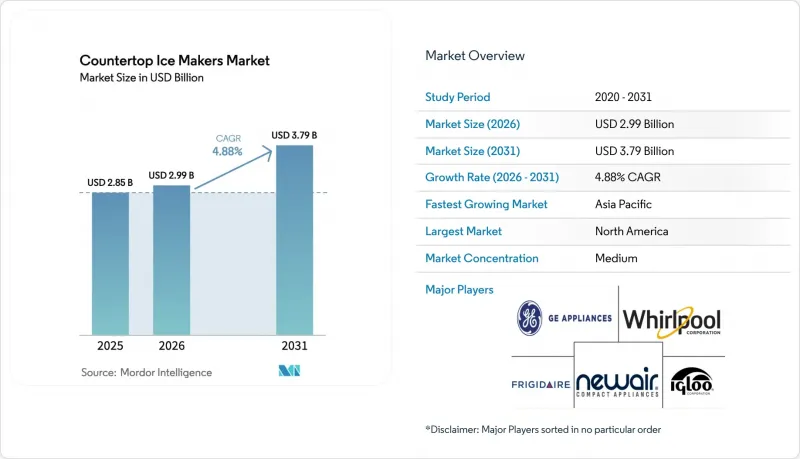
This report Segments by Product Type (Bullet Ice Makers, Nugget Ice Makers and More), by Capacity (Up To 26 Lbs/Day, 26 - 40 Lbs/Day, and More), by End User (Residential, and Commercial), by Distribution Channel (Online, and Offline), and by Geography (North America, Europe, and More). The Market Forecasts are Provided in Terms of Value (USD).
Global Countertop Ice Makers Market Trends and Insights
Growth in Compact Living Spaces Pushing Demand for Portable Appliances
Urban densification drives consumers toward smaller kitchens where built-in dispensers do not fit. Millennials and Gen Z renters choose appliances they can move between leases, favoring lightweight countertop designs that plug into standard outlets. DOE's 2029 energy standards assure baseline efficiency, nudging brands to adopt variable-speed compressors and thicker insulation. These forces position the countertop ice maker market as a staple rather than a discretionary category, particularly in cities where floor-space costs top USD 50 per square foot annually.
Consumer Convenience Preference and At-Home Beverage Culture
Permanent shifts toward home mixology, specialty coffee, and sparkling water elevate ice quality expectations. Nugget machines meet demands for chewable texture ideal for cold brew and craft cocktails. GE Appliances' Opal line exemplifies premium willingness to pay, with models retailing near USD 700 and ranking among the brand's bestsellers. Continuing interest in gourmet beverages sustains double-digit growth for higher-spec units across the countertop ice maker market.
Integration of Ice Dispensers in Modern Refrigerators Reducing Need
High-end fridges now include craft-ice spheres and dual makers, eroding standalone demand in affluent households. LG's Craft Ice refrigerator supplies slow-melting spheres directly from the freezer door, challenging premium countertop units. However, countertop models counter with portability, faster cycle times, and specialty nugget formats, positioning themselves as complementary for parties, patios, and RVs.
Other drivers and restraints analyzed in the detailed report include:
- Rising Adoption in Offices, Breakrooms, and Small HoReCa Outlets
- E-commerce Channel Proliferation Improving Product Accessibility
- Operational Noise and Reliability Concerns Affecting Consumer Satisfaction
For complete list of drivers and restraints, kindly check the Table Of Contents.
Segment Analysis
Bullet units delivered the largest 45.03% countertop ice maker market share in 2025 on the back of mature manufacturing, 8-minute first-freeze cycles, and price points under USD 150. The segment serves apartments, dorms, and breakrooms that value straightforward cubes. Nugget machines, though smaller in volume, expand at 9.22% CAGR on the allure of chewable pellets that retain soda carbonation. Consumers pay 2- 3 times more for these textures, fueling innovation such as GE's Opal 2.0 with WiFi scheduling and scale-inhibiting filtration.
Specialized gourmet models aim at mixologists who require crystal-clear, 2-inch slabs that minimize dilution in aged whisky. Their double-wall freezing chambers force air bubbles out, selling at USD 500-900. Although niche, the category benefits from the craft-cocktail boom and Instagram visual culture. Collectively, product diversification sustains a climb in average selling price across the countertop ice maker market.
The Up to 26 lbs/day tier owned the largest slice of the countertop ice maker market size in 2025 at 38.12%, matching the daily needs of typical households. Units rated 26-40 lb/day bridge into small cafes, providing 6-minute cycles and removable bins that fit under counters.
Above-40 lb/day models, the fastest-growing group at 8.33% CAGR, entice offices and food trucks that prioritize fewer refills and continuous service. Variable-speed condensers and R290 refrigerant cut power draw, satisfying environmental codes in California and the EU. Demand for bigger bins indicates convergence between light commercial and residential entertaining trends and advances overall output expectations in the countertop ice maker market.
Complete Report Scope:
- By Product Type
- Bullet Ice Makers
- Nugget / Pea Ice Makers
- Gourmet / Clear Ice Makers
- By Capacity
- Up to 26 lbs / day
- 26 - 40 lbs / day
- Above 40 lbs / day
- By End User
- Residential
- Commercial
- Small Cafes and Bars
- Offices and Co-working Spaces
- Recreational Vehicles and Marine
- By Distribution Channel
- Offline
- Specialty Appliance Stores
- Big-Box Retailers
- Dealer and Distributor Networks
- Online
- E-commerce Marketplaces
- Brand-owned Webstores
- Offline
- By Geography
- North America
- Canada
- United States
- Mexico
- South America
- Brazil
- Peru
- Chile
- Argentina
- Rest of South America
- Asia-Pacific
- India
- China
- Japan
- Australia
- South Korea
- South East Asia (Singapore, Malaysia, Thailand, Indonesia, Vietnam, and Philippines)
- Rest of Asia Pacific
- Europe
- United Kingdom
- Germany
- France
- Spain
- Italy
- BENELUX (Belgium, Netherlands, and Luxembourg)
- NORDICS (Denmark, Finland, Iceland, Norway, and Sweden)
- Rest of Europe
- Middle East And Africa
- United Arab Emirates
- Saudi Arabia
- South Africa
- Nigeria
- Rest of Middle East And Africa
- North America
Geography Analysis
North America anchors global demand with a 36.62% slice of revenue. U.S. households value nugget textures for cold brew, while offices use 40 lb/day units to replace vending bags. Canada mirrors these patterns, and Mexico's urban condos adopt portable makers as kitchens shrink. FDA food-grade rules and DOE energy targets provide a clear regulatory landscape, nudging brands toward quieter compressors and food-safe interiors.
Asia-Pacific is the growth engine. China's middle-class apartment boom fuels first-time purchases, and malls showcase countertop ice maker market flagships during 11-11 shopping festivals. India's hospitality startups outfit co-working cafes with solar-ready makers, cutting reliance on erratic municipal ice deliveries. Japan's fascination with gadget miniaturization yields crowd-funded upgrades featuring 10-minute crystal-clear cycles. ASEAN economies add volume through beach resorts where portable machines offset unreliable grid power.
Europe contributes stable, margin-rich sales. Energy-label revisions push brands to advertise kilowatt-hour drops, resonating with eco-conscious Nordic consumers. The UK home-bar hobby, rising after pandemic lockdowns, sustains nugget sales, while Spain's coastal bars adopt high-output units to meet tourist surges. Importers must navigate emerging water-quality standards that raise certification costs, yet compliance enhances brand trust, sustaining long-run prospects across the countertop ice maker market.
- Whirlpool Corporation
- NewAir Appliances
- Frigidaire (Electrolux AB)
- Igloo (Nostalgia Products LLC)
- hOmeLabs (Aterian Inc.)
- GE Appliances (Haier)
- Scotsman (Ali Group)
- Manitowoc Ice (Welbilt Inc.)
- Vremi (Aterian Inc.)
- Magic Chef (Midea Group)
- EdgeStar (Living Direct)
- Della (SPT)
- Costway
- Dometic Group
- Luma Comfort (NewAir)
- Maxx Ice (Chef's Deal)
- SPT (Sunpentown)
- Sunpentown International
- Whynter
- Euhomy
- AGLUCKY
- Antarctic Star*
Additional Benefits:
- The market estimate (ME) sheet in Excel format
- 3 months of analyst support
TABLE OF CONTENTS
1 Introduction
- 1.1 Study Assumptions and Market Definition
- 1.2 Scope of the Study
2 Research Methodology
3 Executive Summary
4 Market Landscape
- 4.1 Market Overview
- 4.2 Market Drivers
- 4.2.1 Growth in compact living spaces pushing demand for portable appliances
- 4.2.2 Consumer convenience preference and at-home beverage culture
- 4.2.3 Rising adoption in offices, breakrooms, and small HoReCa outlets
- 4.2.4 E-commerce channel proliferation improving product accessibility
- 4.2.5 Van-life and RV community demand for off-grid ice (under-the-radar)
- 4.2.6 Efficiency gains enabling solar-powered countertop units (under-the-radar)
- 4.3 Market Restraints
- 4.3.1 Integration of ice dispensers in modern refrigerators reducing need
- 4.3.2 Operational noise and reliability concerns affecting consumer satisfaction
- 4.3.3 Emerging water-quality regulations increasing compliance costs (under-the-radar)
- 4.3.4 Influx of sub-standard imports eroding brand trust (under-the-radar)
- 4.4 Value / Supply-Chain Analysis
- 4.5 Technological Outlook
- 4.6 Regulatory Landscape
- 4.7 Porter's Five Forces
- 4.7.1 Threat of New Entrants
- 4.7.2 Bargaining Power of Suppliers
- 4.7.3 Bargaining Power of Buyers
- 4.7.4 Threat of Substitute Products
- 4.7.5 Competitive Rivalry
5 Market Size and Growth Forecasts
- 5.1 By Product Type
- 5.1.1 Bullet Ice Makers
- 5.1.2 Nugget / Pea Ice Makers
- 5.1.3 Gourmet / Clear Ice Makers
- 5.2 By Capacity
- 5.2.1 Up to 26 lbs / day
- 5.2.2 26 - 40 lbs / day
- 5.2.3 Above 40 lbs / day
- 5.3 By End User
- 5.3.1 Residential
- 5.3.2 Commercial
- 5.3.2.1 Small Cafes and Bars
- 5.3.2.2 Offices and Co-working Spaces
- 5.3.2.3 Recreational Vehicles and Marine
- 5.4 By Distribution Channel
- 5.4.1 Offline
- 5.4.1.1 Specialty Appliance Stores
- 5.4.1.2 Big-Box Retailers
- 5.4.1.3 Dealer and Distributor Networks
- 5.4.2 Online
- 5.4.2.1 E-commerce Marketplaces
- 5.4.2.2 Brand-owned Webstores
- 5.4.1 Offline
- 5.5 By Geography
- 5.5.1 North America
- 5.5.1.1 Canada
- 5.5.1.2 United States
- 5.5.1.3 Mexico
- 5.5.2 South America
- 5.5.2.1 Brazil
- 5.5.2.2 Peru
- 5.5.2.3 Chile
- 5.5.2.4 Argentina
- 5.5.2.5 Rest of South America
- 5.5.3 Asia-Pacific
- 5.5.3.1 India
- 5.5.3.2 China
- 5.5.3.3 Japan
- 5.5.3.4 Australia
- 5.5.3.5 South Korea
- 5.5.3.6 South East Asia (Singapore, Malaysia, Thailand, Indonesia, Vietnam, and Philippines)
- 5.5.3.7 Rest of Asia Pacific
- 5.5.4 Europe
- 5.5.4.1 United Kingdom
- 5.5.4.2 Germany
- 5.5.4.3 France
- 5.5.4.4 Spain
- 5.5.4.5 Italy
- 5.5.4.6 BENELUX (Belgium, Netherlands, and Luxembourg)
- 5.5.4.7 NORDICS (Denmark, Finland, Iceland, Norway, and Sweden)
- 5.5.4.8 Rest of Europe
- 5.5.5 Middle East And Africa
- 5.5.5.1 United Arab Emirates
- 5.5.5.2 Saudi Arabia
- 5.5.5.3 South Africa
- 5.5.5.4 Nigeria
- 5.5.5.5 Rest of Middle East And Africa
- 5.5.1 North America
6 Competitive Landscape
- 6.1 Market Concentration
- 6.2 Strategic Moves
- 6.3 Market Share Analysis
- 6.4 Company Profiles (includes Global level Overview, Market level overview, Core Segments, Financials as available, Strategic Information, Market Rank/Share for key companies, Products and Services, and Recent Developments)
- 6.4.1 Whirlpool Corporation
- 6.4.2 NewAir Appliances
- 6.4.3 Frigidaire (Electrolux AB)
- 6.4.4 Igloo (Nostalgia Products LLC)
- 6.4.5 hOmeLabs (Aterian Inc.)
- 6.4.6 GE Appliances (Haier)
- 6.4.7 Scotsman (Ali Group)
- 6.4.8 Manitowoc Ice (Welbilt Inc.)
- 6.4.9 Vremi (Aterian Inc.)
- 6.4.10 Magic Chef (Midea Group)
- 6.4.11 EdgeStar (Living Direct)
- 6.4.12 Della (SPT)
- 6.4.13 Costway
- 6.4.14 Dometic Group
- 6.4.15 Luma Comfort (NewAir)
- 6.4.16 Maxx Ice (Chef's Deal)
- 6.4.17 SPT (Sunpentown)
- 6.4.18 Sunpentown International
- 6.4.19 Whynter
- 6.4.20 Euhomy
- 6.4.21 AGLUCKY
- 6.4.22 Antarctic Star*
7 Market Opportunities & Future Outlook
- 7.1 White-space & unmet-need assessment

