PUBLISHER: Mordor Intelligence | PRODUCT CODE: 2156886

PUBLISHER: Mordor Intelligence | PRODUCT CODE: 2156886
South America Mattress - Market Share Analysis, Industry Trends & Statistics, Growth Forecasts (2026 - 2031)
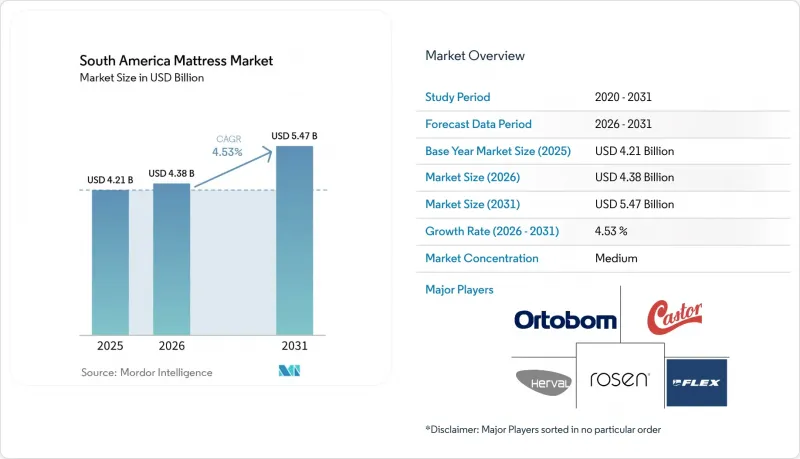
According to Mordor Intelligence, the South America mattress market size was valued at USD 4.21 billion in 2025 and estimated to grow from USD 4.38 billion in 2026 to reach USD 5.47 billion by 2031, at a CAGR of 4.53% during the forecast period (2026-2031).
South America Mattress Market Trends and Insights
Growing Hospitality and Tourism Infrastructure
Brazil's hospitality investment cycle is widening commercial procurement demand in the South America mattress market. Brazil received 9.3 million international visitors in 2025, a 37.1% increase from 2024 Hotel operators need room-ready bedding when they add properties or refresh existing rooms. Commercial mattresses generally follow replacement cycles of 5 to 7 years, which creates recurring purchasing needs. Grupo Wish added 2 properties in Florianopolis in early 2026 and increased its room capacity from 2,000 to 2,500 units. Higher-grade hotel specifications favor hybrid and premium products, which can lift order values beyond the increase in room count.
Rising Sleep-Quality Awareness and Premiumization
Sleep quality has become more relevant to purchasing decisions in urban areas of the South America mattress market. ResMed's 2025 Global Sleep Survey found that respondents lost nearly 3 nights of restorative sleep per week on average. The survey also found that 89% linked sleep quality to self-worth, while 24% said they would take active steps to address poor sleep. This gap leaves room for mattress brands that make comfort and ergonomic benefits easier to understand. Orthopedic and pressure-relief products are gaining attention among middle-income consumers in Sao Paulo, Buenos Aires, and Santiago. The result is a gradual shift toward higher-value construction types rather than entry-level replacements alone.
Inflation and Household Purchasing-Power Volatility
Household purchasing power remains a demand constraint for the South America mattress market. Argentina's annual inflation fell from 211% in December 2023 to 44.7% in May 2025, according to the OECD. The OECD projected private consumption growth of 9.6% in 2025 and 3.8% in 2026 as inflation decelerates and real wages improve. Consumers that delayed purchases during high inflation may initially choose basic replacement products. That behavior can limit price realization even as unit demand recovers. Credit costs and price-sensitive demand also continue to limit innovation spending among smaller Brazilian producers.
Other drivers and restraints analyzed in the detailed report include:
- Expansion of E-Commerce and Mattress-in-a-Box Models
- Adoption of Smart, Adjustable, and Pressure-Relieving Mattresses
- Raw-Material and Foreign-Exchange Cost Exposure
For complete list of drivers and restraints, kindly check the Table Of Contents.
Segment Analysis
Innerspring mattresses held 49.2% of revenue in 2025, making them the leading type in the South America mattress market. Their position reflects price accessibility and established manufacturing capabilities in Brazil. Leggett & Platt operates an innerspring facility near Sao Paulo that the supplied research describes as the largest in the Southern Hemisphere. Memory foam and related foam products form the next major group for buyers seeking pressure relief. Latex serves a smaller premium category among allergy-sensitive and environmentally conscious consumers. Gel, air, and water models remain specialized offerings outside the main residential replacement cycle. Innerspring products still suit value-focused households and familiar retail purchasing patterns. The category's scale gives manufacturers an established base for production and distribution.
Hybrid mattresses are forecast to grow at a 6.2% CAGR through 2031, the fastest rate among mattress types. This South America mattress market size opportunity is linked to hospitality upgrades and premium urban household demand. Hybrids combine pocket-spring support with foam comfort layers. That design supports motion isolation for couples and durability needs in hotels. Breathability also suits warm regional conditions when compared with some all-foam designs. Hotel buyers increasingly consider material traceability in procurement specifications. Global Organic Latex Standard and OEKO-TEX STANDARD 100 certifications can support supplier qualification for commercial accounts. The South America mattress industry is therefore seeing product competition shift from basic construction toward comfort, durability, and documented materials.
Queen-size products accounted for 44.6% of revenue in 2025 and lead the size category in the South America mattress market. They are also projected to grow at a 6.9% CAGR through 2031. Queen-size beds are a common specification for 3-star and higher hotel properties. Urban households in Sao Paulo, Buenos Aires, and Santiago also increasingly select larger sleep surfaces. This combination links commercial procurement with residential premiumization. Double-size mattresses remain important for middle-income households in secondary cities and rural areas. Their lower price point and fit with smaller homes preserve their role in unit volumes. Queen-size demand nevertheless has a stronger effect on revenue because of its higher unit value.
Single-size products serve students, children, and lower-income households across the South America mattress market. Their demand is closely tied to household needs and population replacement. King-size products remain focused on luxury hotels and higher-income households. They represent a modest share of total sales despite their high price point. Queen-size models commonly sell at a 25% to 40% premium over comparable double-size units. This mix helps revenue increase faster than the number of mattresses sold. Larger sizes also give manufacturers more scope to add premium materials and features. The South America mattress market size for queen-size products benefits from both volume needs and higher average selling prices.
Complete Report Scope:
- By Mattress Type
- Innerspring Mattresses
- Memory Foam Mattresses
- Latex Mattresses
- Hybrid Mattresses
- Gel Mattresses
- Air Mattresses
- Water Mattresses
- Other Mattress Types
- By Size
- Single-size
- Double-size
- Queen-size
- King-size
- Other Sizes
- By End-User
- Residential
- Commercial
- By Distribution Channel
- B2B/Directly from the Manufacturers
- B2C/Retail Channels
- Specialty Bedding and Mattress Stores
- Multi-brand Stores/Home Centers
- Online
- Other Distribution Channels
- By Geography
- Brazil
- Peru
- Chile
- Argentina
- Rest of South America
List of Companies Covered in this Report:
- Ortobom
- Colchoes Castor
- Rosen S.A.
- Herval Group
- Flex Group
- Tempur Sealy International, Inc.
- Serta Simmons Bedding, LLC
- Sealy Corporation
- Simmons Bedding Company
- King Koil International
- Emma Sleep GmbH
- Zinus, Inc.
- Luuna
- Colchao Inteligente
- Pikolin Group
- Spring Air International
- Probel Colchoes
- Natura Colchoes
- Restonic Mattress Corporation
- Americanflex
Additional Benefits:
- The market estimate (ME) sheet in Excel format
- 3 months of analyst support
TABLE OF CONTENTS
1 Introduction
- 1.1 Study Assumptions & Market Definition
- 1.2 Scope of the Study
2 Research Methodology
3 Executive Summary
4 Market Landscape
- 4.1 Market Overview
- 4.2 Market Drivers
- 4.2.1 Growing Hospitality and Tourism Infrastructure
- 4.2.2 Rising Sleep-Quality Awareness and Premiumization
- 4.2.3 Expansion of E-Commerce and Mattress-in-a-Box Models
- 4.2.4 Growth of Local Manufacturing and Regional Exports
- 4.2.5 Demand for Sustainable and Certified Materials
- 4.2.6 Adoption of Smart, Adjustable, and Pressure-Relieving Mattresses
- 4.3 Market Restraints
- 4.3.1 Inflation and Household Purchasing-Power Volatility
- 4.3.2 High Replacement-Cycle Duration in Residential Markets
- 4.3.3 Raw-Material and Foreign-Exchange Cost Exposure
- 4.3.4 Reverse Logistics and End-of-Life Mattress Disposal Constraints
- 4.4 Industry Value Chain Analysis
- 4.5 Porter's Five Forces Analysis
- 4.5.1 Threat of New Entrants
- 4.5.2 Bargaining Power of Suppliers
- 4.5.3 Bargaining Power of Buyers
- 4.5.4 Threat of Substitutes
- 4.5.5 Industry Rivalry
- 4.6 Insights into the Latest Trends and Innovations in the Industry
- 4.7 Insights into the Recent Developments (New Product Launches, Strategic Initiatives, Investments, Partnerships, JVs, Expansion, M&As, etc.) in the Industry
5 Market Size & Growth Forecasts (Value in USD Billion)
- 5.1 By Mattress Type
- 5.1.1 Innerspring Mattresses
- 5.1.2 Memory Foam Mattresses
- 5.1.3 Latex Mattresses
- 5.1.4 Hybrid Mattresses
- 5.1.5 Gel Mattresses
- 5.1.6 Air Mattresses
- 5.1.7 Water Mattresses
- 5.1.8 Other Mattress Types
- 5.2 By Size
- 5.2.1 Single-size
- 5.2.2 Double-size
- 5.2.3 Queen-size
- 5.2.4 King-size
- 5.2.5 Other Sizes
- 5.3 By End-User
- 5.3.1 Residential
- 5.3.2 Commercial
- 5.4 By Distribution Channel
- 5.4.1 B2B/Directly from the Manufacturers
- 5.4.2 B2C/Retail Channels
- 5.4.2.1 Specialty Bedding and Mattress Stores
- 5.4.2.2 Multi-brand Stores/Home Centers
- 5.4.2.3 Online
- 5.4.2.4 Other Distribution Channels
- 5.5 By Geography
- 5.5.1 Brazil
- 5.5.2 Peru
- 5.5.3 Chile
- 5.5.4 Argentina
- 5.5.5 Rest of South America
6 Competitive Landscape
- 6.1 Market Concentration
- 6.2 Strategic Moves
- 6.3 Market Share Analysis
- 6.4 Company Profiles {(includes Global level Overview, Market level overview, Core Segments, Financials as available, Strategic Information, Market Rank/Share for key companies, Products & Services, and Recent Developments)}
- 6.4.1 Ortobom
- 6.4.2 Colchoes Castor
- 6.4.3 Rosen S.A.
- 6.4.4 Herval Group
- 6.4.5 Flex Group
- 6.4.6 Tempur Sealy International, Inc.
- 6.4.7 Serta Simmons Bedding, LLC
- 6.4.8 Sealy Corporation
- 6.4.9 Simmons Bedding Company
- 6.4.10 King Koil International
- 6.4.11 Emma Sleep GmbH
- 6.4.12 Zinus, Inc.
- 6.4.13 Luuna
- 6.4.14 Colchao Inteligente
- 6.4.15 Pikolin Group
- 6.4.16 Spring Air International
- 6.4.17 Probel Colchoes
- 6.4.18 Natura Colchoes
- 6.4.19 Restonic Mattress Corporation
- 6.4.20 Americanflex
7 Market Opportunities & Future Outlook
- 7.1 Residential Replacement Demand Outlook
- 7.2 Commercial and Hospitality Demand Outlook

