PUBLISHER: Mordor Intelligence | PRODUCT CODE: 2154215

PUBLISHER: Mordor Intelligence | PRODUCT CODE: 2154215
Middle East and Africa Military Helicopters - Market Share Analysis, Industry Trends & Statistics, Growth Forecasts (2026 - 2031)
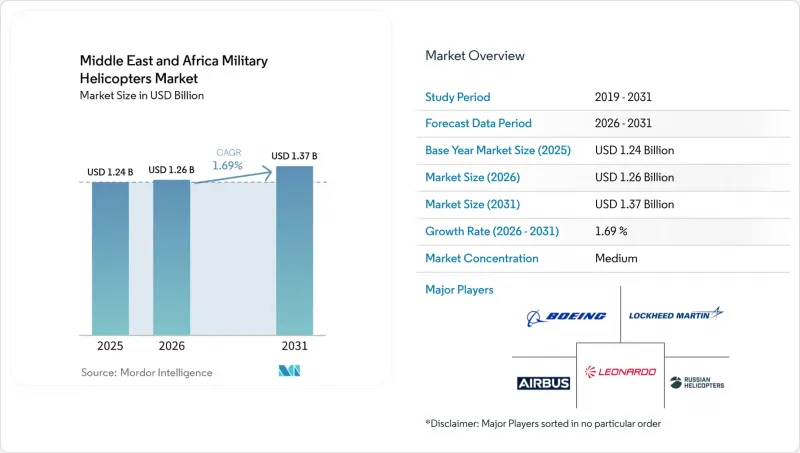
According to Mordor Intelligence, the Middle East and Africa military helicopters market size was valued at USD 1.24 billion in 2025 and is forecast to grow from USD 1.26 billion in 2026 to USD 1.37 billion by 2031, registering a 1.69% CAGR between 2026 and 2031.
Middle East and Africa Military Helicopters Market Trends and Insights
Replacement of Aging Rotorcraft Fleets
Aging fleets are moving replacement decisions up the defense procurement agenda across the region. Older aircraft require more maintenance, and parts availability can weaken operational readiness. Governments also face pressure to improve aircraft survivability, communications, and mission equipment. Egypt's approved CH-47F program illustrates the continuing role of heavy-lift fleet replacement in North Africa. The Middle East and Africa military helicopters market, therefore, benefits from operators replacing aircraft that no longer meet transport or operational requirements. Replacement programs can also create longer service opportunities for maintenance, pilot training, and logistics support.
Fleet replacement is not limited to large Gulf air arms. African operators must balance modern capability requirements against available technical staff and operating budgets. A modern platform can improve availability when a dependable spares and training plan supports it. The procurement case is stronger when one airframe can support transport, medical evacuation, and security missions. Suppliers that structure long-term support commitments can reduce the operational risk of moving away from legacy fleets. This makes lifecycle planning as important as aircraft acquisition in the Middle East and Africa military helicopters market.
Gulf-Led Multi-Mission Modernization
Gulf operators continue to favor helicopters capable of performing multiple tasks with a single fleet. This preference supports purchases of aircraft with adaptable cabins, sensors, communications equipment, and mission kits. It also reflects the need to use limited aircraft inventories across dispersed operational areas. Saudi Arabia's defense spending reached USD 83.2 billion in 2025, providing a substantial defense funding base. The Middle East and Africa military helicopters market gains from this spending when modernization budgets include air mobility and maritime operations. Procurement choices increasingly consider maintenance access and local industrial participation alongside performance.
Multi-mission fleets allow operators to use common training and support arrangements across several mission sets. This can reduce the burden of managing separate aircraft types for transport, rescue, and surveillance. The approach is particularly relevant where operational priorities can change quickly. It also favors aircraft suppliers that can integrate equipment without creating separate sustainment systems. Gulf procurement is shaping expectations elsewhere because regional buyers observe its emphasis on availability and mission flexibility. These conditions support continued demand for versatile aircraft in the market.
High Lifecycle Cost and Budget Trade-Offs
Military helicopters require spending beyond the initial aircraft contract. Operators must fund spare parts, maintenance facilities, simulators, crew training, and mission equipment. These costs can be difficult for smaller defense budgets to sustain. Africa's rise in military expenditure does not remove competing requirements for air defense, ground forces, and unmanned systems. The Middle East and Africa military helicopters market can therefore face delays when aircraft programs compete with other urgent priorities. Long-term support packages can reduce uncertainty but may increase the visible contract value.
Twin-engine aircraft with advanced sensors can be especially expensive to operate over their service lives. Operators must weigh their higher capability against recurring maintenance and training costs. Mixed fleets can add complexity because each type needs separate parts, tools, and technical skills. Lower-cost aircraft may meet limited transport or training needs, but they cannot replace every mission type. Budget decisions can therefore favor fewer highly capable aircraft or gradual fleet modernization. This restraint is strongest where operating funds do not rise with acquisition ambitions.
Other drivers and restraints analyzed in the detailed report include:
- Counter-terrorism and Border Security Operations
- Indigenous Manufacturing, MRO, and Technology Transfer Mandates
- Export Controls and Technology Transfer Friction
For complete list of drivers and restraints, kindly check the Table Of Contents.
Segment Analysis
Multi-mission helicopters accounted for 89.58% of the Middle East and Africa military helicopters market size in 2025. Their position reflects the value operators place on flexible use across transport, escort, medical evacuation, and maritime roles. A common platform can simplify training, maintenance, and parts planning. This is useful for forces managing diverse requirements with limited fleet numbers. The segment also fits Gulf procurement preferences for adaptable aircraft and enduring support. Its scale gives suppliers with established multi-mission fleets a strong base in the region.
Other helicopter types are forecast to grow at a 3.62% CAGR through 2031. This category includes aircraft acquired for more focused attack and reconnaissance requirements. Demand is linked to counter-terrorism operations and the need for a dedicated combat capability. Specialized aircraft can complement multi-mission fleets rather than replace them. Transport helicopters also remain relevant for heavy lift and force mobility. The Middle East and Africa military helicopters market will continue to require a balance between versatile fleets and mission-specific capability.
Army Aviation accounted for 43.87% of the Middle East and Africa military helicopters market in 2025. Large land forces use helicopters for mobility, support, resupply, and emergency response. This role remains important in countries with expansive deserts, remote borders, and dispersed security operations. Army fleets also support the rapid movement of personnel and equipment. Their operational breadth helps explain the segment's leading position. Demand remains linked to ground-force readiness and fleet availability.
Naval/Marine Corps Aviation is forecast to expand at a 3.12% CAGR through 2031. The segment benefits from increased attention to security in the Red Sea and the Gulf of Aden. Shipborne aircraft are needed for surveillance, rescue, transport, and maritime coordination. Egypt's leadership of Combined Task Force 153 shows the continuing importance of regional maritime cooperation. Naval aircraft programs also involve ship integration and specialized crew training. These factors support a sustained service requirement in the regional market.
Complete Report Scope:
- By Helicopter Type
- Multi-mission Helicopter
- Transport Helicopter
- Other Helicopter
- By End-User Service
- Air Force
- Army Aviation
- Naval/Marine Corps Aviation
- Joint/Special Operations
- Paramilitary and Coast Guard
- By Engine Type
- Single-Engine
- Twin-Engine
- By Application
- Combat and Close Air Support
- Troop Transport
- Humanitarian and Disaster Relief
- Pilot Training
- By Geography
- South Africa
- Nigeria
- Qatar
- Saudi Arabia
- United Arab Emirates
- Rest of Middle East and Africa
List of Companies Covered in this Report:
- Airbus SE
- Leonardo S.p.A.
- Lockheed Martin Corporation
- The Boeing Company
- Bell Textron Inc.
- Russian Helicopters (Rostec)
- Turkish Aerospace Industries, Inc.
- Hindustan Aeronautics Limited
- Korea Aerospace Industries, Ltd.
- Aviation Industry Corporation of China, Ltd.
- MD Helicopters, LLC
- Kawasaki Heavy Industries, Ltd.
- Mitsubishi Heavy Industries, Ltd.
- Safran SA
- Saudi Arabian Military Industries
- Denel SOC Ltd.
Additional Benefits:
- The market estimate (ME) sheet in Excel format
- 3 months of analyst support
TABLE OF CONTENTS
1 INTRODUCTION
- 1.1 Study Assumptions and Market Definition
- 1.2 Scope of the Study
2 RESEARCH METHODOLOGY
3 EXECUTIVE SUMMARY
4 MARKET LANDSCAPE
- 4.1 Market Overview
- 4.2 Market Drivers
- 4.2.1 Replacement of aging rotorcraft fleets
- 4.2.2 Gulf-led multi-mission modernization
- 4.2.3 Counter-terrorism and border-security operations
- 4.2.4 Indigenous manufacturing, MRO, and technology-transfer mandates
- 4.2.5 Maritime security demand in the Red Sea, the Gulf of Aden, and Coastal Africa
- 4.2.6 Manned-unmanned teaming and networked precision effects
- 4.3 Market Restraints
- 4.3.1 High lifecycle cost and budget trade-offs
- 4.3.2 Export controls and technology-transfer friction
- 4.3.3 Armed-UAV substitution in selected strike and ISR missions
- 4.3.4 Maintenance skills and readiness gaps in Tier-2 African markets
- 4.4 Value Chain Analysis
- 4.5 Regulatory Landscape
- 4.6 Technological Outlook
- 4.7 Porter's Five Forces Analysis
- 4.7.1 Threat of New Entrants
- 4.7.2 Bargaining Power of Suppliers
- 4.7.3 Bargaining Power of Buyers
- 4.7.4 Threat of Substitutes
- 4.7.5 Intensity of Competitive Rivalry
5 MARKET SIZE AND GROWTH FORECASTS (VALUE)
- 5.1 By Helicopter Type
- 5.1.1 Multi-mission Helicopter
- 5.1.2 Transport Helicopter
- 5.1.3 Other Helicopter
- 5.2 By End-User Service
- 5.2.1 Air Force
- 5.2.2 Army Aviation
- 5.2.3 Naval/Marine Corps Aviation
- 5.2.4 Joint/Special Operations
- 5.2.5 Paramilitary and Coast Guard
- 5.3 By Engine Type
- 5.3.1 Single-Engine
- 5.3.2 Twin-Engine
- 5.4 By Application
- 5.4.1 Combat and Close Air Support
- 5.4.2 Troop Transport
- 5.4.3 Humanitarian and Disaster Relief
- 5.4.4 Pilot Training
- 5.5 By Geography
- 5.5.1 South Africa
- 5.5.2 Nigeria
- 5.5.3 Qatar
- 5.5.4 Saudi Arabia
- 5.5.5 United Arab Emirates
- 5.5.6 Rest of Middle East and Africa
6 COMPETITIVE LANDSCAPE
- 6.1 Market Concentration
- 6.2 Strategic Moves
- 6.3 Market Share Analysis
- 6.4 Company Profiles (includes Global level Overview, Market level overview, Core Segments, Financials as available, Strategic Information, Market Rank/Share for key companies, Products and Services, and Recent Developments)
- 6.4.1 Airbus SE
- 6.4.2 Leonardo S.p.A.
- 6.4.3 Lockheed Martin Corporation
- 6.4.4 The Boeing Company
- 6.4.5 Bell Textron Inc.
- 6.4.6 Russian Helicopters (Rostec)
- 6.4.7 Turkish Aerospace Industries, Inc.
- 6.4.8 Hindustan Aeronautics Limited
- 6.4.9 Korea Aerospace Industries, Ltd.
- 6.4.10 Aviation Industry Corporation of China, Ltd.
- 6.4.11 MD Helicopters, LLC
- 6.4.12 Kawasaki Heavy Industries, Ltd.
- 6.4.13 Mitsubishi Heavy Industries, Ltd.
- 6.4.14 Safran SA
- 6.4.15 Saudi Arabian Military Industries
- 6.4.16 Denel SOC Ltd.
7 MARKET OPPORTUNITIES AND FUTURE OUTLOOK
- 7.1 White-space and Unmet-Need Assessment

