PUBLISHER: Mordor Intelligence | PRODUCT CODE: 2154216

PUBLISHER: Mordor Intelligence | PRODUCT CODE: 2154216
Europe Military Helicopters - Market Share Analysis, Industry Trends & Statistics, Growth Forecasts (2026 - 2031)
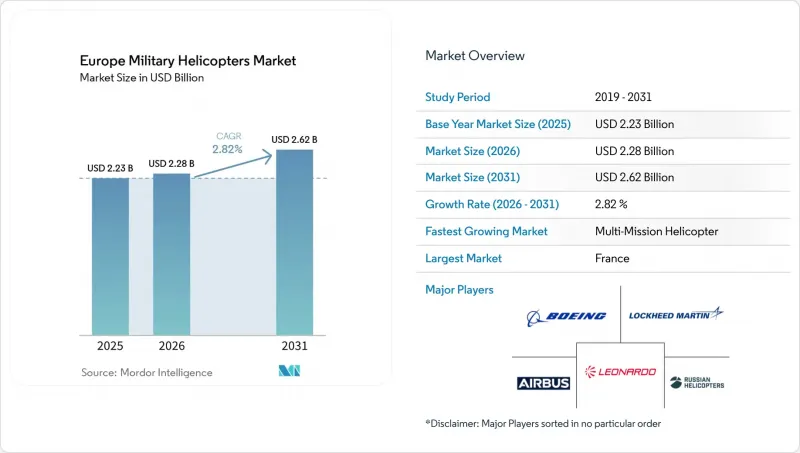
According to Mordor Intelligence, the Europe military helicopters market size was valued at USD 2.23 billion in 2025 and is forecast to grow from USD 2.28 billion in 2026 to USD 2.62 billion by 2031, registering a 2.82% CAGR between 2026 and 2031.
Europe Military Helicopters Market Trends and Insights
NATO And European Defense-Spending Commitments
Defense commitments in NATO Europe have entered multi-year spending frameworks rather than remaining political targets. All 32 NATO allies met the 2% of GDP threshold in 2025, and the June 2025 Hague Summit set a 5% target for 2035, with annual national spending plans. This reporting structure makes prolonged underinvestment more visible and gives ministries a clearer basis for sequencing helicopter purchases. EU equipment procurement reached EUR 100 billion (USD 115.98 billion) in 2025, up 26% from 2024. The Europe military helicopters market, therefore, benefits from budgets that can support aircraft, spare parts, training equipment, and infrastructure. Spain's 100-aircraft package helped Airbus Helicopters expand its Albacete customization and training capacity, linking procurement to a more durable local delivery base.
Fleet Modernization And Replacement Of Aging Platforms
Europe has an aging rotary-wing fleet, including 1,800 transport helicopters and 600 combat helicopters, with an average service life of more than 20 years. Without replacement, many heavy aircraft could remain in operation for more than 50 years by the 2040s. Replacement programs are becoming more concrete as countries define retirement dates for legacy fleets and commit funding for new platforms. Germany's 60 CH-47F Block II helicopters will replace the CH-53G Sea Stallions, which are scheduled to retire by 2030. Its H145M program includes training, simulators, spare parts, and maintenance support from contract signature, placing lifecycle services inside the initial purchasing decision. This approach expands the Europe military helicopters market beyond airframe deliveries and makes reliable support capacity central to supplier selection.
High Lifecycle Cost And Sustainment Burden
Lifecycle spending can exceed the acquisition price over a 30-year helicopter service life, placing significant pressure on defense budgets after delivery. Norway's 2025 settlement with NHIndustries followed persistent problems with NH90 spare-parts availability and showed that support issues can become program-level disputes. NATO's EUR 1.3 billion (USD 1.51 billion) NH90 support contract covers Belgium, France, Germany, Italy, and the Netherlands from 2025 to 2030. The pooled arrangement is expected to save 22% compared with separate bilateral contracts. Even with pooled support, availability constraints during fleet transition can limit training and operational readiness. The NGRC program's EUR 35 million (USD 40.61 million) flyaway cost target and lifecycle cost requirement show that affordability now influences aircraft design and buying decisions.
Other drivers and restraints analyzed in the detailed report include:
- Rising Regional Security Threats And Border-Protection Requirements
- Open Architecture, Crewed-Uncrewed Teaming, And Digital Avionics
- Procurement Lead Times And Skilled-Labor Bottlenecks
For complete list of drivers and restraints, kindly check the Table Of Contents.
Segment Analysis
Multi-mission helicopters accounted for 39.94% of the Europe military helicopters market in 2025, making them the largest helicopter-type category. Operators use these aircraft for combat support, troop transport, and search and rescue, which reduces the need to maintain separate fleets for each task. Spain ordered 31 additional NH90 tactical transport helicopters in December 2025, after already operating or ordering 45 aircraft, underscoring the scale of its commitment once a platform is established across service branches. The order formed part of a wider 100-helicopter package for the Army, Air Force, and Navy. Common platforms can simplify crew training, maintenance planning, and mission-system support. They can also help armed services coordinate procurement when missions overlap. This is important where force structures require aircraft to move quickly between domestic support and military operations. The market consequently places a high value on adaptable airframes that can be configured for multiple roles.
Transport helicopters are forecast to grow at a 3.99% CAGR through 2031. NATO's reinforced force model increases the need to move troops, equipment, and supplies over long distances. Heavy-lift aircraft, therefore, remain necessary even as ministries seek common utility fleets. Germany's planned CH-47F Block II acquisition provides a clear example of this need because it is tied to the retirement of the CH-53G fleet by 2030. Other types, including light liaison and observation aircraft, face lower procurement volumes as countries consolidate platforms. They remain relevant for pilot training and territorial surveillance. The NH90 Standard 2, delivered first to the French special forces in July 2026, demonstrates how mission-specific avionics can extend the capabilities of a baseline platform. NAHEMA and NHIndustries began a Block 2 architecture study in April 2026 for operations after 2040, extending the platform's relevance. France's planned 169 H160M Guepard aircraft will further support multi-mission fleet renewal, with the first Army delivery expected in 2028.
Army Aviation accounted for 41.97% of the Europe military helicopters market in 2025, supported by land-focused force structures and requirements along NATO's eastern flank. Army users need helicopters for reconnaissance, tactical transport, medical support, command mobility, and combat missions. Their demand remains linked to the availability of deployable ground forces and the need to sustain those forces. Air Force, Naval, and Marine Corps Aviation, as well as Joint and Special Operations users, account for the remainder of procurement. Naval demand remains firm because anti-submarine warfare and maritime patrol require specialized rotary-wing capability. Joint and special operations units also seek aircraft with advanced communications and mission equipment. These requirements keep the Europe military helicopters market diverse, even as ministries pursue fewer core airframes.
Paramilitary and Coast Guard services are forecast to grow at a 3.58% CAGR through 2031, the highest rate among end-user services. Border management, maritime surveillance, and emergency-response duties increasingly require military-grade aircraft and support systems. Romania ordered H175M and H145 helicopters for its Ministry of Internal Affairs in June 2026 alongside a separate H225M military transport acquisition. This structure shows how internal-security users can use procurement mechanisms that also support armed-force modernization. The UK selected 23 AW149 helicopters in March 2026 to replace 3 legacy types across Army and Strategic Command missions. France's NH90 Standard 2 deliveries and Spain's orders also reinforce standardization for special operations missions. NATO aircrew-training requirements and allied interoperability agreements favor approved and supportable platforms. This narrows the number of viable choices for users who need to operate with allied forces.
Complete Report Scope:
- By Helicopter Type
- Multi-mission Helicopter
- Transport Helicopter
- Other Helicopter
- By End-User Service
- Air Force
- Army Aviation
- Naval/Marine Corps Aviation
- Joint/Special Operations
- Paramilitary and Coast Guard
- By Engine Type
- Single-Engine
- Twin-Engine
- By Application
- Combat and Close Air Support
- Troop Transport
- Humanitarian and Disaster Relief
- Pilot Training
- By Geography
- United Kingdom
- France
- Germany
- Spain
- Italy
- Russia
- Rest of Europe
List of Companies Covered in this Report:
- Airbus SE
- Leonardo S.p.A.
- Lockheed Martin Corporation
- The Boeing Company
- Bell Textron Inc.
- Russian Helicopters (Rostec)
- Turkish Aerospace Industries, Inc.
- Aviation Industry Corporation of China, Ltd.
- MD Helicopters, LLC
- Kawasaki Heavy Industries, Ltd.
- Safran SA
- BAE Systems plc
- Rheinmetall AG
Additional Benefits:
- The market estimate (ME) sheet in Excel format
- 3 months of analyst support
TABLE OF CONTENTS
1 INTRODUCTION
- 1.1 Study Assumptions and Market Definition
- 1.2 Scope of the Study
2 RESEARCH METHODOLOGY
3 EXECUTIVE SUMMARY
4 MARKET LANDSCAPE
- 4.1 Market Overview
- 4.2 Market Drivers
- 4.2.1 NATO and European defense-spending commitments
- 4.2.2 Fleet modernization and replacement of aging platforms
- 4.2.3 Multi-mission standardization and interoperability requirements
- 4.2.4 Rising regional security threats and border-protection requirements
- 4.2.5 Open-architecture, crewed-uncrewed teaming, and digital avionics
- 4.2.6 Multinational procurement and sovereign industrial-base localization
- 4.3 Market Restraints
- 4.3.1 High lifecycle cost and sustainment burden
- 4.3.2 Procurement lead times and skilled-labor bottlenecks
- 4.3.3 Export controls, technology-transfer limits, and political risk
- 4.3.4 Fragmented requirements and low fleet availability during transition
- 4.4 Value Chain Analysis
- 4.5 Regulatory Landscape
- 4.6 Technological Outlook
- 4.7 Porter's Five Forces Analysis
- 4.7.1 Threat of New Entrants
- 4.7.2 Bargaining Power of Suppliers
- 4.7.3 Bargaining Power of Buyers
- 4.7.4 Threat of Substitutes
- 4.7.5 Intensity of Competitive Rivalry
5 MARKET SIZE AND GROWTH FORECASTS (VALUE)
- 5.1 By Helicopter Type
- 5.1.1 Multi-mission Helicopter
- 5.1.2 Transport Helicopter
- 5.1.3 Other Helicopter
- 5.2 By End-User Service
- 5.2.1 Air Force
- 5.2.2 Army Aviation
- 5.2.3 Naval/Marine Corps Aviation
- 5.2.4 Joint/Special Operations
- 5.2.5 Paramilitary and Coast Guard
- 5.3 By Engine Type
- 5.3.1 Single-Engine
- 5.3.2 Twin-Engine
- 5.4 By Application
- 5.4.1 Combat and Close Air Support
- 5.4.2 Troop Transport
- 5.4.3 Humanitarian and Disaster Relief
- 5.4.4 Pilot Training
- 5.5 By Geography
- 5.5.1 United Kingdom
- 5.5.2 France
- 5.5.3 Germany
- 5.5.4 Spain
- 5.5.5 Italy
- 5.5.6 Russia
- 5.5.7 Rest of Europe
6 COMPETITIVE LANDSCAPE
- 6.1 Market Concentration
- 6.2 Strategic Moves
- 6.3 Market Share Analysis
- 6.4 Company Profiles (includes Global level Overview, Market level overview, Core Segments, Financials as available, Strategic Information, Market Rank/Share for key companies, Products and Services, and Recent Developments)
- 6.4.1 Airbus SE
- 6.4.2 Leonardo S.p.A.
- 6.4.3 Lockheed Martin Corporation
- 6.4.4 The Boeing Company
- 6.4.5 Bell Textron Inc.
- 6.4.6 Russian Helicopters (Rostec)
- 6.4.7 Turkish Aerospace Industries, Inc.
- 6.4.8 Aviation Industry Corporation of China, Ltd.
- 6.4.9 MD Helicopters, LLC
- 6.4.10 Kawasaki Heavy Industries, Ltd.
- 6.4.11 Safran SA
- 6.4.12 BAE Systems plc
- 6.4.13 Rheinmetall AG
7 MARKET OPPORTUNITIES AND FUTURE OUTLOOK
- 7.1 White-space and Unmet-Need Assessment

