PUBLISHER: Mordor Intelligence | PRODUCT CODE: 2154230

PUBLISHER: Mordor Intelligence | PRODUCT CODE: 2154230
Asia-Pacific Automotive Camera - Market Share Analysis, Industry Trends & Statistics, Growth Forecasts (2026 - 2031)
According to Mordor Intelligence, the Asia-Pacific automotive camera market size was valued at USD 3.59 billion in 2025 and is estimated to grow from USD 3.95 billion in 2026 to reach USD 6.44 billion by 2031, at a CAGR of 10.27% during the forecast period (2026-2031).
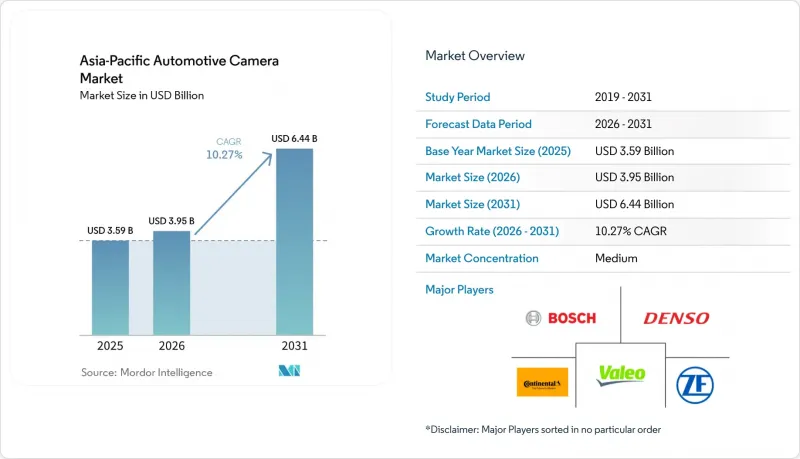
Asia-Pacific Automotive Camera Market Trends and Insights
ADAS Safety-Feature Mandates and NCAP Upgrades
China issued its mandatory national standard for combined driver assistance systems in July 2026, effective January 1, 2027, for new M- and N-category vehicles . The standard covers functional safety, cybersecurity, data recording, and human-machine interaction, broadening camera-related vehicle approval decisions. Australia's ADR 98/01 applies autonomous emergency braking requirements to passenger and light-commercial vehicles from August 2026, while ADR 99/01 will apply lane departure warning requirements to specified commercial vehicles from September 2026. ASEAN NCAP introduced its Intelligent Vehicle Advanced Safety Assessment protocol in July 2026. Mandatory compliance supports Asia-Pacific automotive camera demand, including in price-sensitive vehicle classes.
Multi-Camera Standardization in Chinese New-Energy Vehicles
Chinese new-energy vehicle programs have made multi-camera configurations more common across vehicle ranges that previously had limited camera coverage. BYD introduced its God's Eye tri-camera suite in February 2025 and expanded the system across several vehicle lines that year. This broader adoption indicated that camera count had become a vehicle architecture decision rather than a premium-only feature. By June 2025, China's vehicle type-approval process had required manufacturers to submit integrated driver-assistance parameters, including camera specifications. These developments affected the Asia-Pacific automotive camera market, as Chinese vehicle platforms entered export markets, influencing equipment expectations in ASEAN countries and India. Suppliers needed reliable, cost-effective cameras for high-volume models.
High System Integration and Lifecycle Cost
Advanced camera system costs remain a constraint in vehicle segments with significant sales in India, Vietnam, and Indonesia. Three-dimensional time-of-flight cameras carry higher unit costs than comparable 2D cameras, while thermal long-wave infrared cameras add several hundred dollars to bills of materials at current production volumes. These differentials hinder sensor integration in vehicles priced below USD 15,000. Functional safety and cybersecurity requirements increase engineering workloads, particularly for smaller suppliers competing on price. Aumovio India is developing a single-camera ADAS system for Level 2 assisted driving in mass-market passenger vehicles, highlighting demand for affordable solutions that balance coverage, processing, and compliance.
Other drivers and restraints analyzed in the detailed report include:
- Vehicle Electrification and Software-Defined Architectures
- Export-Oriented Camera Integration by Asia-Pacific OEMs
- Adverse-Weather and Low-Light Performance Variability
For complete list of drivers and restraints, kindly check the Table Of Contents.
Segment Analysis
Passenger vehicles commanded 75.12% of revenue in 2025, forming the Asia-Pacific automotive camera market's volume base. Production volumes and growing ADAS adoption in China, South Korea, and Japan support the segment. Models are shifting from rear-view cameras to three-to-five-camera systems for surround view, parking support, forward safety, and driver monitoring, increasing content per vehicle despite moderating unit growth. Scale spreads development and validation costs, supporting demand for digital CMOS cameras and processing capabilities, but intensifying price competition in entry-level and mid-range programs.
Light commercial vehicles are projected to register an 11.25% CAGR through 2031. Fleet telematics, last-mile delivery activity, and compliance requirements drive driver-facing and road-facing camera adoption. Geotab launched GO Focus Plus in Thailand in April 2026, while EROAD launched Clarity Edge Multicam in Australia. Fleet retrofits complement OEM demand, while medium- and heavy-duty commercial vehicles make a smaller contribution.
Viewing cameras accounted for 54.25% of 2025 revenue, reflecting widespread use in rear-view, surround-view, front-view, and interior-view applications. Their installed base sustains recurring demand for proven imaging components in the Asia-Pacific automotive camera market. Sensing and stereo cameras are projected to grow at a 14.37% CAGR through 2031, the highest among camera types, as they enable depth estimation for Level 2+ driving, urban assisted navigation, and intelligent parking.
BYD's 2025 God's Eye tri-camera deployment illustrated broader vision coverage across mainstream new-energy vehicles. OMNIVISION introduced the 8MP OX08D20 exterior sensor using TheiaCel technology, with mass production scheduled for Q4 2026 . Higher resolution and dynamic range support challenging light conditions but do not remove validation needs in rain or fog. Market growth will depend on sensor performance and reliable local perception functions. Suppliers offering complete perception stacks are better positioned than imaging-module providers.
Complete Report Scope:
- By Vehicle Type
- Passenger Vehicles
- Light Commercial Vehicles
- Medium and Heavy Commercial Vehicles
- By Camera Type
- Viewing (Surround/Rear/Front/Interior)
- Sensing / Stereo Cameras
- By Technology
- Digital (CMOS)
- Infra-red (NIR)
- Thermal (LWIR)
- By Application
- Park Assist
- Advanced Driver Assistance Systems (ADAS)
- Driver Monitoring and Cabin Safety
- By Sales Channel
- OEM-Installed
- Aftermarket
- By Country
- China
- Japan
- India
- South Korea
- Australia
- Rest of Asia-Pacific
List of Companies Covered in this Report:
- Robert Bosch GmbH
- DENSO Corporation
- Continental AG
- Valeo SE
- ZF Friedrichshafen AG
- Aptiv PLC
- Magna International Inc.
- Panasonic Holdings Corporation
- Hyundai Mobis Co., Ltd.
- Gentex Corporation
- Teledyne FLIR LLC
- Stonkam Co., Ltd.
- Sunny Smartlead
- Shanghai Baolong Automotive Corporation
- Freetech Intelligent Systems Co., Ltd.
- Ofilm Group Co., Ltd.
- Mitsubishi Electric Corporation
- Pioneer Corporation
Additional Benefits:
- The market estimate (ME) sheet in Excel format
- 3 months of analyst support
TABLE OF CONTENTS
1 Introduction
- 1.1 Study Assumptions and Market Definition
- 1.2 Scope of the Study
2 Research Methodology
3 Executive Summary
4 Market Landscape
- 4.1 Market Overview
- 4.2 Market Drivers
- 4.2.1 ADAS Safety-Feature Mandates and NCAP Upgrades
- 4.2.2 Multi-Camera Standardization in Chinese New-Energy Vehicles
- 4.2.3 Vehicle Electrification and Software-Defined Architectures
- 4.2.4 Export-Oriented Camera Integration by Asia-Pacific OEMs
- 4.2.5 Commercial Fleet, E-Commerce, and Last-Mile Delivery Digitization
- 4.2.6 Localization of Camera, Lens, and Perception-Software Supply Chains
- 4.3 Market Restraints
- 4.3.1 High System Integration and Lifecycle Cost
- 4.3.2 Adverse-Weather and Low-Light Performance Variability
- 4.3.3 Fragmented Repair, Calibration, and Cybersecurity Standards
- 4.3.4 Privacy Constraints on Cabin and Driver-Monitoring Video
- 4.4 Value and Supply-Chain Analysis
- 4.5 Regulatory Landscape
- 4.6 Technological Outlook
- 4.7 Porter's Five Forces Analysis
- 4.7.1 Threat of New Entrants
- 4.7.2 Bargaining Power of Buyers and Consumers
- 4.7.3 Bargaining Power of Suppliers
- 4.7.4 Threat of Substitute Products
- 4.7.5 Intensity of Competitive Rivalry
5 Market Size & Growth Forecasts (Value (USD) and Volume (Units))
- 5.1 By Vehicle Type
- 5.1.1 Passenger Vehicles
- 5.1.2 Light Commercial Vehicles
- 5.1.3 Medium and Heavy Commercial Vehicles
- 5.2 By Camera Type
- 5.2.1 Viewing (Surround/Rear/Front/Interior)
- 5.2.2 Sensing / Stereo Cameras
- 5.3 By Technology
- 5.3.1 Digital (CMOS)
- 5.3.2 Infra-red (NIR)
- 5.3.3 Thermal (LWIR)
- 5.4 By Application
- 5.4.1 Park Assist
- 5.4.2 Advanced Driver Assistance Systems (ADAS)
- 5.4.3 Driver Monitoring and Cabin Safety
- 5.5 By Sales Channel
- 5.5.1 OEM-Installed
- 5.5.2 Aftermarket
- 5.6 By Country
- 5.6.1 China
- 5.6.2 Japan
- 5.6.3 India
- 5.6.4 South Korea
- 5.6.5 Australia
- 5.6.6 Rest of Asia-Pacific
6 Competitive Landscape
- 6.1 Market Concentration
- 6.2 Strategic Moves
- 6.3 Market Share Analysis
- 6.4 Company Profiles (Includes Global Level Overview, Market Level Overview, Core Segments, Financials as Available, Strategic Information, Market Rank/Share for Key Companies, Products and Services, SWOT Analysis, and Recent Developments)
- 6.4.1 Robert Bosch GmbH
- 6.4.2 DENSO Corporation
- 6.4.3 Continental AG
- 6.4.4 Valeo SE
- 6.4.5 ZF Friedrichshafen AG
- 6.4.6 Aptiv PLC
- 6.4.7 Magna International Inc.
- 6.4.8 Panasonic Holdings Corporation
- 6.4.9 Hyundai Mobis Co., Ltd.
- 6.4.10 Gentex Corporation
- 6.4.11 Teledyne FLIR LLC
- 6.4.12 Stonkam Co., Ltd.
- 6.4.13 Sunny Smartlead
- 6.4.14 Shanghai Baolong Automotive Corporation
- 6.4.15 Freetech Intelligent Systems Co., Ltd.
- 6.4.16 Ofilm Group Co., Ltd.
- 6.4.17 Mitsubishi Electric Corporation
- 6.4.18 Pioneer Corporation
7 Market Opportunities & Future Outlook
- 7.1 White-Space and Unmet-Need Assessment

