PUBLISHER: Mordor Intelligence | PRODUCT CODE: 2184652

PUBLISHER: Mordor Intelligence | PRODUCT CODE: 2184652
China Automotive Camera - Market Share Analysis, Industry Trends & Statistics, Growth Forecasts (2026 - 2031)
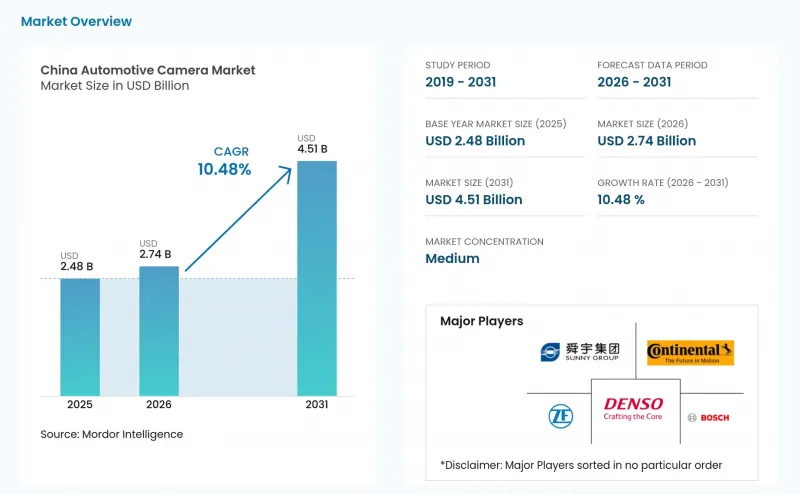
According to Mordor Intelligence, the Chinese automotive camera market size was valued at USD 2.48 billion in 2025, is estimated at USD 2.74 billion in 2026, and is projected to reach USD 4.51 billion by 2031, growing at a CAGR of 10.48% from 2026 to 2031.
China Automotive Camera Market Trends and Insights
Rapid Level-2/2+ ADAS Penetration in China
Level-2 features have become increasingly standard in new-car sales as price wars have made ACC and LKA bundles more accessible in affordable sedans. XPeng's P7+ and Li Auto's AD Max highlight the industry's shift toward vision-only systems, which are replacing costly lidar solutions. This transition aligns with the State Council's objectives for software-defined vehicles, enabling suppliers to spread their R&D efforts across higher volumes and reduce unit costs ahead of schedule.
Regulatory Mandate for Rear-View and ADAS Cameras
MIIT's enforcement of GB 15084 and GB 7258 regulations bans mirror-only builds, requiring new passenger vehicles to include rear cameras and ADAS-grade forward units. Commercial trucks must also comply within a tighter timeline compared to similar EU regulations. Consequently, automakers are accelerating sourcing from domestic suppliers. These suppliers maintain ISO 26262-certified stock within China, which reduces customs delays and drives notable near-term demand.
High ASP of Above-8 MP Sensors and ISP Limiting Mid-Tier Adoption
Fabs, prioritizing the demand for 7nm silicon, are making 8 MP sensors significantly pricier than their 2 MP counterparts. This cost disparity is primarily due to the limited production capacity allocated to higher-resolution sensors, as fabs focus on meeting the growing demand for advanced silicon technology used in smartphones and other devices. Brands eyeing models under USD 15,000 are holding off on introducing 8 MP sensors, anticipating a drop in average selling prices (ASPs) as new capacity comes online. The delay in adopting 8 MP sensors reflects a strategic decision to balance cost efficiency with market competitiveness in the budget segment.
Other drivers and restraints analyzed in the detailed report include:
- NEV Boom Boosting Multi-Camera Demand
- Emergence of Camera-Linked ADB/Micro-LED Headlights
- Precision-Optics Supply Bottlenecks Raising Lead Times
For complete list of drivers and restraints, kindly check the Table Of Contents.
Segment Analysis
China's automotive camera market size for passenger vehicles accounted for an 87.22% share in 2025. The passenger slice is driven by sedan and SUV buyers seeking Level-2 safety at mass-market prices. Logistics firms are retrofitting LCVs, driving significant growth in commercial fleets at a 10.72% CAGR to 2031. This move not only secures them substantial insurance discounts but also ensures compliance with upcoming mirror-elimination regulations.
NEV makers are driving the sedan sub-segment's rapid expansion by bundling ADAS at no additional cost. Meanwhile, SUVs dominate the passenger market, thanks to their elevated ride height and expansive dashboards that prominently feature 360-degree camera views. Trucks weighing over 12 tons are now being factory-integrated with rear and side cameras to meet provincial registration standards. Additionally, the aftermarket is enhancing the heavy-truck lifecycle with competitively priced retrofit kits.
Viewing cameras generated 69.73% of the 2025 revenue, as every vehicle requires at least one rear-view unit. Sensing modules nevertheless book a 10.73% CAGR as C-NCAP awards bonus points for night pedestrian AEB, forcing OEMs to add >=3 MP HDR units up front.
Aftermarket demand still skews toward low-cost viewing kits priced under USD 60, while OEM programs integrate dual-function 5 MP cameras that stitch surround views and feed neural networks. Valeo's "Smart Camera," which combines a 5 MP imager with embedded AI, eliminates one ECU and 1.2 kg of wiring, thereby reducing both cost and weight budgets simultaneously.
Complete Report Scope:
- By Vehicle Type
- Passenger Vehicle
- Hatchback
- Sedan
- Sports Utility Vehicle
- Multi-Purpose Vehicle
- Commercial Vehicle
- Light Commercial Vehicle (LCV)
- Medium and Heavy Commercial Vehicle (M&HCV)
- Passenger Vehicle
- By Camera Type
- Viewing Camera
- Sensing Camera
- By Application
- ADAS
- Parking and Surround View
- Driver Monitoring
- By Resolution
- Up to 1 MP
- 2-5 MP
- Above 5 MP
- By Sales Channel
- OEM-Fit
- Aftermarket
- By Mounting Location
- Front
- Rear
- Side
- Interior / In-Cabin
List of Companies Covered in this Report:
- Robert Bosch GmbH
- Denso Corporation
- Continental AG
- ZF Friedrichshafen AG
- Valeo SA
- Magna International
- Panasonic Holdings
- Sunny Optical Technology (Group) Company Limited
- OFILM Group
- Desay SV Automotive
- Freetech Intelligent Systems
- Aptiv PLC
- Mobileye (Intel)
- LG Innotek
- Sony Semiconductor Solutions
- OmniVision Technologies
- MCNEX Co., Ltd.
Additional Benefits:
- The market estimate (ME) sheet in Excel format
- 3 months of analyst support
TABLE OF CONTENTS
1 Introduction
- 1.1 Study Assumptions and Market Definition
- 1.2 Scope of the Study
2 Research Methodology
3 Executive Summary
4 Market Landscape
- 4.1 Market Overview
- 4.2 Market Drivers
- 4.2.1 Regulatory Mandate for Rear-View and ADAS Cameras
- 4.2.2 Rapid Level-2/2+ ADAS Penetration in China
- 4.2.3 NEV Boom Boosting Multi-Camera Demand
- 4.2.4 Cost-Down of Above 2 MP CMOS Modules
- 4.2.5 Emergence of Camera-Linked ADB/Micro-LED Headlights
- 4.2.6 Shift to Map-Less BEV Algorithms Raising Camera Count
- 4.3 Market Restraints
- 4.3.1 High ASP of Above 8 MP Sensors and ISP Limiting Mid-Tier Adoption
- 4.3.2 Harsh-Weather Reliability and Self-Cleaning Complexity
- 4.3.3 Cyber-Security / Data-Privacy Compliance Cost
- 4.3.4 Precision-Optics Supply Bottlenecks Raising Lead Times
- 4.4 Value / Supply-Chain Analysis
- 4.5 Regulatory Landscape
- 4.6 Technological Outlook
- 4.7 Porter's Five Forces Analysis
- 4.7.1 Threat of New Entrants
- 4.7.2 Bargaining Power of Suppliers
- 4.7.3 Bargaining Power of Buyers
- 4.7.4 Threat of Substitutes
- 4.7.5 Competitive Rivalry
5 Market Size and Growth Forecasts (Value, USD)
- 5.1 By Vehicle Type
- 5.1.1 Passenger Vehicle
- 5.1.1.1 Hatchback
- 5.1.1.2 Sedan
- 5.1.1.3 Sports Utility Vehicle
- 5.1.1.4 Multi-Purpose Vehicle
- 5.1.2 Commercial Vehicle
- 5.1.2.1 Light Commercial Vehicle (LCV)
- 5.1.2.2 Medium and Heavy Commercial Vehicle (M&HCV)
- 5.1.1 Passenger Vehicle
- 5.2 By Camera Type
- 5.2.1 Viewing Camera
- 5.2.2 Sensing Camera
- 5.3 By Application
- 5.3.1 ADAS
- 5.3.2 Parking and Surround View
- 5.3.3 Driver Monitoring
- 5.4 By Resolution
- 5.4.1 Up to 1 MP
- 5.4.2 2-5 MP
- 5.4.3 Above 5 MP
- 5.5 By Sales Channel
- 5.5.1 OEM-Fit
- 5.5.2 Aftermarket
- 5.6 By Mounting Location
- 5.6.1 Front
- 5.6.2 Rear
- 5.6.3 Side
- 5.6.4 Interior / In-Cabin
6 Competitive Landscape
- 6.1 Market Concentration
- 6.2 Strategic Moves
- 6.3 Market Share Analysis
- 6.4 Company Profiles (Includes Global Level Overview, Market Level Overview, Core Segments, Financials as available, Strategic Information, Market Rank/Share for key companies, Products and Services, and Recent Developments)
- 6.4.1 Robert Bosch GmbH
- 6.4.2 Denso Corporation
- 6.4.3 Continental AG
- 6.4.4 ZF Friedrichshafen AG
- 6.4.5 Valeo SA
- 6.4.6 Magna International
- 6.4.7 Panasonic Holdings
- 6.4.8 Sunny Optical Technology (Group) Company Limited
- 6.4.9 OFILM Group
- 6.4.10 Desay SV Automotive
- 6.4.11 Freetech Intelligent Systems
- 6.4.12 Aptiv PLC
- 6.4.13 Mobileye (Intel)
- 6.4.14 LG Innotek
- 6.4.15 Sony Semiconductor Solutions
- 6.4.16 OmniVision Technologies
- 6.4.17 MCNEX Co., Ltd.
7 Market Opportunities and Future Outlook

