PUBLISHER: Mordor Intelligence | PRODUCT CODE: 2184617

PUBLISHER: Mordor Intelligence | PRODUCT CODE: 2184617
Germany Automotive Camera - Market Share Analysis, Industry Trends & Statistics, Growth Forecasts (2026 - 2031)
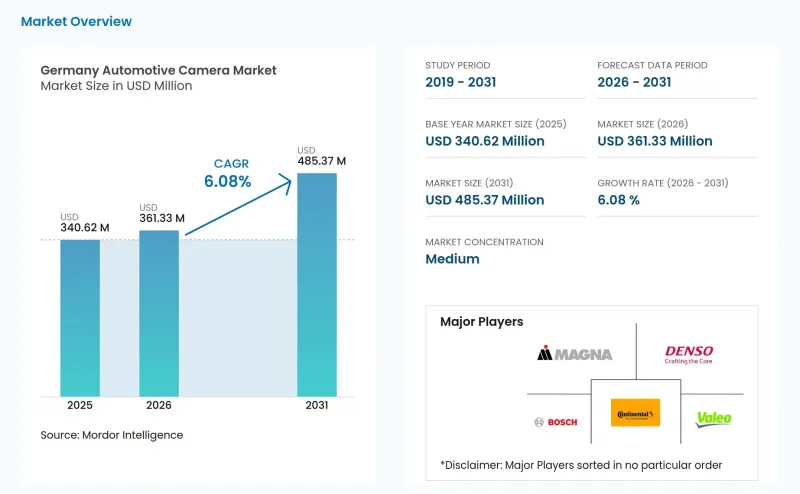
According to Mordor Intelligence, the German automotive camera market size was valued at USD 340.62 million in 2025, is estimated at USD 361.33 million in 2026, and is projected to reach USD 485.37 million by 2031, growing at a CAGR of 6.08% from 2026 to 2031.
Germany Automotive Camera Market Trends and Insights
EU-GSR Mandated Rear-View and ADAS Cameras
Germany is set to enforce the EU General Safety Regulation, which recently took effect. This regulation mandates that every new vehicle type approval must include rear-view and lane-keeping cameras. As a result, what was once an optional feature has now become standard equipment. Consequently, a significant portion of passenger cars that would have previously been shipped without cameras will now be outfitted with multiple cameras. Suppliers have ramped up their capacities since the full-registration deadline. Furthermore, to meet the required performance benchmarks, module specifications are now focusing on sensors that offer wide-angle coverage. The design process has become more intricate, as replacements for traditional mirrors must provide visibility comparable to that of glass mirrors. This requirement not only increases validation costs but also tightens the optical tolerances.
Premium-Car ADAS Packages Cascading to Mid-Segment
German automakers are integrating established ADAS camera suites into their volume models, now priced in the affordable range. Volkswagen is standardizing forward cameras on its Golf and Tiguan models, while Opel is introducing surround-view parking in the Astra . When a module achieves significant production volumes, economies of scale significantly reduce its per-unit cost. This allows OEMs to enhance safety features without increasing the vehicle's price. Additionally, data from insurers highlights a significant drop in collision claims for cars equipped with forward cameras, underscoring the perception of these systems as standard features rather than luxury add-ons.
Semiconductor Supply-Chain Vulnerability
In the automotive image sensor market, major players such as Sony, Samsung, and OmniVision dominate, with the majority of production concentrated in Asia. Recently, lead times significantly increased, delaying the launches of several German models by several weeks. Continental reported a loss of EUR 180 million in revenue, attributing it to insufficient allocations, while noting that dual-sourcing provides only a partial remedy, necessitating re-validation .
Other drivers and restraints analyzed in the detailed report include:
- Falling CMOS Sensor ASPs and Higher On-Board Compute
- Germany OEM L3 Rollout Demanding Above 8 MP Tri-Cam Stacks
- High Validation Cost and ISO 26262 Compliance Burden
For complete list of drivers and restraints, kindly check the Table Of Contents.
Segment Analysis
Passenger vehicle held 72.48% of the German automotive camera market in 2025; however, their 7.11% forecast CAGR is below the market-wide pace, as commercial vehicle are catching up. Sport utility vehicles, with wider blind zones, commonly integrate four- to six-camera surround-view systems, whereas sedans typically have two or three units. Fleet operators of vans and trucks are eligible for insurance rebates that reward the use of camera-based evidence, thereby shifting purchase priorities toward driver-monitoring and side-view modules. In heavy trucks, Daimler Truck made driver-facing cameras standard on the Actros, illustrating how safety metrics and liability exposure can override initial hardware costs. Commercial vehicle buyers apply total cost of ownership logic that assigns tangible savings to each avoided collision, so adoption momentum should continue to outpace the passenger-vehicle baseline.
The German automotive camera market size for commercial vehicles is therefore positioned to scale rapidly as EU Vision Zero targets place extra scrutiny on blind-spot fatalities in urban zones. Light vans are increasingly specifying pillar-mounted cameras that replace external mirrors, thereby trimming aerodynamic drag and fuel consumption. German postal and grocery fleets are piloting side-view plus rear-view digital mirrors, which have been shown to lower in-city accident rates. The resulting claims savings are then fed directly back into procurement budgets. Passenger cars will maintain volume leadership; however, the increase in cameras-per-vehicle is flattening, as most models already ship with rear and front modules. Incremental gains rely on adding interior monitoring, a regulatory-driven rather than consumer-driven feature.
Viewing cameras accounted for 64.12% of 2025 shipments because rear parking and mirror replacement still rely on driver-view video streams. However, sensing cameras that integrate object-detection algorithms are expected to grow at an 8.23% CAGR, in line with the adoption of Level 2+ and Level 3 functions. The German automotive camera market size for sensing modules is growing faster as AI processing shifts into the camera housing, offloads central ECUs, and enables redundancy. Bosch's 16 TOPS multipurpose unit typifies the blurring of the line between viewing and sensing, as it can output video for user confirmation while executing neural networks locally.
The viewing segment will continue to grow in absolute terms, as every new car now requires a backup camera, yet margin pressure remains intense. Chinese low-cost entrants target rear-view modules at European OEM platforms, and commoditization forces Tier 1 suppliers to funnel R&D toward sensing variants where intellectual property can still command premium pricing. Hybrid "smart-view" designs that add low-power convolution engines help defend average selling prices while giving OEMs an upgrade path through over-the-air software releases.
Complete Report Scope:
- By Vehicle Type
- Passenger Vehicle
- Hatchback
- Sedan
- Sports Utility Vehicle (SUV)
- Multi-Purpose Vehicle (MPV)
- Commercial Vehicle
- Light Commercial Vehicle (LCV)
- Medium and Heavy Commercial Vehicle (M&HCV)
- Passenger Vehicle
- By Camera Type
- Viewing Camera
- Sensing Camera
- By Application
- Advanced Driver-Assistance Systems (ADAS)
- Parking and Surround View
- Driver Monitoring
- By Resolution
- Up to 1 MP
- 2-5 MP
- Above 5 MP
- By Sales Channel
- OEM-Fit
- Aftermarket
- By Mounting Location
- Front
- Rear
- Side
- Interior / In-Cabin
List of Companies Covered in this Report:
- Robert Bosch GmbH
- Continental AG
- ZF Friedrichshafen AG
- Valeo SA
- Magna International Inc.
- Aptiv PLC
- Denso Corp.
- Mobileye (Intel)
- Panasonic Corporation
- LG Innotek Co. Ltd.
- Forvia Hella GmbH and Co. KGaA
- Veoneer AB
- MCNEX Co. Ltd.
- Ambarella Inc.
Additional Benefits:
- The market estimate (ME) sheet in Excel format
- 3 months of analyst support
TABLE OF CONTENTS
1 Introduction
- 1.1 Study Assumptions and Market Definition
- 1.2 Scope of the Study
2 Research Methodology
3 Executive Summary
4 Market Landscape
- 4.1 Market Overview
- 4.2 Market Drivers
- 4.2.1 EU-GSR Mandated Rear-View and ADAS Cameras
- 4.2.2 Premium-Car ADAS Packages Cascading to Mid-Segment
- 4.2.3 Falling CMOS Sensor ASPs and Higher On-Board Compute
- 4.2.4 Insurance Telematics Incentives for Camera Evidence
- 4.2.5 Germany's OEM L3 Rollout Demanding Above 8 MP Tri-Cam Stacks
- 4.2.6 Digital Twin Calibration Requirement Boosting Camera Recall Tools
- 4.3 Market Restraints
- 4.3.1 High Validation Cost and ISO 26262 Compliance Burden
- 4.3.2 Semiconductor Supply-Chain Vulnerability
- 4.3.3 GDPR-Linked In-Cabin Data-Sovereignty Constraints
- 4.3.4 Skilled-Labor Shortage for Multi-Camera ADAS Calibration
- 4.4 Value / Supply-Chain Analysis
- 4.5 Regulatory Landscape
- 4.6 Technological Outlook
- 4.7 Porter's Five Forces
- 4.7.1 Threat of New Entrants
- 4.7.2 Bargaining Power of Suppliers
- 4.7.3 Bargaining Power of Buyers
- 4.7.4 Threat of Substitutes
- 4.7.5 Competitive Rivalry
5 Market Size and Growth Forecasts (Value, USD)
- 5.1 By Vehicle Type
- 5.1.1 Passenger Vehicle
- 5.1.1.1 Hatchback
- 5.1.1.2 Sedan
- 5.1.1.3 Sports Utility Vehicle (SUV)
- 5.1.1.4 Multi-Purpose Vehicle (MPV)
- 5.1.2 Commercial Vehicle
- 5.1.2.1 Light Commercial Vehicle (LCV)
- 5.1.2.2 Medium and Heavy Commercial Vehicle (M&HCV)
- 5.1.1 Passenger Vehicle
- 5.2 By Camera Type
- 5.2.1 Viewing Camera
- 5.2.2 Sensing Camera
- 5.3 By Application
- 5.3.1 Advanced Driver-Assistance Systems (ADAS)
- 5.3.2 Parking and Surround View
- 5.3.3 Driver Monitoring
- 5.4 By Resolution
- 5.4.1 Up to 1 MP
- 5.4.2 2-5 MP
- 5.4.3 Above 5 MP
- 5.5 By Sales Channel
- 5.5.1 OEM-Fit
- 5.5.2 Aftermarket
- 5.6 By Mounting Location
- 5.6.1 Front
- 5.6.2 Rear
- 5.6.3 Side
- 5.6.4 Interior / In-Cabin
6 Competitive Landscape
- 6.1 Market Concentration
- 6.2 Strategic Moves
- 6.3 Market Share Analysis
- 6.4 Company Profiles (Includes Global level Overview, Market level overview, Core Segments, Financials as available, Strategic Information, Market Rank/Share for key companies, Products and Services, and Recent Developments)
- 6.4.1 Robert Bosch GmbH
- 6.4.2 Continental AG
- 6.4.3 ZF Friedrichshafen AG
- 6.4.4 Valeo SA
- 6.4.5 Magna International Inc.
- 6.4.6 Aptiv PLC
- 6.4.7 Denso Corp.
- 6.4.8 Mobileye (Intel)
- 6.4.9 Panasonic Corporation
- 6.4.10 LG Innotek Co. Ltd.
- 6.4.11 Forvia Hella GmbH and Co. KGaA
- 6.4.12 Veoneer AB
- 6.4.13 MCNEX Co. Ltd.
- 6.4.14 Ambarella Inc.
7 Market Opportunities and Future Outlook

