PUBLISHER: Mordor Intelligence | PRODUCT CODE: 2154284

PUBLISHER: Mordor Intelligence | PRODUCT CODE: 2154284
United States Electric Vehicle Leasing - Market Share Analysis, Industry Trends & Statistics, Growth Forecasts (2026 - 2031)
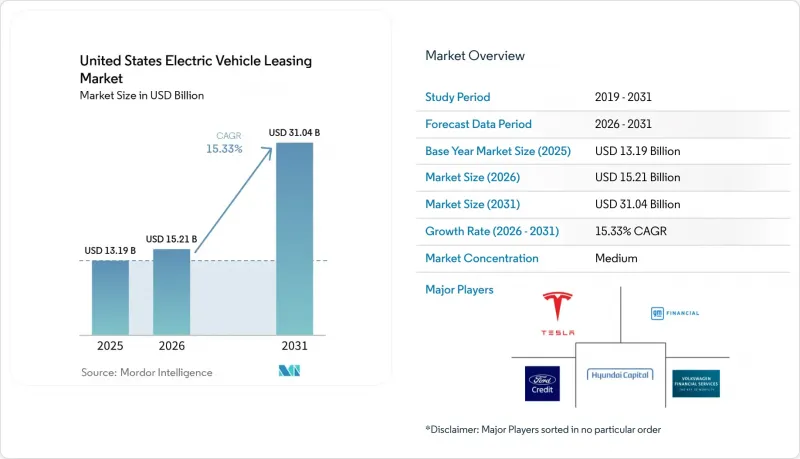
According to Mordor Intelligence, the United States electric vehicle leasing market size was valued at USD 13.19 billion in 2025, is estimated at USD 15.21 billion in 2026, and is projected to reach USD 31.04 billion by 2031, growing at a CAGR of 15.33% over 2026-2031.
United States Electric Vehicle Leasing Market Trends and Insights
Federal Electric Vehicle Tax Credit Applied to Leases
Section 45W lets commercial lessors claim the full USD 7,500 incentive and roll it directly into lower payments, bypassing income and MSRP caps that apply to outright purchases . After consumer credits lapsed in 2025, leases surged to account for a significant portion of all electric vehicle (EV) transactions. This trend underscores the structural favoritism of the United States electric vehicle leasing market due to the existing subsidy framework. In a strategic move, captive finance arms pre-funded dealer inventories earlier in the year, securing credits for monetization throughout the final quarter. This maneuver effectively broadened the window of opportunity for customers. The payment advantage over loans not only counters rate pressures but also appeals to both retail and fleet buyers. This trend is likely to continue unless Congress amends the legislation or market interest rates drop significantly.
Declining Battery Costs Lower TCO
In 2024, pack prices fell significantly and are projected to decline further by 2026, surpassing a key parity threshold. This reduction in costs leads to higher residuals, allowing for tighter lease factors. Such dynamics bolster the United States electric vehicle leasing market, appealing even to budget-conscious fleet managers. Analyses reveal fleets incur a significantly lower total cost compared to gasoline, a difference that magnifies with increased mileage, propelling corporate mandates towards electrification. As depreciation curves flatten, lessors find themselves with enhanced pricing power, while customers benefit from quicker paybacks, especially in the face of fluctuating fuel prices.
High Interest-Rate Environment Inflates Monthly Payments
In March 2026, the Fed maintained the funds rate at its current level. During the same period, new-car loan rates remained elevated. These rates, reflected in lease money factors, significantly increase monthly charges for electric vehicles (EVs) compared to lower-rate scenarios. This disparity limits the addressable demand in the United States electric vehicle leasing market, particularly among households sensitive to payment fluctuations.
Other drivers and restraints analyzed in the detailed report include:
- OEM Captive Finance Arms Expand Lease Offerings
- IRA Cell-and-Pack Content Subsidy Passed Through to Lessees
- Limited Rural Charging Infrastructure
For complete list of drivers and restraints, kindly check the Table Of Contents.
Segment Analysis
Commercial vans and light trucks expanded at 17.13% through 2031, even though passenger cars still held 84.25% share in 2025. Amazon's deployment of 30,000 Rivian vans exemplifies how high-utilization routes rapidly justify electrification . The United States electric vehicle leasing market size for commercial vehicles is forecast to compound faster than the passenger segments as fleet managers chase lower maintenance and fuel outlays. In parallel, passenger cars maintain momentum via model breadth and Section 45W pass-through benefits.
Passenger demand is gravitating towards the Tesla Model 3, Model Y, Honda Prologue, and Hyundai IONIQ 5. However, Hertz's recent writedown on Teslas highlights the volatility of residual values, especially when MSRP cuts meet software locks. Despite this setback, the commercial fleet remains undeterred. Vans, typically running to the end of their life, don't re-enter retail resale channels, bolstering confidence in lease economics.
Battery-electric units owned 77.14% share in 2025, supported by 192,000 public charging ports nationwide. Plug-in hybrids fill range-anxiety gaps, while fuel-cell vehicles-despite low share-are slated for 15.91% CAGR as Toyota and Hyundai expand hydrogen corridors. The United States electric vehicle leasing market share for BEVs will still dominate, yet second-mover propulsion options capture niche duty cycles, particularly in drayage and long-haul, where battery weight is punitive.
CARB's Advanced Clean Fleets rule compels 100% zero-emission medium and heavy-duty purchases starting by model year 2036, lifting both BEV and FCEV leasing volume . OEMs with domestic battery lines qualify for IRA credits, while European imports face subsidy gaps, a differential visible in lease penetration rates that favor compliant models.
Complete Report Scope:
- By Vehicle Type
- Passenger Cars
- Commercial Vehicles
- By Propulsion Type
- Battery Electric Vehicles
- Plug-in Hybrid Electric Vehicles
- Fuel-Cell Electric Vehicles
- By End User
- Individual Customers
- Corporate Fleets
- Government Agencies
- Ride-Sharing and Delivery Platforms
- By Duration
- Short-Term (Less than 12 months)
- Mid-Term (1-3 years)
- Long-Term (More than 3 years)
List of Companies Covered in this Report:
- Tesla Financial Services
- GM Financial
- Ford Motor Credit Company LLC
- Hyundai Capital Services
- Volkswagen Financial Services
- Toyota Financial Services
- Nissan Motor Acceptance Company
- BMW Financial Services
- Mercedes-Benz Financial Services
- Stellantis Financial Services
- Ally Financial Inc.
- Santander Consumer USA
- Enterprise Fleet Management
- LeasePlan (Ayvens Group)
- Rivian Financial Services
- Lucid Financial Services
Additional Benefits:
- The market estimate (ME) sheet in Excel format
- 3 months of analyst support
TABLE OF CONTENTS
1 Introduction
- 1.1 Study Assumptions and Market Definition
- 1.2 Scope of the Study
2 Research Methodology
3 Executive Summary
4 Market Landscape
- 4.1 Market Overview
- 4.2 Market Drivers
- 4.2.1 Federal EV Tax Credit Applied to Leases
- 4.2.2 Declining Battery Costs Lower TCO
- 4.2.3 OEM Captive Finance Arms Expand Lease Offerings
- 4.2.4 IRA Cell-&-Pack Content Subsidy Passed Through to Lessees
- 4.2.5 Growth Of Subscription-Style "Flex" Contracts
- 4.2.6 Battery Second-Life Revenue Boosts Residual Values
- 4.3 Market Restraints
- 4.3.1 High Interest-Rate Environment Inflates Monthly Payments
- 4.3.2 Limited Rural Charging Infrastructure
- 4.3.3 OEM Software Locks Create Residual-Value Risk
- 4.3.4 State Mileage-Tax Proposals Deter High-Usage Fleets
- 4.4 Value / Supply-Chain Analysis
- 4.5 Regulatory Landscape
- 4.6 Technological Outlook
- 4.7 Porter's Five Forces
- 4.7.1 Competitive Rivalry
- 4.7.2 Threat of New Entrants
- 4.7.3 Bargaining Power of Suppliers
- 4.7.4 Bargaining Power of Customers
- 4.7.5 Threat of Substitutes
5 Market Size and Growth Forecasts (Value (USD))
- 5.1 By Vehicle Type
- 5.1.1 Passenger Cars
- 5.1.2 Commercial Vehicles
- 5.2 By Propulsion Type
- 5.2.1 Battery Electric Vehicles
- 5.2.2 Plug-in Hybrid Electric Vehicles
- 5.2.3 Fuel-Cell Electric Vehicles
- 5.3 By End User
- 5.3.1 Individual Customers
- 5.3.2 Corporate Fleets
- 5.3.3 Government Agencies
- 5.3.4 Ride-Sharing and Delivery Platforms
- 5.4 By Duration
- 5.4.1 Short-Term (Less than 12 months)
- 5.4.2 Mid-Term (1-3 years)
- 5.4.3 Long-Term (More than 3 years)
6 Competitive Landscape
- 6.1 Market Concentration
- 6.2 Strategic Moves
- 6.3 Market Share Analysis
- 6.4 Company Profiles (Includes Global Level Overview, Market Level Overview, Core Segments, Financials as Available, Strategic Information, Market Rank/Share for Key Companies, Products and Services, SWOT Analysis, and Recent Developments)
- 6.4.1 Tesla Financial Services
- 6.4.2 GM Financial
- 6.4.3 Ford Motor Credit Company LLC
- 6.4.4 Hyundai Capital Services
- 6.4.5 Volkswagen Financial Services
- 6.4.6 Toyota Financial Services
- 6.4.7 Nissan Motor Acceptance Company
- 6.4.8 BMW Financial Services
- 6.4.9 Mercedes-Benz Financial Services
- 6.4.10 Stellantis Financial Services
- 6.4.11 Ally Financial Inc.
- 6.4.12 Santander Consumer USA
- 6.4.13 Enterprise Fleet Management
- 6.4.14 LeasePlan (Ayvens Group)
- 6.4.15 Rivian Financial Services
- 6.4.16 Lucid Financial Services
7 Market Opportunities and Future Outlook
- 7.1 White-space and Unmet-Need Assessment

