PUBLISHER: Mordor Intelligence | PRODUCT CODE: 2154512

PUBLISHER: Mordor Intelligence | PRODUCT CODE: 2154512
South America Offshore Support Vessels - Market Share Analysis, Industry Trends & Statistics, Growth Forecasts (2026 - 2031)
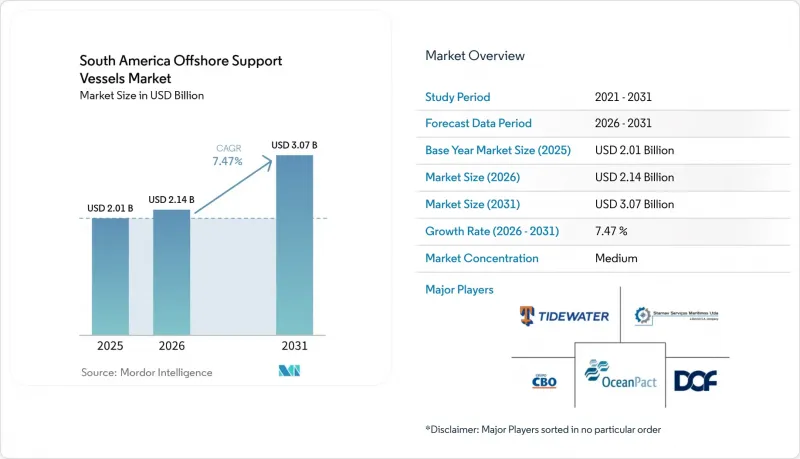
According to Mordor Intelligence, the South America offshore support vessels market size is expected to increase from USD 2.01 billion in 2025 to USD 2.14 billion in 2026 and reach USD 3.07 billion by 2031, at a CAGR of 7.47% over 2026-2031.
South America Offshore Support Vessels Market Trends and Insights
Deepwater Pre-Salt Production Expansion
Brazil's pre-salt fields support large offshore developments with established geology, infrastructure, and production systems. Petrobras produced more than 3 million barrels per day in 2026, with over 80% coming from pre-salt assets. Petrobras is progressing the P-80, P-82, and P-83 systems for Buzios, and each unit is designed to produce 225,000 barrels of oil per day. Equinor began a 6-well drilling campaign for the Raia project in the Campos Basin in March 2026, with first production targeted for 2028. These projects extend the South America offshore support vessels market beyond short-cycle vessel demand because each production unit requires continuing logistics, mooring, and subsea support throughout its operating life, including routine materials movements and intervention work. The operating conditions also favor DP2 and DP3 vessels with deepwater ROV capability, which raises the equipment and financing threshold for new suppliers.
Petrobras Offshore Fleet Renewal Program
Petrobras' Open Sea Program brings together new vessel construction and long-duration operating contracts. Petrobras signed contracts in December 2024 for 12 new platform supply vessels to be built in Brazil with 40% local content. The contract structure provides 4 years for mobilization and 12 years for operations, giving local yards and vessel owners a longer revenue base. In May 2026, DOF announced contracts for 4 newbuild subsea support vessels that will be built at Navship in Santa Catarina. The South America offshore support vessels market is therefore placing greater weight on operators that can coordinate construction, financing, vessel availability, supplier delivery schedules, and the operational preparation needed before a vessel enters a long-term charter. Starnav's hybrid vessels use mtu Series 4000 engines, battery systems, HVO fuel capability, and IMO Tier III equipment, showing how technical requirements are becoming part of procurement decisions.
Local-Content Compliance and Brazilian-Flag Constraints
Brazil's local-content rules add requirements to offshore vessel construction and chartering. Law 15,075 of 2024 and related rules set local-content conditions for maritime support vessels and link some incentives to compliance. The ANTAQ circularization process checks whether a Brazilian-flag vessel is available before foreign tonnage is chartered. Brazil had 390 Brazilian-flagged vessels among 481 active OSVs in February 2026, leaving limited flexibility when specialized demand rises. The South America offshore support vessels market also faces port turnaround, drydock, and crew constraints, particularly when class-docking requirements cluster in the Brazilian fleet and several vessels require the same specialized repair resources during a limited period. These conditions favor established local operators but can delay access to vessels that are needed for specialized assignments.
Other drivers and restraints analyzed in the detailed report include:
- Subsea Inspection, Maintenance and Repair Backlog
- Offshore Decommissioning Vessel Demand
- High Capital Intensity and Financing Dependence
For complete list of drivers and restraints, kindly check the Table Of Contents.
Segment Analysis
AHT/AHTS vessels accounted for 40.4% of the South America offshore support vessels market in 2025. Their leading position reflects the mooring demands of ultra-deepwater FPSOs, which require high-bollard-pull anchor handling at water depths reaching 3,000 meters. DOF's Skandi Iguacu was contracted for Petrobras work with more than 350 metric tons of bollard pull. DOF also secured long-term AHTS work for the Skandi Angra, Skandi Paraty, and Skandi Urca. Platform supply vessels remain important because active FPSOs need regular fuel, cargo, and materials supply. The 12 hybrid PSVs ordered for Petrobras work reinforce the need for local supply capacity. Vessel owners with equipment suited to deepwater operations have a clearer route into long-term contracts.
Other Types, including multi-purpose, subsea support, standby, and crew vessels, are the fastest-growing vessel type segment at a 7.8% CAGR through 2031. The South America offshore support vessels market size for this group is being supported by inspection, maintenance, repair, and decommissioning assignments. DOF's May 2026 awards cover 4 new ROV support vessels for Petrobras work and a 12-year contract term. Oceaneering's Petrobras contracts also require ROV services for inspection, FPSO hookups, mooring inspections, and pile installations. The category benefits from work that cannot be completed by conventional supply or anchor-handling vessels. ANP decommissioning rules also add advance planning for multi-purpose and diving support vessels. This mix of services gives specialized vessel owners a role in both new production activity and end-of-life field work.
Complete Report Scope:
- By Vessel Type
- Anchor Handling Tug/Anchor Handling Towing Supply Vessels (AHT/AHTSs)
- Platform Supply Vessels (PSV)
- Other Types (MPSV, Subsea, Standby Crew)
- By Application
- Offshore Oil and Gas
- Offshore Wind
- Offshore Decommissioning
- Other Applications
- By Geography
- Brazil
- Argentina
- Chile
- Rest of South America
List of Companies Covered in this Report:
- Tidewater Inc.
- Companhia Brasileira de Offshore (CBO)
- OceanPact Servicos Maritimos S.A.
- DOF Group ASA
- Starnav Servicos Maritimos Ltda.
- Bram Offshore Transportes Maritimos Ltda.
- Edison Chouest Offshore LLC
- Bourbon Corporation SA
- Solstad Offshore ASA
- Seacor Marine Holdings Inc.
- Hornbeck Offshore Services, Inc.
- Maersk Supply Service A/S
- Bravante Group
- CMM Offshore Brasil Ltda.
- OOS Shipping do Brasil Ltda.
- Posidonia Shipping
- Companhia de Navegacao Norsul
- Wilson Sons S.A.
- Ultratug Participacoes S.A.
Additional Benefits:
- The market estimate (ME) sheet in Excel format
- 3 months of analyst support
TABLE OF CONTENTS
1 INTRODUCTION
- 1.1 Study Assumptions and Market Definition
- 1.2 Scope of the Study
2 RESEARCH METHODOLOGY
3 EXECUTIVE SUMMARY
4 MARKET LANDSCAPE
- 4.1 Market Overview
- 4.2 Market Drivers
- 4.2.1 Deepwater Pre-Salt Production Expansion
- 4.2.2 Petrobras Offshore Fleet Renewal Program
- 4.2.3 Subsea Inspection, Maintenance and Repair Backlog
- 4.2.4 Offshore Decommissioning Vessel Demand
- 4.2.5 Offshore Wind Project Optionality
- 4.2.6 Hybrid Vessel Replacement Economics
- 4.3 Market Restraints
- 4.3.1 Local-Content Compliance and Brazilian-Flag Constraints
- 4.3.2 High Capital Intensity and Financing Dependence
- 4.3.3 Fragmented Offshore Wind Project Pipeline
- 4.3.4 Port, Shipyard and Specialized-Crew Bottlenecks
- 4.4 Supply-Chain Analysis
- 4.5 Porter's Five Forces Analysis
- 4.5.1 Bargaining Power of Suppliers
- 4.5.2 Bargaining Power of Buyers
- 4.5.3 Threat of New Entrants
- 4.5.4 Threat of Substitutes
- 4.5.5 Competitive Rivalry
- 4.6 Technology Outlook
- 4.7 Regulatory Landscape
- 4.8 Investment Analysis
5 MARKET SIZE AND GROWTH FORECASTS
- 5.1 By Vessel Type
- 5.1.1 Anchor Handling Tug/Anchor Handling Towing Supply Vessels (AHT/AHTSs)
- 5.1.2 Platform Supply Vessels (PSV)
- 5.1.3 Other Types (MPSV, Subsea, Standby Crew)
- 5.2 By Application
- 5.2.1 Offshore Oil and Gas
- 5.2.2 Offshore Wind
- 5.2.3 Offshore Decommissioning
- 5.2.4 Other Applications
- 5.3 By Geography
- 5.3.1 Brazil
- 5.3.2 Argentina
- 5.3.3 Chile
- 5.3.4 Rest of South America
6 COMPETITIVE LANDSCAPE
- 6.1 Market Concentration
- 6.2 Strategic Moves
- 6.3 Market Share Analysis
- 6.4 Company Profiles (includes Global Level Overview, Market Level Overview, Core Segments, Financials as available, Strategic Information, Market Rank/Share, Products and Services, Recent Developments)
- 6.4.1 Tidewater Inc.
- 6.4.2 Companhia Brasileira de Offshore (CBO)
- 6.4.3 OceanPact Servicos Maritimos S.A.
- 6.4.4 DOF Group ASA
- 6.4.5 Starnav Servicos Maritimos Ltda.
- 6.4.6 Bram Offshore Transportes Maritimos Ltda.
- 6.4.7 Edison Chouest Offshore LLC
- 6.4.8 Bourbon Corporation SA
- 6.4.9 Solstad Offshore ASA
- 6.4.10 Seacor Marine Holdings Inc.
- 6.4.11 Hornbeck Offshore Services, Inc.
- 6.4.12 Maersk Supply Service A/S
- 6.4.13 Bravante Group
- 6.4.14 CMM Offshore Brasil Ltda.
- 6.4.15 OOS Shipping do Brasil Ltda.
- 6.4.16 Posidonia Shipping
- 6.4.17 Companhia de Navegacao Norsul
- 6.4.18 Wilson Sons S.A.
- 6.4.19 Ultratug Participacoes S.A.
7 MARKET OPPORTUNITIES AND FUTURE OUTLOOK
- 7.1 White-Space and Unmet-Need Assessment

