PUBLISHER: Mordor Intelligence | PRODUCT CODE: 2154720

PUBLISHER: Mordor Intelligence | PRODUCT CODE: 2154720
South America Pancreatic Cancer Therapeutics and Diagnostics - Market Share Analysis, Industry Trends & Statistics, Growth Forecasts (2026 - 2031)
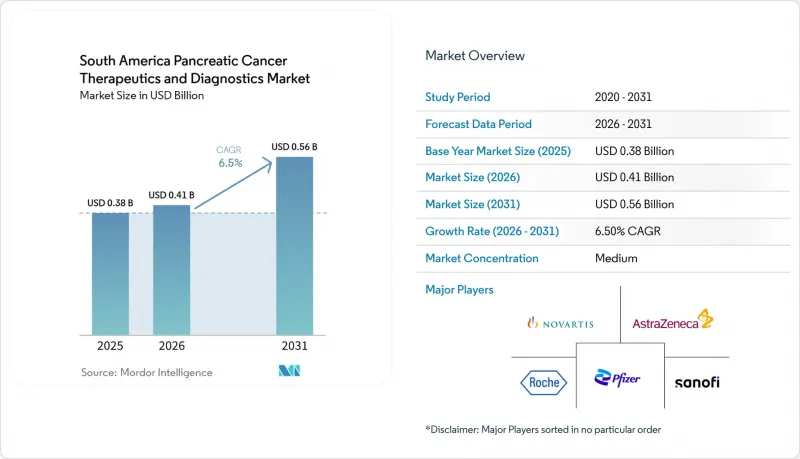
According to Mordor Intelligence, the South America pancreatic cancer therapeutics and Diagnostics Market size was valued at USD 0.38 billion in 2025 and is estimated to grow from USD 0.41 billion in 2026 to reach USD 0.56 billion by 2031, at a CAGR of 6.5% during the forecast period (2026-2031).
South America Pancreatic Cancer Therapeutics and Diagnostics Market Trends and Insights
Increasing Pancreatic Cancer Burden Accelerates Treatment Demand
The rising pancreatic cancer burden supported demand in the South American pancreatic cancer therapeutics and diagnostics market. A January 2025 analysis reported that Brazil's age-standardized incidence increased by 0.7% annually from 1990 to 2019 for both sexes, while Peru recorded the region's sharpest increase, at 3.0% to 3.9% annually. Brazil's annual case volume rose from 4,431 in 1990 to 14,430 in 2019, while Argentina recorded incidence rates of 12.7 per 100,000 men and 10.5 per 100,000 women, with rising mortality trends. INCA projected 10,980 new pancreatic cancer cases annually in Brazil during the 2023-2025 estimation period, highlighting the need to expand treatment capacity beyond metropolitan hospitals.
Expansion of Advanced Oncology Diagnostics Creates New Revenue Pools
Advanced diagnostics expanded beyond a limited number of metropolitan laboratories in the South American pancreatic cancer therapeutics and diagnostics market. Greater adoption of molecular testing linked diagnostic demand with targeted therapy approvals, as each treatment target required reliable patient identification before prescribing decisions. Companion diagnostics became increasingly integral to treatment access rather than a standalone laboratory service. Centralized laboratory models improved sample logistics and reporting capabilities for hospitals outside major cancer centers, supporting diagnostic revenue growth through biomarker selection and genomic profiling.
High Cost of Multimodal Treatment and Molecular Testing Limits Addressable Volume
High treatment and testing costs restricted the addressable patient population in the South American pancreatic cancer therapeutics and diagnostics market. An ISPOR Europe 2025 analysis reported annual oncology treatment costs of USD 50,054 in Brazil and USD 1,992 in Argentina, compared with USD 134,933 in the United States. Public procurement limits and purchasing-power constraints reduced prices but did not ensure access to advanced therapies or molecular tests. Guardant360 was available through reference laboratories, including Diagnosticos do Brasil, but limited coverage mandates kept uptake concentrated among private-pay and supplemental-insurance patients.
Other drivers and restraints analyzed in the detailed report include:
- Rising Use of Combination Chemotherapy Regimens Sustains Therapeutic Market
- Growth of Precision Oncology and Biomarker Testing Unlocks Targeted Therapy Access
- Late Diagnosis and Limited Resectability at Presentation Compresses Therapeutic Opportunity
For complete list of drivers and restraints, kindly check the Table Of Contents.
Segment Analysis
Diagnostic modalities are the fastest-growing product category in the South America pancreatic cancer therapeutics and diagnostics market, with a CAGR of 7.55% during 2026-2031. Therapeutics remains the larger revenue-generating category due to the widespread use of systemic treatment in advanced disease management. CT, MRI, and PET remain the highest-volume tools for staging and treatment monitoring, while high-volume centers in Sao Paulo, Buenos Aires, and Bogota increasingly use endoscopic ultrasound. Biomarker testing and molecular diagnostics are expanding as treatment selection relies more heavily on genomic information; the February 2025 DNBSEQ-G400 deployment supported 1,000 somatic and germline samples per month.
The diagnostics segment benefits from the wider adoption of centralized testing services and trial-led liquid biopsy development. The mirPANC 2 and BLENTI studies in Brazil supported liquid biopsy evidence generation, while the Panuri study began in June 2026 to assess a urine proteolytic-enzyme test for pancreatic ductal adenocarcinoma detection. Therapeutic demand remains anchored in FOLFIRINOX and gemcitabine plus nab-paclitaxel, while olaparib is relevant for the 4%-7% of patients with germline BRCA mutations and pembrolizumab for the rare MSI-H subset. Immunotherapy remains limited by the immunosuppressive pancreatic tumor microenvironment, while radiotherapy is constrained by limited stereotactic body radiotherapy capacity outside major academic centers; ImmunityBio updated its Phase 1 neoadjuvant chemoimmunotherapy protocol in April 2026.
Complete Report Scope:
- By Product
- Therapeutic Modality
- Chemotherapy
- Targeted Therapy
- Immunotherapy
- Radiotherapy
- Combination Therapy
- Diagnostic Modality
- Imaging (CT, MRI, PET)
- Endoscopic Ultrasound (EUS)
- Biomarker Tests
- Liquid Biopsy
- Molecular Diagnostics
- Therapeutic Modality
- By End User
- Hospitals & Academic Medical Centers
- Oncology Specialty Clinics
- Diagnostic Laboratories
- Research Institutes
- By Geography
- Brazil
- Argentina
- Colombia
- Chile
- Peru
- Rest of South America
List of Companies Covered in this Report:
- Astellas Pharma
- AstraZeneca
- Bio-Rad Laboratories
- Bristol-Myers Squibb
- Daiichi Sankyo
- Eli Lilly and Company
- Roche
- GE HealthCare Technologies Inc.
- Guardant Health, Inc.
- Illumina
- Ipsen
- Koninklijke Philips
- Merck Sharp & Dohme LLC
- Myriad Genetics
- Novartis
- Pfizer
- QIAGEN
- Sanofi
- Siemens Healthineers
- Thermo Fisher Scientific
Additional Benefits:
- The market estimate (ME) sheet in Excel format
- 3 months of analyst support
TABLE OF CONTENTS
1 INTRODUCTION
- 1.1 Study Assumptions and Market Definition
- 1.2 Scope of the Study
2 RESEARCH METHODOLOGY
3 EXECUTIVE SUMMARY
4 MARKET LANDSCAPE
- 4.1 Market Overview
- 4.2 Market Drivers
- 4.2.1 Increasing Pancreatic Cancer Burden
- 4.2.2 Expansion of Advanced Oncology Diagnostics
- 4.2.3 Rising Use of Combination Chemotherapy Regimens
- 4.2.4 Growth of Precision Oncology and Biomarker Testing
- 4.2.5 Centralization of Complex Pancreatic Cancer Care
- 4.2.6 Expansion of Clinical Trial Activity in South America
- 4.3 Market Restraints
- 4.3.1 High Cost of Multimodal Treatment and Molecular Testing
- 4.3.2 Late Diagnosis and Limited Resectability at Presentation
- 4.3.3 Public-System Budget Constraints and Unequal Treatment Access
- 4.3.4 Fragmented Tissue-to-Genomics Logistics Outside Major Hubs
- 4.4 Value/Supply-Chain Analysis
- 4.5 Regulatory Landscape
- 4.6 Technological Outlook
- 4.7 Porter's Five Forces Analysis
- 4.7.1 Threat of New Entrants
- 4.7.2 Bargaining Power of Suppliers
- 4.7.3 Bargaining Power of Buyers
- 4.7.4 Threat of Substitutes
- 4.7.5 Competitive Rivalry
5 MARKET SIZE AND GROWTH FORECASTS (VALUE, USD)
- 5.1 By Product
- 5.1.1 Therapeutic Modality
- 5.1.1.1 Chemotherapy
- 5.1.1.2 Targeted Therapy
- 5.1.1.3 Immunotherapy
- 5.1.1.4 Radiotherapy
- 5.1.1.5 Combination Therapy
- 5.1.2 Diagnostic Modality
- 5.1.2.1 Imaging (CT, MRI, PET)
- 5.1.2.2 Endoscopic Ultrasound (EUS)
- 5.1.2.3 Biomarker Tests
- 5.1.2.4 Liquid Biopsy
- 5.1.2.5 Molecular Diagnostics
- 5.1.1 Therapeutic Modality
- 5.2 By End User
- 5.2.1 Hospitals & Academic Medical Centers
- 5.2.2 Oncology Specialty Clinics
- 5.2.3 Diagnostic Laboratories
- 5.2.4 Research Institutes
- 5.3 By Geography
- 5.3.1 Brazil
- 5.3.2 Argentina
- 5.3.3 Colombia
- 5.3.4 Chile
- 5.3.5 Peru
- 5.3.6 Rest of South America
6 COMPETITIVE LANDSCAPE
- 6.1 Market Concentration
- 6.2 Market Share Analysis
- 6.3 Company Profiles (includes Global Level Overview, Market Level Overview, Core Segments, Financials as available, Strategic Information, Market Rank/Share, Products and Services, Recent Developments)
- 6.3.1 Astellas Pharma Inc.
- 6.3.2 AstraZeneca PLC
- 6.3.3 Bio-Rad Laboratories, Inc.
- 6.3.4 Bristol-Myers Squibb Company
- 6.3.5 Daiichi Sankyo Company, Limited
- 6.3.6 Eli Lilly and Company
- 6.3.7 F. Hoffmann-La Roche Ltd
- 6.3.8 GE HealthCare Technologies Inc.
- 6.3.9 Guardant Health, Inc.
- 6.3.10 Illumina, Inc.
- 6.3.11 Ipsen Pharma
- 6.3.12 Koninklijke Philips N.V.
- 6.3.13 Merck Sharp & Dohme LLC
- 6.3.14 Myriad Genetics, Inc.
- 6.3.15 Novartis AG
- 6.3.16 Pfizer Inc.
- 6.3.17 QIAGEN N.V.
- 6.3.18 Sanofi
- 6.3.19 Siemens Healthineers AG
- 6.3.20 Thermo Fisher Scientific Inc.
7 MARKET OPPORTUNITIES AND FUTURE OUTLOOK
- 7.1 White-Space and Unmet-Need Assessment

