PUBLISHER: Mordor Intelligence | PRODUCT CODE: 2154778

PUBLISHER: Mordor Intelligence | PRODUCT CODE: 2154778
South America Meglitinide - Market Share Analysis, Industry Trends & Statistics, Growth Forecasts (2026 - 2031)
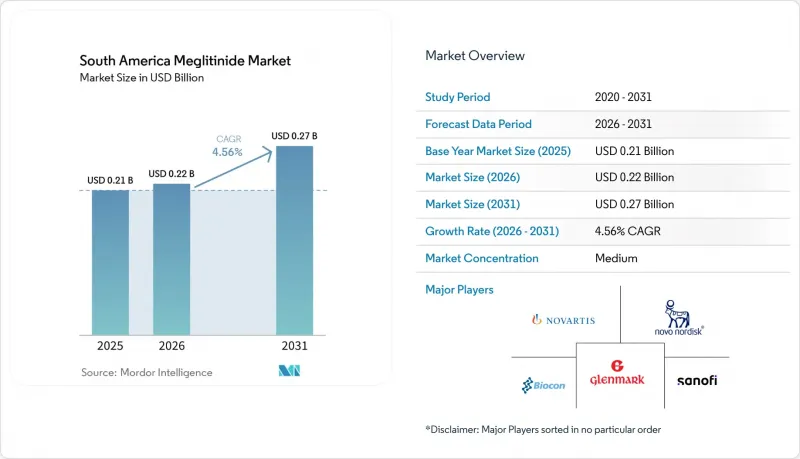
According to Mordor Intelligence, the South America meglitinide market size was valued at USD 0.21 billion in 2025 and is estimated to grow from USD 0.22 billion in 2026 to reach USD 0.27 billion by 2031, at a CAGR of 4.56% during the forecast period (2026-2031).
South America Meglitinide Market Trends and Insights
Expanding Type 2 Diabetes Treatment Pool
South America's diabetes burden provides a substantial demand base for the South America meglitinide market. The region had 35.4 million adults with diabetes in 2024, and the total is projected to reach 52 million by 2050. Brazil accounted for 17.0 million cases, while Argentina had 4.3 million cases and an age-standardized prevalence of 14%. As 30.4% of regional cases were undiagnosed in 2024, expanded screening can increase the treatment pool. Diabetes-related health expenditure reached USD 81 billion in 2024, underscoring the scale of healthcare demand.
Meal-Time Flexibility and Short-Acting Alternatives
Meglitinides support patients with irregular eating patterns by stimulating insulin release in response to meals. This flexibility benefits shift workers, informal workers, and older adults with variable meal schedules. Nateglinide has a faster onset of action and a lower hypoglycemia risk than repaglinide, supporting its use in selected private specialist settings. Colombia's 2025 clinical guideline recognized meal-related glucose excursions as a treatment consideration, sustaining a limited role for meglitinides when first-line therapy is unsuitable or insufficient.
Non-Incorporation in Brazil's Sistema Unico de Saude Treatment Protocol
Brazil's public health system shapes access in the South America meglitinide market, as SUS covers 76% of the population. The February 2026 PCDT DM2 update listed metformin, gliclazide, glibenclamide, dapagliflozin, and insulin analogs but excluded meglitinides. Repaglinide also remained outside RENAME 2024 and lacked support under Santa Catarina's state dispensing protocol, limiting demand primarily to private retail pharmacies and supplementary insurance channels. The absence of routine public reimbursement increases patient cost exposure and demand volatility, while the 2026 Brazilian Diabetes Society guidance prioritized gliclazide MR among secretagogues.
Other drivers and restraints analyzed in the detailed report include:
- Generic Price Accessibility
- Local Registration and Supply-Chain Localization
- Therapeutic Substitution by Newer Antidiabetic Classes
For complete list of drivers and restraints, kindly check the Table Of Contents.
Segment Analysis
Repaglinide held 65.12% of the South America meglitinide market in 2025, supported by its long-standing registration history and broad generic base in Brazil. EMS S.A. and Glenmark Farmaceutica market repaglinide products in Brazil through distinct brands and retail channels. The 1 mg and 2 mg formulations have broad availability across pharmacy chains, supporting treatment continuity for patients and prescribers familiar with the molecule. Its established market presence and lower cost in private pharmacies reinforce its position despite guidelines favoring other drug classes for patients with specific comorbidities.
Nateglinide is forecast to be the fastest-growing drug type, expanding at a CAGR of 6.89% from 2026 to 2031. Its faster insulin secretion profile and lower hypoglycemia risk relative to repaglinide support use among some older patients and those with cardiovascular comorbidities. Endocrinologists in private practice may prefer nateglinide for patients taking multiple medications who require a lower interaction burden. Novartis AG's Starlix brand, licensed from KISSEI Pharmaceutical, maintains visibility in specialist centers and hospital pharmacies, creating a two-track market alongside repaglinide's broad generic retail presence.
Complete Report Scope:
- By Drug Type
- Repaglinide
- Nateglinide
- Other Meglitinide
- By Dosage Form
- Immediate-Release Tablets
- Fixed-Strength Tablets
- Combination and Co-Prescribed Regimens
- By Distribution Channel
- Retail Pharmacies
- Hospital Pharmacies
- Online Pharmacies
- By Geography
- Brazil
- Argentina
- Colombia
- Chile
- Peru
- Rest of South America
List of Companies Covered in this Report:
- Ache Laboratorios Farmaceuticos S.A.
- Biocon
- Boehringer Ingelheim
- Eli Lilly and Company
- EMS S.A.
- Eurofarma Laboratorios S.A.
- Fundacao para o Remedio Popular - FURP
- Glenmark Pharmaceuticals
- Hypera S.A.
- KISSEI PHARMACEUTICAL CO., LTD.
- Lupin
- Merck
- Novartis
- Novo Nordisk
- Pfizer
- Sandoz Group AG
- Sanofi
- Teva Pharmaceutical Industries
- Torrent Pharmaceuticals Limited
- Viatris
Additional Benefits:
- The market estimate (ME) sheet in Excel format
- 3 months of analyst support
TABLE OF CONTENTS
1 INTRODUCTION
- 1.1 Study Assumptions and Market Definition
- 1.2 Scope of the Study
2 RESEARCH METHODOLOGY
3 EXECUTIVE SUMMARY
4 MARKET LANDSCAPE
- 4.1 Market Overview
- 4.2 Market Drivers
- 4.2.1 Expanding Type 2 Diabetes Treatment Pool
- 4.2.2 Demand for Meal-Time Glycemic Flexibility
- 4.2.3 Generic Price Accessibility
- 4.2.4 Local Registration and Supply-Chain Localization
- 4.2.5 Prescriber Need for Short-Acting Alternatives in Irregular Meal Patterns
- 4.3 Market Restraints
- 4.3.1 Non-Incorporation in Brazils Sistema Unico de Saude Treatment Protocol
- 4.3.2 Therapeutic Substitution by Metformin, Sulfonylureas, SGLT2 Inhibitors, DPP-4 Inhibitors, and Insulin
- 4.3.3 Limited Public Evidence on Local Meglitinide Utilization and Reimbursement
- 4.4 Value/Supply-Chain Analysis
- 4.5 Regulatory Landscape
- 4.6 Technological Outlook
- 4.7 Porter's Five Forces Analysis
- 4.7.1 Threat of New Entrants
- 4.7.2 Bargaining Power of Active Pharmaceutical Ingredient Suppliers
- 4.7.3 Bargaining Power of Buyers
- 4.7.4 Threat of Substitutes
- 4.7.5 Rivalry Among Existing Competitors
5 MARKET SIZE AND GROWTH FORECASTS
- 5.1 By Drug Type
- 5.1.1 Repaglinide
- 5.1.2 Nateglinide
- 5.1.3 Other Meglitinide
- 5.2 By Dosage Form
- 5.2.1 Immediate-Release Tablets
- 5.2.2 Fixed-Strength Tablets
- 5.2.3 Combination and Co-Prescribed Regimens
- 5.3 By Distribution Channel
- 5.3.1 Retail Pharmacies
- 5.3.2 Hospital Pharmacies
- 5.3.3 Online Pharmacies
- 5.4 By Geography
- 5.4.1 Brazil
- 5.4.2 Argentina
- 5.4.3 Colombia
- 5.4.4 Chile
- 5.4.5 Peru
- 5.4.6 Rest of South America
6 COMPETITIVE LANDSCAPE
- 6.1 Market Concentration
- 6.2 Market Share Analysis
- 6.3 Company Profiles (includes Global Level Overview, Market Level Overview, Core Segments, Financials as available, Strategic Information, Market Rank/Share, Products and Services, Recent Developments)
- 6.3.1 Ache Laboratorios Farmaceuticos S.A.
- 6.3.2 Biocon Limited
- 6.3.3 Boehringer Ingelheim International GmbH
- 6.3.4 Eli Lilly and Company
- 6.3.5 EMS S.A.
- 6.3.6 Eurofarma Laboratorios S.A.
- 6.3.7 Fundacao para o Remedio Popular - FURP
- 6.3.8 Glenmark Pharmaceuticals Limited
- 6.3.9 Hypera S.A.
- 6.3.10 KISSEI PHARMACEUTICAL CO., LTD.
- 6.3.11 Lupin Limited
- 6.3.12 Merck & Co., Inc.
- 6.3.13 Novartis AG
- 6.3.14 Novo Nordisk A/S
- 6.3.15 Pfizer Inc.
- 6.3.16 Sandoz Group AG
- 6.3.17 Sanofi
- 6.3.18 Teva Pharmaceutical Industries Ltd.
- 6.3.19 Torrent Pharmaceuticals Limited
- 6.3.20 Viatris Inc.
7 MARKET OPPORTUNITIES AND FUTURE OUTLOOK
- 7.1 White-Space and Unmet-Need Assessment

