PUBLISHER: Mordor Intelligence | PRODUCT CODE: 2154811

PUBLISHER: Mordor Intelligence | PRODUCT CODE: 2154811
Injector Springs For Hydrogen Engine - Market Share Analysis, Industry Trends & Statistics, Growth Forecasts (2026 - 2031)
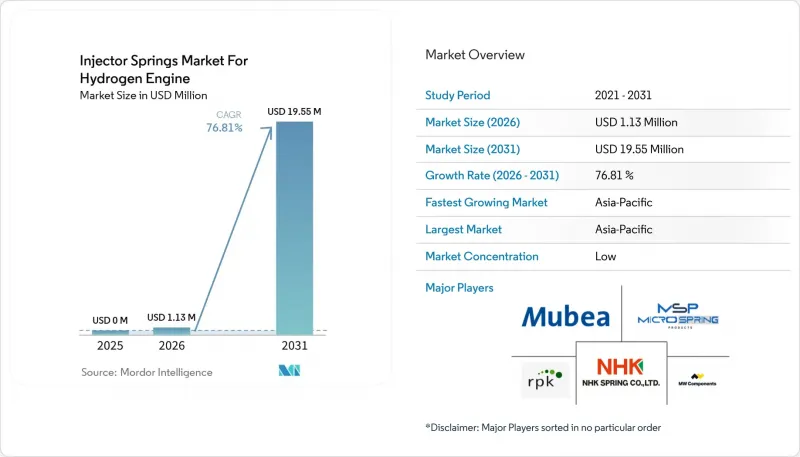
According to Mordor Intelligence, the injector springs market for hydrogen engine industry size is projected to be USD 1.13 million in 2026, and reach USD 19.55 million by 2031, growing at a CAGR of 76.81% from 2026 to 2031.
Insights and Trends of Injector Springs Market For Hydrogen Engine
Expansion of Hydrogen Combustion Fleets and Qualification Orders
The hydrogen engine injector springs market is supported by the transition from funded demonstrations to daily commercial operations. IAV and DEUTZ placed 2 road-approved 18-ton trucks into logistics work at DEUTZ and BMW facilities in March 2026. Southwest Research Institute completed development of a spark-ignited, medium-duty hydrogen engine with diesel-equivalent torque in August 2026. These developments place injector components within active vehicle development programs. Spring suppliers must enter qualification programs before fleet deployment reaches scale. Injector durability validation can require 12 to 18 months before series procurement. The hydrogen engine injector springs market can therefore receive qualification orders before fleets create a meaningful replacement cycle.
High-Pressure Direct Injection Raises Injector Spring Duty
Hydrogen direct-injection systems operate at 30 to 200 bar, depending on the injection strategy. Higher pressure can improve combustion control, but it also increases the mechanical demands placed on the injector return spring. A 2025 study of cam-driven outward-opening hydrogen injectors found that stiffness of 160 to 200 N/mm and preload of 560 to 600 N govern valve-lift behavior. The study attributed 5.4% of injection quantity variation to spring stiffness and 30% to preload force. In the hydrogen engine injector springs market, tolerance control becomes part of fuel-metering performance rather than a secondary component attribute. Higher rail pressures also raise the importance of material purity, surface treatment, and fatigue validation.
Limited Commercial Engine Volume Delays Replacement Demand
The hydrogen engine injector springs market begins from an effectively zero 2025 base, which makes its forecast sensitive to fleet deployment schedules. Most near-term demand comes from prototypes and qualification orders instead of replacement components. Hydrogen truck programs are beginning to enter road use, but broad fleet adoption is still developing. IAV and DEUTZ's March 2026 delivery shows that hydrogen combustion trucks have entered daily logistics service in Germany. Volvo plans a commercial European launch for its hydrogen combustion trucks before 2030. Replacement demand will lag original equipment demand because injectors must complete long service intervals before being replaced. Fleet fuel costs and refueling availability can also determine whether prototype activity becomes recurring component volume.
Other drivers and restraints analyzed in the detailed report include:
- Hydrogen-Compatible Materials and Production Reuse Improve Readiness
- Asian Localization Broadens the Supply Base
- Hydrogen Exposure and Validation Costs Limit Qualification Speed
For complete list of drivers and restraints, kindly check the Table Of Contents.
Segment Analysis
Multi-layer springs record the fastest growth within the type segment at an 89.7% CAGR through 2031. Their ability to provide tunable stiffness within a limited axial space suits outward-opening hydrogen injectors. The hydrogen engine injector springs market requires designs that counter needle lift against rail pressure and back pressure. The 2025 injector study showed that stiffness and preload together influence injection quantity variation. This relationship makes repeatable geometry and force control important selection criteria. Multi-layer designs can address the packaging limits of advanced injector bodies. They also give manufacturers a route to tailor force response without enlarging the injector package.
Coil springs remain the conventional choice for port-injection systems and lower-duty hydrogen applications. They can retain relevance where rail pressures remain within validated diesel-derived limits. Belleville and disc springs serve different roles, including sealing and preload within injector body assemblies. Disc springs are also used in electrolyzers and stationary fuel-cell stack assemblies because they combine compact dimensions with high stiffness. The hydrogen engine injector springs industry can draw on this wider hydrogen equipment experience as suppliers serve several related applications. Type selection will remain linked to injection pressure, available space, and the required actuation life.
Nickel alloys are the fastest-growing material segment at an 88.3% CAGR through 2031. The hydrogen engine injector springs market size for nickel-alloy applications is expanding because high-pressure direct injection places material reliability ahead of conventional cost priorities. Standard spring steels can face embrittlement risk when sustained stress and hydrogen partial pressure occur together. Inconel 718 showed hydrogen-related cracking and void formation under flame charging in 2025 testing. This evidence shows why tensile strength and corrosion resistance alone cannot establish fitness for hydrogen injector use. Material choice must reflect hydrogen diffusion, cyclic loading, and real operating conditions. Nickel-alloy specifications can therefore become a necessary qualification requirement for demanding injector programs.
Stainless steel retains a role in lower-stress configurations and port-injection designs. Its suitability declines as stress and hydrogen exposure rise within the injector. Precipitation-hardening steels can provide a middle ground for elevated-temperature spring duties where a different balance of performance and cost is needed. Advanced composites and hybrid materials remain early-stage options for nonmagnetic or weight-sensitive applications. Greater field history will be needed before these alternatives can support critical dynamic injector functions. Certification to spring-material standards can raise the entry threshold for suppliers that currently serve conventional fuel systems. The strongest material programs will combine laboratory evidence with component-level durability testing.
Complete Report Scope:
- By Type
- Coil Springs
- Belleville / Disc Springs
- Multi-layer Springs
- By Material
- Stainless Steel
- Nickel Alloys
- Precipitation Hardening Steels
- Advanced Composites & Hybrids
- By Coating/Surface Treatment
- PVD/CVD Hard Coatings
- Nitriding & Nitrocarburizing
- Ceramic & DLC Coatings
- Shot Peening & Residual Stress Treatments
- By Application
- On-road Hydrogen Engines
- Off-road Hydrogen Engines
- Stationary Hydrogen Power Systems
- By End-user
- Automotive OEMs
- Heavy-duty Engine Manufacturers
- Industrial Engine OEMs
- Hydrogen Power System Integrators
- By Geography
- North America
- United States
- Canada
- Mexico
- Europe
- United Kingdom
- Germany
- France
- Spain
- Nordic Countries
- Russia
- Rest of Europe
- Asia-Pacific
- China
- India
- Japan
- South Korea
- ASEAN Countries
- Rest of Asia-Pacific
- South America
- Brazil
- Argentina
- Colombia
- Rest of South America
- Middle East and Africa
- United Arab Emirates
- Saudi Arabia
- South Africa
- Egypt
- Rest of Middle East and Africa
- North America
Geography Analysis
North America is an important research base for the hydrogen engine injector springs market. Southwest Research Institute completed a medium-duty spark-ignited hydrogen engine with diesel-equivalent torque in August 2026. The program validates the technical path for hydrogen combustion in U.S. commercial vehicles. Toyota Hydrogen Solutions also achieved fuel-cell certifications for commercial stationary units that can support 1 MW generators in April 2026. Canada and Mexico can participate through supply-chain links with U.S. engine and spring producers. Near-term component orders will depend on the conversion of development programs into fleet deployment.
Europe is the most active regulatory setting for the hydrogen engine injector springs market. Euro 7 applies to new heavy-duty vehicle models from May 2028 and establishes extended lifetime emissions performance requirements. IAV and DEUTZ began daily logistics work with hydrogen trucks in Germany during March 2026. Daimler Truck and KEYOU target a 2027 European launch for the HICE.40. Volvo Trucks has begun road testing and plans commercial availability before 2030. The region gives suppliers a clear but demanding route from demonstration vehicles to platform approval.
Asia-Pacific records the fastest regional growth at a 99.2% CAGR through 2031. Japan's hydrogen programs support hardware development across transport and marine uses. The 2025 land-based marine hydrogen-engine operation brought together Kawasaki Heavy Industries, Yanmar Power Solutions, and Japan Engine Corporation. China's policy goal of 40% new-energy heavy-truck penetration by 2030 broadens the addressable environment for component suppliers. India's hydrogen localization effort can create opportunities for domestic engine and precision-component production. South America and the Middle East and Africa remain early-stage markets within the forecast period. Their long-term potential is tied to hydrogen infrastructure and commercial-vehicle deployment.
- Barnes Group Inc.
- Lee Spring
- Microspring Products
- Mubea
- MW Components
- NHK Spring Co., Ltd.
- RPK, S. Coop.
- SCHERDEL GmbH
Additional Benefits:
- The market estimate (ME) sheet in Excel format
- 3 months of analyst support
TABLE OF CONTENTS
1 INTRODUCTION
- 1.1 Study Assumptions and Market Definition
- 1.2 Scope of the Study
2 RESEARCH METHODOLOGY
3 EXECUTIVE SUMMARY
4 MARKET LANDSCAPE
- 4.1 Market Overview
- 4.2 Market Drivers
- 4.2.1 Expansion of Hydrogen Internal-Combustion Engines in Heavy-Duty and Off-Highway Fleets
- 4.2.2 High-Pressure Direct Injection Increasing Injector Spring Duty Cycles
- 4.2.3 Hydrogen-Compatible Spring Materials and Coatings Improving Injector Service Life
- 4.2.4 Reuse of Established Engine Manufacturing Capacity for Hydrogen Powertrains
- 4.2.5 Hydrogen Engine Demonstration Fleets Converting Prototype Demand Into Qualification Orders
- 4.2.6 Localization Mandates Accelerating Precision Spring Manufacturing in Asia
- 4.3 Market Restraints
- 4.3.1 Limited Commercial Volume of Hydrogen Engines and Replacement Injectors
- 4.3.2 Hydrogen-Induced Embrittlement and Premature Fracture in High-Strength Spring Steels
- 4.3.3 Dry Hydrogen, Galling, and Poor Internal Lubricity Increasing Failure Risk
- 4.3.4 High Validation Cost for Multi-Billion-Cycle Injector Durability
- 4.4 Supply-Chain Analysis
- 4.5 Porter's Five Forces Analysis
- 4.5.1 Bargaining Power of Suppliers
- 4.5.2 Bargaining Power of Buyers
- 4.5.3 Threat of New Entrants
- 4.5.4 Threat of Substitutes
- 4.5.5 Competitive Rivalry
- 4.6 Technology Outlook
- 4.7 Regulatory Landscape
- 4.8 Investment Analysis
5 MARKET SIZE AND GROWTH FORECASTS
- 5.1 By Type
- 5.1.1 Coil Springs
- 5.1.2 Belleville / Disc Springs
- 5.1.3 Multi-layer Springs
- 5.2 By Material
- 5.2.1 Stainless Steel
- 5.2.2 Nickel Alloys
- 5.2.3 Precipitation Hardening Steels
- 5.2.4 Advanced Composites & Hybrids
- 5.3 By Coating/Surface Treatment
- 5.3.1 PVD/CVD Hard Coatings
- 5.3.2 Nitriding & Nitrocarburizing
- 5.3.3 Ceramic & DLC Coatings
- 5.3.4 Shot Peening & Residual Stress Treatments
- 5.4 By Application
- 5.4.1 On-road Hydrogen Engines
- 5.4.2 Off-road Hydrogen Engines
- 5.4.3 Stationary Hydrogen Power Systems
- 5.5 By End-user
- 5.5.1 Automotive OEMs
- 5.5.2 Heavy-duty Engine Manufacturers
- 5.5.3 Industrial Engine OEMs
- 5.5.4 Hydrogen Power System Integrators
- 5.6 By Geography
- 5.6.1 North America
- 5.6.1.1 United States
- 5.6.1.2 Canada
- 5.6.1.3 Mexico
- 5.6.2 Europe
- 5.6.2.1 United Kingdom
- 5.6.2.2 Germany
- 5.6.2.3 France
- 5.6.2.4 Spain
- 5.6.2.5 Nordic Countries
- 5.6.2.6 Russia
- 5.6.2.7 Rest of Europe
- 5.6.3 Asia-Pacific
- 5.6.3.1 China
- 5.6.3.2 India
- 5.6.3.3 Japan
- 5.6.3.4 South Korea
- 5.6.3.5 ASEAN Countries
- 5.6.3.6 Rest of Asia-Pacific
- 5.6.4 South America
- 5.6.4.1 Brazil
- 5.6.4.2 Argentina
- 5.6.4.3 Colombia
- 5.6.4.4 Rest of South America
- 5.6.5 Middle East and Africa
- 5.6.5.1 United Arab Emirates
- 5.6.5.2 Saudi Arabia
- 5.6.5.3 South Africa
- 5.6.5.4 Egypt
- 5.6.5.5 Rest of Middle East and Africa
- 5.6.1 North America
6 COMPETITIVE LANDSCAPE
- 6.1 Market Concentration
- 6.2 Strategic Moves
- 6.3 Market Share Analysis
- 6.4 Company Profiles (includes Global Level Overview, Market Level Overview, Core Segments, Financials as available, Strategic Information, Market Rank/Share, Products and Services, Recent Developments)
- 6.4.1 Barnes Group Inc.
- 6.4.2 Lee Spring
- 6.4.3 Microspring Products
- 6.4.4 Mubea
- 6.4.5 MW Components
- 6.4.6 NHK Spring Co., Ltd.
- 6.4.7 RPK, S. Coop.
- 6.4.8 SCHERDEL GmbH
7 MARKET OPPORTUNITIES AND FUTURE OUTLOOK
- 7.1 White-Space and Unmet-Need Assessment

