PUBLISHER: Mordor Intelligence | PRODUCT CODE: 2154823

PUBLISHER: Mordor Intelligence | PRODUCT CODE: 2154823
Germany Autonomous Agricultural Tractors - Market Share Analysis, Industry Trends & Statistics, Growth Forecasts (2026 - 2031)
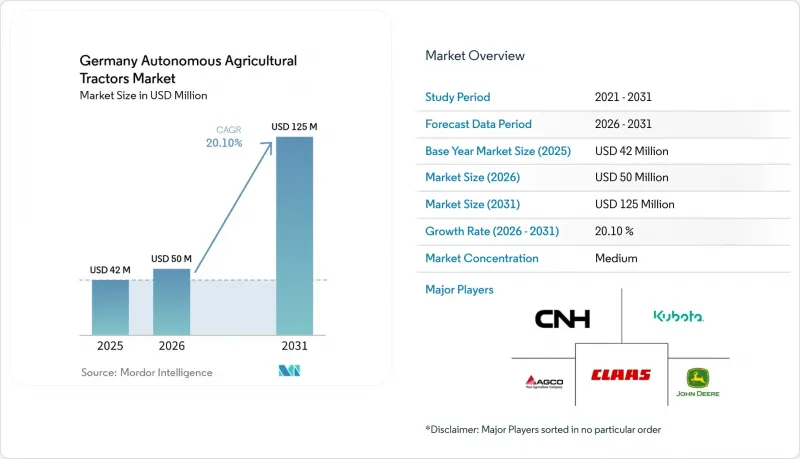
According to Mordor Intelligence, the Germany autonomous agricultural tractors market size was valued at USD 42 million in 2025 and is estimated to grow from USD 50 million in 2026 to reach USD 125 million by 2031, at a CAGR of 20.10% during the forecast period (2026-2031).
Germany Autonomous Agricultural Tractors Market Trends and Insights
Farm Labor Shortages and Skilled Operator Scarcity
Agricultural employment in Germany declined by 3,000 workers, or 0.5%, to 562,000 in 2025, continuing the downward trend in the agricultural workforce and increasing pressure to complete fieldwork with fewer available operators. The average farmer age is 56, as reported by the Federal Statistical Office (Destatis). Seasonal labor remains important during peak planting and harvest periods. Autonomous tractors can help farms complete routine tasks when skilled operators are unavailable, with the greatest benefit achieved when one supervisor oversees multiple machines across defined field areas. Fraunhofer IVI identifies multi-machine coordination as a means of reducing labor input per hectare. Contractors can apply this model to deliver services across multiple farms within short seasonal windows. These factors support demand in the Germany autonomous agricultural tractors market, particularly on larger arable farms.
Precision Agriculture and Connected Guidance Stack Adoption
Many German farms already use guidance systems, digital records, and connected implements. These tools provide a practical foundation for autonomous operation, as field boundaries and work records are already digitized. ISOBUS-enabled implements also reduce the integration work required for automated field tasks. Farms with existing digital field management can evaluate autonomous systems using their current operating data. Open telematics and interoperable platforms are important for mixed fleets. The EU Data Act is relevant to the broader discussion of access to and use of machine data. This established technology base shortens the transition from assisted guidance to supervised autonomy, supporting adoption in the Germany autonomous agricultural tractors market without requiring farms to change all operating processes at once.
High Acquisition Cost Limits Reach Beyond Large Enterprises
A fully autonomous system requires sensors, computing hardware, integration work, and safety validation. These costs make it difficult to justify a new system for farms below 200 hectares. The equipment adds EUR 30,000 to EUR 80,000 (USD 34,200 to USD 91,200) to the base tractor cost. Germany had 255,000 agricultural holdings in the cited dataset, many of which operated below 100 hectares. Utilization levels at these holdings may not support a direct purchase. Service contracts and leasing can reduce the upfront cost. Lower-cost retrofit options may also help, but they do not eliminate the costs of training, connectivity, and support. This remains a central constraint on the Germany autonomous agricultural tractors market.
Other drivers and restraints analyzed in the detailed report include:
- Government Support for Smart and Low-Emission Farm Equipment
- Productivity Gains From Continuous Field Operations and Multi-Machine Supervision
- Regulatory Ambiguity Delays Fully Unattended Deployment
For complete list of drivers and restraints, kindly check the Table Of Contents.
Segment Analysis
The 31 to 100 HP segment held 38.9% of the Germany autonomous agricultural tractors market in 2025. This power class supports a wide range of tillage, sowing, and crop-protection tasks and has a substantial installed base of guidance-enabled tractors, making it suitable for autonomy upgrades. These machines can be used across a wide range of field sizes and crop systems, making this segment a practical starting point for many autonomous deployments.
The above 100 HP category is forecast to grow at a 23.4% CAGR through 2031. Large arable operations in North and East Germany require high power for continuous tillage and drilling work. Deere & Company's autonomous 9RX targets this high-power use case and uses 16 cameras for machine perception. These tractors are more likely to travel between parcels, which raises type-approval considerations. The up to 30 HP category remains specialized, used primarily for narrow vineyard and orchard applications where low axle loads and compact dimensions are necessary.
Semi-autonomous systems held 64.0% of the Germany autonomous agricultural tractors market share in 2025. These systems automate guidance, turns, and implement functions while retaining an operator role. This operating model aligns with current farm practices and reduces the risk of adoption, while allowing operators to build familiarity with automated tasks. A 2026 study of German arable farmers found that robotic systems and smart machines had relatively low adoption readiness, with technological maturity and the degree of disruption among the most important evaluation criteria. Semi-autonomous equipment can help reduce perceived disruption by maintaining human oversight and allowing farmers to retain an active role in field operations.
Fully autonomous systems are forecast to grow at a 25.0% CAGR through 2031. The EU machinery framework provides a clearer compliance structure for supervised autonomy from 2027. In April 2026, CLAAS KGaA mbH announced that its XERION 12 would receive an AgXeed-developed Vehicle Control Unit, available from mid-2026 for driver-monitored automated field operations. This development moves premium tractors beyond assisted guidance. However, growth in this category will remain dependent on certification, connectivity, and operator confidence.
Complete Report Scope:
- By Horsepower
- Up to 30 HP
- 31 to 100 HP
- Above 100 HP
- By Automation Level
- Fully Autonomous
- Semi-Autonomous
- By Drive Type
- Diesel
- Hybrid
- Battery-Electric
- By Application
- Tillage
- Sowing
- Harvesting
- Orchard and Vineyard Operations
- By Component
- GPS and GNSS
- Sensors and Vision Systems
- LiDAR and Radar Modules
- Control and Navigation Software
- By Farm Size
- Small (Less than 100 ha)
- Medium (100-500 ha)
- Large (More than 500 ha)
List of Companies Covered in this Report:
- AGCO Corporation
- Deere & Company
- CNH Industrial N.V.
- CLAAS KGaA mbH
- Kubota Corporation
- SDF Group
- YANMAR HOLDINGS CO., LTD.
- Mahindra and Mahindra Limited
- TYM Corporation
- ZETOR TRACTORS a.s.
- ISEKI and Co., Ltd.
- J.C.Bamford Excavators Limited
- Monarch Tractor
- AgXeed B.V.
- NEXAT GmbH
Additional Benefits:
- The market estimate (ME) sheet in Excel format
- 3 months of analyst support
TABLE OF CONTENTS
1 Introduction
- 1.1 Study Assumptions and Market Definition
- 1.2 Scope of the Study
2 Research Methodology
3 Executive Summary
4 Market Landscape
- 4.1 Market Overview
- 4.2 Market Drivers
- 4.2.1 Farm labor shortages and skilled operator scarcity
- 4.2.2 Precision agriculture and connected guidance stack adoption
- 4.2.3 Government support for smart and low-emission farm equipment
- 4.2.4 Productivity gains from 24-hour field operations and multi-machine supervision
- 4.2.5 Retrofit autonomy kits and autonomy-ready tractor platforms
- 4.2.6 Specialty-crop mechanization in orchards and vineyards
- 4.3 Market Restraints
- 4.3.1 High acquisition cost limits reach beyond large enterprises
- 4.3.2 Regulatory ambiguity delays fully unattended deployment
- 4.3.3 Connectivity and positioning weaknesses reduce operating confidence
- 4.3.4 Mixed-fleet compatibility and service readiness still need work
- 4.4 Regulatory Landscape
- 4.5 Technological Outlook
- 4.6 Porter's Five Forces Analysis
- 4.6.1 Bargaining Power of Suppliers
- 4.6.2 Bargaining Power of Buyers
- 4.6.3 Threat of New Entrants
- 4.6.4 Threat of Substitutes
- 4.6.5 Intensity of Competitive Rivalry
5 Market Size And Growth Forecasts (Value)
- 5.1 By Horsepower
- 5.1.1 Up to 30 HP
- 5.1.2 31 to 100 HP
- 5.1.3 Above 100 HP
- 5.2 By Automation Level
- 5.2.1 Fully Autonomous
- 5.2.2 Semi-Autonomous
- 5.3 By Drive Type
- 5.3.1 Diesel
- 5.3.2 Hybrid
- 5.3.3 Battery-Electric
- 5.4 By Application
- 5.4.1 Tillage
- 5.4.2 Sowing
- 5.4.3 Harvesting
- 5.4.4 Orchard and Vineyard Operations
- 5.5 By Component
- 5.5.1 GPS and GNSS
- 5.5.2 Sensors and Vision Systems
- 5.5.3 LiDAR and Radar Modules
- 5.5.4 Control and Navigation Software
- 5.6 By Farm Size
- 5.6.1 Small (Less than 100 ha)
- 5.6.2 Medium (100-500 ha)
- 5.6.3 Large (More than 500 ha)
6 Competitive Landscape
- 6.1 Market Concentration
- 6.2 Strategic Moves
- 6.3 Market Share Analysis
- 6.4 Company Profiles (Includes Global Level Overview, Market Level Overview, Core Segments, Financials as Available, Strategic Information, Market Rank/Share, Products and Services, Recent Developments)
- 6.4.1 AGCO Corporation
- 6.4.2 Deere & Company
- 6.4.3 CNH Industrial N.V.
- 6.4.4 CLAAS KGaA mbH
- 6.4.5 Kubota Corporation
- 6.4.6 SDF Group
- 6.4.7 YANMAR HOLDINGS CO., LTD.
- 6.4.8 Mahindra and Mahindra Limited
- 6.4.9 TYM Corporation
- 6.4.10 ZETOR TRACTORS a.s.
- 6.4.11 ISEKI and Co., Ltd.
- 6.4.12 J.C.Bamford Excavators Limited
- 6.4.13 Monarch Tractor
- 6.4.14 AgXeed B.V.
- 6.4.15 NEXAT GmbH
7 Market Opportunities And Future Outlook

