PUBLISHER: Mordor Intelligence | PRODUCT CODE: 2155333

PUBLISHER: Mordor Intelligence | PRODUCT CODE: 2155333
South America Commercial Aircraft - Market Share Analysis, Industry Trends & Statistics, Growth Forecasts (2026 - 2031)
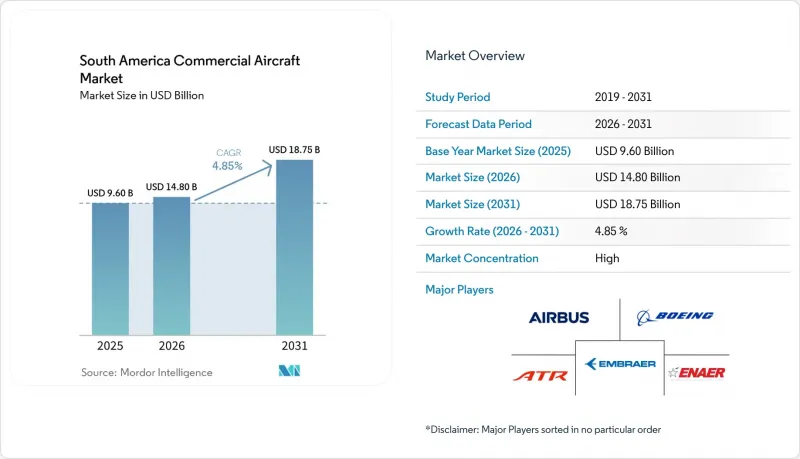
According to Mordor Intelligence, the South America commercial aircraft market size was valued at USD 9.60 billion in 2025 and is forecast to grow from USD 14.80 billion in 2026 to USD 18.75 billion by 2031, at a 4.85% CAGR during the forecast period (2026-2031).
South America Commercial Aircraft Market Trends and Insights
Fleet Replacement and Fuel-Efficiency Economics
Commercial airline fleets across South America entered a replacement cycle during 2025 and 2026. Airlines are retiring older narrowbody aircraft and adding newer, more fuel-efficient platforms. Abra Group announced a 246-aircraft commitment in October 2025, including A320neo, B737 MAX, A350, and A330neo aircraft. This order supports demand across the South America commercial aircraft market and gives the group greater certainty over future delivery positions. GE Aerospace expanded its Tres Rios maintenance operation after completing its 1,000th engine test in December 2025. Faster fleet replacement can reduce operating costs and strengthen airline competition on established domestic routes.
Newer aircraft also change the maintenance needs of regional operators. The growing installed base of LEAP-powered aircraft supports longer-term demand for engine repair capacity. Local maintenance capability can reduce the time and foreign-currency costs of sending engines overseas. Airlines still need sufficient airport slots and trained personnel before they can fully use new aircraft. These operating limits can delay the economic benefit from a new delivery. The South America commercial aircraft market therefore depends on fleet renewal and the supporting maintenance system progressing together.
Expansion of Low-Cost and Ultra-Low-Cost Networks
LCCs and ULCCs are expanding route networks across South America. These carriers use single-aisle fleets to offer lower fares and add service between large and secondary cities. JetSMART operated 56 A320neo and A321neo aircraft across its regional operating certificates in 2026. Its investment plan for Argentina covered 23 additional aircraft, 5 routes, and 300 jobs. Lower fares can attract travelers who previously did not use air transport. This approach broadens the demand base for the South America commercial aircraft market.
LCC networks also increase competition for capacity at major airports. Carriers need reliable access to airports, ground services, and operating slots to maintain high aircraft use. Brazil recorded 37 million departure seats in the first quarter of 2026, while Colombia recorded 16.4 million seats during the same period. These volumes show the importance of the two countries for airline network planning. The model favors aircraft that can serve dense routes with lower unit costs. It also supports further narrowbody deliveries as airlines seek fleet commonality and lower maintenance complexity.
Dollar-Denominated Costs Versus Local-Currency Revenues
Aircraft leases, fuel, and many maintenance contracts are priced in USD. Airline ticket revenue is largely earned in local currencies across South America. This mismatch creates pressure when domestic currencies weaken against the USD. LATAM reported USD 624 million in foreign-exchange hedging derivatives as of June 2026. Hedging can manage some exposure, but it does not remove currency risk. The South America commercial aircraft market can be affected when airlines delay orders or adjust delivery schedules to protect cash flow.
Currency exposure directly affects fleet planning. Airlines with weaker balance sheets may have limited capacity to commit to multiyear aircraft programs. Higher financing and lease costs can reduce the benefit of fuel-efficient aircraft. Carriers must balance lower operating costs from new fleets against the foreign-currency burden of acquiring them. This is particularly relevant in countries with volatile exchange rates. It also creates a competitive advantage for airline groups with stronger liquidity, diversified revenue, or established hedging programs.
Other drivers and restraints analyzed in the detailed report include:
- Connectivity Demand from Secondary Cities and Thin Routes
- Brazil-Led Regional Aerospace and Financing Ecosystem
- Airport and Air-Traffic-Control Bottlenecks
For complete list of drivers and restraints, kindly check the Table Of Contents.
Segment Analysis
Narrowbody aircraft held 79.34% of the South America commercial aircraft market share in 2025. Single-aisle aircraft are central to high-frequency domestic and regional routes. Their capacity suits the route structure of Brazil, Colombia, Chile, and Argentina. The A320 and B737 families remain important fleet platforms for major airline groups. Abra Group's aircraft commitment included large volumes of A320neo and B737 MAX aircraft. This demand reinforces the narrowbody position in the South America commercial aircraft market.
Regional jets are forecast to grow at a 5.45% CAGR from 2026 to 2031. Their smaller capacity allows airlines to serve underserved cities without relying on large aircraft. LATAM's planned E195-E2 route deployment illustrates this role in Brazil. Embraer's commercial aircraft backlog also indicates continuing demand for its regional platforms. Widebodies remain relevant for longer international routes, but they serve a more selective set of network needs. Airlines will continue to match aircraft size with route economics and airport conditions.
Passenger aircraft accounted for 96.89% of the South America commercial aircraft market in 2025. Passenger traffic was supported by rising regional travel and international connectivity. South America and Caribbean passenger traffic reached 477.30 million travelers in 2025. Passenger carriers need additional aircraft when load factors and network demand remain strong. The segment's 6.87% CAGR forecast through 2031 reflects this sustained central role. Most fleet orders are therefore directed to passenger service requirements.
Freighter aircraft represented a smaller part of the market, but cargo activity remains commercially important. Air cargo grew during 2025, with additional international tonnage concentrated in Brazil and Colombia. E-commerce, pharmaceuticals, and export corridors increase demand for time-sensitive air transport. Passenger aircraft can provide belly capacity on many routes. Dedicated freighters may be needed where cargo demand is concentrated or service timing is critical. Airlines are considering these needs when allocating aircraft across passenger and cargo networks.
Complete Report Scope:
- By Aircraft Type
- Narrowbody
- Widebody
- Regional Jets
- By Application
- Passenger
- Freighter
- By Propulsion Type
- Turbofan
- Turboprop
- By Component
- Airframe Structures
- Aero-Engines
- Avionics and Flight Control
- Cabin Interior and IFEC
- Other Components
- By Geography
- Brazil
- Argentina
- Colombia
- Chile
- Peru
- Rest of South America
List of Companies Covered in this Report:
- Aircraft OEMs
- Systems Manufacturers and Integrators
Additional Benefits:
- The market estimate (ME) sheet in Excel format
- 3 months of analyst support
TABLE OF CONTENTS
1 INTRODUCTION
- 1.1 Study Assumptions and Market Definition
- 1.2 Scope of the Study
2 RESEARCH METHODOLOGY
3 EXECUTIVE SUMMARY
4 MARKET LANDSCAPE
- 4.1 Market Overview
- 4.2 Market Drivers
- 4.2.1 Fleet replacement and fuel-efficiency economics
- 4.2.2 Expansion of LCC and ULCC networks
- 4.2.3 Connectivity demand from secondary cities and thin routes
- 4.2.4 Brazil-led regional aerospace and financing ecosystem
- 4.2.5 Rising middle-class and tourism air-travel demand
- 4.2.6 Air cargo and e-commerce network development
- 4.3 Market Restraints
- 4.3.1 Dollar-denominated costs versus local-currency revenues
- 4.3.2 Airport and air-traffic-control bottlenecks
- 4.3.3 Pilot, maintenance technician, and training capacity constraints
- 4.3.4 SAF availability and decarbonization compliance costs
- 4.4 Value Chain Analysis
- 4.5 Regulatory Landscape
- 4.6 Technological Outlook
- 4.7 Porter's Five Forces Analysis
5 MARKET SIZE AND GROWTH FORECASTS (VALUE)
- 5.1 By Aircraft Type
- 5.1.1 Narrowbody
- 5.1.2 Widebody
- 5.1.3 Regional Jets
- 5.2 By Application
- 5.2.1 Passenger
- 5.2.2 Freighter
- 5.3 By Propulsion Type
- 5.3.1 Turbofan
- 5.3.2 Turboprop
- 5.4 By Component
- 5.4.1 Airframe Structures
- 5.4.2 Aero-Engines
- 5.4.3 Avionics and Flight Control
- 5.4.4 Cabin Interior and IFEC
- 5.4.5 Other Components
- 5.5 By Geography
- 5.5.1 Brazil
- 5.5.2 Argentina
- 5.5.3 Colombia
- 5.5.4 Chile
- 5.5.5 Peru
- 5.5.6 Rest of South America
6 COMPETITIVE LANDSCAPE
- 6.1 Market Concentration
- 6.2 Strategic Moves
- 6.3 Market Share Analysis
- 6.4 Company Profiles (includes Global Level Overview, Market Level Overview, Core Segments, Financials as available, Strategic Information, Market Rank/Share, Products and Services, and Recent Developments)
- 6.4.1 Aircraft OEMs
- 6.4.1.1 Airbus SE
- 6.4.1.2 The Boeing Company
- 6.4.1.3 Embraer S.A.
- 6.4.1.4 Avions de Transport Regional GIE (ATR)
- 6.4.1.5 Textron Aviation Inc.
- 6.4.2 Systems Manufacturers and Integrators
- 6.4.2.1 GE Aerospace
- 6.4.2.2 Rolls-Royce Holdings PLC
- 6.4.2.3 Safran S.A.
- 6.4.2.4 Honeywell Aerospace Inc.
- 6.4.2.5 Empresa Nacional de Aeronautica de Chile (ENAER)
- 6.4.2.6 AerCap Holdings N.V.
- 6.4.1 Aircraft OEMs
7 MARKET OPPORTUNITIES AND FUTURE OUTLOOK
- 7.1 White-Space and Unmet-Need Assessment

