PUBLISHER: Mordor Intelligence | PRODUCT CODE: 2155337

PUBLISHER: Mordor Intelligence | PRODUCT CODE: 2155337
Rice Derivatives - Market Share Analysis, Industry Trends & Statistics, Growth Forecasts (2026 - 2031)
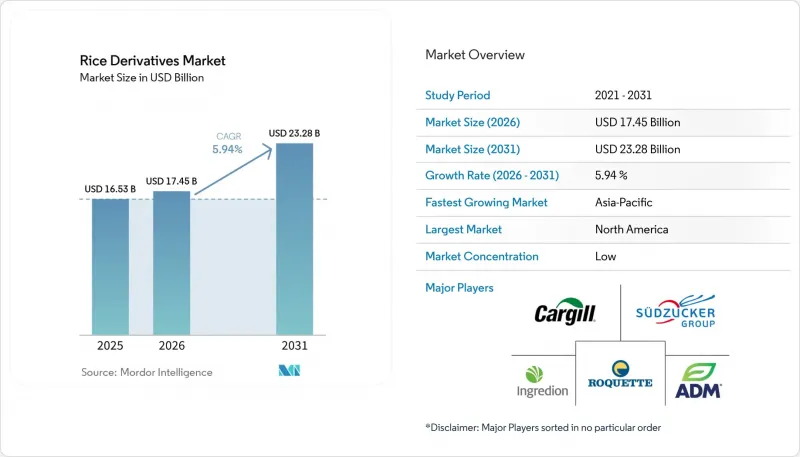
According to Mordor Intelligence, the rice derivatives market size was valued at USD 16.53 billion in 2025 to USD 17.45 billion in 2026, and is forecast to reach USD 23.28 billion by 2031 at a 5.94% CAGR over 2026-2031.
Global Rice Derivatives Market Trends and Insights
Rising Demand for Rice-Based Ingredients in Processed Foods
Ready-to-eat and minimally processed food products use rice starch and rice flour as binding and texturizing ingredients. According to an article published by Multidisciplinary Digital Publishing Institute (MDPI) in 2025, rice starch thickens, stabilizes, gels, and encapsulates ingredients in soups, sauces, puddings, and confectionery products. Its neutral color and mild taste also support its use in clear broths and infant foods. Large consumer packaged goods companies are incorporating rice flour into standard product lines, shifting procurement beyond specialty retail and generating more consistent bulk demand. Rice milling by-products also supply animal feed ingredients, particularly in Asia-Pacific, where processors can improve material utilization across each milling stream. This supply position enables the rice derivatives market to compete with wheat-based inputs in processed foods and encourages integrated processors to capture value from multiple outputs.
Expansion of Gluten-Free and Allergen-Free Products
The United States Food and Drug Administration provides allergen-labeling guidance that helps food manufacturers manage ingredient disclosure and reformulation decisions. Manufacturers use rice flour and rice starch in gluten-free bakery, snack, and infant nutrition formulations because these ingredients provide a familiar plant-based option with neutral sensory properties. Larger contracts can increase millers' volumes but may also pressure unit margins, favoring vertically integrated processors with reliable milling, testing, and logistics capabilities. The rice derivatives market is better positioned when processors combine scale with consistent specifications and customer support. In the European Union, rice is not among the 14 allergens requiring labeling under Regulation (EU) No. 1169/2011, as stated by European Union law in January 2025. This regulatory position supports the broader use of rice-based ingredients in allergen-friendly formulations and drives demand for high-purity ingredients that meet technical requirements.
Rapid Rancidity of Rice Bran Limits Storage Flexibility
Rice bran deteriorates rapidly after milling because lipase and lipoxygenase activity causes hydrolytic and oxidative rancidity. Small and mid-sized mills must either invest in stabilization equipment or accept lower value from the bran stream, a challenge that is particularly significant in price-sensitive producing regions. Cold plasma, ultra-high-pressure processing, and electron beam irradiation can extend shelf life under controlled conditions. However, capital requirements, equipment availability, and industrial scalability remain challenging for many mills in Asia. The rice derivatives market faces constraints in areas where milling infrastructure cannot preserve bran quality quickly enough for high-value downstream conversion.
Other drivers and restraints analyzed in the detailed report include:
- Growth of Functional, Nutraceutical, and Plant-Based Nutrition
- Expanding Industrial Applications for Rice Starch
- High Sensitivity of Rice Derivatives to Fluctuations in Rice and Energy Prices
For complete list of drivers and restraints, kindly check the Table Of Contents.
Segment Analysis
Rice starch accounted for 31.58% of the rice derivatives market size in 2025, making it the largest product type. Demand across food, pharmaceutical, and personal care applications supports its leading position. Its small granule size of 2-7 micrometers and high paste clarity enable its use in tablet molding and dusting applications. Rice flour supports gluten-free bakery products, infant nutrition, and convenience foods. Rice bran oil serves edible oil and nutraceutical applications, while rice syrup, rice bran wax, and rice germ oil remain smaller, specialized products.
Rice protein is projected to grow at a CAGR of 6.73% during 2026-2031, representing the fastest growth rate among product types. Its increasing use in sports nutrition, allergen-friendly infant products, and functional beverages supports this growth. Water-soluble rice protein enables its application in high-acid beverages, where conventional powdered proteins are unsuitable. Rising demand for clean-label and plant-based protein alternatives further drives its adoption across emerging food and beverage applications. The rice derivatives industry can benefit from investments in stabilization and oil extraction facilities near rice mills.
Powder accounted for 42.35% of category revenue in 2025, driven by its ease of handling, ambient shelf stability, and compatibility with dry-mixing and direct-compression processes. Manufacturers use powdered rice starch in precision-dosing pharmaceutical products and powdered rice protein in sports nutrition mixes and meal replacements. Powdered rice flour is well suited for bakery and snack products that require moisture control. Its established advantages in storage, transportation, and processing further support widespread industrial adoption. Growing demand for shelf-stable, convenient ingredient formats continues to reinforce the preference for powdered rice derivatives across end-use industries.
Liquid rice derivatives are projected to grow at a CAGR of 6.25% during the 2026-2031 forecast period. Liquid starch suspensions support wet-process paper applications by distributing through fibers differently than powdered slurries. Rice protein formulations for clear beverages also enable liquid products to enter ready-to-drink nutrition formats. Growing demand for convenient liquid formulations is expected to further expand their use across beverage and industrial applications. Granular products remain relevant for textile sizing, adhesives, and paper coatings. Other formats include modified and pre-gelatinized materials, which offer rapid hydration and cold-water dispersibility.
Complete Report Scope:
- By Product Type
- Rice Starch
- Rice Flour
- Rice Bran Oil
- Rice Protein
- Others
- By Form
- Powder
- Liquid
- Granular
- Others
- By Nature
- Organic
- Conventional
- By Distribution Channel
- Industrial
- Retail
- Supermarkets and Hypermarkets
- Online Retail
- Other Distribution Channels
- By Geography
- North America
- United States
- Canada
- Mexico
- Rest of North America
- Europe
- Germany
- United Kingdom
- Italy
- France
- Spain
- Netherlands
- Poland
- Belgium
- Sweden
- Rest of Europe
- Asia-Pacific
- China
- India
- Japan
- Australia
- Indonesia
- South Korea
- Thailand
- Singapore
- Rest of Asia-Pacific
- South America
- Brazil
- Argentina
- Colombia
- Chile
- Peru
- Rest of South America
- Middle East and Africa
- South Africa
- Saudi Arabia
- United Arab Emirates
- Nigeria
- Egypt
- Morocco
- Turkey
- Rest of Middle East and Africa
- North America
Geography Analysis
North America held 37.12% of regional revenue in 2025, the largest geographic share. The region has established food processing capabilities and strong demand for gluten-free, plant-based, and organic products. Large food manufacturers are incorporating rice flour into standard bakery, snack, and infant nutrition products. Rice protein is also used in ready-to-drink beverages, energy bars, and direct-to-consumer supplements. These applications extend demand beyond small specialty brands.
Europe sustains demand through premium consumer segments in Germany, France, the United Kingdom, the Netherlands, and Italy. Organic-certified rice starch and rice protein command higher prices than conventional products in these markets. Regulatory requirements for organic products further reinforce the importance of verified supply chains. South America combines local rice production with a developing food processing base, while the Middle East and Africa remain more dependent on imports for standard rice starch and flour. Food security programs and investments in agricultural supply chains could support future demand growth.
Asia-Pacific is projected to record the highest CAGR among all regions, at 7.24% during 2026-2031. The region benefits from abundant rice availability, expanding processing capacity, and government support for rice-based ingredients. China is expanding its rice starch and rice protein production capacity. Growing demand from the food, beverage, and animal feed industries is further strengthening regional processing capabilities and export opportunities. Improvements in processing infrastructure may also increase exports of bran-derived products from the region.
- Cargill, Incorporated
- Adani Wilmar Ltd.
- Ingredion Incorporated
- Sudzucker Group
- Archer Daniels Midland Company
- Roquette Freres
- Olam International
- BCL Industries
- Manildra Group
- Thai Flour Industry Co., Ltd.
- Sacchetto S.p.A.
- RIBUS, Inc.
- Agarwal Industries Pvt. Ltd.
- Riceland Foods, Inc.
- Ricela Group
- Tsuno Group Co., Ltd.
- King Rice Oil Group
- Ebro Ingredients
- Shafi Gluco Chem
- Producers Rice Mill
Additional Benefits:
- The market estimate (ME) sheet in Excel format
- 3 months of analyst support
TABLE OF CONTENTS
1 INTRODUCTION
- 1.1 Study Assumptions and Market Definition
- 1.2 Scope of the Study
2 RESEARCH METHODOLOGY
3 EXECUTIVE SUMMARY
4 MARKET LANDSCAPE
- 4.1 Market Overview
- 4.2 Market Drivers
- 4.2.1 Rising demand for rice based ingredients in processed foods
- 4.2.2 Expansion of gluten-free and allergen-free product expansion
- 4.2.3 Use of rice milling by-products in animal feed
- 4.2.4 Growth of functional, nutraceutical and plant-based nutrition growth
- 4.2.5 Industrial applications for rice starch
- 4.2.6 High-purity and customized ingredients
- 4.3 Market Restraints
- 4.3.1 Rapid rancidity of rice bran limits storage flexibility
- 4.3.2 High sensitivity of rice derivatives to fluctuations in rice and energy prices
- 4.3.3 Limited awareness of value-added products
- 4.3.4 Inconsistent milling by-product quality
- 4.4 Supply Chain Analysis
- 4.5 Regulatory Outlook
- 4.6 Porter's Five Forces Analysis
- 4.6.1 Threat of New Entrants
- 4.6.2 Bargaining Power of Buyers/Consumers
- 4.6.3 Bargaining Power of Suppliers
- 4.6.4 Threat of Substitute Products
- 4.6.5 Intensity of Competitive Rivalry
5 MARKET SIZE AND GROWTH FORECASTS (VALUE)
- 5.1 By Product Type
- 5.1.1 Rice Starch
- 5.1.2 Rice Flour
- 5.1.3 Rice Bran Oil
- 5.1.4 Rice Protein
- 5.1.5 Others
- 5.2 By Form
- 5.2.1 Powder
- 5.2.2 Liquid
- 5.2.3 Granular
- 5.2.4 Others
- 5.3 By Nature
- 5.3.1 Organic
- 5.3.2 Conventional
- 5.4 By Distribution Channel
- 5.4.1 Industrial
- 5.4.2 Retail
- 5.4.2.1 Supermarkets and Hypermarkets
- 5.4.2.2 Online Retail
- 5.4.2.3 Other Distribution Channels
- 5.5 By Geography
- 5.5.1 North America
- 5.5.1.1 United States
- 5.5.1.2 Canada
- 5.5.1.3 Mexico
- 5.5.1.4 Rest of North America
- 5.5.2 Europe
- 5.5.2.1 Germany
- 5.5.2.2 United Kingdom
- 5.5.2.3 Italy
- 5.5.2.4 France
- 5.5.2.5 Spain
- 5.5.2.6 Netherlands
- 5.5.2.7 Poland
- 5.5.2.8 Belgium
- 5.5.2.9 Sweden
- 5.5.2.10 Rest of Europe
- 5.5.3 Asia-Pacific
- 5.5.3.1 China
- 5.5.3.2 India
- 5.5.3.3 Japan
- 5.5.3.4 Australia
- 5.5.3.5 Indonesia
- 5.5.3.6 South Korea
- 5.5.3.7 Thailand
- 5.5.3.8 Singapore
- 5.5.3.9 Rest of Asia-Pacific
- 5.5.4 South America
- 5.5.4.1 Brazil
- 5.5.4.2 Argentina
- 5.5.4.3 Colombia
- 5.5.4.4 Chile
- 5.5.4.5 Peru
- 5.5.4.6 Rest of South America
- 5.5.5 Middle East and Africa
- 5.5.5.1 South Africa
- 5.5.5.2 Saudi Arabia
- 5.5.5.3 United Arab Emirates
- 5.5.5.4 Nigeria
- 5.5.5.5 Egypt
- 5.5.5.6 Morocco
- 5.5.5.7 Turkey
- 5.5.5.8 Rest of Middle East and Africa
- 5.5.1 North America
6 COMPETITIVE LANDSCAPE
- 6.1 Market Concentration
- 6.2 Strategic Moves
- 6.3 Market Positioning Analysis
- 6.4 Company Profiles (includes Global-level Overview, Market-level Overview, Core Segments, Financials (if available), Strategic Information, Market Rank/Share, Products and Services, Recent Developments)
- 6.4.1 Cargill, Incorporated
- 6.4.2 Adani Wilmar Ltd.
- 6.4.3 Ingredion Incorporated
- 6.4.4 Sudzucker Group
- 6.4.5 Archer Daniels Midland Company
- 6.4.6 Roquette Freres
- 6.4.7 Olam International
- 6.4.8 BCL Industries
- 6.4.9 Manildra Group
- 6.4.10 Thai Flour Industry Co., Ltd.
- 6.4.11 Sacchetto S.p.A.
- 6.4.12 RIBUS, Inc.
- 6.4.13 Agarwal Industries Pvt. Ltd.
- 6.4.14 Riceland Foods, Inc.
- 6.4.15 Ricela Group
- 6.4.16 Tsuno Group Co., Ltd.
- 6.4.17 King Rice Oil Group
- 6.4.18 Ebro Ingredients
- 6.4.19 Shafi Gluco Chem
- 6.4.20 Producers Rice Mill
7 MARKET OPPORTUNITIES AND FUTURE OUTLOOK

