PUBLISHER: Mordor Intelligence | PRODUCT CODE: 2155639

PUBLISHER: Mordor Intelligence | PRODUCT CODE: 2155639
Asia-Pacific Bulk Cargo Shipping - Market Share Analysis, Industry Trends & Statistics, Growth Forecasts (2026 - 2031)
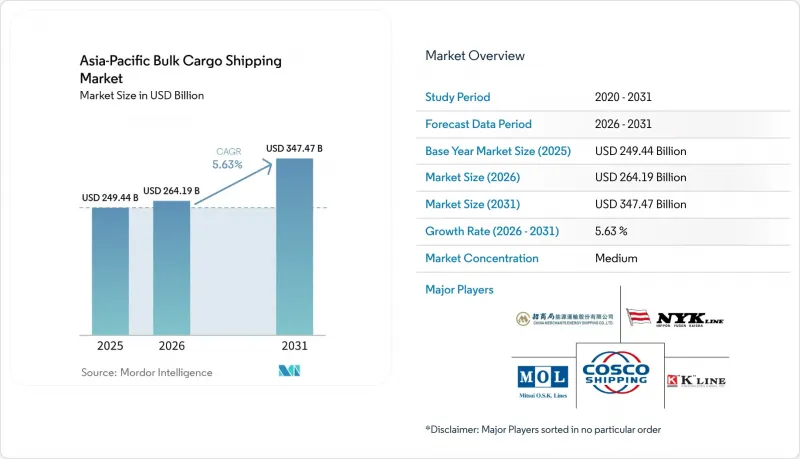
According to Mordor Intelligence, the Asia-Pacific bulk cargo shipping market size was valued at USD 249.44 billion in 2025 and estimated to grow from USD 264.19 billion in 2026 to reach USD 347.47 billion by 2031, at a CAGR of 5.63% during the forecast period (2026-2031).
Asia-Pacific Bulk Cargo Shipping Market Trends and Insights
Asia-Pacific Infrastructure-Led Commodity Flow Growth
Public infrastructure programs in the Asia-Pacific are supporting demand for large commodity parcels and repeat shipping movements. Vietnam imported 30.5 million tons of ores and minerals in 2025, up 16.8% by volume, as infrastructure activity required more steel and construction materials. India's Sagarmala program is implementing 845 projects worth INR 6.06 trillion (USD 67.45 billion), with 315 projects worth INR 1.57 trillion (USD 17.47 billion) completed. These programs increase demand for inputs that move in Capesize and Panamax parcels. Long-term infrastructure procurement can favor contracted tonnage over spot fixtures because buyers need dependable delivery schedules. This pattern supports capacity use in the Asia-Pacific bulk cargo shipping market when other commodity demand is less certain.
Deep-Sea Trade Expansion in Iron Ore and Coal Corridors
Iron ore remains a core source of vessel demand across the Asia-Pacific bulk cargo shipping market. Global seaborne iron ore shipments reached 1.71 billion metric tons in 2025, and Australia exported 944.8 million metric tons. Capesize vessels moved more than 70% of global seaborne iron ore, supporting the importance of Australia-China and Brazil-China routes. Coal sourcing patterns changed during 2025 as Indonesian thermal coal movements to North China weakened. Australia East to South China Capesize coal routes expanded as the relative economics of imported coal changed. The shift added distance and supported Capesize utilization despite weaker headline coal volumes.
Volatility in Dry Bulk Freight Rates
Freight rate volatility remains a key operating challenge for owners with limited contracted revenue. The Baltic Dry Index averaged 2,023 points in 2025, down 8.3% from the prior period, before ending the year at 2,770 points. Capesize day rates moved from USD 7,000 to USD 10,000 per day early in 2025 to nearly USD 45,000 per day in December. Port delays, cargo rerouting, and slower new vessel deliveries contributed to the late-year rate recovery. That recovery reflected tighter utilization and supply friction rather than stronger cargo demand. The Asia-Pacific bulk cargo shipping market remains exposed if delays ease or fleet deliveries accelerate.
Other drivers and restraints analyzed in the detailed report include:
- Fleet Renewal Toward Fuel-Efficient Capesize and Panamax Tonnage
- Port Automation and Berth Productivity Improvements
- Port Congestion and Draft Limit Constraints
For complete list of drivers and restraints, kindly check the Table Of Contents.
Segment Analysis
Dry bulk held the leading position in the Asia-Pacific bulk cargo shipping market, accounting for 68.07% of the market share in 2025, with regional production and construction requiring large volumes of iron ore, coal, grain, fertilizers, cement, and bauxite. Iron ore and coal together represented more than half of global dry bulk cargo by weight, with iron ore supporting Capesize demand and thermal coal supporting Panamax and Supramax movements. Australia-China and Indonesia-Asia-Pacific routes remained major freight corridors, while bauxite and alumina linked Australian and Southeast Asian suppliers with Chinese and Indian smelters. Grain shipments of wheat, corn, and soybeans supported Panamax demand through Southern Hemisphere harvest cycles, and fertilizer, cement, and clinker cargoes supported Handysize and Supramax deployment. These varied cargoes made dry bulk the volume base of the Asia-Pacific bulk cargo shipping market. They tied its performance to industrial production, infrastructure activity, agricultural demand, and power generation.
Liquid bulk cargo is projected to be the fastest-growing cargo category through 2031, expanding at a 7.05% CAGR, supported by LNG trade, refined petroleum products, and expanding chemical manufacturing across the Asia-Pacific. The Asia-Pacific bulk cargo shipping market size for liquid bulk was supported by the LNG trade of 437 million tons in 2025, with Japan, China, and South Korea accounting for the largest regional imports. Crude oil moved on Middle East-China and Middle East-Korea routes, while LPG supported VLGC and chemical tanker deployment in Japan and South Korea. Chemical and edible oil shipments from Malaysia, Indonesia, and Thailand added recurring intra-regional tanker demand, linking regional processing hubs to consuming markets. MARPOL Annex I and the IMO greenhouse gas strategy are influencing vessel specifications, with owners considering dual-fuel capability for VLCC and LNG carrier newbuildings as sourcing patterns and refinery activity evolve.
Complete Report Scope:
- By Cargo Type
- Dry Bulk Cargo
- Iron Ore
- Coal
- Grain (Wheat, Corn, Soybeans, etc.)
- Fertilizers
- Cement & Clinker
- Bauxite & Alumina
- Steel Products
- Other Minor Dry Bulk Commodities
- Liquid Bulk Cargo
- Crude Oil
- Refined Petroleum Products
- Liquefied Natural Gas (LNG)
- Liquefied Petroleum Gas (LPG)
- Chemicals
- Edible & Vegetable Oils
- Molasses
- Other Liquid Bulk Commodities
- Dry Bulk Cargo
- By Shipping Route
- Domestic (Coastal)
- International
- By End-Use Industry
- Mining & Metals
- Energy & Utilities
- Agriculture
- Chemicals & Petrochemicals
- Construction & Infrastructure
- Food Processing
- Manufacturing (General Industrial)
- Others
- By Country
- China
- Japan
- South Korea
- India
- Australia
- Singapore
- Thailand
- Indonesia
- Vietnam
- Rest of Asia-Pacific
List of Companies Covered in this Report:
- COSCO Shipping Bulk Co., Ltd.
- China Merchants Energy Shipping Co., Ltd.
- Mitsui O.S.K. Lines, Ltd.
- Nippon Yusen Kabushiki Kaisha (NYK Line)
- Kawasaki Kisen Kaisha, Ltd. (K Line)
- Pacific Basin Shipping Limited
- Berge Bulk Pte. Ltd.
- Pan Ocean Co., Ltd.
- Eastern Pacific Shipping
- Wisdom Marine Lines Co., Ltd.
- U-Ming Marine Transport Corporation
- Oldendorff Carriers GmbH & Co. KG
- Great Eastern Shipping Company Limited
- Star Bulk Carriers Corp.
- CMB.TECH (Including Golden Ocean Group Limited)
- Shipping Corporation of India Limited
- Swire Bulk
- Chinese Maritime Transport Ltd.
- Shandong Shipping Corporation
- Sincere Navigation Corporation
- IMC Shipping Pte. Ltd.
- Precious Shipping Public Company Limited
Additional Benefits:
- The market estimate (ME) sheet in Excel format
- 3 months of analyst support
TABLE OF CONTENTS
1 Introduction
- 1.1 Study Assumptions & Market Definition
- 1.2 Scope of the Study
2 Research Methodology
3 Executive Summary
4 Market Landscape
- 4.1 Market Overview and Importance of Bulk Cargo Shipping
- 4.2 Market Drivers
- 4.2.1 Asia-Pacific Infrastructure-Led Commodity Flow Growth
- 4.2.2 Deep-Sea Trade Expansion in Iron Ore and Coal Corridors
- 4.2.3 Fleet Renewal Toward Fuel-Efficient Capesize and Panamax Tonnage
- 4.2.4 Port Automation and Berth Productivity Improvements
- 4.2.5 Export-Oriented Agricultural and Industrial Raw Material Flows
- 4.2.6 Digitized Voyage Optimization and Cargo Visibility Adoption
- 4.3 Market Restraints
- 4.3.1 Volatility in Dry Bulk Freight Rates
- 4.3.2 Port Congestion and Draft Limit Constraints
- 4.3.3 Emission Compliance and Fuel Cost Pressure
- 4.3.4 Commodity Substitution and Demand Cyclicality
- 4.4 Industry Regulatory Framework
- 4.5 Value Chain and Distribution Channel Architecture Analysis
- 4.6 Technology Megatrends and Structural Shifts Bulk Cargo Shipping
- 4.7 Porter's Five Forces Analysis
- 4.7.1 Threat of New Entrants
- 4.7.2 Bargaining Power of Suppliers
- 4.7.3 Bargaining Power of Buyers
- 4.7.4 Threat of Substitutes
- 4.7.5 Rivalry Among Competitors
- 4.8 Freight Rate Analysis
- 4.8.1 Freight Rate Trends
- 4.8.2 Spot Market Analysis
- 4.8.3 Country-wise Freight Rate Comparison
- 4.8.4 Factors Influencing Freight Rates
- 4.9 Cost Structure Analysis
- 4.9.1 Shipping Cost Components
- 4.9.2 Fuel Cost Trends
- 4.9.3 Port Charges
- 4.9.4 Cost Optimization Strategies
- 4.10 Import-Export Trade Analysis
- 4.11 Port and Terminal Infrastructure Analysis
- 4.12 Sustainability and ESG Analysis
- 4.13 Impact of Geo-Political Events on Supply Chain Shifts
5 Market Size & Growth Forecasts (Value, 2026-2031)
- 5.1 By Cargo Type
- 5.1.1 Dry Bulk Cargo
- 5.1.1.1 Iron Ore
- 5.1.1.2 Coal
- 5.1.1.3 Grain (Wheat, Corn, Soybeans, etc.)
- 5.1.1.4 Fertilizers
- 5.1.1.5 Cement & Clinker
- 5.1.1.6 Bauxite & Alumina
- 5.1.1.7 Steel Products
- 5.1.1.8 Other Minor Dry Bulk Commodities
- 5.1.2 Liquid Bulk Cargo
- 5.1.2.1 Crude Oil
- 5.1.2.2 Refined Petroleum Products
- 5.1.2.3 Liquefied Natural Gas (LNG)
- 5.1.2.4 Liquefied Petroleum Gas (LPG)
- 5.1.2.5 Chemicals
- 5.1.2.6 Edible & Vegetable Oils
- 5.1.2.7 Molasses
- 5.1.2.8 Other Liquid Bulk Commodities
- 5.1.1 Dry Bulk Cargo
- 5.2 By Shipping Route
- 5.2.1 Domestic (Coastal)
- 5.2.2 International
- 5.3 By End-Use Industry
- 5.3.1 Mining & Metals
- 5.3.2 Energy & Utilities
- 5.3.3 Agriculture
- 5.3.4 Chemicals & Petrochemicals
- 5.3.5 Construction & Infrastructure
- 5.3.6 Food Processing
- 5.3.7 Manufacturing (General Industrial)
- 5.3.8 Others
- 5.4 By Country
- 5.4.1 China
- 5.4.2 Japan
- 5.4.3 South Korea
- 5.4.4 India
- 5.4.5 Australia
- 5.4.6 Singapore
- 5.4.7 Thailand
- 5.4.8 Indonesia
- 5.4.9 Vietnam
- 5.4.10 Rest of Asia-Pacific
6 Competitive Landscape
- 6.1 Market Concentration
- 6.2 Key Strategic Moves
- 6.3 Market Share Analysis
- 6.4 Company Profiles (includes Global level Overview, Market level overview, Core Segments, Financials as available, Strategic Information, Geographic/Network Coverage, Products & Services, and Recent Developments)
- 6.4.1 COSCO Shipping Bulk Co., Ltd.
- 6.4.2 China Merchants Energy Shipping Co., Ltd.
- 6.4.3 Mitsui O.S.K. Lines, Ltd.
- 6.4.4 Nippon Yusen Kabushiki Kaisha (NYK Line)
- 6.4.5 Kawasaki Kisen Kaisha, Ltd. (K Line)
- 6.4.6 Pacific Basin Shipping Limited
- 6.4.7 Berge Bulk Pte. Ltd.
- 6.4.8 Pan Ocean Co., Ltd.
- 6.4.9 Eastern Pacific Shipping
- 6.4.10 Wisdom Marine Lines Co., Ltd.
- 6.4.11 U-Ming Marine Transport Corporation
- 6.4.12 Oldendorff Carriers GmbH & Co. KG
- 6.4.13 Great Eastern Shipping Company Limited
- 6.4.14 Star Bulk Carriers Corp.
- 6.4.15 CMB.TECH (Including Golden Ocean Group Limited)
- 6.4.16 Shipping Corporation of India Limited
- 6.4.17 Swire Bulk
- 6.4.18 Chinese Maritime Transport Ltd.
- 6.4.19 Shandong Shipping Corporation
- 6.4.20 Sincere Navigation Corporation
- 6.4.21 IMC Shipping Pte. Ltd.
- 6.4.22 Precious Shipping Public Company Limited
7 Market Opportunities & Future Outlook
- 7.1 White-space & Unmet-Need Assessment

