PUBLISHER: Mordor Intelligence | PRODUCT CODE: 2155650

PUBLISHER: Mordor Intelligence | PRODUCT CODE: 2155650
Singapore Cargo Insurance - Market Share Analysis, Industry Trends & Statistics, Growth Forecasts (2026 - 2031)
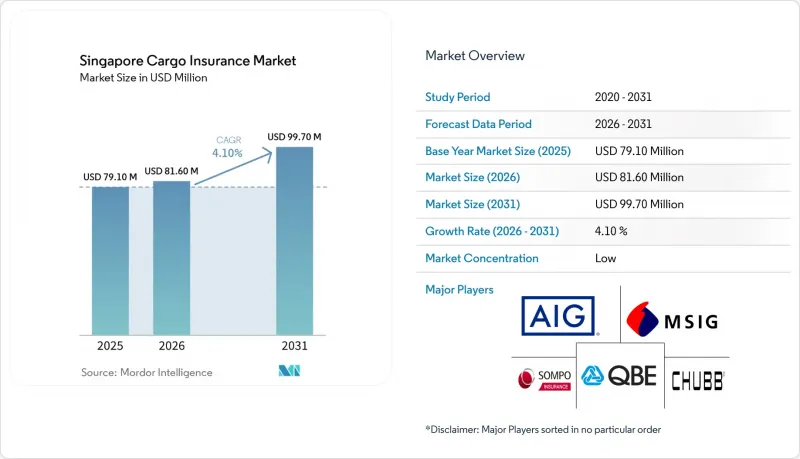
According to Mordor Intelligence, the Singapore cargo insurance market size was valued at USD 79.1 million in 2025, is estimated at USD 81.6 million in 2026, and is forecast to reach USD 99.7 million by 2031, growing at a CAGR of 4.1% during 2026-2031.
Singapore Cargo Insurance Market Trends and Insights
Singapore's Position as a Major Asia-Pacific Transshipment and Trading Hub
Singapore's port processed a record 44.7 million TEUs in 2025, up 8.6% from 2024, and the Singapore cargo insurance market draws on the concentration of goods moving through this network. The port activity supports regular movement of containerized goods across global shipping routes. Electronics, petrochemicals, and project goods can carry high declared values and require more detailed insurance arrangements. These shipments often use open-cover structures instead of isolated policies because traders and logistics firms manage recurring movements. More than 200 international shipping groups operated from Singapore after 35 companies opened or expanded operations there in 2025. Singapore's registered fleet reached 137.5 million gross tons at the end of 2025, adding to the country's wider marine services base.
Rising Exposure to Supply-Chain Disruptions and Cargo Transit Risks
Cargo exposure rises when vessels are delayed, rerouted, or held at transshipment points. Singapore's role as a major transfer point means that disruptions can leave cargo in ports, bonded warehouses, and yards for longer periods. Extended dwell times can increase accumulation risk for insurers, even when the number of shipments does not change. The Singapore cargo insurance market, therefore, needs policy limits and declarations that reflect where goods are held during a disruption. Geopolitical events also increase interest in transit-risk, war-risk, and political violence cover for affected routes. This creates a different pricing environment from routine commodity shipments because the risk depends on route conditions, cargo concentration, and the duration of delay.
Intense Competition and Downward Pressure on Cargo Insurance Premium Rates
The Singapore cargo insurance market is characterized by intense competition among direct insurers, international composite insurers, specialty insurers, and Lloyd's syndicates, giving brokers and large commercial buyers greater flexibility to compare coverage terms, service levels, and premium rates. Increased underwriting capacity and competitive pricing can benefit trading and logistics companies by reducing insurance costs in the short term; however, sustained downward pressure on premiums can constrain insurers' premium income and underwriting margins, particularly when cargo values and shipment activity increase faster than insurance rates. This may limit insurers' ability to invest in technology, specialist underwriting expertise, risk engineering, and cargo-monitoring capabilities, while also creating pressure to maintain adequate pricing for higher-exposure cargo accumulated at ports, warehouses, distribution centers, and transshipment facilities.
Other drivers and restraints analyzed in the detailed report include:
- Growing Trade in High-Value and Specialized Cargo
- Digitalization of Cargo Insurance and Trade Documentation
- Complexity in Underwriting Emerging and Multimodal Cargo Risks
For complete list of drivers and restraints, kindly check the Table Of Contents.
Segment Analysis
Sea and ocean freight held 73.9% of the Singapore cargo insurance market share in 2025, making it the largest transport mode in the Singapore cargo insurance market. The position reflects Singapore's role as a major liner and transshipment hub. Cargo owners moving large and regular volumes commonly use open-cover arrangements to manage repeated declarations. The mode includes commodity flows, manufactured goods, and high-value containerized cargo. Port scale supports a deep flow of insurable exposures across many shipping lines and destinations. Land freight serves the Singapore-Johor and wider Peninsular Malaysia corridor. This business is smaller and more stable because routes are shorter and transport patterns are more established. It remains important for cargo moving between ports, warehouses, industrial sites, and regional distribution centers.
Air freight is the fastest-growing transport mode, with a forecast CAGR of 5.8% through 2031. Changi Airport handled 2.1 million tonnes of freight in 2025, up 4.5% from the prior year. Air freight supports electronics, semiconductor equipment, pharmaceuticals, and other goods where speed and cargo value are central. These shipments can command higher premiums per unit of insured value because a delay or loss may have greater commercial consequences. The Singapore cargo insurance market size is exposed to the shift toward air cargo through policy demand for time-sensitive goods. Faster air cargo growth can support premium yield even if sea freight continues to dominate total premium. Insurers still need to assess packaging, security, temperature control, and handling quality. The difference between sea and air risks supports separate underwriting practices within marine cargo portfolios.
Electronics, electrical equipment, and semiconductors held 27.1% of the Singapore cargo insurance market share in 2025, making it the largest cargo type segment. Singapore's electronics base supports this position through large regional and global trade flows. The sector accounted for 43.2% of manufacturing nominal value added in 2025, while semiconductor output represented 80.2% of the electronics cluster. High unit values make loss prevention, secure handling, and accumulation controls important for insurers. Machinery, industrial equipment, and project cargo form another material source of demand. Chemicals, petroleum products, and dangerous goods also require specialist policy terms because of their physical loss characteristics. Food, perishables, and general merchandise add volume across routine regional movements.
Pharmaceuticals and healthcare products are the fastest-growing cargo type, with a forecast CAGR of 6.0% through 2031. Temperature-sensitive goods introduce an additional coverage issue because a temperature deviation can create a loss even without physical damage. Requirements for temperature monitoring, packaging, transport time, and notification of deviations therefore influence the Singapore cargo insurance market size. Pharmaceutical movement through air and sea routes supports demand for endorsements designed for controlled conditions. Lithium-ion battery materials and renewable energy components also add complexity because insurers need to consider their particular fire and handling risks. These goods cannot always be evaluated in the same way as standard ambient cargo. The growing mix of complex shipments can support specialist premium demand. It also makes loss data, risk engineering, and capacity management more important for cargo insurers.
Complete Report Scope:
- By Transport Mode
- Sea / Ocean Freight
- Air Freight
- Land Freight
- By Cargo Type
- Electronics, Electrical Equipment and Semiconductors
- Machinery, Industrial Equipment and Project / Out-of-Gauge Cargo
- Chemicals, Petroleum Products and Dangerous Goods
- Pharmaceuticals and Healthcare Products
- Food, Perishables and Other Temperature-Controlled Cargo
- Bulk Commodities
- General Merchandise and Other Manufactured Goods
- By End User
- Manufacturers and Industrial Producers
- Trading Houses, Importers and Exporters
- Retailers and e-commerce Cargo Owners
- Freight Forwarders, NVOCCs and Logistics Operators
- Project Owners, EPC and Infrastructure Companies
- Other Commercial Cargo Owners
- By Trade-Lane Orientation
- Singapore Domestic Movements
- Southeast Asia
- Rest of Asia-Pacific
- Europe
- North America
- Middle East and Africa
- Rest of World
- By Distribution Channel
- Brokers
- Agents
- Direct
List of Companies Covered in this Report:
- MSIG Insurance (Singapore) Pte. Ltd.
- Chubb Insurance Singapore Limited
- AIG Asia Pacific Insurance Pte. Ltd.
- QBE Insurance (Singapore) Pte. Ltd.
- Sompo Insurance Singapore Pte. Ltd.
- Tokio Marine Insurance Singapore Ltd.
- Allianz Insurance Singapore Pte. Ltd.
- Zurich Insurance Company Ltd. (Singapore Branch)
- AXA XL Insurance Company SE, Singapore Branch
- Great American Insurance Company
- HDI Global SE
- Liberty Specialty Markets Pte. Limited
- Allied World Assurance Company Ltd.
- Canopius Asia Pte. Ltd.
- Markel International Singapore Pte.
- Starr International Insurance (Singapore) Pte. Ltd
- Chaucer Singapore Pte. Limited
Additional Benefits:
- The market estimate (ME) sheet in Excel format
- 3 months of analyst support
TABLE OF CONTENTS
1 INTRODUCTION
- 1.1 Study Assumptions and Market Definition
- 1.2 Scope of the Study
2 RESEARCH METHODOLOGY
3 EXECUTIVE SUMMARY
4 MARKET LANDSCAPE
- 4.1 Market Overview
- 4.2 Market Drivers
- 4.2.1 Singapore's Position as a Major Asia-Pacific Transshipment and Trading Hub
- 4.2.2 Growth in Cross-Border and Multimodal Cargo Movements
- 4.2.3 Rising Exposure to Supply-Chain Disruptions and Cargo Transit Risks
- 4.2.4 Growing Trade in High-Value and Specialised Cargo
- 4.2.5 Digitalisation of Cargo Insurance and Trade Documentation
- 4.2.6 Increasing Demand for Enhanced Cargo Visibility and Risk Management
- 4.3 Market Restraints
- 4.3.1 Intense Competition and Downward Pressure on Cargo Insurance Premium Rates
- 4.3.2 Volatility in Global Trade Volumes and Cargo Values
- 4.3.3 High Accumulation Exposure at Concentrated Logistics and Transshipment Locations
- 4.3.4 Complexity in Underwriting Emerging and Multimodal Cargo Risks
- 4.4 Value Chain Analysis
- 4.4.1 Cargo Owners, Traders, and Logistics Providers as Primary Risk Originators
- 4.4.2 Insurance Brokers and Specialist Intermediaries in Cargo Insurance Distribution
- 4.4.3 Insurers, Lloyd's Market Underwriters, and Claims-Service Providers in Risk Transfer and Loss Management
- 4.5 Regulatory Landscape
- 4.5.1 Monetary Authority of Singapore Licensing and Prudential Supervision
- 4.5.2 Marine Insurance Legal and Contractual Framework
- 4.5.3 Sanctions, Trade Controls, Financial Crime, and Data Protection Compliance
- 4.6 Technological Outlook
- 4.6.1 Digital Policy Administration and Cargo Certificate Issuance
- 4.6.2 IoT-Enabled Shipment Monitoring and Cargo Risk Data Collection
- 4.6.3 Artificial Intelligence and Advanced Analytics for Underwriting, Claims, and Loss Prevention
- 4.7 Porter's Five Forces Analysis
- 4.7.1 Threat of New Entrants
- 4.7.2 Bargaining Power of Suppliers
- 4.7.3 Bargaining Power of Buyers
- 4.7.4 Threat of Substitutes
- 4.7.5 Competitive Rivalry
5 MARKET SIZE AND GROWTH FORECASTS
- 5.1 By Transport Mode
- 5.1.1 Sea / Ocean Freight
- 5.1.2 Air Freight
- 5.1.3 Land Freight
- 5.2 By Cargo Type
- 5.2.1 Electronics, Electrical Equipment and Semiconductors
- 5.2.2 Machinery, Industrial Equipment and Project / Out-of-Gauge Cargo
- 5.2.3 Chemicals, Petroleum Products and Dangerous Goods
- 5.2.4 Pharmaceuticals and Healthcare Products
- 5.2.5 Food, Perishables and Other Temperature-Controlled Cargo
- 5.2.6 Bulk Commodities
- 5.2.7 General Merchandise and Other Manufactured Goods
- 5.3 By End User
- 5.3.1 Manufacturers and Industrial Producers
- 5.3.2 Trading Houses, Importers and Exporters
- 5.3.3 Retailers and e-commerce Cargo Owners
- 5.3.4 Freight Forwarders, NVOCCs and Logistics Operators
- 5.3.5 Project Owners, EPC and Infrastructure Companies
- 5.3.6 Other Commercial Cargo Owners
- 5.4 By Trade-Lane Orientation
- 5.4.1 Singapore Domestic Movements
- 5.4.2 Southeast Asia
- 5.4.3 Rest of Asia-Pacific
- 5.4.4 Europe
- 5.4.5 North America
- 5.4.6 Middle East and Africa
- 5.4.7 Rest of World
- 5.5 By Distribution Channel
- 5.5.1 Brokers
- 5.5.2 Agents
- 5.5.3 Direct
6 COMPETITIVE LANDSCAPE
- 6.1 Market Concentration
- 6.2 Strategic Moves
- 6.3 Market Share Analysis (Top 5-6 players)
- 6.4 Company Profiles (includes Global Level Overview, Market Level Overview, Core Segments, Financials as available, Strategic Information, Market Rank/Share, Products and Services, Recent Developments)
- 6.4.1 MSIG Insurance (Singapore) Pte. Ltd.
- 6.4.2 Chubb Insurance Singapore Limited
- 6.4.3 AIG Asia Pacific Insurance Pte. Ltd.
- 6.4.4 QBE Insurance (Singapore) Pte. Ltd.
- 6.4.5 Sompo Insurance Singapore Pte. Ltd.
- 6.4.6 Tokio Marine Insurance Singapore Ltd.
- 6.4.7 Allianz Insurance Singapore Pte. Ltd.
- 6.4.8 Zurich Insurance Company Ltd. (Singapore Branch)
- 6.4.9 AXA XL Insurance Company SE, Singapore Branch
- 6.4.10 Great American Insurance Company
- 6.4.11 HDI Global SE
- 6.4.12 Liberty Specialty Markets Pte. Limited
- 6.4.13 Allied World Assurance Company Ltd.
- 6.4.14 Canopius Asia Pte. Ltd.
- 6.4.15 Markel International Singapore Pte.
- 6.4.16 Starr International Insurance (Singapore) Pte. Ltd
- 6.4.17 Chaucer Singapore Pte. Limited
7 MARKET OPPORTUNITIES AND FUTURE OUTLOOK
- 7.1 White-Space and Unmet-Need Assessment
- 7.1.1 Accessible and Flexible Shipment-Level Cargo Insurance for SMEs and Smaller Traders
- 7.1.2 Integrated Multimodal and Embedded Cargo Insurance Across Freight and Trade Platforms
- 7.1.3 Specialised Coverage for Supply-Chain Disruption and High-Value or Sensitive Cargo
- 7.2 Future Outlook
- 7.2.1 Expansion of Digital Data, Automation, and AI-Enabled Cargo Underwriting and Claims
- 7.2.2 Growth of Parametric and Event-Triggered Protection for Cargo and Transit Disruptions
- 7.2.3 Increasing Focus on Climate, Geopolitical, War, and Supply-Chain Risk Capacity

