PUBLISHER: Mordor Intelligence | PRODUCT CODE: 2163630

PUBLISHER: Mordor Intelligence | PRODUCT CODE: 2163630
Asia-Pacific Cargo Insurance - Market Share Analysis, Industry Trends & Statistics, Growth Forecasts (2026 - 2031)
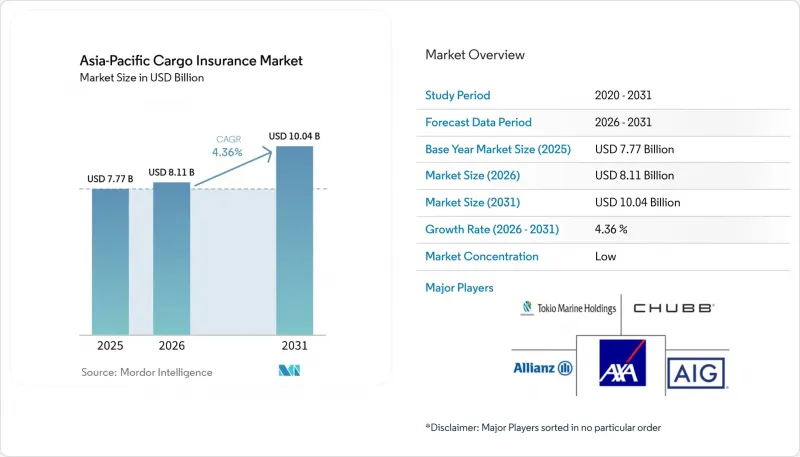
According to Mordor Intelligence, the Asia-Pacific cargo insurance market was valued at USD 7.77 billion in 2025, is estimated at USD 8.11 billion in 2026, and is projected to reach USD 10.04 billion by 2031, growing at a CAGR of 4.36% from 2026 to 2031.
Asia-Pacific Cargo Insurance Market Trends and Insights
Expansion of Cross-Border Trade and Manufacturing Exports
The Regional Comprehensive Economic Partnership is in its 4th year of full implementation and is increasing the density of trade within the region. Manufacturing activity is extending from China into Vietnam, Thailand, and Indonesia, which creates additional insured corridors rather than merely shifting existing volumes. A study of 12 Regional Comprehensive Economic Partnership members found that China's cross-border e-commerce export potential with several partners remained below 0.8 utilization. Longer routes can add transit legs and increase the time for which shipments remain exposed. Inventory stockpiling before tariff deadlines also creates a need for warehouse-to-warehouse extensions beyond a standard voyage policy. Regional customs and rules-of-origin requirements add documentation work, surveys, and endorsements for insurers serving cross-jurisdiction shipments.
Growth of E-Commerce and High-Frequency Small Shipments
E-commerce is adding cargo insurance demand that was not previously served through conventional declaration-based policies. China's return-shipping insurance contributed to cargo premium growth that exceeded 7.1% export volume growth in 2024. India's e-commerce logistics activity supports demand for embedded cover across a growing number of parcel movements. High-frequency parcel traffic is difficult to price through manual declarations because misclassification, undeclared lithium-ion batteries, and fraudulent returns can be concentrated in these flows. Thailand removed its de minimis threshold in January 2026, and Vietnam removed a comparable exemption in February 2025, creating customs records for parcels that may previously have lacked formal insurance documentation. These records can support coverage at booking, while adding compliance responsibilities for cross-border sellers.
Regulatory Fragmentation Across Asia-Pacific Markets
The region includes more than a dozen national licensing and foreign-ownership frameworks, which increases the complexity of regional placements. Vietnam requires Vietnamese-language policy translations, and some domestic inland transit legs require locally admitted policies. The Institute Cargo Clauses are accepted internationally for voyages, but their scope does not remove national requirements for domestic or inland cover. Shippers may need several local endorsements rather than one Singapore-issued program across multiple countries. Customs changes in Thailand and Vietnam show that regulation is evolving quickly, while insurance product harmonization remains slower. Smaller exporters may rely on carrier liability or retain risk when the cost of a legally compliant program becomes too high.
Other drivers and restraints analyzed in the detailed report include:
- Increasing Cargo Values and Cold-Chain Dependence
- Digital Embedded Insurance and Automated Certificate Issuance
- Catastrophe Accumulation at Ports and Inland Hubs
For complete list of drivers and restraints, kindly check the Table Of Contents.
Segment Analysis
Sea and marine cargo insurance accounted for 62.1% of premiums in 2025, giving it the largest Asia-Pacific cargo insurance market share among transport modes. Deep-sea and short-sea routes provide the policy volume that supports treaty reinsurance structures. Standardized Institute Cargo Clauses and transparent open-cover pricing have also made this business highly competitive. Large shippers can compare terms and rates across several insurers with relative ease. Sea transport remains central because of the region's container throughput and established trading routes.
Air cargo is projected to grow at a 5.9% CAGR through 2031, above the overall forecast pace. Time-sensitive semiconductors, pharmaceuticals, and express parcels raise the insured value carried per kilogram. India handled 6.78 lakh (0.678 million) tonnes of international air cargo at major airports in the April to June quarter of fiscal year 2025, and e-commerce accounted for 70% of express-carrier international shipments. Temperature-controlled pharmaceuticals require close control because a documented temperature excursion can make the goods unusable. Road, rail, and inland waterway coverage is also expanding as intermodal connections link ports with inland production centers.
Containerized cargo held 46.7% of 2025 premiums and remained the largest cargo-profile segment. It supports deep-sea trade between the Asia-Pacific, Europe, and North America. Open-cover programs make it a dependable source of underwriting volume. Digital platforms are increasing price competition on more routine container shipments. Dry bulk and liquid bulk businesses can move with commodity prices even when shipment units remain unchanged.
Project, heavy-lift, and out-of-gauge cargo is projected to grow at a 6.4% CAGR through 2031. Energy-transition projects require shipments of wind turbine blades, transformer modules, electrolyzer stacks, and utility-scale battery packs. Allianz Commercial identified these movements as a source of unusual risk because of their weight, value, and technical novelty. Some high-mass cargo moves on dry bulk vessels that are not designed for specialist stowage. Rolling cargo also benefits from automotive exports, though electric vehicle batteries increase fire-severity concerns. Break-bulk cargo remains relevant for machinery, steel, and capital goods that cannot be containerized.
Complete Report Scope:
- By Mode of Transport
- Sea (Deep-Sea and Short-Sea / Coastal)
- Inland Waterway
- Road
- Rail
- Air
- By Cargo Profile
- Containerized Cargo
- Dry Bulk Cargo
- Liquid Bulk Cargo
- Break-Bulk and General Cargo
- Project, Heavy-Lift and Out-of-Gauge
- Rolling Cargo / Ro-Ro
- By Trade Scope
- Cross-Border (Import, Export, Entrepot)
- Domestic Inland Transit
- By Distribution Channel
- Brokers and Agents
- Direct Insurers
- Online and Digital Platforms
- By Policyholder Type
- Cargo Owner, Seller, Buyer or Trader
- Freight Forwarder / 3PL-Arranged Shipper's Interest
- By End-User Industry
- Food, Beverage, and Agri-Commodities
- Energy and Bulk Commodities
- Chemicals and Pharmaceuticals
- Automotive and Industrial Equipment
- Electronics and High-Value Manufactured Goods
- Retail, Consumer Goods, and E-Commerce
- Construction and Infrastructure Project Owners
- Other End-User Industries
- By Geography
- China
- Japan
- India
- South Korea
- Australia
- Indonesia
- Singapore
- Malaysia
- Vietnam
- Thailand
- New Zealand
- Rest of Asia-Pacific
List of Companies Covered in this Report:
- Allianz SE
- American International Group, Inc.
- AXA S.A.
- Chubb Limited
- Zurich Insurance Group Ltd
- Tokio Marine Holdings, Inc.
- SOMPO Holdings, Inc.
- QBE Insurance Group Limited
- HDI Global SE
- Liberty Mutual Insurance Company
- Berkshire Hathaway Specialty Insurance Company
- Assicurazioni Generali S.p.A.
- Arch Capital Group Ltd.
- AXIS Capital Holdings Limited
- Ascot Group Limited
- Munich Reinsurance Company
- Swiss Re Ltd
- Lloyd's
- Ping An Insurance (Group) Company of China, Ltd.
- ICICI Lombard General Insurance Company Limited
- China Pacific Insurance (Group) Co., Ltd.
- Samsung Fire and Marine Insurance Co., Ltd.
- Mitsui Sumitomo Insurance Company, Limited
- Tata AIG General Insurance Company Limited
Additional Benefits:
- The market estimate (ME) sheet in Excel format
- 3 months of analyst support
TABLE OF CONTENTS
1 INTRODUCTION
- 1.1 Study Assumptions and Market Definition
- 1.2 Scope of the Study
2 RESEARCH METHODOLOGY
3 EXECUTIVE SUMMARY
4 MARKET LANDSCAPE
- 4.1 Market Overview
- 4.2 Market Drivers
- 4.2.1 Expansion of Cross-Border Trade and Manufacturing Exports
- 4.2.2 Growth of E-Commerce and High-Frequency Small Shipments
- 4.2.3 Increasing Cargo Values and Cold-Chain Dependence
- 4.2.4 Digital Embedded Insurance and Automated Certificate Issuance
- 4.2.5 Supply-Chain Disruption and Delay-Cost Protection
- 4.2.6 Rising Adoption of Multimodal and Intra-Asia Trade Corridors
- 4.3 Market Restraints
- 4.3.1 Regulatory Fragmentation Across Asia-Pacific Markets
- 4.3.2 Catastrophe Accumulation at Ports and Inland Hubs
- 4.3.3 Cyber-Enabled Cargo Theft and Data Vulnerability
- 4.3.4 Low Awareness and Underinsurance Among Small Exporters
- 4.4 Value Chain Analysis
- 4.4.1 Cargo Owners, Traders and Shippers
- 4.4.2 Freight Forwarders, 3PLs and Digital Freight Platforms
- 4.4.3 Brokers, Agents and Managing General Agents
- 4.4.4 Primary Insurers, Lloyd's Market and Reinsurers
- 4.4.5 Ports, Terminals, Carriers and Tracking Providers
- 4.4.6 Claims Adjusters, Surveyors and Loss-Prevention Specialists
- 4.5 Regulatory Landscape
- 4.5.1 National Insurance Licensing and Foreign Ownership Rules
- 4.5.2 ASEAN Trade and Customs Protocols
- 4.5.3 Institute Cargo Clauses and Contractual Allocation of Risk
- 4.5.4 IMO Maritime Single Window and Electronic Reporting
- 4.5.5 Hague-Visby Rules and Multimodal Transport Liability
- 4.5.6 Sanctions, War-Risk and Export-Control Compliance
- 4.6 Technological Outlook
- 4.6.1 AI Underwriting and Predictive Risk Scoring
- 4.6.2 IoT Temperature, Location and Shock Monitoring
- 4.6.3 Blockchain Bills of Lading and Chain-of-Custody Records
- 4.6.4 Satellite-Based Route and Loss Assessment
- 4.6.5 Parametric Delay and Supply-Chain Disruption Cover
- 4.6.6 Automated Claims, Digital Proof of Delivery and Fraud Analytics
- 4.7 Porter's Five Forces Analysis
- 4.7.1 Bargaining Power of Suppliers
- 4.7.2 Bargaining Power of Buyers
- 4.7.3 Threat of New Entrants
- 4.7.4 Threat of Substitutes
- 4.7.5 Competitive Rivalry
5 MARKET SIZE AND GROWTH FORECASTS
- 5.1 By Mode of Transport
- 5.1.1 Sea (Deep-Sea and Short-Sea / Coastal)
- 5.1.2 Inland Waterway
- 5.1.3 Road
- 5.1.4 Rail
- 5.1.5 Air
- 5.2 By Cargo Profile
- 5.2.1 Containerized Cargo
- 5.2.2 Dry Bulk Cargo
- 5.2.3 Liquid Bulk Cargo
- 5.2.4 Break-Bulk and General Cargo
- 5.2.5 Project, Heavy-Lift and Out-of-Gauge
- 5.2.6 Rolling Cargo / Ro-Ro
- 5.3 By Trade Scope
- 5.3.1 Cross-Border (Import, Export, Entrepot)
- 5.3.2 Domestic Inland Transit
- 5.4 By Distribution Channel
- 5.4.1 Brokers and Agents
- 5.4.2 Direct Insurers
- 5.4.3 Online and Digital Platforms
- 5.5 By Policyholder Type
- 5.5.1 Cargo Owner, Seller, Buyer or Trader
- 5.5.2 Freight Forwarder / 3PL-Arranged Shipper's Interest
- 5.6 By End-User Industry
- 5.6.1 Food, Beverage, and Agri-Commodities
- 5.6.2 Energy and Bulk Commodities
- 5.6.3 Chemicals and Pharmaceuticals
- 5.6.4 Automotive and Industrial Equipment
- 5.6.5 Electronics and High-Value Manufactured Goods
- 5.6.6 Retail, Consumer Goods, and E-Commerce
- 5.6.7 Construction and Infrastructure Project Owners
- 5.6.8 Other End-User Industries
- 5.7 By Geography
- 5.7.1 China
- 5.7.2 Japan
- 5.7.3 India
- 5.7.4 South Korea
- 5.7.5 Australia
- 5.7.6 Indonesia
- 5.7.7 Singapore
- 5.7.8 Malaysia
- 5.7.9 Vietnam
- 5.7.10 Thailand
- 5.7.11 New Zealand
- 5.7.12 Rest of Asia-Pacific
6 COMPETITIVE LANDSCAPE
- 6.1 Market Concentration
- 6.2 Strategic Moves
- 6.3 Market Share Analysis
- 6.4 Company Profiles (includes Global Level Overview, Market Level Overview, Core Segments, Financials as available, Strategic Information, Market Rank/Share, Products and Services, Recent Developments)
- 6.4.1 Allianz SE
- 6.4.2 American International Group, Inc.
- 6.4.3 AXA S.A.
- 6.4.4 Chubb Limited
- 6.4.5 Zurich Insurance Group Ltd
- 6.4.6 Tokio Marine Holdings, Inc.
- 6.4.7 SOMPO Holdings, Inc.
- 6.4.8 QBE Insurance Group Limited
- 6.4.9 HDI Global SE
- 6.4.10 Liberty Mutual Insurance Company
- 6.4.11 Berkshire Hathaway Specialty Insurance Company
- 6.4.12 Assicurazioni Generali S.p.A.
- 6.4.13 Arch Capital Group Ltd.
- 6.4.14 AXIS Capital Holdings Limited
- 6.4.15 Ascot Group Limited
- 6.4.16 Munich Reinsurance Company
- 6.4.17 Swiss Re Ltd
- 6.4.18 Lloyd's
- 6.4.19 Ping An Insurance (Group) Company of China, Ltd.
- 6.4.20 ICICI Lombard General Insurance Company Limited
- 6.4.21 China Pacific Insurance (Group) Co., Ltd.
- 6.4.22 Samsung Fire and Marine Insurance Co., Ltd.
- 6.4.23 Mitsui Sumitomo Insurance Company, Limited
- 6.4.24 Tata AIG General Insurance Company Limited
7 MARKET OPPORTUNITIES AND FUTURE OUTLOOK
- 7.1 White-Space and Unmet-Need Assessment
- 7.1.1 Affordable Modular Cover for Small and Mid-Sized Exporters
- 7.1.2 Parametric Delay Cover for Port Closure and Route Disruption
- 7.1.3 Embedded Protection for E-Commerce and Digital Freight Platforms
- 7.1.4 Temperature and Condition-Triggered Cover for Perishables and APIs
- 7.1.5 Renewable-Energy Equipment and Project-Cargo Insurance
- 7.1.6 Cross-Border Standardization and Portable Certificates

