PUBLISHER: Mordor Intelligence | PRODUCT CODE: 2163629

PUBLISHER: Mordor Intelligence | PRODUCT CODE: 2163629
GCC Cargo Insurance - Market Share Analysis, Industry Trends & Statistics, Growth Forecasts (2026 - 2031)
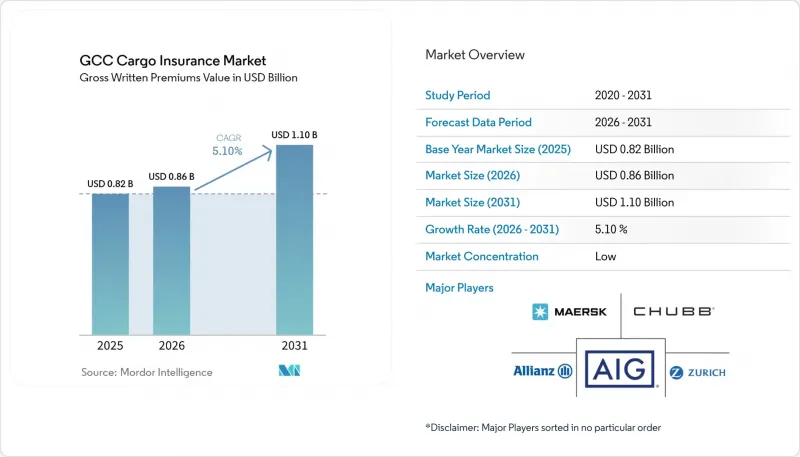
According to Mordor Intelligence, the GCC cargo insurance market, measured in terms of gross written premiums, was valued at USD 0.82 billion in 2025, is estimated at USD 0.86 billion in 2026, and is forecast to reach USD 1.10 billion by 2031, registering a CAGR of 5.10% from 2026 to 2031.
GCC Cargo Insurance Market Trends and Insights
GCC Logistics-Hub and Re-Export Concentration Anchors Baseline Premium Volume
The GCC cargo insurance market draws recurring demand from the region's ports, free zones, and re-export networks. Jebel Ali handled 15.6 million twenty-foot equivalent units (TEU) in 2025, and DP World reported 9% growth in origin-and-destination container volumes during the year. These direct trade flows add to transshipment volumes and widen the base of cargo that requires declared values and insurance certificates. Breakbulk volumes at Jebel Ali reached 5.67 million tonnes in 2025, the highest level in nearly 2 decades. JAFZA recorded USD 190 billion in trade volume during 2025, a 15% increase that reinforced its importance as a re-export location. Large volumes also increase accumulation exposure because a disruption at one terminal can affect many shipments covered through open-cover arrangements.
E-Commerce and Cross-Border Shipment Growth Reshapes SME Coverage Demand
E-commerce is expanding the base of smaller merchants and direct-to-consumer shippers that need cargo protection. These shipments often carry lower values than traditional commercial freight, which can make conventional broker-placed open covers less suitable. High shipment frequency, varied goods, and the use of multiple carriers create a more complex risk pattern for underwriters. Automated risk categorization is better suited to these shipment profiles than manual review for every declaration. Embedded cargo cover and parametric delay products are gaining attention because they can be included within digital shipment journeys. The GCC cargo insurance market can therefore reach smaller shippers when digital products provide simple certificates and clear terms without losing underwriting discipline.
Fragmented GCC Regulatory and Compliance Requirements Complicate Cross-Border Placements
Each GCC state has its own supervisory framework for insurance activity and admitted-market requirements. Saudi Arabia applies cooperative, or Takaful-based, insurance rules through its Insurance Authority. The Central Bank of the United Arab Emirates regulates insurers in the United Arab Emirates under Federal Decree-Law No. 6 of 2025. Qatar, Kuwait, Bahrain, and Oman also apply separate supervision, coverage requirements, and local-content expectations. A certificate issued in the United Arab Emirates may not meet Saudi customs requirements when the issuing insurer is not admitted in Saudi Arabia. Until mutual recognition or harmonized rules develop, cross-border cargo programs will face added cost and administrative work.
Other drivers and restraints analyzed in the detailed report include:
- Infrastructure and Economic-Diversification Projects Drive Project-Cargo Insurance Demand
- Bank and Incoterm-Driven Insurance Requirements Support Contractual Demand
- Price Competition and Limited Underwriting Differentiation Constrain Premium Adequacy
For complete list of drivers and restraints, kindly check the Table Of Contents.
Segment Analysis
Sea transport held 61.8% of the GCC cargo insurance market size in 2025. This position reflects the region's reliance on maritime trade through Jebel Ali, Dammam, and Shuwaikh. Trade connections with Asia Pacific, Europe, East Africa, the United Kingdom, and the United States primarily rely on ocean routes because of geography and cargo volumes. Chemicals, pharmaceuticals, and electronics are among the higher-value goods that commonly move in containerized maritime shipments. Short-sea coastal services also form part of the insured maritime freight base. Sea transport consequently remains central to premium generation across the GCC cargo insurance market.
Rail freight is projected to grow at 8.7% CAGR through 2031, the highest rate among transport modes. Etihad Rail operates a 900-kilometer freight network across all 7 emirates and is expanding toward a 60 million-ton annual target by 2030. Saudi Arabian Railways launched 5 multimodal logistics corridors in 2026 to connect Gulf ports, inland regions, and Red Sea ports. Road transport remains important for intra-GCC movements and final delivery, while air freight serves time-sensitive and high-value shipments. Rail-specific risks have a different accumulation pattern from sea and road movements. Insurers need terms that recognize overland rail transit as volumes move from infrastructure plans into operating freight corridors.
Containerized cargo held 40.6% premium share in the GCC cargo insurance market in 2025. Jebel Ali, Khalifa, and Dammam support standardized container trade for a wide range of general merchandise. Containerization allows insurers to use open-cover arrangements and standard Institute Cargo Clauses for many shipments. This reduces underwriting complexity compared with individual assessments of irregular loads. Dry bulk, liquid bulk, and roll-on, roll-off cargo serve energy, petrochemical, and automotive supply chains. The GCC cargo insurance market continues to depend on containerized cargo because it is the most established form of regional trade movement.
Project, heavy-lift, and out-of-gauge cargo is forecast to grow at 6.9% CAGR through 2031. These loads include turbines, modular construction units, offshore platforms, and energy infrastructure components for NEOM, the Red Sea Project, and Amaala. Their movement requires bespoke underwriting, marine warranty surveyors, and policy terms that standard open covers cannot provide. Port of NEOM's terminal has capacity for up to 1.5 million TEU and is receiving project cargo for hydrogen facilities and data center construction. The more complex the shipment, the more important specialist engineering and survey capacity becomes. Global specialty insurers are well placed where technical capability is needed for the largest project movements.
Complete Report Scope:
- By Mode of Transport
- Sea (Deep-Sea and Short-Sea / Coastal)
- Inland Waterway
- Road
- Rail
- Air
- By Cargo Profile
- Containerized Cargo
- Dry Bulk Cargo
- Liquid Bulk Cargo
- Break-Bulk and General Cargo
- Project, Heavy-Lift and Out-of-Gauge
- Rolling Cargo / Ro-Ro
- By Trade Scope
- Cross-Border (Import, Export, Entrepot)
- Domestic Inland Transit
- By Distribution Channel
- Brokers and Agents
- Direct Insurers
- Online and Digital Platforms
- By Policyholder Type
- Cargo Owner, Seller, Buyer or Trader
- Freight Forwarder / 3PL-Arranged Shipper's Interest
- By End-User Industry
- Food, Beverage, and Agri-Commodities
- Energy and Bulk Commodities
- Chemicals and Pharmaceuticals
- Automotive and Industrial Equipment
- Electronics and High-Value Manufactured Goods
- Retail, Consumer Goods, and E-Commerce
- Construction and Infrastructure Project Owners
- Other End-User Industries
- By Geography
- United Arab Emirates
- Saudi Arabia
- Qatar
- Kuwait
- Bahrain
- Oman
List of Companies Covered in this Report:
- Allianz SE
- American International Group, Inc.
- AP Moller Maersk A/S
- Assicurazioni Generali S.p.A.
- AXA XL
- Chubb Limited
- Gulf Union Insurance Company
- Qatar General Insurance and Reinsurance Company Q.P.S.C.
- Qatar Islamic Insurance Company
- Qatar Insurance Company Q.S.P.C.
- Saudi Reinsurance Company
- MEDGULF
- Sukoon Insurance PJSC
- GIG Gulf
- Abu Dhabi National Insurance Company PJSC
- Orient Insurance PJSC
- Union Insurance Company PSC
- Liva Insurance Company
- Zurich Insurance Company Ltd.
- Liberty Mutual Holding Company Inc.
Additional Benefits:
- The market estimate (ME) sheet in Excel format
- 3 months of analyst support
TABLE OF CONTENTS
1 INTRODUCTION
- 1.1 Study Assumptions and Market Definition
- 1.2 Scope of the Study
2 RESEARCH METHODOLOGY
3 EXECUTIVE SUMMARY
4 MARKET LANDSCAPE
- 4.1 Market Overview
- 4.2 Market Drivers
- 4.2.1 GCC logistics-hub and re-export concentration
- 4.2.2 E-commerce and cross-border shipment growth
- 4.2.3 Infrastructure and economic-diversification projects
- 4.2.4 Bank and Incoterm-driven insurance requirements
- 4.2.5 Digital quotation, certificates, and claims processing
- 4.2.6 Geopolitical and route-risk repricing
- 4.3 Market Restraints
- 4.3.1 Fragmented GCC regulatory and compliance requirements
- 4.3.2 Price competition and limited underwriting differentiation
- 4.3.3 War-risk, climate, and accumulation volatility
- 4.3.4 Low cargo-insurance awareness among smaller shippers
- 4.4 Value and Supply-Chain Analysis
- 4.5 Regulatory Landscape
- 4.5.1 UAE insurance regulation and admitted-market requirements
- 4.5.2 Saudi Arabia Insurance Authority framework
- 4.5.3 Qatar, Kuwait, Bahrain, and Oman supervisory frameworks
- 4.5.4 Institute Cargo Clauses, War, and Strikes extensions
- 4.5.5 Incoterms, letters of credit, and contractual insurance obligations
- 4.6 Technological Outlook
- 4.6.1 Digital policy issuance and open-cover declarations
- 4.6.2 AI-assisted underwriting and claims triage
- 4.6.3 Shipment visibility, telematics, and sensor data
- 4.6.4 Parametric and blockchain-enabled cargo solutions
- 4.7 Porter's Five Forces Analysis
- 4.7.1 Bargaining Power of Insurers and Reinsurers
- 4.7.2 Bargaining Power of Cargo Owners and Intermediaries
- 4.7.3 Threat of New Entrants
- 4.7.4 Threat of Substitutes
- 4.7.5 Competitive Rivalry
5 MARKET SIZE AND GROWTH FORECASTS
- 5.1 By Mode of Transport
- 5.1.1 Sea (Deep-Sea and Short-Sea / Coastal)
- 5.1.2 Inland Waterway
- 5.1.3 Road
- 5.1.4 Rail
- 5.1.5 Air
- 5.2 By Cargo Profile
- 5.2.1 Containerized Cargo
- 5.2.2 Dry Bulk Cargo
- 5.2.3 Liquid Bulk Cargo
- 5.2.4 Break-Bulk and General Cargo
- 5.2.5 Project, Heavy-Lift and Out-of-Gauge
- 5.2.6 Rolling Cargo / Ro-Ro
- 5.3 By Trade Scope
- 5.3.1 Cross-Border (Import, Export, Entrepot)
- 5.3.2 Domestic Inland Transit
- 5.4 By Distribution Channel
- 5.4.1 Brokers and Agents
- 5.4.2 Direct Insurers
- 5.4.3 Online and Digital Platforms
- 5.5 By Policyholder Type
- 5.5.1 Cargo Owner, Seller, Buyer or Trader
- 5.5.2 Freight Forwarder / 3PL-Arranged Shipper's Interest
- 5.6 By End-User Industry
- 5.6.1 Food, Beverage, and Agri-Commodities
- 5.6.2 Energy and Bulk Commodities
- 5.6.3 Chemicals and Pharmaceuticals
- 5.6.4 Automotive and Industrial Equipment
- 5.6.5 Electronics and High-Value Manufactured Goods
- 5.6.6 Retail, Consumer Goods, and E-Commerce
- 5.6.7 Construction and Infrastructure Project Owners
- 5.6.8 Other End-User Industries
- 5.7 By Geography
- 5.7.1 United Arab Emirates
- 5.7.2 Saudi Arabia
- 5.7.3 Qatar
- 5.7.4 Kuwait
- 5.7.5 Bahrain
- 5.7.6 Oman
6 COMPETITIVE LANDSCAPE
- 6.1 Market Concentration
- 6.2 Strategic Moves
- 6.3 Market Share Analysis
- 6.4 Company Profiles (includes Global Level Overview, Market Level Overview, Core Segments, Financials as available, Strategic Information, Market Rank/Share, Products and Services, Recent Developments)
- 6.4.1 Allianz SE
- 6.4.2 American International Group, Inc.
- 6.4.3 AP Moller Maersk A/S
- 6.4.4 Assicurazioni Generali S.p.A.
- 6.4.5 AXA XL
- 6.4.6 Chubb Limited
- 6.4.7 Gulf Union Insurance Company
- 6.4.8 Qatar General Insurance and Reinsurance Company Q.P.S.C.
- 6.4.9 Qatar Islamic Insurance Company
- 6.4.10 Qatar Insurance Company Q.S.P.C.
- 6.4.11 Saudi Reinsurance Company
- 6.4.12 MEDGULF
- 6.4.13 Sukoon Insurance PJSC
- 6.4.14 GIG Gulf
- 6.4.15 Abu Dhabi National Insurance Company PJSC
- 6.4.16 Orient Insurance PJSC
- 6.4.17 Union Insurance Company PSC
- 6.4.18 Liva Insurance Company
- 6.4.19 Zurich Insurance Company Ltd.
- 6.4.20 Liberty Mutual Holding Company Inc.
7 MARKET OPPORTUNITIES AND FUTURE OUTLOOK
- 7.1 White-Space and Unmet-Need Assessment
- 7.1.1 SME shipment-level digital cover
- 7.1.2 GCC-wide open-cover portability
- 7.1.3 War-risk and route-triggered pricing
- 7.1.4 Sensor-linked cold-chain and pharmaceutical cover
- 7.1.5 Project-cargo and infrastructure risk pools
- 7.1.6 Takaful-compatible cargo ecosystems

